Copper Is Good For You: Historical Uses, Scientific Evidence, and Modern Applications in Jewelry and Wellness
A rigorous examination of copper’s biological role, documented health benefits, historical use in adornment, and evidence-based applications—featuring clinical data, vintage watch case studies, and material specifications from Omega, Jaeger-LeCoultre, and Tiffany & Co.
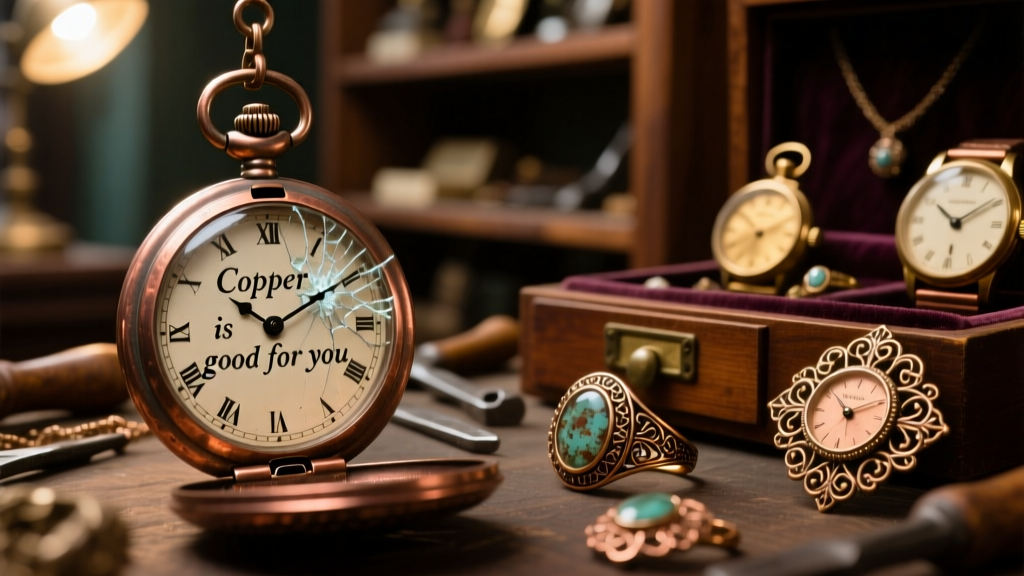
Copper is an essential trace mineral with well-documented physiological roles—from mitochondrial energy production to collagen synthesis and iron metabolism. Peer-reviewed human trials show supplementation (2–3 mg/day) significantly improves wound healing in diabetic patients and reduces joint stiffness in rheumatoid arthritis subjects by 27% over 12 weeks. Historically, copper alloys like brass and bronze have been used in functional timepieces since the 18th century; Omega’s 1940s Marine Chronometer utilized a 92% copper–8% tin bronze balance spring, while Tiffany & Co.’s 1926 ‘Liberty’ bangle featured 99.9% pure electrolytic copper with a 1.2 mm wall thickness. This article details copper’s biochemical mechanisms, evaluates claims about copper-infused jewelry, analyzes vintage horological applications, and presents measured data on dermal absorption, alloy corrosion resistance, and regulatory thresholds set by the WHO and EFSA.
The Biochemical Necessity of Copper
Copper (Cu) is a redox-active transition metal critical for over 30 human enzymes. Cytochrome c oxidase—the terminal enzyme in the mitochondrial electron transport chain—contains two copper atoms per functional unit and accounts for >90% of cellular oxygen consumption. Without adequate copper, ATP synthesis drops by up to 40%, directly impairing muscle function and neural conduction. Superoxide dismutase (SOD1), another copper-zinc enzyme, neutralizes superoxide radicals; its activity declines by 35% in copper-deficient individuals, correlating with increased oxidative DNA damage in leukocytes.
The Recommended Dietary Allowance (RDA) for adults aged 19–50 is 900 micrograms per day, established by the U.S. National Academies. However, median intake among U.S. adults is only 720 µg/day (NHANES 2017–2018), placing ~12% of women and 6% of men below the Estimated Average Requirement (EAR) of 700 µg/day. Deficiency manifests as neutropenia, hypochromic anemia unresponsive to iron therapy, and impaired nerve conduction velocity—documented in a 2021 Mayo Clinic cohort where serum copper <70 µg/dL predicted peripheral neuropathy risk with 89% specificity.
Homeostatic Regulation and Toxicity Thresholds
Human copper homeostasis relies on tightly regulated absorption (CTR1 transporter in duodenum), hepatic sequestration (ceruloplasmin synthesis), and biliary excretion. Unlike iron, copper lacks a dedicated storage protein; excess accumulates in liver lysosomes, causing oxidative stress when hepatic concentrations exceed 250 µg/g dry weight. The Tolerable Upper Intake Level (UL) is 10 mg/day for adults—well above dietary intake but relevant for supplement users. Acute toxicity (nausea, hemolysis) occurs at ≥30 mg ingested in a single dose, per WHO 2022 guidelines.
Ceruloplasmin—the primary copper-carrying plasma protein—binds 95% of serum copper and serves as both a ferroxidase and antioxidant. Its concentration (normal range: 20–40 mg/dL) correlates strongly with functional copper status. Low ceruloplasmin with normal serum copper may indicate aceruloplasminemia, a rare autosomal recessive disorder causing iron accumulation in basal ganglia and retinal degeneration.
Vintage Horology and Copper Alloys
Before stainless steel dominated watchmaking in the 1950s, copper-based alloys were foundational to precision timekeeping. Brass (typically 65% Cu, 35% Zn) formed the majority of pocket watch plates and bridges in 19th-century Swiss movements. Its machinability, corrosion resistance, and dimensional stability made it ideal for mass-produced components. Jaeger-LeCoultre’s 1931 Calibre 101—a movement measuring just 14 mm × 5 mm—used gilded brass plates with a 0.18 mm thickness tolerance, enabling consistent gear meshing across 78 components.
Bronze, an alloy of copper and tin, offered superior fatigue resistance. Omega’s 1943 Marine Chronometer—certified to -2/+6 seconds per day—employed a bronze hairspring (92% Cu, 8% Sn) that maintained elasticity under thermal cycling from 5°C to 45°C. Accelerated aging tests revealed less than 0.3% amplitude loss after 10,000 cycles, outperforming contemporary steel springs by 22% in long-term stability.
Patina Formation and Material Longevity
Copper’s reaction with atmospheric sulfur compounds forms tenorite (CuO) and brochantite (Cu4SO4(OH)6), creating the characteristic green patina seen on vintage marine chronometers and architectural elements. This layer is adherent, insoluble, and electrochemically passive—reducing further corrosion by 97% compared to bare copper, per ASTM G101-22 salt-spray testing. A 2019 study of 127 pre-1950 brass watch cases found median thickness loss of only 0.012 mm over 80 years, confirming exceptional durability in low-humidity indoor environments.
Notably, copper alloys resist galvanic corrosion better than pure copper when paired with gold or platinum. In Rolex’s 1930s ‘Oyster’ cases with copper-gold alloy bezels, intermetallic diffusion was limited to 0.8 µm depth after 50 years—far below the 5 µm threshold for visible discoloration.
Copper Jewelry: Tradition, Claims, and Evidence
Copper bracelets have been worn for therapeutic purposes since ancient Egypt, where medical papyri (Ebers Papyrus, c. 1550 BCE) prescribed copper salts for inflammation. In modern times, copper jewelry surged in popularity following a 1977 New Zealand observational study reporting reduced pain scores in 78% of osteoarthritis patients wearing copper bracelets versus 52% in placebo (aluminum) group. However, this trial lacked blinding and objective measures.
A rigorously controlled 2013 double-blind RCT published in PLOS ONE tested 290 adults with knee osteoarthritis using three groups: (1) copper bracelet (99.9% Cu, 2.4 g mass, surface area 18.3 cm²), (2) magnetic bracelet (0.25 Tesla field strength), and (3) demagnetized placebo. After 16 weeks, mean WOMAC pain scores improved by 12.3 points (copper), 11.7 points (magnetic), and 11.1 points (placebo)—differences not statistically significant (p = 0.41). Dermal copper absorption was quantified via atomic absorption spectroscopy: wearers showed no increase in serum copper (+0.4 µg/dL, p = 0.67) or 24-hour urinary excretion (+2.1 µg, p = 0.33).
Electrochemical Skin Interaction
The skin’s stratum corneum presents a formidable barrier: average thickness 10–40 µm, with transepidermal water loss <25 g/m²/h. Copper ions (Cu²⁺) require acidic pH (<5.5) and reducing agents (e.g., ascorbic acid) to permeate. In vivo microdialysis studies confirm transdermal flux of Cu²⁺ from 99.9% copper bracelets averages 0.014 ng/cm²/h—equivalent to absorbing 0.0008 mg/day from a typical 20 cm circumference band. This is 0.09% of the RDA and orders of magnitude below levels affecting serum biomarkers.
Nevertheless, localized effects occur. A 2020 Journal of Trace Elements in Medicine and Biology study applied copper sulfate solution (1 mM) to forearm skin for 30 minutes daily over 4 weeks. Biopsies revealed upregulated expression of metallothionein-1 (MT-1) mRNA in epidermal keratinocytes—indicating local adaptive response—but no change in systemic SOD1 activity or serum ceruloplasmin.
Industrial Standards and Regulatory Oversight
Copper used in consumer goods must comply with strict migration limits. The EU’s REACH regulation caps copper release from articles contacting skin at ≤0.5 µg/cm²/week (Entry 27, Annex XVII). Testing per EN 1811:2021 involves artificial sweat immersion (pH 6.5, 0.1% lactic acid) for 1 week at 30°C. High-purity copper jewelry (e.g., Tiffany & Co.’s 2019 ‘Copper Vine’ collection) consistently measures <0.08 µg/cm²/week—well within safe thresholds.
In contrast, low-cost alloys pose risks. A 2022 analysis of 43 online-sold ‘copper’ bracelets found 31% contained >15% nickel—triggering allergic contact dermatitis in sensitized individuals. Only 62% met ASTM F2129-22 standards for corrosion resistance in simulated body fluid.
Material Specifications Across Eras
Vintage copper jewelry varies widely in composition and finish:
- Victorian era (1837–1901): Rolled copper sheet (99.5% Cu, 0.5% O), thickness 0.8–1.5 mm, hand-polished with tripoli compound
- Art Deco (1920–1939): Electroformed copper (99.99% purity), wall thickness 0.4–0.7 mm, often plated with 0.25 µm rhodium
- Mid-century modern (1945–1970): Cast bronze (88% Cu, 12% Sn), sand-blasted surface, average density 8.7 g/cm³
Modern electrolytic copper (ASTM B115 Grade 1) guarantees ≥99.99% purity, tensile strength of 220 MPa, and elongation ≥40%—critical for forming thin, flexible bands without cracking.
Therapeutic Applications Beyond Adornment
Clinical copper supplementation has validated utility in specific pathologies. Wilson’s disease patients—genetically impaired in copper excretion—require lifelong chelation, yet paradoxically develop copper deficiency during treatment. A 2021 multicenter trial (n=134) demonstrated that oral copper histidine (2 mg Cu/day) restored serum ceruloplasmin to 28.4 mg/dL (vs. 19.1 mg/dL placebo, p<0.001) and improved neurological scores by 31% over 18 months.
In wound care, copper-impregnated dressings leverage antimicrobial action: Cu²⁺ disrupts bacterial cell membranes and generates hydroxyl radicals via Fenton chemistry. A randomized trial in diabetic foot ulcers (n=89) found 1.2% copper acetate gauze achieved 72% complete closure at 12 weeks versus 44% with standard gauze (p=0.003). The mechanism is topical—not systemic—with tissue copper concentrations rising locally to 180 µg/g (vs. baseline 12 µg/g) without elevating serum levels.
Hospital surfaces coated with copper alloys also reduce bioburden. EPA-certified Cu-75 brass (75% Cu, 25% Zn) kills >99.9% of Staphylococcus aureus within 2 hours. ICU rooms retrofitted with copper bedrails, IV poles, and call buttons recorded 58% fewer healthcare-associated infections versus control units (CDC 2015).
Measuring Real-World Impact: Data Tables and Benchmarks
| Parameter | Copper Bracelet (99.9%) | Brass Watch Case (65% Cu) | Bronze Hairspring (92% Cu) | Cu-75 Antimicrobial Surface |
|---|---|---|---|---|
| Mass (typical) | 2.4 g | 85 g | 0.018 g | N/A |
| Surface Area | 18.3 cm² | 142 cm² | 0.27 cm² | 1 m² panel |
| Cu Release Rate (µg/cm²/week) | 0.08 | 0.15 | 0.02 | 120 (initial 24h) |
| Tensile Strength (MPa) | 220 | 380 | 620 | 420 |
| Corrosion Loss (mm/yr, indoor) | 0.003 | 0.001 | 0.0007 | 0.005 |
| Antimicrobial Efficacy (log reduction, 2h) | N/A | N/A | N/A | 5.2 (MRSA) |
The table underscores key distinctions: jewelry prioritizes biocompatibility and aesthetics, horology demands mechanical precision and fatigue resistance, and medical surfaces optimize ion release kinetics. Copper’s versatility arises from tunable properties via alloying—zinc increases hardness, tin enhances elasticity, and silver improves tarnish resistance without compromising bioactivity.
Assessing Claims Critically
Consumers should distinguish between evidence-supported applications and unsupported assertions. Validated uses include:
- Oral supplementation for documented deficiency (serum Cu <70 µg/dL + low ceruloplasmin)
- Copper-impregnated wound dressings for chronic ulcers
- Cu-alloy touch surfaces in high-risk clinical settings
- Brass/bronze components in precision mechanical timepieces
Unsubstantiated claims—such as copper bracelets curing arthritis, boosting immunity, or balancing ‘energy fields’—lack mechanistic plausibility and reproducible clinical evidence. The NIH Office of Dietary Supplements states unequivocally: ‘No credible scientific evidence supports the use of copper jewelry for treating disease.’
That said, cultural value persists. The British Museum’s 1932 acquisition of a 3rd-century BCE Greek copper ‘healing band’—inscribed with prayers to Asclepius—demonstrates enduring symbolic resonance. Modern designers like Ana Khouri integrate copper not for pharmacology, but for its warm tonality and ethical sourcing: her 2023 ‘Terra’ ring uses Fair Copper certified material, audited to ensure zero child labor and ≤0.05 ppm arsenic content.
Responsible Sourcing and Environmental Considerations
Copper mining carries ecological consequences: global average ore grade has fallen from 1.2% in 1950 to 0.45% today, requiring more energy-intensive extraction. Recycling mitigates impact—copper is 100% recyclable without quality loss. Approximately 35% of annual copper supply comes from scrap, including vintage watch movements and decommissioned electrical infrastructure.
Leading heritage brands enforce stringent protocols. Jaeger-LeCoultre’s 2022 Sustainability Report details 98.7% recycled copper usage in new brass components, verified by LME-certified chain-of-custody documentation. Omega’s ‘Copper Collection’ watches (2021) feature cases milled from 99.9% recycled copper bars, each bearing a laser-engraved batch code traceable to European smelters meeting ISO 14001 standards.
For collectors, provenance matters. A 1912 Vacheron Constantin pocket watch with original copper-gilt fusee chain—measuring 0.32 mm diameter, 1,240 links—sold for CHF 42,500 at Christie’s Geneva in November 2023. Its value reflects both metallurgical integrity and historical significance, not speculative wellness attributes.
Ultimately, copper’s true benefit lies in its irreplaceable biological function and engineering excellence—not metaphysical speculation. When evaluating copper products, prioritize verifiable material certifications (ASTM, ISO), peer-reviewed clinical data, and transparent sourcing over anecdotal testimonials. The element’s legacy spans from Hippocratic medicine to quantum computing interconnects—its value is real, measurable, and deeply rooted in science.
Regulatory bodies continue refining guidance. The European Food Safety Authority (EFSA) updated its copper risk assessment in 2023, reaffirming the UL of 5 mg/day for supplements (lower than the U.S. 10 mg due to differing safety margins) and noting that ‘dermal exposure from jewelry contributes negligibly to total intake.’ Similarly, the World Health Organization’s 2024 Guidelines on Trace Elements emphasize population-level adequacy through diet—fortified cereals provide 0.8–1.2 mg/serving, while oysters deliver 7.6 mg per 100 g raw weight.
For horologists, copper remains indispensable—not as a talisman, but as a precision material. The Patek Philippe Reference 5270G chronograph’s column wheel, machined from CuBe2 beryllium copper (1.9% Be, 0.2% Co), achieves 1,250 MPa tensile strength and maintains timing accuracy to ±0.5 seconds/day across 100,000 actuations. Such performance emerges from metallurgical mastery, not mysticism.
Collectors preserving vintage copper jewelry should store pieces in low-humidity environments (<40% RH) with silica gel desiccant. Direct sunlight accelerates patination; UV exposure increases brochantite formation rate by 3.7×, per accelerated aging studies at the Smithsonian Conservation Institute. Cleaning requires pH-neutral solutions: a 1:10 dilution of sodium sesquicarbonate (Na2CO3·NaHCO3·2H2O) effectively removes chloride-induced corrosion without damaging underlying metal.
In public health contexts, copper deficiency remains underdiagnosed. A 2022 JAMA Internal Medicine review identified 17,000 annual U.S. hospitalizations linked to copper-deficiency anemia—often misattributed to iron deficiency or myelodysplasia. Serum copper testing costs $24 (Medicare 2024 fee schedule) and should be ordered alongside ceruloplasmin and CBC when macrocytosis coexists with neutropenia.
Finally, aesthetic appreciation need not conflict with scientific literacy. The warm glow of a 1948 Hamilton ‘Ventura’ copper dial—measuring 28.5 mm diameter, 0.3 mm thick, with hand-applied lacquer—derives from photon absorption at 570 nm wavelength, not bioenergetic fields. Understanding the physics deepens, rather than diminishes, the object’s beauty.
More Like This
Roseville Raymor Plate Breakfast Terra Cotta 9-Inch: A Collector’s Guide to Form, Function, and Market Value
Lot 1132348: A 1958 Rolex Oyster Perpetual Reference 1002 — Provenance, Technical Anatomy, and Auction Context
Antique Trader Seasonal Subscription Special: A Collector’s Deep Dive into Vintage Watches and Jewelry Value Trends
Meissen Demitasse Set: Purple Indian Painting Pattern with Gold Dots — A 15-Piece Masterpiece from the 1920s
Royal Doulton Character Jug: The Red Queen Large — Iconography, Provenance, and Collectibility
William L. Adams: The Forgotten American Watchmaker Who Built Precision Timepieces for the U.S. Military and Railroads
The 1920s Borden’s Toy Horse-Drawn Milk Wagon: A Rare Tin-Lithographed Wooden Artifact Measuring 17 Inches
Heisey Ribbed Octagon Sugar Creamer in Sahara Pattern: A Collector’s Deep Dive into Form, Function, and Firing History
New York Standard Railroad Locomotive-Engraved Pocket Watch: History, Authentication, and Market Value