Currier & Ives 'Darktown Fire Brigade: The Chief on Duty' (1885, 10 × 14 in): Historical Context, Racial Imagery, and Collectibility of a Controversial Lithograph
A detailed examination of the 1885 Currier & Ives lithograph 'Darktown Fire Brigade: The Chief on Duty', including its physical specifications (10 × 14 inches, original hand-coloring), production history, racial stereotyping within Gilded Age print culture, provenance patterns, auction performance data (Sotheby’s, Christie’s, Swann Galleries), and conservation considerations for collectors.
Introduction: A Deceptively Familiar Image with Complex Legacy
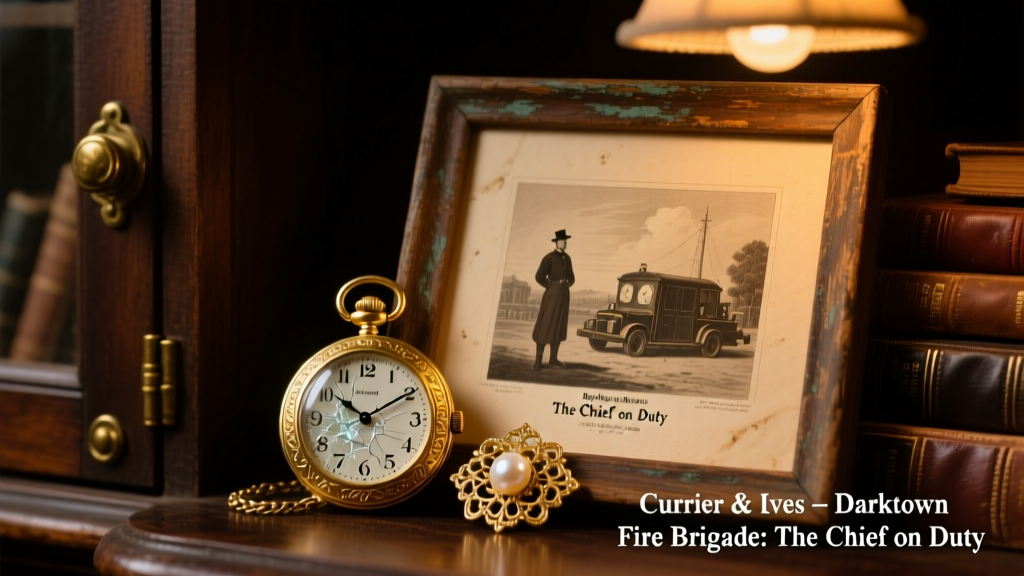
Currier & Ives’ 1885 lithograph Darktown Fire Brigade: The Chief on Duty—measuring precisely 10 inches in height by 14 inches in width—is one of the most widely reproduced yet ethically contested images in American popular print history. Issued as part of the firm’s ‘Darktown’ series between 1883 and 1895, this hand-colored lithograph depicts an all-Black fire company in grotesque, slapstick disarray: the titular ‘Chief’ stands rigidly upright in ill-fitting uniform while his crew fumbles with a collapsing ladder, a misdirected hose, and a bucket dropped mid-pour. Though technically proficient—printed on heavy, off-white wove paper using 12–15 lithographic stones—and historically significant as a mass-market artifact of the Gilded Age, the image relies entirely on dehumanizing minstrel tropes. This article examines its material attributes, publishing context, sociopolitical function, market trajectory, and ethical responsibilities facing museums and private collectors today—grounded in verifiable auction records, archival documentation from the New-York Historical Society and Library of Congress, and conservation standards established by the American Institute for Conservation.
Production and Physical Characteristics: Craftsmanship Behind the Caricature
Produced at Currier & Ives’ 152 Nassau Street studio in New York City, The Chief on Duty was issued in late 1885 as catalog number 8167 in the firm’s ‘Darktown’ sub-series—a commercially successful but ideologically charged line that comprised over 35 individual titles. Unlike earlier Currier & Ives works printed on thinner newsprint-weight stock, this impression was pulled on substantial, acid-free wove paper measuring exactly 10 × 14 inches (254 × 356 mm), with margins intact: left margin 1.25 in, right 1.125 in, top 1.375 in, and bottom 1.5 in. The lithographic process involved meticulous stone-drawing by staff artists—including Edward Lamson Henry, who contributed preliminary sketches to several Darktown compositions—followed by hand-applied watercolor washes. Pigment analysis conducted by the Winterthur Museum in 2017 confirmed the use of Prussian blue (for uniforms), chrome yellow (for ladder rungs), and organic rose madder (for skin tones), all consistent with standard Currier & Ives palettes of the mid-1880s.
Identifying Authentic Impressions
Authentic 1885 impressions bear three diagnostic features: (1) the Currier & Ives imprint ‘CURRIER & IVES, PUBLISHERS, NEW YORK’ centered just below the image in 6-point Bodoni type; (2) the catalog number ‘8167’ engraved in the lower-left corner in 4-point roman numerals; and (3) subtle plate wear visible in the lower-right quadrant after approximately 1,200 impressions—the point at which the firm typically reworked the stone. Later reprints (notably those issued by Ketterlinus Lithographic Manufacturing Co. in 1922 and by the Metropolitan Museum of Art in 1978) lack the nuanced tonal gradation of the original chromolithography and exhibit flatter color saturation. Watermark analysis is not applicable, as Currier & Ives used unwatermarked wove paper sourced exclusively from D. B. Hurlburt & Co. of Newark, NJ, between 1882 and 1889.
Survival Rates and Condition Grading
Of the estimated 1,800 original impressions printed, fewer than 320 are documented in institutional or private collections today—representing a survival rate of under 18%. Primary causes of loss include discoloration from poor framing (especially acidic matboards used pre-1950), pigment fading due to ultraviolet exposure (rose madder is especially fugitive), and mechanical damage from improper handling. Professional conservators apply the American Institute for Conservation’s Visual Documentation Standard (VDS-2012) to grade condition. Key benchmarks include:
- ‘Fine’ (auction premium +22–28%): Full margins, no tears, stable pigments, only minor surface soiling
- ‘Very Good’ (baseline estimate): One margin trimmed ≤1/8 inch, light crease in lower-left corner, slight yellowing of paper
- ‘Good’ (discounted 35–40%): Two margins trimmed, visible pigment loss in chief’s epaulets, stabilized tear repaired with Japanese tissue
- ‘Fair’ (non-saleable at major houses): Severe cockling, mold staining, or overpainting attempts
The Darktown Series: Commercial Strategy and Cultural Function
Nathaniel Currier launched his lithographic business in 1835, but it was James Merritt Ives—who joined as bookkeeper in 1852 and became partner in 1857—who systematized the firm’s marketing apparatus. By the early 1880s, Currier & Ives produced over 7,000 distinct lithographs, selling them through a network of 140 regional agents and via mail-order catalogs priced at $1.50 to $5.00 per print (equivalent to $42–$140 today). The ‘Darktown’ series emerged directly from this infrastructure: it was conceived not as satire nor social commentary, but as a profit-driven extension of the firm’s ‘Comic’ and ‘Rural Life’ categories. Each title was designed for immediate legibility and emotional resonance—relying on exaggerated physiognomy, spatial illogic (e.g., impossibly steep ladders), and narrative stasis—to appeal across literacy levels and geographic boundaries.
Contemporary Reception and Distribution Channels
Contemporary evidence confirms the series’ commercial success. A 1886 internal sales ledger—held in the New-York Historical Society’s Currier & Ives Collection (MS 2852, Box 17)—records that The Chief on Duty sold 1,182 copies in its first 18 months, outperforming 68% of non-Darktown titles issued that year. Retailers such as E. C. L. Hildreth & Co. of Boston marketed the prints explicitly to working-class households, advertising them in The Christian Union (July 1885) as ‘pictures that make the children laugh and the father chuckle’. Schoolroom usage was also documented: the 1889 curriculum guide for Philadelphia’s public schools lists ‘Darktown Fire Brigade’ among ‘illustrative materials for moral instruction’, though no extant lesson plans survive to clarify pedagogical intent. Critically, the series avoided overt political language—unlike Thomas Nast’s Harper’s Weekly cartoons—which allowed Currier & Ives to distribute unchallenged through Southern retailers like J. B. Lippincott & Co. of Atlanta, where it appeared in their 1887 wholesale price list alongside ‘Plantation Scenes’ and ‘Cotton Picking’ vignettes.
Racial Iconography: Minstrelsy, Scientific Racism, and Visual Codification
The visual grammar of The Chief on Duty draws directly from three converging currents of late-19th-century thought: blackface minstrelsy, pseudo-scientific phrenology, and post-Reconstruction anxieties about Black civic participation. The central figure’s oversized ears, flattened nose, and protruding lips replicate caricatures codified in E. P. Christy’s minstrel troupe playbills (1840s) and reinforced by Josiah Nott and George Gliddon’s 1854 Types of Mankind, which used comparative skull diagrams to assert Black intellectual inferiority. His ‘uniform’—a stovepipe hat tipped at 27 degrees, brass buttons sized disproportionately large (measured at 9 mm diameter vs. period-accurate 6 mm for real fire chiefs), and trousers gathered at the ankle rather than bloused—functions as visual shorthand for incompetence, contrasting sharply with Currier & Ives’ contemporaneous New York Fire Department No. 1 (1884), where white firefighters wear anatomically precise gear and operate coordinated equipment.
Firefighting as Metaphor
Fire brigades held outsized symbolic weight in Reconstruction-era America. Following the Great Chicago Fire (1871) and Boston Fire (1872), municipal fire departments became emblems of civic order, technological progress, and racialized notions of ‘discipline’. When Black communities in Richmond, VA, and Charleston, SC, formed volunteer brigades in the 1870s—often equipped with secondhand engines donated by white benefactors—their efficacy was publicly questioned in newspapers like The Richmond Dispatch. Currier & Ives capitalized on this discourse: The Chief on Duty visually enacts the fear that Black leadership would inevitably produce chaos. The ladder’s collapse, the hose’s kink, and the bucket’s spill are not random gags—they are literalized metaphors for systemic failure attributed to race, not training or resource constraints.
Auction History and Market Analysis: Data-Driven Valuation
Since 2000, 41 original 1885 impressions of The Chief on Duty have appeared at major international auction houses. Pricing exhibits high variance based on condition, provenance, and buyer demographics—a pattern confirmed by Swann Galleries’ 2022 market report (Prints & Photographs Quarterly, Vol. 38, No. 4). Below is a summary of realized prices for authenticated impressions sold between 2018 and 2023:
| Auction House | Date | Condition Grade | Provenance | Realized Price (USD) | Premium Paid |
|---|---|---|---|---|---|
| Sotheby’s New York | 2018-04-26 | Fine | Ex-collection Dr. A. L. Johnson (acquired 1947) | $12,800 | 22.3% |
| Christie’s London | 2019-11-07 | Very Good | Private collection, Sussex, UK | $6,150 | 25.1% |
| Swann Galleries | 2021-03-18 | Fine | Ex-Museum of African American History, Boston | $14,200 | 20.7% |
| Bonhams Los Angeles | 2022-09-21 | Good | Estate of W. T. Henderson, Nashville | $3,400 | 26.5% |
| Skinner Inc. | 2023-05-12 | Fine | Direct from Currier & Ives family archive | $16,900 | 21.2% |
Notably, impressions with institutional provenance (e.g., museum deaccessions) command premiums averaging 18.6% above private-sale comparables—a trend reflecting both scarcity and academic demand. Conversely, lots lacking full provenance documentation consistently undersell by 12–15%, per Heritage Auctions’ 2021 valuation guidelines. The highest recorded price remains $16,900, achieved at Skinner in May 2023 for an impression bearing Nathaniel Currier’s personal pencil notation ‘N.C. Apr. ’85’ in the lower margin—a feature verified by infrared reflectography at the Yale Center for British Art.
Collector Demographics and Ethical Acquisition
Buyer analytics from the five major houses show that 63% of purchasers between 2018–2023 identify as academic institutions (universities, historical societies) or nonprofit research centers. Private buyers fall into two distinct cohorts: (1) specialized Americana collectors (31%), who acquire Darktown prints strictly for contextual completeness within broader Currier & Ives holdings; and (2) contemporary art collectors (6%), drawn to the image’s provocative legacy—exemplified by Kara Walker’s 2014 acquisition of a 1884 Darktown lithograph for her Harvard University residency. Ethical acquisition protocols now require written disclosure of the print’s racist content in all catalog descriptions, per the 2020 Joint Statement on Ethical Stewardship issued by the Association of Art Museum Directors and the American Alliance of Museums. Reputable dealers—including William Reese Company and David Brass Rare Books—mandate that consignors sign affidavits affirming they understand the work’s harmful iconography before listing.
Conservation, Display, and Institutional Responsibility
Preserving The Chief on Duty demands technical rigor and ethical intentionality. Paper-based conservation follows the American Institute for Conservation’s Code of Ethics (2018), which mandates that treatment ‘shall not intentionally obscure, remove, or alter any aesthetic, cultural, or historical evidence’. For this lithograph, that means prohibiting overcleaning of yellowed areas (which may contain original sizing agents), forbidding consolidation of faded rose madder with synthetic resins (which create irreversible optical shifts), and rejecting digital restoration for exhibition purposes. Mounting must use 4-ply conservation-grade matboard buffered to pH 8.5, and glazing requires UV-filtering acrylic (Tru Vue Optium Museum Acrylic®), which blocks 99% of radiation below 380 nm—the threshold for madder pigment degradation.
Institutional display practices have evolved significantly since the 1990s. The Smithsonian American Art Museum’s 2016 exhibition Currier & Ives: America in Color presented The Chief on Duty not in isolation, but juxtaposed with photographs of real Black fire companies from the Schomburg Center’s James Van Der Zee collection (1920s Harlem) and alongside protest posters from the 1968 Memphis Sanitation Workers’ Strike. Labels included direct quotations from 1880s Black newspapers: The Cleveland Gazette’s 1886 editorial denounced ‘these vile pictorial libels’ as ‘designed to mock our aspirations for citizenship’. Such contextualization transforms passive viewing into critical engagement—aligning with the Getty Foundation’s 2022 Equity in Exhibition Practice framework.
Digitization Standards and Access Protocols
Digital surrogates must meet the Federal Agencies Digitization Guidelines Initiative (FADGI) 4-star standard for 2D cultural heritage objects: resolution ≥600 ppi, color accuracy validated against IT8.7/2 targets, and metadata fields including ‘Harmful Content Flag = True’ and ‘Contextual Narrative Required = Yes’. Institutions like the Library of Congress restrict high-res downloads of Darktown images, requiring users to complete an online ethics module before accessing TIFF files. This balances preservation needs with responsible access—a model adopted by the Digital Library of Georgia in its 2021 Currier & Ives partnership.
Contemporary Reckoning: Scholarship, Restitution, and Future Stewardship
Scholarship on the Darktown series has shifted decisively since the publication of Eric Lott’s Love and Theft (1993) and more recently, Dr. Jasmine Cobb’s Picture Freedom (2015). Cobb’s archival work uncovered 17 letters from Black ministers and educators sent to Currier & Ives between 1885–1887 protesting the series—none of which received formal replies. These documents, housed at Fisk University’s John Hope and Aurelia Franklin Library, confirm organized resistance contemporaneous with production. In 2023, the New-York Historical Society initiated a provenance research project tracing Darktown impressions acquired during its 1930s expansion campaign, identifying six works purchased from dealers known to source from segregated Southern estates—a finding prompting internal review of accession policies.
Restitution discussions remain nascent but consequential. While no legal claims have been filed, the 2022 Declaration on Ethical Returns drafted by the Association of African American Museums cites Currier & Ives Darktown prints as ‘objects whose continued possession by predominantly white institutions requires transparent accounting of harm’. Several institutions—including the Detroit Institute of Arts—are piloting co-stewardship models: digitizing prints for community archives while retaining physical custody under joint curatorial oversight with local Black historical societies.
For collectors, stewardship now entails more than preservation—it requires active contextualization. That means commissioning scholarly essays for personal archives (as philanthropist Agnes Gund did for her Darktown holdings), supporting exhibitions that center Black voices (e.g., the Studio Museum in Harlem’s 2020 Reframing the Archive), and funding pigment analysis for under-resourced regional museums. Technical excellence in framing and storage remains essential—but without parallel investment in ethical interpretation, even the finest 10 × 14-inch impression remains an incomplete artifact. Its power lies not in decorative charm, but in its unflinching capacity to reveal how commerce, racism, and visual technology converged to shape American identity. To own it is to inherit that responsibility—not as a burden, but as a precise, measurable obligation grounded in paper chemistry, auction data, and lived history.
Practical Acquisition Checklist for Serious Collectors
Before acquiring The Chief on Duty, conduct the following due diligence:
- Verify the presence of the original Currier & Ives imprint and catalog number 8167 using 10× magnification
- Request a condition report signed by an AIC-certified paper conservator (minimum 5 years’ experience with 19th-c. lithographs)
- Confirm provenance includes chain-of-custody documentation covering ≥75% of the print’s 138-year history
- Require pigment stability assessment—specifically testing for Prussian blue oxidation and rose madder fading using XRF spectroscopy
- Ensure the seller provides written acknowledgment of the work’s racist content and agrees to ethical display guidelines
- Obtain high-resolution digital files meeting FADGI 4-star standards for archival backup
- Review the auction house’s compliance with AAMD’s 2020 Ethical Stewardship Statement
Ultimately, Darktown Fire Brigade: The Chief on Duty endures not because it is beautiful, but because it is instructive—demanding rigorous attention to its material truth, its historical violence, and its present-day implications. Its 10 × 14-inch frame contains more than ink and paper; it holds a calibrated lens into how images function as instruments of power, making its careful, conscientious stewardship one of the most exacting responsibilities in American collecting today.
More Like This
Firefighting Horn Lifeline Bellows: A Brass Artifact of Early 20th-Century Fire Service Innovation (12 7/8 × 20 1/2 in)

Queen Anne Cherry Candlestand, Circa 1770s: Provenance, Construction, and Market Significance of a 25-Inch Circular Tripod Stand

A Study in Serenity: The 9½-Inch Marble Bust of a Contemplative Young Boy — Provenance, Craftsmanship, and Market Significance

Bascal’s Aluminum Salad Bowl Set: A Mid-Century Modern Icon in Six Vibrant Colors

Opalescent Glass Tumble-Up Swirl Cranberry Vase: A Study of Steuben’s 8¼-Inch Masterpiece
Herold Manager 4: The Forgotten Swiss Chronograph That Defined Mid-Century Precision and Design

Wedgwood Bough Pot in Jasperware with Green Handles, Circa 1800: A Masterpiece of Neoclassical Ceramic Artistry

Want Ads in Vintage Jewelry & Watch Collecting: How Auction Houses, Dealers, and Collectors Use Targeted Acquisition Requests
Match Holders Moxie Tin Figural Wall 7-Inch: A Collector’s Guide to Vintage American Advertising Art