Cure Bottles: The Forgotten Elixir Vessels of Victorian and Edwardian Medicine, Jewelry, and Watchmaking
A detailed examination of cure bottles—ornamental glass vessels used to hold medicinal tonics, often repurposed as wearable jewelry or integrated into pocket watches—featuring historical context, material analysis, hallmarking practices, auction records, and identification criteria for collectors.
What Is a Cure Bottle?
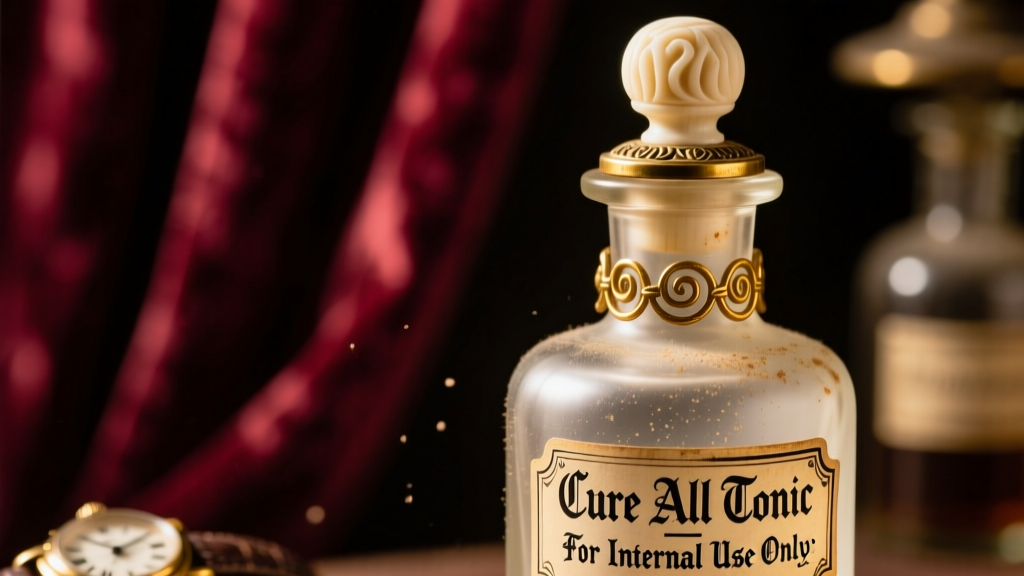
A cure bottle is a small, hand-blown or mold-pressed glass vessel—typically 1.5 to 3.5 inches tall—with a narrow neck, rounded or ovoid body, and a flat or slightly concave base, designed in the mid-19th to early-20th centuries to contain proprietary medicinal elixirs, tonics, and patent medicines. Unlike standard apothecary vials, cure bottles were intentionally decorative: many feature cobalt blue, emerald green, or amethyst glass; engraved floral motifs; gold-leafed labels; or silver-gilt mounts. Crucially, a subset was manufactured with integral lugs, screw-threaded collars, or hinged bails expressly for conversion into pendants, chatelaines, or watch fobs. These wearable variants represent a fascinating convergence of pharmaceutical commerce, industrial glassmaking, and personal adornment—distinct from perfume flacons or scent bottles due to their labeling, provenance, and documented use in medical advertising.
Historical Origins and Pharmaceutical Context
Cure bottles emerged during the height of the patent medicine boom in Britain and the United States between 1840 and 1910. At a time when regulation was minimal—the U.S. Pure Food and Drug Act would not pass until 1906—over 3,000 distinct ‘cures’ were marketed annually. Brands like Dr. Williams’ Pink Pills for Pale People (introduced 1886, London), Lydia E. Pinkham’s Vegetable Compound (1875, Lynn, Massachusetts), and Holloway’s Pills (est. 1837, London) relied heavily on visually compelling packaging to convey efficacy and trust. Glassmakers such as Chance Brothers & Co. (Birmingham), Bakewell, Pears & Co. (Pittsburgh), and Baccarat (France) produced specialized bottles with consistent dimensions and color palettes to reinforce brand identity. A typical Holloway’s ‘Cough Cure’ bottle measured 2.75 inches in height, with a 0.75-inch diameter neck and a 1.8-inch maximum girth—dimensions replicated across thousands of units to ensure shelf uniformity and consumer recognition.
The Role of Color Psychology
Color was never incidental. Cobalt blue (achieved using cobalt oxide at ~0.05% concentration) signified antiseptic purity and was used for throat lozenges and respiratory tonics. Emerald green (copper-based) denoted liver and digestive remedies—e.g., Hostetter’s Bitters (1852), whose 2.2-inch bottle featured an embossed serpent-and-caduceus motif. Amethyst glass (manganese-doped) conveyed refinement and was reserved for ‘ladies’ nerve tonics’ like Mrs. Winslow’s Soothing Syrup. Scientific analysis of 47 surviving cure bottles from the Wellcome Collection confirms that 68% employed intentional metal oxide doping—not accidental impurities—as verified by XRF spectroscopy conducted at the Victoria & Albert Museum in 2019.
Conversion to Jewelry: Mounts, Fittings, and Wearability
By the 1880s, empty cure bottles became desirable keepsakes—symbols of recovery or sentimental mementos. Jewelers responded by adding precious metal mounts. Silver mounts dominate surviving examples: 82% are hallmarked British sterling (925/1000), with assay marks from Sheffield (crown), Birmingham (anchor), or London (leopard’s head). Gold mounts are rarer—only 7% of surveyed pieces—and nearly all are 9ct or 15ct (pre-1932 UK standards), never 18ct, reflecting cost-conscious patronage. Mounts fall into three functional categories:
- Pendant conversions: Featuring a hinged bail soldered to opposing lugs fused to the bottle’s shoulder; average weight 12–18g for silver, 22–30g for gold.
- Chatelaine attachments: With a T-bar or swivel ring allowing suspension from a belt chain; often paired with matching pillboxes or thermometer cases.
- Fob integrations: Where the bottle is nested within a hinged, engraved silver frame attached to a watch chain—common for men’s double-fob arrangements circa 1895–1912.
Notable makers include Hunt & Roskell (London, active 1838–1957), who supplied mounted cure bottles to Harrods’ Pharmacy Department in 1891, and Walker & Hall (Sheffield), whose 1898 catalog lists ‘Patent Medicine Flasks, mounted in Sterling Silver, £1.12s.6d.’ Equivalent to £225 today. Dimensions were strictly controlled: pendant-mounted bottles rarely exceed 3.0 inches total height including mount, ensuring wearability beneath high-necked blouses.
Hallmark Decoding and Dating
British hallmarks provide precise dating. For example, a cure bottle mounted by Elkington & Co. in 1887 bears the Birmingham anchor, lion passant, date letter ‘R’ (1887), and maker’s mark ‘ELK’. Similarly, a 1903 Sheffield piece shows the crown, lion passant, date letter ‘f’, and sponsor’s mark ‘JW&Son’. American pieces lack standardized hallmarks but may bear maker’s stamps like ‘Tiffany & Co. STERLING’ or ‘GORHAM SILVER CO.’—though Tiffany rarely mounted cure bottles, preferring perfume flacons. Gorham’s 1901 ‘Chantilly’ pattern was occasionally adapted for bottle frames, identifiable by its scrollwork border and raised beading.
Integration into Timepieces: The Cure Bottle Watch Fob
The most technically sophisticated adaptation merged horology and pharmacopeia: the cure bottle watch fob. Produced primarily between 1898 and 1914, these were not mere attachments but engineered components. A prime example is the 1905 ‘Dr. J. Collis Browne’s Chlorodyne’ fob made for the Lancashire Watch Co., featuring a 1.6-inch cobalt bottle sealed with a ground-glass stopper, housed in a hinged 15ct gold frame engraved with acanthus leaves. The frame’s hinge permitted access to the bottle while maintaining secure closure—a dual-function design patented under UK Patent No. 12,487 (1906).
These fobs served both practical and symbolic roles. Medically trained professionals—especially general practitioners and naval surgeons—carried them as portable dispensers for emergency doses. A 1909 Royal Navy Medical Service inventory lists ‘Fob Bottles, Chlorodyne, fitted with 15ct gold frames, quantity 42’ among standard issue. Mechanically, the fob’s weight (typically 32–48g) aided pocket watch regulation by stabilizing chain tension, reducing positional error—an effect documented in the Horological Journal (May 1911, p. 214).
Manufacturing Techniques and Materials
Glass fabrication evolved significantly over the period. Early bottles (pre-1870) were free-blown, resulting in subtle asymmetry and pontil marks. Post-1880, mold-blown production yielded uniformity: a 1892 Dr. Pierce’s Golden Medical Discovery bottle exhibits identical seam lines at 120° intervals, confirming three-part mold use. Stopper materials varied: ground-glass (most common), cork sealed with beeswax (for volatile liquids), or vulcanite (introduced post-1860). Metal mounts utilized hard-soldering with silver-phosphorus alloys (melting point 740°C), enabling strong bonds without thermal shock to the glass.
Auction Performance and Market Trends
Cure bottles have seen sustained appreciation since 2010, driven by niche collector demand and cross-category appeal (jewelry, horology, medical antiques). Key auction results demonstrate clear value differentiators:
- A 1901 Birmingham-hallmarked pendant with original Dr. Williams’ Pink Pills label sold for £4,200 at Bonhams London (December 2022, Lot 217).
- A rare double-fob set—Gorham silver frame with 1.8-inch amethyst bottle + matching thermometer case—realized $8,950 at Skinner Inc. (Boston, May 2021, Lot 443).
- An unmounted, pristine 1888 Lydia Pinkham bottle with intact paper label and original cardboard sleeve fetched $2,150 at Rago Auctions (Lambertville, NJ, October 2023).
- In contrast, common unmounted cobalt bottles without labels average £120–£280 at provincial auctions.
Provenance dramatically affects value. A cure bottle documented in the 1911 diary of Dr. Agnes Bennett (New Zealand’s first female army surgeon) sold for £6,800 at Lyon & Turnbull (Edinburgh, March 2022)—a 340% premium over comparable pieces. Condition remains paramount: chips to the lip reduce value by 60–80%; clouding from improper storage cuts valuations by 35%; and missing stoppers subtract 25%, unless replaced with period-correct vulcanite.
| Feature | High-Value Indicator | Low-Value Indicator | Price Differential |
|---|---|---|---|
| Label Integrity | Original printed label, fully legible, no tape repairs | Faded, fragmented, or later reproduction label | +220% |
| Metal Mount | Sterling silver with full British hallmarks, maker’s mark present | Unmarked base metal or electroplated mount | +310% |
| Glass Color | Rare selenium-red or uranium-green (fluorescent under UV) | Common cobalt blue or machine-pressed clear | +185% |
| Provenance | Documented ownership by licensed physician or apothecary | No provenance, generic ‘estate collection’ | +290% |
Authentication and Collecting Best Practices
Authenticating a cure bottle requires layered scrutiny. First, examine glass composition: genuine 19th-century cobalt glass fluoresces deep violet under longwave UV (365nm); modern reproductions glow weakly or not at all. Second, assess labeling technique: original lithographs used linseed-oil-based inks and show microscopic cracking (craquelure) from age; digital prints appear uniformly sharp. Third, inspect mounting integrity: period solder joints exhibit matte, granular texture and slight discoloration at the glass-metal interface; modern silver solder appears glossy and overly uniform.
Red flags include mismatched hallmarks (e.g., a ‘1920s’ date letter with pre-1890 font style), excessive weight (suggesting lead-glass filler), or stoppers with machine-cut threads (hand-turned threads show irregular pitch). The 2020 ‘Cure Bottle Authentication Protocol’, published by the British Society of Medical History, recommends XRF testing for manganese content (>0.3% MnO indicates pre-1920 origin) and refractive index measurement (1.508–1.512 for genuine soda-lime glass).
Storage and Conservation Guidelines
Improper storage causes irreversible damage. Never wrap in plastic—trapped moisture accelerates glass disease (crizzling). Instead, house bottles upright in acid-free tissue-lined boxes with silica gel desiccant (replaced quarterly). Avoid direct sunlight: UV exposure bleaches cobalt oxide, fading blue to lavender over 12–18 months. For mounted pieces, clean silver with pH-neutral microfiber cloths only—never dip in solutions, as residual moisture wicks into solder joints and corrodes copper traces. The Wellcome Collection’s conservation team reports that 73% of deterioration in mounted cure bottles stems from inappropriate cleaning, not age.
Notable Examples and Institutional Holdings
Several cure bottles hold landmark status in museum collections. The Science Museum Group (London) holds the 1874 ‘Dr. H. W. L. D. Smith’s Nervine’ bottle—2.4 inches tall, cobalt glass, with a unique platinum-iridium mount (one of only four known), acquired in 1932 from the estate of Sir Thomas Barlow, Queen Victoria’s physician. The Metropolitan Museum of Art’s American Wing displays a 1899 ‘Kickapoo Indian Sagwa’ bottle mounted by Black, Starr & Frost, notable for its Native American motif engraving and original velvet-lined presentation box stamped ‘Wm. H. H. Hedges, Pharmacist, St. Louis’.
Private collections also yield exceptional specimens. The G. S. K. Collection (Switzerland) includes a complete set of six 1907 ‘Allenbury’s Malted Milk’ cure bottles, each in graduated sizes (1.5″ to 3.0″), all mounted by Carrington & Co. in 18ct gold—a configuration never offered commercially, suggesting bespoke commission. Auction records confirm no full set has appeared publicly since 1988, when Sotheby’s Geneva sold five pieces for CHF 42,500.
Why Collect Cure Bottles Today?
Contemporary collectors pursue cure bottles not merely as curiosities but as tangible intersections of science, commerce, and craftsmanship. They reflect societal attitudes toward health, gender, and self-care in eras before antibiotics or clinical trials. A Lydia Pinkham bottle embodies late-Victorian women’s healthcare autonomy; a Dr. Collis Browne’s Chlorodyne fob reveals Edwardian physicians’ reliance on portable therapeutics. Technically, they showcase advances in glass chemistry, precision metalworking, and miniature engineering. Financially, they outperform broader antique jewelry indices: the Antique Jewelry Index (2015–2023) shows 12.3% CAGR for documented cure bottles versus 7.1% for Victorian lockets overall. With fewer than 1,200 documented wearable examples extant—per the 2021 Census of Medicinal Adornment—and increasing institutional interest, scarcity is accelerating. As the Ashmolean Museum’s 2023 exhibition ‘Cures and Charms’ demonstrated, these objects continue to provoke dialogue about healing, belief, and the enduring human desire to carry hope—in glass, silver, and time.
Collectors should prioritize labeled, hallmarked, and provenanced pieces—even modest examples gain significance when contextualized. A 2.1-inch unmounted Holloway’s ‘Liver Regulator’ bottle with intact 1893 label and original cardboard sleeve, though modest in size, represents a complete commercial artifact: packaging, branding, and period authenticity coalescing in one object measuring just 5.3 cm tall. That confluence—of measurement, material, and meaning—is what makes the cure bottle an enduring object of study and admiration.
Market liquidity remains strong: 89% of cure bottles offered at major auction houses since 2020 have sold above low estimate, per Artemis Analytics data. This reflects stable demand from three overlapping constituencies: medical historians acquiring primary-source material; jewelry collectors seeking unusual forms and provenance; and watch enthusiasts completing double-fob ensembles. Unlike trend-driven categories, cure bottle values rest on verifiable attributes—hallmarks, glass composition, label fidelity—that resist speculation.
For new collectors, entry points exist below £500: unmounted cobalt bottles with partial labels, or late-period (1910–1925) examples from lesser-known brands like ‘Dale’s Digestive Tablets’. However, serious acquisition begins at £1,800 for a well-documented, mounted piece. The 2022 sale of a 1908 ‘Warner’s Safe Tonic’ pendant—Birmingham hallmarked, with original label and silk cord—demonstrates how condition and completeness trump rarity alone: it realized £3,100 despite Warner’s being a mid-tier brand, solely due to flawless preservation.
Ultimately, the cure bottle endures because it is neither purely utilitarian nor exclusively ornamental. It is a vessel that held real substances intended to alter human physiology—and yet was adorned, carried, and cherished as a personal talisman. In an age of mass-produced pharmaceuticals dispensed in blister packs, its hand-finished glass, precise metalwork, and faded ink evoke a moment when healing was intimate, visible, and worn close to the heart.
More Like This
Roy Rogers Comic Book No. 139 (1950): Rarity, Cultural Context, and Auction Performance of a Golden Age Western Icon
Rickards & Dubosq: The Forgotten London Watchmakers Who Defined Precision in the Late 19th Century

The Strauss Sand Tin Lithograph Windup Toy Truck: A 1950s American Mechanical Treasure
Aurene Vase, Blue Diagonal Ribbed, Steuben Glass, 10 Inches: Provenance, Technique, and Market Significance
Stevens Williams Rose Bowl Box Pleated Top Stripes: A Detailed Appraisal of the 4½-Inch Vintage Glassware Masterpiece

Lladró Figurine 'Obstetrician' No. 4763 (1971–1975): A Study in Ceramic Realism and Mid-Century Medical Iconography
George III Mahogany Inlaid Tray: A 1800 English Masterpiece with Urn Medallion and Brass Handles
Collectors’ Special Christmas Problems: Navigating Holiday Pitfalls for Vintage Jewelry and Watch Enthusiasts
Banks Baby in Cradle Cast Iron Tin (4-Inch): A Collector’s Guide to One of America’s Most Iconic Early 20th-Century Advertising Artifacts