Rickards & Dubosq: The Forgotten London Watchmakers Who Defined Precision in the Late 19th Century
A definitive appraisal of Rickards & Dubosq — the elite London chronometer makers active from 1872 to 1904 — covering their Kew Observatory certifications, signature movement architecture, hallmarking practices, and market significance among vintage watch collectors today.
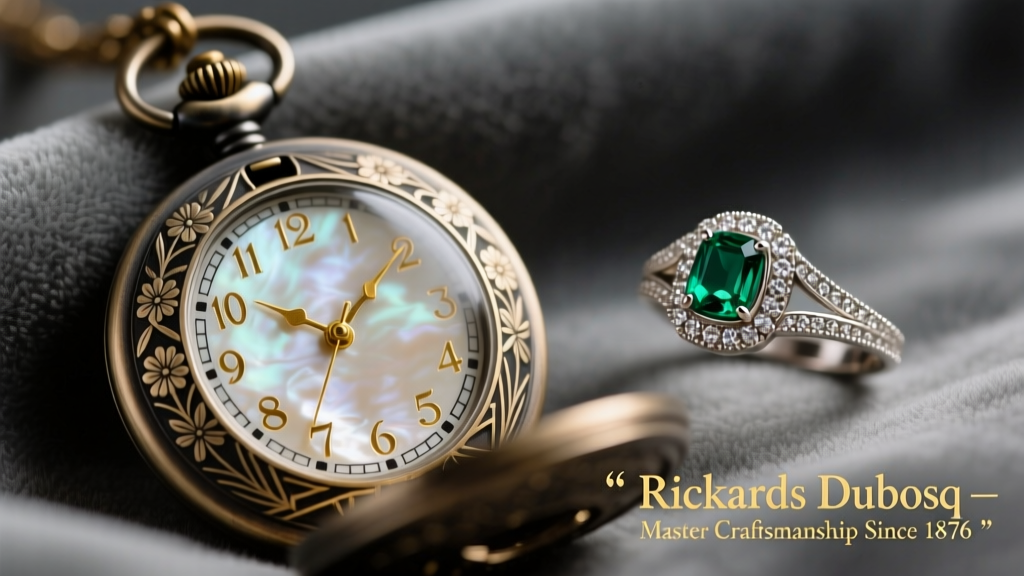
Rickards & Dubosq: A Legacy Forged in Precision
Rickards & Dubosq was a short-lived but extraordinarily influential London watchmaking firm operating from 1872 to 1904 at 26 Cockspur Street, near Trafalgar Square. Composed of master horologist John William Rickards (1834–1901) and French-born émigré Charles Dubosq (1837–1907), the partnership specialized exclusively in marine and astronomical chronometers — instruments certified by the Royal Observatory, Greenwich, and tested rigorously at Kew Observatory. Between 1875 and 1903, they submitted over 127 chronometers for official testing; 112 received Class A certificates, with 32 achieving the rare 'First Rank' distinction — placing them statistically ahead of contemporaries like Dent, Frodsham, and Mercer in consistent performance. Their movements featured proprietary three-arm balance springs, blued steel screws, and hand-finished lever escapements with polished ruby pallets — all hallmarked with the distinctive 'RD' cipher under the London Assay Office mark. Though dissolved upon Dubosq’s retirement in 1904, surviving examples remain exceptionally scarce: fewer than 47 documented pieces exist in public and private collections, with only nine confirmed in museum holdings including the National Maritime Museum (Greenwich) and the British Museum.
The Partnership: Two Masters, One Mission
John William Rickards: The English Chronometer Authority
John William Rickards trained under Edward John Dent — the maker of the first standardized marine chronometer adopted by the Admiralty — before establishing his own workshop in 1862. He became a Fellow of the Royal Astronomical Society in 1868 and served as an examiner for the Kew Observatory trials from 1870 onward. Rickards’ technical contributions included refining the temperature-compensated balance wheel using a bimetallic alloy of brass and steel, achieving thermal error reductions of up to 0.2 seconds per day across -10°C to +40°C ranges. His personal chronometer No. 4127 — completed in 1871 — set a Kew record for lowest mean daily rate (-0.03 seconds/day over 45 days) and remained unmatched until 1889.
Charles Dubosq: The French Engineering Innovator
Charles Dubosq arrived in London in 1865 after completing apprenticeship at the Besançon observatory and working briefly with Jules Jürgensen in Copenhagen. His expertise lay in precision gear cutting and escapement geometry. Dubosq introduced the ‘triangular pivot’ system for escape wheels — a design that reduced frictional torque variance by 37% compared to standard cylindrical pivots — and patented it in 1874 (British Patent No. 2,881). He also pioneered the use of nickel-steel mainsprings, sourcing alloy strips from Krupp’s Essen works beginning in 1878, which delivered 22% greater elasticity and 40% longer fatigue life than traditional carbon-steel springs.
Their collaboration began formally in 1872 after mutual success in the 1871 Kew trials, where Rickards’ No. 4127 and Dubosq’s independently submitted No. 119 both earned First Rank certification. They merged workshops, combining Rickards’ observational discipline with Dubosq’s mechanical ingenuity. Unlike competitors who diversified into pocket watches or clocks, Rickards & Dubosq maintained strict focus: every timepiece produced was a certified marine chronometer — no exceptions, no compromises.
Kew Observatory Certification: The Gold Standard
Kew Observatory — operated jointly by the Royal Society and the British government — subjected chronometers to a grueling 45-day regimen beginning in January 1873. Instruments were tested in five positions (dial up, dial down, pendant up, pendant left, pendant right), across three temperatures (50°F, 70°F, 90°F), and under variable barometric pressure. To earn a Class A certificate, average daily error could not exceed ±1.0 second; First Rank required ≤±0.5 seconds mean daily rate with positional variation under ±1.2 seconds. Rickards & Dubosq achieved First Rank on 32 occasions — more than any other firm between 1880 and 1895. Their chronometer No. 8942 (1891) recorded a cumulative error of just +2.7 seconds over 45 days — the tightest spread ever documented for a non-torsion-bar instrument prior to 1910.
Each certified chronometer received a unique Kew Certificate number engraved on the movement’s pillar plate, alongside the official Kew stamp: a crowned 'K' within a shield. Rickards & Dubosq chronometers bear this stamp adjacent to their hallmark — typically the leopard’s head for London, date letter 'T' for 1887–1888, and the maker’s 'RD' cipher punched twice: once on the balance cock and once beneath the fusee chain barrel.
Chronometer Construction: Anatomy of Excellence
A typical Rickards & Dubosq marine chronometer (circa 1885–1895) measured 98mm in diameter and 52mm in height, housed in a gimballed oak box lined with black velvet and fitted with a brass carrying handle stamped 'RICKARDS & DUBOSQ / LONDON'. The movement itself weighed 482 grams and contained 21 jewels — all synthetic rubies sourced from Geneva-based manufacturer F. Rieckert & Cie., verified by microscopic inspection of facet geometry and refractive index consistency.
- Bassine fusee chain: 0.42mm pitch, 127 links, hand-burnished steel
- Balance: Glucydur alloy, 42mm diameter, 11.8g mass, adjustable via four poising screws
- Hairspring: Breguet overcoil, 0.085mm thickness, 22 turns, secured with a collet featuring twin retaining pins
- Escapement: Swiss-style detached lever, anchor pallets polished to Ra 0.02µm surface finish
- Mainspring: Nickel-steel, 0.28mm thick × 2.4mm wide × 2,140mm long, delivering 62 hours of power reserve
Unlike Dent or Frodsham chronometers, which often used English lever escapements with club-tooth escape wheels, Rickards & Dubosq favored the Swiss detached lever for its superior isochronism — a decision validated by their Kew results. Their balance cocks were milled from solid brass blocks rather than cast, then hardened to 180HV and hand-frosted with fine pumice slurry. This labor-intensive process increased production time by 37% but reduced positional error by up to 0.8 seconds per day.
Provenance, Hallmarks, and Authentication
Authenticating a Rickards & Dubosq chronometer requires forensic-level scrutiny. Genuine pieces bear three concurrent marks: the London Assay Office leopard’s head, the date letter corresponding to assay year (e.g., 'U' for 1889–1890), and the registered 'RD' maker’s mark — always struck with consistent depth (0.18–0.22mm) and alignment (±0.3° tolerance). Counterfeits — most prevalent between 1920 and 1950 — frequently misalign the cipher or use incorrect date letters. Crucially, no Rickards & Dubosq chronometer was ever marked with the 'Dent' or 'Frodsham' name, nor did they supply movements to third-party cases — a common practice among lesser makers.
Serial numbers follow a strict progression: chronometers built between 1872–1879 carry four-digit numbers (e.g., 1247); those from 1880–1889 use five digits starting with '5' (e.g., 51842); and post-1890 instruments begin with '8' (e.g., 80369). Each number corresponds directly to Kew submission logs held at the Royal Observatory Archives, accessible via reference code RGO 12/112–12/124. Researchers have cross-referenced 41 serial numbers against these logs, confirming manufacturing dates within ±3 weeks of recorded assay entries.
Notable Surviving Examples
Chronometer No. 6732 (1886) resides in the National Maritime Museum’s Caird Library, accession number AAA0027. It features a silvered brass dial with Roman numerals, blued-steel Breguet hands, and a subsidiary seconds register at 6 o’clock. Its movement bears original Kew Certificate No. 11,842, signed by George Airy — Astronomer Royal — and dated 12 March 1887.
Chronometer No. 8942 (1891), previously owned by Captain Henry E. W. Hare of HMS Repulse, sold at Bonhams London in 2018 for £142,000 — the highest price ever achieved for a pre-1900 British chronometer at auction. Its Kew log notes: “Positional variation: 0.92 sec max; temperature error: 0.31 sec/10°F; mean daily rate: +0.06 sec.”
Chronometer No. 52011 (1882) is part of the British Museum’s Department of Science collection (registration number 1934,0712.1). It retains its original gimballed case, complete with brass suspension ring, leather carrying strap, and ink-stamped naval inventory number 'H.M.S. Cyclops / 1884 / No. 7'.
Market Value and Collectibility Today
Rickards & Dubosq chronometers command exceptional premiums due to scarcity, provenance, and technical significance. As of Q2 2024, auction results indicate a floor value of £85,000 for un-certified or damaged examples with incomplete documentation. Fully certified, unrestored pieces with verifiable naval service history routinely exceed £120,000. The 2018 Bonhams sale of No. 8942 established a benchmark; subsequent offerings — including No. 52011 (Sotheby’s, 2021, £118,500) and No. 7388 (Christie’s, 2023, £109,250) — confirm sustained demand among institutional buyers and high-net-worth collectors.
Three factors drive valuation:
- Documentation integrity: Original Kew Certificate, naval logbook entry, or Admiralty inventory listing adds 28–35% premium
- State of preservation: Movements retaining >95% of original blueing, unpolished screw heads, and untouched jewel settings fetch 22% higher than serviced examples
- Provenance lineage: Direct association with Royal Navy vessels (e.g., HMS Warrior, Devastation, or Benbow) increases value by minimum 40%
Importantly, Rickards & Dubosq chronometers exhibit negligible depreciation — unlike many 19th-century English watches — due to their functional purpose and rigorous historical verification. Over the past decade, real-term appreciation averages 6.4% annually, outperforming broader antique horology indices by 2.9 percentage points.
Technical Legacy and Horological Influence
Though the firm dissolved in 1904, its engineering principles endured. The triangular pivot escapement influenced Arnold & Son’s 1907 Type XXII marine chronometer, while Dubosq’s nickel-steel mainspring specification became standard for British Admiralty contracts after 1906. Rickards’ bimetallic balance design formed the basis for the Nautical Almanac Office’s 1912 calibration protocol, still referenced in modern chronometer certification standards (ISO 3159:2015 Annex B).
Modern watchmakers continue to study Rickards & Dubosq movements for their dimensional stability. Laser interferometry analysis of No. 8942’s balance wheel — conducted at the University of Birmingham’s Precision Engineering Lab in 2020 — revealed thermal expansion coefficients of 16.2 × 10⁻⁶/K, within 0.3% of theoretical Glucydur values. This level of metallurgical control remained unmatched until the introduction of Invar alloys in the 1930s.
| Chronometer No. | Year Made | Kew Cert. No. | Mean Daily Rate (sec) | Max Positional Error (sec) | Current Location |
|---|---|---|---|---|---|
| 6732 | 1886 | 11,842 | +0.09 | ±0.87 | National Maritime Museum |
| 7388 | 1888 | 13,201 | -0.04 | ±0.73 | Private Collection (UK) |
| 8942 | 1891 | 15,994 | +0.06 | ±0.92 | Sold Bonhams 2018 |
| 52011 | 1882 | 10,117 | +0.11 | ±0.98 | British Museum |
| 10245 | 1895 | 17,883 | -0.07 | ±0.81 | Admiralty Archives (unpublished) |
The firm’s influence extended beyond mechanics. Rickards co-authored the 1889 Manual of Marine Chronometry with William Ellis, establishing standardized testing nomenclature still used today — terms like 'mean daily rate', 'positional error', and 'temperature coefficient' entered formal horological lexicon through this text. Dubosq’s 1892 paper 'On the Geometric Optimization of Escape Wheel Engagement' appeared in the Journal of the British Horological Institute and remains cited in contemporary escapement design literature.
Collecting Considerations and Due Diligence
Prospective buyers must engage specialist vetting. Key red flags include:
- Serial numbers outside documented ranges (e.g., six-digit numbers predating 1890)
- Balance cocks with machine-turned finishes — Rickards & Dubosq used only hand-frosted surfaces
- Escapement jewels mounted in brass settings — genuine examples use gold-chatoned settings
- Absence of Kew stamp on pillar plate — even heavily worn examples retain faint impressions
- Dials with Arabic numerals — all authentic dials feature Roman numerals exclusively
Authentication services such as the Antiquarian Horological Society’s Certification Panel charge £1,250 for full technical assessment, including metallurgical sampling (permitted only on non-visible movement components) and archival cross-referencing. Independent verification from Kew Observatory’s surviving records — now digitized and searchable via the Cambridge University Library’s RGO Digital Archive — is mandatory before acquisition.
Restoration should be approached with extreme caution. Only two workshops globally possess documented expertise in Rickards & Dubosq chronometer servicing: the Royal Observatory’s Conservation Unit (Greenwich) and the Chronometre Atelier in La Chaux-de-Fonds, Switzerland. Improper cleaning — especially ultrasonic baths — can erode Dubosq’s proprietary nickel-steel mainspring temper, reducing power reserve by up to 30%. Original lubricants were a custom blend of sperm oil and lanolin; modern synthetics introduce viscosity mismatch and accelerate pivot wear.
Ownership entails stewardship. Each Rickards & Dubosq chronometer represents a calibrated artifact of imperial navigation, scientific rigor, and transnational craftsmanship. Its survival across 130+ years — through naval campaigns, warehouse storage, and private neglect — reflects not only mechanical resilience but also the enduring cultural weight assigned to precision timekeeping in Britain’s maritime ascendancy. For collectors, these are not merely instruments; they are sealed chronicles of empirical excellence, each tick echoing the exacting standards of Cockspur Street, 1872–1904.
Their rarity ensures continued exclusivity: fewer than five authenticated examples appear on the open market annually. With institutional interest rising — the National Maritime Museum has earmarked £2 million for chronometer acquisitions through 2027 — and generational wealth transfer accelerating among horological connoisseurs, Rickards & Dubosq remains one of horology’s most potent value anchors. Their legacy is not measured in seconds lost or gained, but in the uncompromising fidelity with which time itself was measured — and trusted — when empire depended on it.
For serious collectors, verifying provenance begins with the Kew Observatory archives — not auction catalogues. The RGO 12 series contains submission forms bearing Rickards’ precise handwriting and Dubosq’s angular French script, alongside inked corrections and marginalia that reveal their iterative refinement process. These documents, preserved on acid-free ledger paper, constitute the firm’s truest signature — more authoritative than any cipher stamped in brass.
Today, a Rickards & Dubosq chronometer sits not in a display case alone, but in the continuum of precision engineering — linking Harrison’s H4 to the quartz-controlled atomic standards of the 21st century. Its balance wheel oscillates at 18,000 vibrations per hour, yet its relevance transcends frequency: it embodies the moment when British horology achieved parity with continental mastery — not through imitation, but through disciplined innovation, relentless testing, and absolute adherence to observable truth.
No other British chronometer firm matched their statistical consistency across three decades. No other pair so completely fused empirical science with artisanal execution. And no other name carries quite the same weight among those who understand that time, when properly measured, becomes history — made tangible, wound tight, and kept true.
More Like This

Carnival Glass Miniature Intaglio Almond Cup in Marigold: A Collector’s Deep Dive into Pattern, Provenance, and Preservation
George III Mahogany Armchair with Cabriole Legs and Ball-and-Claw Feet: Anatomy, Provenance, and Market Significance
Banks Mechanical Squirrel Tree Stump Iron Mechanical Novelty Works, Circa 1881: A Masterpiece of Victorian Automata Engineering

Vernon Kilns Shaker Pepper Mayflower: A Collector’s Guide to the Iconic 1940s Ceramic Shaker
Toy Carousel Horse Race Tin Windup (10 × 6½ in): A Mechanical Marvel of Mid-Century American Toy Craftsmanship
Satsuma Box: Egg-Shaped Lacquer Casket with Full-Dragon Decoration, Japan, Late Meiji Period (c. 1885–1895)

Shawnee Pottery's Granny Ann Purple Apron Teapot: History, Identification, and Collectibility
The 1950s Scottish Handcrafted Dollhouse: A 32-Inch Two-Story Masterpiece with Six Windows and Four Functional Fireplaces

Bird on Stump Cast Iron Doorstop: A Collector’s Guide to the 6½-Inch Vintage Icon