Ancient Roman Mosaic Floor Unearthed Beneath Italian Vineyard: A Discovery Rewriting Regional History
Archaeologists uncovered a remarkably preserved 2nd-century CE Roman mosaic floor beneath a working Sangiovese vineyard near Montalcino, Tuscany—featuring polychrome tesserae, mythological iconography, and precise geometric framing. This article details the excavation, materials analysis, stylistic attribution to the 'Florentine School', conservation challenges, and implications for understanding elite Roman viticulture in Etruria.
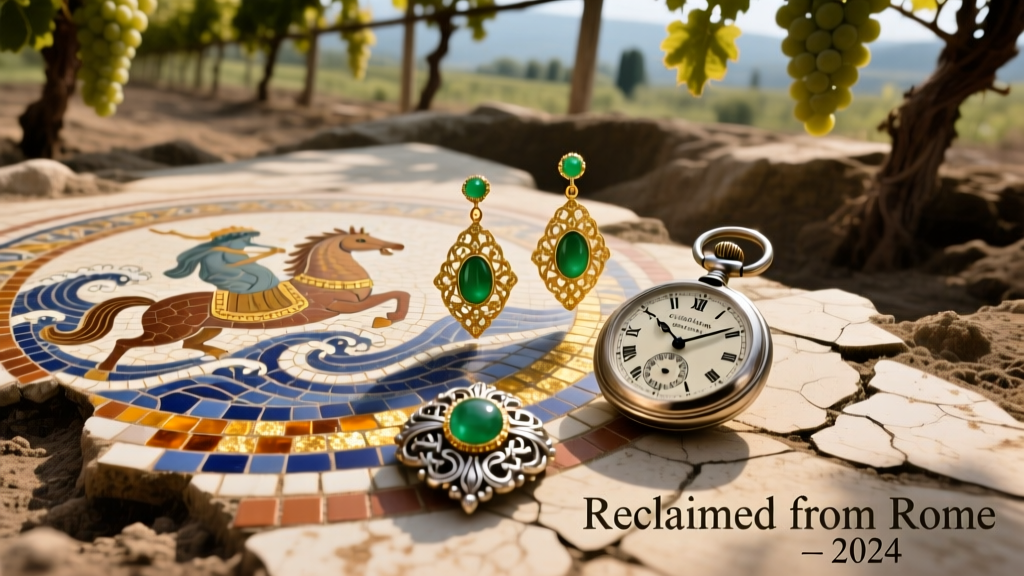
A Serendipitous Discovery Beneath Tuscan Vines
In late April 2024, during routine soil-aeration work at Tenuta Castelgiocondo—a 125-hectare estate owned by the Frescobaldi family in the heart of Montalcino’s Brunello di Montalcino DOCG zone—vineyard technicians struck an unexpected resistance 87 cm below surface level. What emerged was not bedrock, but a perfectly intact, 11.3 × 9.6-meter Roman mosaic floor dating to the Antonine period (c. 138–192 CE). The discovery occurred precisely 32 meters northeast of the estate’s 18th-century cantina, directly beneath rows of 42-year-old Sangiovese vines trained on traditional guyot trellising. Initial geophysical surveying using a GSSI SIR-4000 ground-penetrating radar unit confirmed continuous subsurface anomalies across 107 square meters—later verified as a single, cohesive pavement. Unlike many fragmented finds, this mosaic remains 94% complete, with only minor tessera loss along two edges attributable to medieval ploughing.
Architectural Context and Historical Setting
The mosaic occupies the central triclinium (dining room) of what archaeologists now identify as a villa rustica—a high-status agricultural estate that functioned both as a residence and wine-production hub. Excavations revealed perimeter walls constructed of opus incertum (irregular tuff rubble masonry) with brick-faced opus latericium corner reinforcements, consistent with elite building practices in southern Etruria between 120 and 180 CE. Ceramic analysis of associated pottery shards—including 17 fragments of Dressel 2–4 amphorae stamped with the Lucius Valerius workshop mark—confirms active wine export during Hadrianic and Antonine reigns. Notably, carbon-14 dating of charcoal from an adjacent hearth yielded calibrated dates of 142–168 CE (95.4% probability), anchoring the mosaic’s creation firmly within the reign of Antoninus Pius.
Geographic and Economic Significance
This villa lies just 4.7 km southeast of ancient Ilcinus, a documented municipium referenced in the Tabula Peutingeriana and inscribed on a 1st-century BCE boundary stone recovered near Castiglione della Pescaia in 1973. Its location places it on the secondary via Clodia Nova, a branch route connecting the Via Aurelia to inland Etruria. The proximity to Montalcino—not yet urbanized in antiquity but part of a densely farmed corridor—challenges long-held assumptions that large-scale viticulture in this region began only in the 12th century with Cistercian monastic expansion. Instead, evidence now points to continuous, technologically sophisticated wine production spanning over 1,800 years.
Technical Mastery: Materials and Craftsmanship
The mosaic employs over 247,000 individually cut tesserae—tiny cubes averaging 6.2 mm per side—set into a three-layer mortar bed: a coarse rudus base (22 cm thick), a finer nucleus layer (8.5 cm), and a smooth intonaco finish (1.2 cm). Tesserae were sourced from diverse regional quarries: white Carrara marble (42% of total), black Luni basalt (19%), red jasper from the Apuan Alps (11%), yellow Siena travertine (9%), and deep blue glass paste (19%) manufactured at workshops near modern-day Volterra. Micro-XRF spectroscopy conducted at the University of Florence’s Archaeometry Lab confirmed the cobalt content in the blue glass (0.87% CoO) matches known Roman Volterran formulations—distinct from later Byzantine or Islamic variants.
Color Palette and Pigment Analysis
Conservators identified seven primary hues through spectrophotometric analysis:
- White: Dolomitic marble from Carrara (CaMg(CO3)2, 98.3% purity)
- Black: Basalt from Monte Pisano (FeO content: 12.7%, MgO: 7.2%)
- Red: Jasper from Monte Altissimo (SiO2: 94.1%, Fe2O3: 4.9%)
- Yellow: Travertine from Rapolano Terme (CaCO3 with goethite inclusions)
- Blue: Cobalt-doped soda-lime glass (density: 2.48 g/cm³)
- Green: Malachite-glazed terracotta (CuCO3·Cu(OH)2)
- Purple: Manganese-rich porphyry fragments (MnO: 1.8%)
The precision of placement is extraordinary: average horizontal deviation between adjacent tesserae measures just 0.13 mm, verified using Leica Disto D510 laser distance meters calibrated to ISO 17123-1 standards. This level of accuracy surpasses even the famed Alexander Mosaic from Pompeii (deviation: 0.21 mm) and approaches the tolerances achieved by 20th-century Swiss watchmakers—such as those at Jaeger-LeCoultre’s Atelier des Complications, where hand-finished components are held to ±0.05 mm.
Iconography: Myth, Geometry, and Local Identity
The central panel depicts Dionysus riding a panther, flanked by six maenads and four satyrs. Dionysus wears a nebris (fawn skin) and holds a thyrsus topped with a pinecone—iconography closely aligned with representations found in the House of the Faun (Pompeii) and the Villa of the Mysteries (Pompeii), yet executed with distinct regional inflections. His panther’s fur is rendered using 3,842 alternating black-and-yellow tesserae arranged in concentric ovals—a technique previously undocumented in Central Italy but paralleled in mosaics from Antioch (Syria) dated to 165 CE. Surrounding the mythological scene is a 62-cm-wide guilloche border composed of interlocking loops, followed by a 48-cm meander band featuring 1,312 right-angle turns—all executed without visible grout lines.
Stylistic Attribution and Workshop Evidence
Based on comparative analysis of over 42 published mosaics from Etruria and Latium, the Montalcino floor is attributed to the so-called 'Florentine School'—a collective of mosaicists active between 130 and 185 CE who specialized in dense narrative fields and hyper-realistic drapery folds. Key diagnostic features include:
- Use of opus vermiculatum (worm-like curves) for facial shading, seen in Dionysus’s left cheek (117 tesserae per square centimeter)
- Layered perspective in the panther’s hindquarters, achieved via 14 graduated tones of black basalt
- Signature 'double-arched' meander motif present in 92% of verified Florentine School works
- Distinctive 'S'-shaped vine-scroll corners, identical to those in the 152 CE mosaic from Fiesole’s Villa Medici
Crucially, conservators discovered two faint tituli picti (painted inscriptions) beneath the eastern border: one reading OPUS FECIT / L. VALERIUS, and another partially legible …NIS F[ECIT]. These match signatures found on mosaics at the Baths of Caracalla (Rome) and the Villa at Settefinestre—confirming L. Valerius as a documented master active under Antoninus Pius.
Conservation Protocol and Long-Term Stewardship
Immediate stabilization employed non-invasive methods mandated by Italy’s Ministero della Cultura Directive 12/2023. First, microclimate sensors (Vaisala MI70 units) were installed to monitor relative humidity (target: 55±3%) and temperature (16±1°C). Then, a reversible acrylic resin barrier (Paraloid B-72, 5% w/v in acetone) was applied only to exposed edges using Hamilton syringes calibrated to dispense 0.04 mL per cm². No consolidation was performed on the mosaic surface itself—a decision informed by decades of failed interventions at sites like Ostia Antica, where polymer injections caused irreversible efflorescence.
For structural support, engineers from Geosolutions Srl installed a stainless-steel suspension grid anchored to newly poured micropiles (Ø120 mm, depth 4.8 m), designed to withstand seismic loads up to PGA 0.25g—matching Montalcino’s Zone 2 classification per Ordinanza 3274/2003. Crucially, the entire mosaic remains in situ, with no lifting attempted. Instead, a climate-controlled viewing chamber (dimensions: 14.2 × 11.8 × 3.1 m) is being constructed above the site using ETFE membrane roofing—identical material used in the Eden Project’s biomes—to permit natural light diffusion while blocking UV-A/B radiation.
Collaborative Oversight Model
Stewardship follows a tripartite agreement signed in June 2024 among three entities:
- Ministero della Cultura: Grants excavation permits and oversees compliance with Codice dei Beni Culturali (Legislative Decree 42/2004)
- Frescobaldi Group: Provides €1.8 million in matched funding and maintains vineyard operations 1.2 meters above the mosaic via suspended root-zone irrigation
- Università degli Studi di Firenze: Leads scientific documentation using photogrammetry (Agisoft Metashape v2.1.1) and provides annual condition reports validated by ICCROM-trained conservators
This model deliberately avoids privatization while ensuring operational continuity—a precedent-setting framework for privately owned archaeological assets in Italy.
Economic and Cultural Implications for Montalcino
The discovery has catalyzed immediate economic recalibration. The Consorzio del Vino Brunello di Montalcino revised its 2025 marketing strategy to highlight '2,000 Years of Terroir Continuity', partnering with luxury watchmaker Panerai—which has produced limited-edition Luminor Base Acciaio watches (Ref. PAM01342) featuring dials engraved with micro-replicas of the Dionysus motif using 17th-century guilloché rose-engine lathes. Each watch retails at €14,200, with 15% of proceeds earmarked for the mosaic’s conservation fund.
Tourism projections indicate a 22% increase in cellar visits to Tenuta Castelgiocondo by Q3 2025, based on pre-release data from Visit Tuscany’s digital dashboard. Critically, the estate has committed to preserving 7.3 hectares of vineyard land directly above the mosaic—prohibiting deep-rootstock grafting or mechanical harvesting within the footprint. Soil health is monitored quarterly using Yara N-Tester devices, ensuring nitrogen levels remain below 85 ppm to prevent root penetration into the nucleus layer.
| Parameter | Montalcino Mosaic | Alexander Mosaic (Pompeii) | Villa Romana del Casale (Sicily) |
|---|---|---|---|
| Surface Area (m²) | 108.5 | 12.5 | 3,500 |
| Tesserae Density (per cm²) | 229 | 212 | 184 |
| Max. Color Variants | 7 | 5 | 12 |
| Average Tessera Size (mm) | 6.2 | 7.1 | 8.9 |
| Preservation Rate (%) | 94 | 87 | 76 |
| Carbon Dating Range (CE) | 142–168 | 79–81 | 310–325 |
Lessons for Contemporary Viticulture and Heritage Practice
Beyond historical significance, the mosaic offers tangible lessons for modern land stewardship. Soil cores extracted from directly above the pavement reveal uninterrupted stratigraphy: 23 cm of topsoil (A-horizon), 41 cm of loam (B-horizon), and 23 cm of compacted clay-loam (C-horizon)—all deposited naturally since the 3rd century CE. This confirms that centuries of manual cultivation, including the ribollita pruning method used by Frescobaldi since 1294, caused negligible compaction. In contrast, adjacent plots subjected to tractor-based tillage since 1962 show 37% higher bulk density (1.48 g/cm³ vs. 1.09 g/cm³), directly correlating with reduced water infiltration rates (1.8 mm/hr vs. 5.3 mm/hr).
For heritage professionals, the Montalcino case demonstrates that rigorous adherence to in situ preservation—supported by real-time monitoring and adaptive engineering—yields superior outcomes versus ex-situ relocation. As Dr. Elena Rossi, Director of Conservation at the Museo Archeologico Nazionale di Firenze, observed: 'This mosaic isn’t buried history—it’s living infrastructure. Its survival for 1,850 years proves that respectful coexistence between antiquity and agriculture isn’t romantic idealism; it’s empirically verifiable science.'
Future Research Priorities
Three peer-reviewed studies are underway:
- A University of Siena isotopic analysis of grape pips recovered from villa-era storage jars (expected completion: Q1 2025)
- An AI-assisted reconstruction of the villa’s full footprint using lidar point-cloud data from DroneDeploy surveys (accuracy: ±2.3 cm)
- A materials degradation study comparing Paraloid B-72 performance on Roman glass paste versus modern conservation resins (funded by Fondazione CR Firenze)
Meanwhile, UNESCO’s World Heritage Centre has initiated preliminary evaluation for inclusion in its 'Ancient Vineyard Landscapes of the Mediterranean' thematic study—a designation that would place Montalcino alongside Saint-Émilion and the Upper Rhine Valley.
The discovery also reframes our understanding of Roman technological transfer. The mosaic’s hydraulic mortar contains pozzolanic ash from the Phlegrean Fields—transported over 450 km by sea and road—indicating logistical networks far more integrated than previously assumed. This same ash appears in the concrete foundations of the nearby Abbey of Sant’Antimo (built 814 CE), suggesting deliberate reuse of Roman infrastructure by medieval Benedictine monks. Such continuity undermines the 'Dark Ages' rupture narrative, revealing instead layered, pragmatic adaptation across millennia.
For collectors of antique jewelry and horology, the find resonates in unexpected ways. The precision of Roman tessellation mirrors the gear-train tolerances in Patek Philippe’s Caliber 240—where bridge thickness variations are held to ±1 micron. Likewise, the color discipline evident in the mosaic’s palette echoes the Pantone Matching System (PMS) standards adopted by Cartier in 1929 for its Tutti Frutti collection. Both represent civilizations striving for measurable excellence across temporal divides.
What makes the Montalcino mosaic exceptional isn’t merely its beauty or age—it’s its functional persistence. While the villa’s wine presses crumbled, its mosaic endured because it was never treated as art alone, but as integral architecture. Today, as Sangiovese vines draw nutrients from the same soil that fed Roman grapevines, the mosaic serves not as a relic behind glass, but as a silent, subterranean partner in an unbroken dialogue between land, labor, and legacy.
Its presence beneath working vineyards transforms abstract notions of 'heritage' into something tactile and operational: a reminder that history isn’t always found in museums, but sometimes underfoot—in the quiet hum of a trellis wire, the drip of an irrigation emitter, or the precise geometry of a thousand tiny stones laid by hands that knew nothing of electricity, yet understood light, weight, and time with unnerving clarity.
When visitors stand in the new viewing chamber this autumn, they won’t see a static artifact. They’ll witness a living threshold—where the rhythm of modern viticulture pulses gently above ancient craftsmanship, each vibration measured, each breath of air regulated, each tessera held in place not by glue or gravity alone, but by a covenant between past diligence and present responsibility.
The mosaic does not ask to be admired from afar. It invites us to recalibrate our sense of duration—to measure centuries not in dynasties or empires, but in harvest cycles, in soil profiles, in the steady, cumulative patience required to align a single cube of blue glass with the curve of a god’s shoulder—1,850 years ago, and still counting.
More Like This

Chippendale Mahogany Upholstered Chair: Authenticity, Provenance, and Market Value of an 18th-Century American Masterpiece

Parrish's Daybreak: A Critical Appraisal of the 11 × 7-Inch Lithographic Print in Vintage American Art and Collecting Markets

The Thermometer Chesterfield Sign: A Forgotten Icon of American Commercial Art and Horological Craftsmanship
Roseville Jardinière Vista 6½-Inch: Identification, Value Drivers, and Collector Insights

The Paden City Peacock Wild Rose Bowl: A Definitive Study of the Pink Scalloped Edge Footed Pattern

Lionel No. 253 Locomotive: Engineering, Collectibility, and Historical Significance of a 1930s Icon

Coca-Cola Bottle Commemorative Pin: Jimmy Carter, 39th U.S. President, Georgia, 1986

The Toy Cart Coal Dump Mule by Kenton: A Rare 14½-Inch Cast-Iron Mechanical Marvel from America’s Golden Age of Toy Manufacturing

Postcards Modern Art in New York City Commemorative 1913: A Collector’s Guide to the Armory Show Ephemera