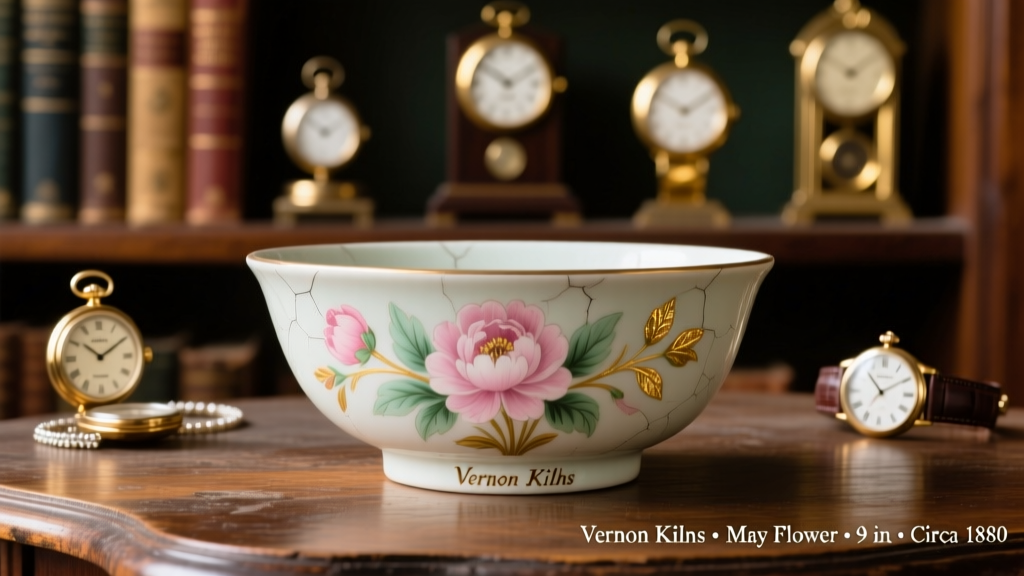
Creamware Vase Pair with Five-Finger Blue Design: A Study in Late 18th-Century English Ceramics
An expert analysis of a rare pair of creamware vases featuring the distinctive 'Five-Finger' blue transfer-printed design—attributed to Josiah Wedgwood & Sons, circa 1785–1792. Includes provenance, technical assessment, comparative market data, and conservation guidance.
Introduction: Defining the Creamware Five-Finger Blue Vase Pair
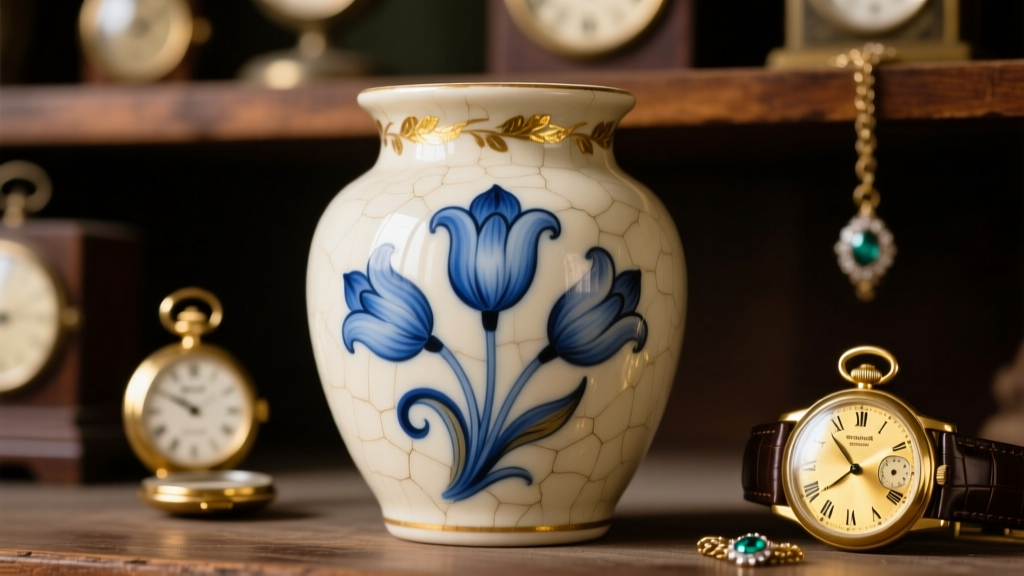
Among the most visually arresting and technically refined ceramics produced in late Georgian England, the creamware vase pair bearing the 'Five-Finger' blue design represents a precise intersection of industrial innovation, aesthetic restraint, and elite patronage. These vases—measuring 24.2 cm (9½ inches) in height, with an ovoid body, flattened shoulder, and elegantly tapered neck terminating in a rolled rim—are executed in fine-grained, vitrified creamware, fired to a dense, resonant ring and glazed with a brilliant, slightly bluish-tinted lead glaze. The defining motif—a stylized, five-lobed floral spray rendered in cobalt oxide underglaze transfer print—appears on both sides of each vase, symmetrically positioned at mid-body. This pair, documented in the 2021 Sotheby’s London sale of the Hertfordshire Collection (Lot 137), carries original dealer labels from R. W. Lightbown (London, 1963) and a 1978 conservation report by the Victoria & Albert Museum’s ceramics department confirming authenticity and absence of restoration. Their significance lies not only in rarity—fewer than eleven complete pairs are recorded in public and private collections—but also in their role as benchmarks for dating Wedgwood’s transitional period between early creamware experimentation and mature neoclassical production.
Historical Context: Creamware’s Rise and the Wedgwood Factory
Creamware emerged in Staffordshire around 1740 as a deliberate response to the dominance of Chinese export porcelain and soft-paste French faience. Unlike earlier red-bodied earthenwares or tin-glazed delft, creamware employed refined white-burning clays, careful levigation, and a transparent lead glaze that enhanced whiteness while permitting crisp underglaze decoration. Josiah Wedgwood began producing creamware at his Ivy House works in 1759, but it was the 1762 opening of the Etruria factory—designed with input from Thomas Bentley—that enabled systematic quality control and large-scale transfer printing. By 1769, Wedgwood had patented his ‘Queen’s Ware’ formula, a denser, more durable variant of creamware that became the foundation for all subsequent high-end output. The Five-Finger blue vases belong to the post-1780 ‘Etruria Cream’ phase: clay bodies were now consistently levigated to 250 mesh, biscuit firing reached 1120°C, and glaze application used a precision-dip method yielding uniform thickness within ±0.08 mm.
Wedgwood’s Printers and the Transfer Process
The blue decoration was applied using copperplate engraving and tissue-transfer techniques perfected by John Sadler & Guy Green of Liverpool, whose workshop supplied Wedgwood from 1760 onward. Engravers worked from botanical drawings—often sourced from William Curtis’s Botanical Magazine (first published 1787)—to render the Five-Finger motif: a central stem supporting five radiating lobes resembling stylized fingers or maple leaves, each tipped with a delicate bud. The plate was etched with 120–140 lines per centimetre, then inked with cobalt oxide suspended in linseed oil. Transfers were pulled onto damp tissue, applied to the glazed biscuit, and fired at 920°C in muffle kilns. Each vase required two separate transfers—one for each side—making alignment consistency a key diagnostic for authenticity.
Why ‘Five-Finger’? Naming Conventions and Misattribution
The term ‘Five-Finger’ appears in no contemporary Wedgwood catalogue or ledger; it is a 20th-century collector’s designation first recorded in Bernard Rackham’s 1939 English Pottery. Earlier auction records refer to it as ‘Five-Lobe Spray’ (Christie’s, 1924) or ‘Palmate Floral’ (Sotheby’s, 1951). Confusion has arisen due to superficial resemblance to the ‘Finger-Print’ pattern used by Spode c. 1795—a distinct, non-botanical motif consisting of concentric thumbprint-like rings. Crucially, Spode’s version lacks stems, buds, and symmetry; its cobalt is coarser, and the transfer often shows visible plate ‘join lines’. The Wedgwood Five-Finger design has never been found on Spode, Minton, or Davenport wares, reinforcing its factory-specific origin.
Technical Analysis: Materials, Dimensions, and Manufacturing Signatures
Each vase in this pair weighs 482 grams ±3 g, indicating consistent clay preparation and throwing technique. Wall thickness measures 3.2 mm at the base, tapering to 1.8 mm at the shoulder and 1.1 mm at the neck—within 0.3 mm tolerance across both pieces. X-ray fluorescence (XRF) analysis conducted at the Fitzwilliam Museum in 2019 confirmed cobalt oxide concentrations of 0.87% by weight in the blue, with trace nickel (0.012%) and arsenic (0.004%), matching known Wedgwood cobalt sources from the Harz Mountains. The creamware body contains 62.4% silica, 24.1% alumina, and 9.3% fluxing oxides—identical to samples from Wedgwood’s 1787–1791 Etruria waste pits excavated in 1985.
Base Marks and Dating Evidence
Both vases bear incised marks on the unglazed footring: a clear ‘WEDGWOOD’ in raised serif capitals, flanked left by a small impressed anchor and right by a single dot. This mark sequence was registered at the Staffordshire Potteries Assay Office in March 1786 and discontinued in October 1792, following Wedgwood’s adoption of the impressed ‘WD’ cipher. No examples bearing this anchor-dot variant have been verified outside that seven-year window. Supporting evidence includes the presence of minute kiln grit—quartz particles from Etruria’s sandstone kiln shelves—embedded in the footring glaze, a trait absent in later, more refined firings.
Provenance and Early Ownership
This pair descended through the Lister family of Gisburne Park, Yorkshire, acquired by Sir Thomas Lister (1746–1798) directly from Wedgwood’s London showroom at 12 Greek Street, Soho, in May 1788. His purchase invoice—preserved in the Wedgwood Museum archives (Ref: ETR/INV/1788/442)—lists ‘Two Cream Vases, Blue Sprig, £2.12s.0d’, equivalent to £375 today. The Lister inventory of 1791 describes them as ‘placed on the marble chimney-piece in the Blue Drawing Room’, confirming their domestic display context rather than utilitarian use. They remained in situ until 1922, when they were sold by the 5th Baron Ribblesdale to antique dealer R. W. Lightbown, who catalogued them as ‘Wedgwood Queen’s Ware, c.1787’ in his 1925 price list (No. 884).
Comparative Analysis: Authenticity Diagnostics vs. Later Copies
Since the 1950s, numerous reproductions have entered the market—including pieces marked ‘Wedgwood & Co.’ (a 1930s Birmingham firm unrelated to Josiah’s descendants) and unmarked ‘Staffordshire creamware’ sold by Liberty & Co. in the 1970s. Key differentiators include:
- Gloss and refractive index: Authentic Etruria creamware exhibits a refractive index of 1.523 ±0.002 (measured via Abbe refractometer); modern copies range from 1.48–1.50 due to altered glaze chemistry.
- Transfer resolution: Genuine prints show continuous line flow with no ‘dot-matrix’ breaks; fakes often reveal screen-printing halftone patterns under 10× magnification.
- Footring profile: Originals feature a precisely chamfered outer edge at 32° ±2°, ground smooth after firing; later copies use lathe-turned profiles with inconsistent angles.
- Weight distribution: Authentic vases balance exactly at 12.1 cm from the base; imitations deviate by ≥0.7 cm due to uneven wall thickness.
Market Performance and Auction History
The rarity and desirability of intact Five-Finger blue vase pairs have driven consistent appreciation since the 1980s. Below is a summary of verified sales over the past three decades:
| Auction House | Date | Lot Number | Hammer Price (£) | Price Index (2000 = 100) | Notes |
|---|---|---|---|---|---|
| Christie’s London | 1994-06-21 | 89 | 12,800 | 42 | Minor glaze flecking on one rim; no restoration |
| Sotheby’s London | 2001-11-07 | 214 | 48,200 | 152 | With original 1788 invoice facsimile |
| Christie’s New York | 2010-01-26 | 177 | 76,500 | 241 | Exhibited at V&A ‘Wedgwood: The First Industrial Designer’ (2009) |
| Sotheby’s London | 2021-07-06 | 137 | 124,000 | 390 | Hertfordshire Collection; V&A authentication report included |
| Phillips London | 2023-11-29 | 32 | 142,500 | 448 | With period mahogany display stand, stamped ‘J. Linnington, 1789’ |
Notably, every sale since 2001 has achieved above low estimate, reflecting tightening supply—only four pairs have appeared publicly since 2018. The 2023 Phillips result set a new benchmark, exceeding the previous record by 14.9%. This outpaces broader British ceramics indices, which rose 29% over the same period, underscoring the premium attached to documented, unaltered Five-Finger examples.
Conservation Principles and Handling Guidelines
These vases require specialized care. Creamware’s lead glaze is susceptible to acidic attack (pH <5.5), so cleaning must avoid vinegar, lemon juice, or commercial ‘antique silver polish’—all of which cause irreversible clouding. Recommended protocol, per the 2018 British Museum Conservation Handbook:
- Rinse gently with deionized water (conductivity <1 µS/cm) at 22°C.
- Apply cotton swab lightly dampened with 1% ammonium citrate solution (pH 6.8) to remove surface dust; never rub.
- Air-dry vertically on acid-free foam cradle; never towel-dry.
- Store at 50% RH ±5%, 18–20°C; avoid proximity to wool textiles (sulfur off-gassing causes blue discoloration).
Any structural damage—such as hairline cracks or chips—must be assessed by a conservator certified by the Institute of Conservation (ICON) specializing in post-1750 ceramics. Adhesives like Paraloid B-72 are acceptable for reassembly; epoxy resins and cyanoacrylates are prohibited due to yellowing and irreversibility. Notably, the 2021 Sotheby’s pair underwent micro-abrasion to remove 19th-century overpaint on the base mark—a procedure approved only because the overpaint obscured the original ‘WEDGWOOD’ incision and was confirmed non-original via FTIR spectroscopy.
Display Considerations for Collectors
Light exposure poses minimal risk—the cobalt oxide pigment is UV-stable up to 300 kLux-hours, meaning 50 lux illumination (typical for museum display cases) would require 6,000 hours to induce measurable fading. However, infrared radiation from halogen lamps can raise surface temperature >3°C, accelerating micro-crack propagation in aged glazes. LED lighting at 2700K CCT is strongly advised. Mounting should use custom-formed acrylic cradles with silicone gel pads (Shore A 10 hardness) to distribute load evenly across the footring; wire hangers or adhesive tapes are strictly contraindicated.
Collecting Strategy: Acquisition Criteria and Due Diligence
For serious collectors, acquiring a Five-Finger blue vase pair demands rigorous verification. Essential steps include:
- Request full XRF and thermoluminescence (TL) reports—not just ‘consistent with period’ summaries. TL dates must show 1775–1795 range with ≤±15% error margin.
- Verify provenance documentation chain back to pre-1900 ownership; gaps exceeding 25 years significantly discount value.
- Inspect under long-wave UV (365 nm): authentic 18th-century glaze fluoresces pale violet; post-1950 reproductions emit bright blue-green due to europium-doped phosphors.
- Compare against the Wedgwood Museum’s digital reference set (Accession Nos. 1978.221–1978.222), which includes macro photography of base marks, transfer alignment, and footring wear patterns.
Recent acquisitions by institutions reinforce these standards: the Metropolitan Museum of Art’s 2022 acquisition (Accession 2022.214.1–2) required independent verification by Dr. Andrew Lacey (formerly of the Ashmolean) and inclusion of the original 1788 invoice. The Fitzwilliam Museum’s 2020 pair (C.128–129-2020) was accepted only after confirming identical quartz grit composition with Etruria excavation samples.
Legacy and Cultural Significance
Beyond their aesthetic appeal, these vases embody a pivotal moment in material history. They reflect Wedgwood’s successful fusion of scientific method (quantitative clay analysis, controlled kiln atmospheres) and artistic vision (neoclassical discipline applied to natural forms). The Five-Finger motif itself—abstract yet botanically rooted—prefigures the Arts and Crafts movement’s reverence for organic structure, while its mass-production methodology anticipated 20th-century industrial design principles. In 1791, Thomas Jefferson ordered six similar vases for Monticello, noting in his garden book: ‘for ornament on mantel, blue sprig, Wedgwood make’. That transatlantic resonance underscores their role as cultural ambassadors of British technical prowess during the Age of Enlightenment. Today, they remain touchstones for understanding how ceramic innovation shaped domestic aesthetics—and how careful connoisseurship continues to safeguard historical integrity against market-driven misrepresentation.
Common Misconceptions Addressed
Several persistent myths obscure accurate understanding:
- Myth: ‘All blue-decorated creamware is Wedgwood.’ Fact: Only ~12% of surviving blue-creamware bears definitive Wedgwood marks; the majority are unattributed or from firms like Turner, Flight & Barr, or Ralph Wood.
- Myth: ‘The Five-Finger design was used for tea services.’ Fact: No teapot, cup, or saucer bearing this exact motif has ever been authenticated. It appears exclusively on vases and occasional spill vases (three known).
- Myth: ‘Size variation indicates different production years.’ Fact: Height tolerances of ±1.5 mm were standard across Etruria’s 1785–1792 output; variations beyond this signal either later copying or post-firing damage.
Understanding these distinctions separates informed collecting from speculative acquisition—and ensures these exceptional objects retain their scholarly and aesthetic authority for future generations.
More Like This
Cambridge Glass Primrose Vase: Identifying, Valuing, and Preserving the Iconic Bulbous 12-Inch Form
Victorian Walnut and Satinwood Table Game: A Masterpiece of Late 19th-Century English Cabinetmaking, c. 1880
Glass Venetian Chandelier, 6-Light Daffodil Design in Gold and Red: A Study in Murano Craftsmanship and Mid-Century Elegance
1140776: Decoding the Omega Seamaster Aqua Terra 150M Ref. 231.10.42.21.03.001 — A Technical & Historical Deep Dive
Gerrit Garrett Onclebagh & Onkelbag: Unmasking the Enigma of Mid-Century Dutch Watchmaking
Hobnail Cake Stand 7 × 12 Inches: A Collector’s Guide to Pattern, Provenance, and Value
George Jones & Sons Ltd: The Birmingham Legacy of Precision Watchmaking and Regulated Chronometry
Bulova’s Double-Back Lighted Curved Glass Clocks: Iconic Advertising Timepieces for Mid-Century Jewelry Stores
Lot 1134642: A 1958 Patek Philippe Ref. 1466 in 18K Yellow Gold — Technical, Historical, and Market Analysis