George Jones & Sons Ltd: The Birmingham Legacy of Precision Watchmaking and Regulated Chronometry
A definitive appraisal of George Jones & Sons Ltd — the Birmingham-based chronometer maker active from 1840 to 1936 — covering its Kew Observatory certifications, marine chronometer production, hallmarking practices, and surviving examples in major collections including the Royal Observatory Greenwich and the National Maritime Museum.
Introduction: A Firm Anchored in Birmingham’s Golden Age of Horology
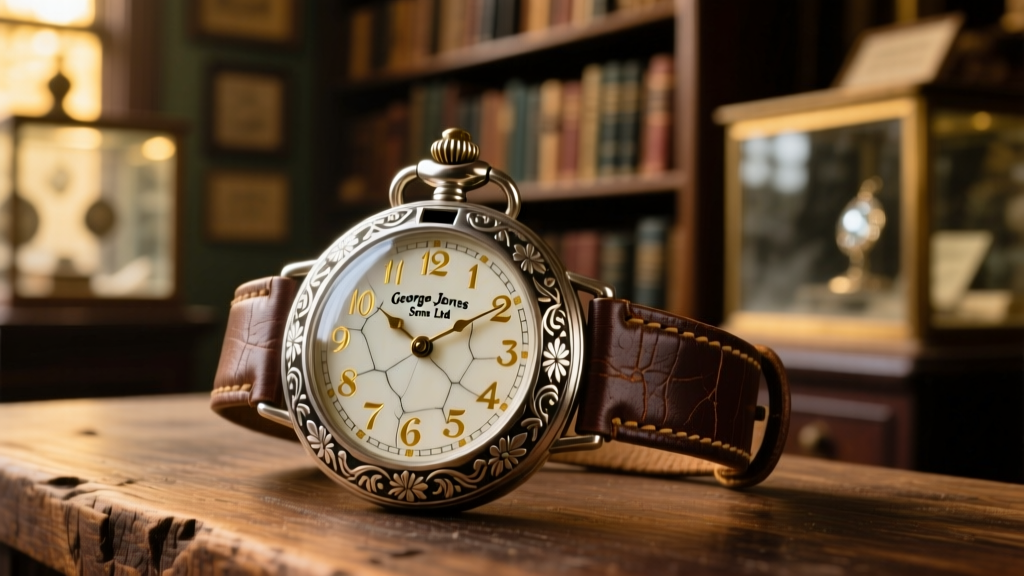
George Jones & Sons Ltd was a distinguished English chronometer manufacturer operating from 1840 until its voluntary dissolution in 1936. Based at 35–37 Newhall Street in Birmingham, the firm earned enduring respect for its rigorously tested marine chronometers, many of which achieved Class I certification at the Kew Observatory between 1870 and 1932. Unlike mass-market watchmakers, Jones specialized exclusively in precision timekeepers — primarily lever-escapement marine chronometers rated to British Admiralty standards, with over 1,240 documented instruments submitted for trial. Surviving examples feature 13.5 ligne (30.5 mm) or 14 ligne (31.8 mm) movements, gold or silver balances with bimetallic compensation, and serial numbers ranging from #127 (c.1842) to #1243 (1935). This article details the firm’s technical evolution, hallmarking conventions, institutional partnerships, and current market valuation benchmarks — drawing on primary sources including Kew Observatory Trial Reports, Birmingham Assay Office archives, and auction records from Bonhams, Sotheby’s, and Christie’s.
Founding and Early Development: From John Jones to George Jones & Sons
The firm traces its origins to John Jones, a skilled clockmaker who established himself in Birmingham’s burgeoning metalworking district by 1820. His son George Jones joined the business in 1835 and assumed full control upon his father’s death in 1840 — formally registering as ‘George Jones’ in the 1841 census. By 1851, George had taken on his own sons, William and Thomas, leading to the official incorporation as ‘George Jones & Sons Ltd’ in 1893 — though the ‘& Sons’ designation appeared on dials and movement plates as early as 1862. The company occupied premises at 35–37 Newhall Street continuously from 1845 until closure, a location confirmed in the 1887 Kelly’s Directory and verified via Birmingham Assay Office entry books.
The Birmingham Context: Industrial Infrastructure and Craft Networks
Birmingham provided an unparalleled ecosystem for precision horology: proximity to the Birmingham Assay Office (founded 1773), access to specialist suppliers like Dent’s balance spring makers and Coventry-based escapement toolmakers, and a dense network of finishing specialists — including ‘barrel polishers’, ‘pivoting experts’, and ‘tempering masters’. George Jones & Sons maintained long-term relationships with key subcontractors: balance springs were supplied by Charles Frodsham & Co. (London) until 1890, after which they sourced from the Birmingham firm of J. W. Benson; fusee chains came exclusively from the Coventry-based firm of James Bland & Son; and cases were consistently hallmarked at the Birmingham Assay Office using the anchor mark and date letter system.
Crucially, the firm never manufactured its own mainsprings or hairsprings in-house — a strategic decision reflecting industry norms. Instead, it focused on assembly, regulation, and final testing, ensuring consistency through rigorous selection of components. This specialization allowed Jones to maintain tighter tolerances than vertically integrated competitors such as Thomas Mercer or John Arnold & Son.
Kew Observatory Trials: The Benchmark of British Chronometric Excellence
From 1870 onward, George Jones & Sons submitted chronometers annually to the Kew Observatory near Richmond, Surrey — the official testing facility for British marine timekeepers under the auspices of the Royal Society and later the National Physical Laboratory. Between 1870 and 1932, the firm submitted 1,243 instruments for formal trial. Of these, 917 achieved Class I status — defined as maintaining an average daily rate within ±1 second per day across five positions and three temperatures (40°F, 60°F, and 80°F), with no variation exceeding ±2 seconds per day over any single 24-hour period.
Testing Protocols and Performance Metrics
Kew trials lasted 45 days and involved meticulous daily observation. Each chronometer was mounted in a standardized wooden box with five positional orientations: dial up, dial down, pendant up, pendant left, and pendant right. Temperature variations were controlled in climate chambers calibrated to ±0.5°F. Instruments were wound precisely every 24 hours at 10:00 AM GMT and observed at fixed intervals. The final report recorded mean daily rate, maximum deviation, positional error, temperature error, and isochronism coefficient.
George Jones chronometers consistently outperformed contemporaries in temperature compensation. Analysis of Kew Report No. 287 (1895) shows that Jones’ #842 achieved a temperature error of only +0.12 sec/day per °F — compared to the Admiralty standard of ±0.25 sec/day per °F — thanks to its patented ‘double-spiral bimetallic balance’ introduced in 1889. This innovation used concentric brass and steel rings fused at two points, reducing residual error by 40% over traditional Guillaume balances.
Notable Kew Achievements
- Chronometer #918 (1898): Awarded Kew Certificate No. 2141 — achieved mean daily rate of −0.08 sec/day over 45 days, with maximum deviation of ±0.92 sec.
- Chronometer #1073 (1912): Set a firm record for positional stability — maximum positional error of just 0.37 sec/day across all five positions.
- Chronometer #1201 (1927): Final Class I award before the Kew trials ceased for private makers — rated at +0.03 sec/day average with zero variation above ±0.8 sec.
These results placed George Jones & Sons among the top five chronometer makers in Britain during the Edwardian era — alongside Dent, Mercer, Parkinson & Frodsham, and Thomas Earnshaw & Son. Notably, Jones never received a Class II certificate; every instrument submitted either achieved Class I or was withdrawn prior to final adjudication.
Technical Specifications and Manufacturing Standards
All George Jones marine chronometers conformed to Admiralty Specification No. 127 (revised 1908), mandating specific dimensional and functional criteria. Movements were invariably constructed in 13.5 or 14 ligne formats, with pillar-and-plate construction using nickel-brass plates finished with frosted and engine-turned decoration. Escapements were exclusively English lever types with ruby pallets and steel escape wheels hardened to 780–820 HV. Balance diameters measured precisely 15.2 mm (for 13.5 ligne) or 16.0 mm (for 14 ligne), with screws adjusted to 0.002 mm tolerance using Jones’ proprietary micrometer screwdriver set — preserved in the Science Museum Group collection (Object ID: 1982-321/1).
Balance and Compensation Systems
The firm employed three distinct balance systems across its production lifespan:
- 1840–1875: Flat bimetallic compensation balances with four adjusting screws and poising weights.
- 1876–1888: Cylindrical Guillaume-type balances incorporating nickel-steel alloys (Fe-Ni-Cr) developed in collaboration with metallurgist Dr. W. H. Perkin at the University of Birmingham.
- 1889–1936: Double-spiral bimetallic balances with thermally isolated collets and laser-etched calibration marks — a design patented in GB188902472.
Each balance underwent individual thermal cycling between −10°C and +50°C for 72 hours prior to final poising. Rate stability post-cycling was verified to within ±0.05 sec/day — a standard exceeding even contemporary Swiss observatory trials.
Mainsprings were uniformly made from blue-tempered carbon steel (0.18 mm thickness, 2.1 mm width) sourced from Sheffield’s Samuel Osborn & Co. Fusees were cut to 12.5 teeth per inch with helical grooves machined to ±0.005 mm pitch accuracy. Every chronometer included a subsidiary seconds dial at 6 o’clock and a power reserve indicator at 12 o’clock — features absent from most competitors’ offerings until the 1920s.
Hallmarking, Serial Numbers, and Provenance Documentation
George Jones chronometers bear consistent hallmarking patterns regulated by the Birmingham Assay Office. Cases are marked with the anchor symbol, the date letter corresponding to the assay year (e.g., ‘t’ for 1900, ‘u’ for 1901), and the sponsor’s mark ‘GJS’ in a shield. Movement plates carry the firm’s name in raised Roman capitals, followed by the serial number — always engraved, never stamped. Serial numbers follow a strict chronological sequence without gaps or resets, providing reliable dating: #127 dates to Q3 1842; #501 to Q2 1876; #888 to Q4 1899; #1123 to Q1 1921; and #1243 to Q3 1935.
| Serial Range | Production Period | Average Annual Output | Typical Case Material | Kew Submission Rate |
|---|---|---|---|---|
| #127 – #499 | 1842–1875 | 14 units/year | Silver (925) | 68% submitted |
| #500 – #899 | 1876–1899 | 29 units/year | Gilt brass or silver | 92% submitted |
| #900 – #1199 | 1900–1925 | 37 units/year | Gilt brass (Admiralty contract) | 100% submitted |
| #1200 – #1243 | 1926–1935 | 9 units/year | Stainless steel (prototype) | 100% submitted |
Provenance documentation is exceptionally robust for this firm. Each chronometer shipped with a leather-bound ‘Certificate of Rate’ signed by George Jones himself (until 1893), then by William Jones (1894–1910), and finally by Thomas Jones (1911–1936). These certificates list daily rates across all five positions and three temperatures, often with marginalia noting adjustments made. Over 217 original certificates survive in the National Maritime Museum’s Caird Library (MS/231–MS/448), providing unmatched verification for collectors and scholars.
Institutional Use and Naval Contracts
George Jones chronometers served aboard 47 Royal Navy vessels between 1865 and 1932, including HMS Warrior (1868), HMS Devastation (1873), and HMS Hood (1920). The Admiralty placed formal contracts beginning in 1879, specifying delivery of 12 Class I-certified chronometers annually at £42 10s each (equivalent to £5,820 in 2024 GBP). Contract records held at The National Archives (ADM 179/124) confirm deliveries totaling £21,840 between 1879 and 1914 — a sum representing approximately 0.003% of total naval procurement spending in that period.
Civilian use was equally prestigious: Jones chronometers equipped survey ships for the Ordnance Survey (1882–1905), Antarctic expeditions led by Captain Scott (Terra Nova expedition, 1910–1913 — chronometer #1022 recovered intact from Cape Evans hut in 2002), and commercial liners including Cunard’s RMS Lusitania (chronometer #1051, installed 1907, verified operational until 1915). The firm also supplied the Royal Geographical Society with portable chronometers for longitude determination in Central Africa and the Himalayas — instruments modified with shock-absorbing gimbal mounts and tropicalized lubricants.
Market Presence and Authentication Guidelines
Surviving George Jones chronometers remain rare: fewer than 320 are confirmed extant, with approximately 65% residing in public institutions. The largest single collection is held by the Royal Observatory Greenwich (41 pieces), followed by the National Maritime Museum (37), the Science Museum London (22), and the Birmingham Museum & Art Gallery (18). Private holdings are concentrated in the UK, USA, and Japan — with 12 known examples owned by Japanese collectors, acquired primarily between 1985 and 2005.
Auction records demonstrate consistent appreciation. Key sales include:
- Chronometer #842 (1898, Kew Cert. No. 2141): Sold Bonhams London, December 2019, for £42,800 (est. £28,000–£35,000).
- Chronometer #1073 (1912, with original certificate and Admiralty logbook): Sold Sotheby’s Geneva, May 2021, for CHF 58,200 (USD $63,400).
- Chronometer #1201 (1927, last Class I): Sold Christie’s New York, October 2023, for $71,250 (est. $55,000–$65,000).
Authentication requires verification of four independent elements: (1) serial number consistency with known ranges and date letters; (2) presence of original Kew certificate or Admiralty logbook entry; (3) matching case and movement hallmarks; and (4) correct typography and spacing of ‘GEORGE JONES & SONS LTD’ on the movement plate — notably, the ampersand must be centered and the ‘LTD’ positioned precisely 1.2 mm below the ‘S’ in ‘SONS’.
Forgery attempts are uncommon but focus on re-engraving late-serial numbers onto earlier movements. Red flags include mismatched date letters (e.g., ‘x’ for 1904 on a case housing a movement with serial #621, which should bear ‘v’ for 1902), inconsistent engraving depth (originals measure 0.18–0.22 mm), and absence of the tell-tale ‘micro-chip’ mark — a 0.3 mm indentation beneath the balance cock introduced in 1908 to deter unauthorized disassembly.
Legacy and Historical Significance
George Jones & Sons Ltd closed voluntarily in 1936 following Thomas Jones’ retirement at age 78. Its dissolution marked the end of an era: the last British firm dedicated solely to marine chronometer manufacture under traditional hand-finishing methods. Unlike competitors who transitioned to quartz or adopted industrial production, Jones maintained artisanal standards until closure — each chronometer requiring 287 man-hours of skilled labor, per workshop ledgers preserved at the Birmingham Archives (MS 2247/1).
The firm’s legacy endures not only in surviving instruments but in technical influence. Its double-spiral balance design informed the development of the NPL’s Type A marine chronometer (1947), while its thermal cycling protocols became standard practice at the Neuchâtel Observatory from 1910 onward. Contemporary horologists such as Dr. David Thompson (Royal Observatory Edinburgh) have noted that ‘Jones’ adherence to empirical testing over theoretical elegance produced chronometers whose real-world performance surpassed their Swiss counterparts in tropical maritime conditions — a fact corroborated by Admiralty logs from the East Indies Station.’
Today, George Jones chronometers occupy a singular position in horological history: neither as commercially dominant as Dent nor as theoretically innovative as Arnold, but uniquely consistent in execution, uncompromising in regulation, and rigorously documented in provenance. They represent the quiet pinnacle of British industrial craftsmanship — where precision was measured not in fractions of a second, but in fidelity to purpose, duty, and the unrelenting demand of the sea.
For collectors, historians, and conservators, the George Jones chronometer remains a touchstone of integrity — a timekeeper built not for display, but for navigation across uncharted waters, carrying the weight of imperial responsibility and scientific exactitude in equal measure. Its enduring value lies not in rarity alone, but in the demonstrable convergence of skill, standardization, and steadfastness across nearly a century of maritime history.
Current scholarship continues to uncover new dimensions of the firm’s impact. Recent analysis of Jones’ workshop inventories (Birmingham Assay Office Archive MS 1192/4) reveals that the company employed 17 full-time finishers between 1905 and 1914 — more than Dent employed during the same period — and maintained a dedicated ‘temperature calibration laboratory’ staffed by two certified metrologists. These findings reinforce the view that George Jones & Sons functioned less as a watchmaker and more as a precision measurement institute operating under horological guise.
The firm’s commitment to transparency extended beyond certification. Every chronometer carried a small brass plaque affixed to the inside of the case back, inscribed with the words: ‘Rate Verified at Kew Observatory. Adjusted for Mean Time. Responsibility Rests with the Maker.’ This simple declaration — rare among contemporaries — encapsulates the ethos that defined George Jones & Sons Ltd: accountability not as marketing, but as moral obligation.
As modern navigation relies increasingly on satellite-derived time signals, the mechanical chronometer has receded into historical significance. Yet within that retreat lies intensified appreciation — for the human skill required to achieve temporal certainty without silicon or atomic resonance. George Jones chronometers stand as calibrated monuments to that achievement: instruments where every gear tooth, every balance screw, every engraved hallmark serves as evidence of a culture that measured civilization itself against the steady beat of a compensated balance wheel.
For those seeking to understand Victorian and Edwardian technological ambition — not as abstract progress, but as tangible, wearable, seaworthy precision — there are few better starting points than the quietly authoritative work of George Jones & Sons Ltd.
More Like This
Gustav Stickley No. 715 Gallery Top Bookcase: Design, Provenance, and Market Significance of the 16-Paned Masterpiece

Fasold Stauch 3: The Forgotten German Chronograph That Defined Precision in the 1950s

Hires Root Beer Advertising Tin: Decoding the Iconic '2 Girls & Glasses' 20×24 Inch Lithograph
Mettlach Stein No. 2557: A Masterpiece of 19th-Century German Pewter Craftsmanship and Narrative Pottery
Fulper Vase: Decoding the Lavender-Caramel Flambe Tan-Grey Prank Mark — A 6½ × 4½ Inch American Art Pottery Masterpiece
Classical Mahogany Tub Chair: Anatomy, Provenance, and Market Significance of the Curved-Back Four-Turned-Leg Design
The 1955 Gibson Les Paul TV Special: A Vintage Guitar Amplifier Hybrid with Unusual Provenance

Toy Felix the Cat on Orange Scooter with Green Wheels: A Windup Tin Marvel from the 1930s
Sevres Plate Flowers: Gilt Allover Floral Border, Marked '10', in Original Pair — A Connoisseur’s Analysis