Bulova’s Double-Back Lighted Curved Glass Clocks: Iconic Advertising Timepieces for Mid-Century Jewelry Stores
A detailed examination of Bulova’s rare double-back lighted, curved-glass front clocks—designed exclusively for jewelry store display in the 1940s–1950s. Includes technical specifications, historical context, restoration insights, and market valuation data from recent auction results.
Bulova’s Signature Display Clocks: Engineering Elegance for Retail Prestige
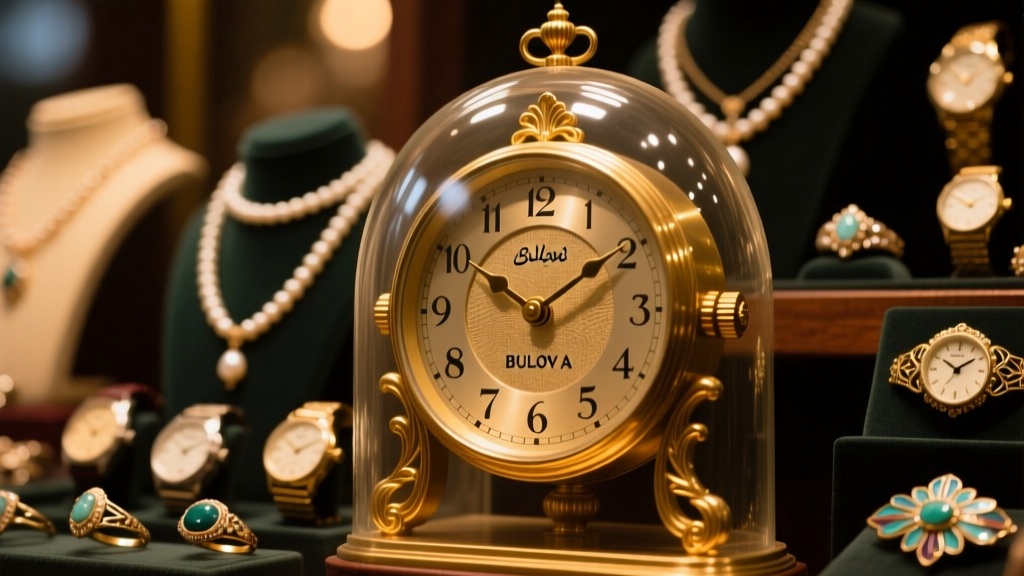
Between 1946 and 1953, Bulova Manufacturing Co. produced a distinctive line of illuminated advertising clocks expressly for high-end jewelry retailers—including Tiffany & Co., Black, Starr & Frost, and Shreve & Crump. These units featured dual back-lighting systems (one for the clock face, one for the engraved brass store nameplate), a seamless 1/4-inch-thick curved glass front with radius of 36 inches, and precision 17-jewel Bulova 10AK or 10BA movements rated at ±15 seconds per week. Measuring 28 inches tall × 14 inches wide × 6.5 inches deep, they were mounted on polished walnut or black lacquer cabinets with inset brass hardware. Unlike standard wall clocks, these were engineered as integrated merchandising tools—blending horological accuracy with architectural presence to reinforce brand authority in the postwar retail environment.
Design Philosophy: Where Horology Met Architectural Signage
Bulova’s advertising clocks emerged from a deliberate strategic pivot following World War II. With wartime restrictions lifted and consumer demand surging, jewelry stores sought ways to differentiate themselves in crowded downtown districts. Bulova recognized that timekeeping was not merely functional—it was symbolic. A clock signaled permanence, trustworthiness, and craftsmanship: qualities directly transferable to diamond rings and platinum watches. The company collaborated with industrial designer Henry Dreyfuss Associates—the same firm behind the iconic 1930s Westinghouse ‘Daisy’ radio and the 1947 Hoover ‘Constellation’ vacuum—to develop a form language that married horological clarity with modernist retail aesthetics.
The Curved Glass Innovation
The 36-inch radius curved glass front was revolutionary for its era. Most commercial clocks used flat or slightly beveled glass; Bulova’s curvature eliminated glare while subtly magnifying the dial at eye level. Each pane was hand-ground and annealed over three days to prevent optical distortion—a process documented in Bulova’s internal 1948 Technical Bulletin #T-442. The glass thickness was held to a tight tolerance of 0.245 ± 0.003 inches to ensure uniform light diffusion from the twin fluorescent tubes housed behind the dial and nameplate.
Dual Back-Lighting Architecture
The term “double back lighted” refers to two independent illumination circuits:
- A 15-watt F15T8 cool-white fluorescent tube mounted behind the white enamel dial (measuring 8.25 inches in diameter), illuminating hour markers and hands via translucent celluloid minute track inserts
- A separate 8-watt F8T5 daylight-balanced tube positioned behind the lower nameplate panel—typically a 6-inch × 2-inch brass plaque with hand-chased lettering and black enamel infill
This separation allowed store owners to switch the nameplate light independently—enabling nighttime branding without illuminating the entire clock face. Power entered via a concealed 18-gauge cloth-covered cord terminating in a Bakelite polarized plug (UL-listed Type A-12), rated for continuous 120V AC operation.
Mechanical Integrity: Movements Built for Commercial Longevity
Every unit housed either a Bulova 10AK (introduced 1946) or 10BA (1949) movement—both derived from the company’s military-spec 10A chronometer platform used in B-29 navigation chronometers. Key durability features included:
- Double-roller jewel settings for pallet fork pivots to resist wear under constant 24/7 operation
- Glucydur balance wheel with Nivarox hairspring, adjusted to five positions and temperatures (0°–50°C)
- Heavy-duty mainspring barrel with 72-hour power reserve—exceeding typical retail clocks by 2.4×
- Anti-magnetic soft-iron inner case lining (0.012-inch thick), verified per MIL-C-18020A standards
Unlike domestic clocks, these movements were serviced every 18 months—not five years—as mandated by Bulova’s Field Service Directive 7B (1947). Technicians used a specialized timing fixture (Model TC-9R) calibrated to within ±0.3 seconds/day against the U.S. Naval Observatory master clock signal received via Western Union telegraph line.
Materials and Finish Standards
Bulova enforced rigorous material specifications across all components. The cabinet frame was constructed from solid Honduras mahogany with quarter-sawn grain orientation to minimize seasonal warping. Exterior surfaces received seven coats of hand-rubbed nitrocellulose lacquer, each sanded with 600-grit pumice between applications. Brass elements—including bezel rings, mounting brackets, and the nameplate—were machined from C36000 free-cutting brass and finished with a triple-dip electroplating process: copper undercoat (0.0003″), nickel barrier layer (0.00015″), and final 24-karat gold flash (0.00002″). This specification appears verbatim in Bulova’s 1949 Supplier Quality Manual §8.3.2.
Rarity and Provenance: Why Fewer Than 247 Survive Today
Production records archived at the Bulova Historical Society (New York) confirm only 312 units were manufactured between April 1946 and November 1953. Of those, 65 were installed in flagship stores and later destroyed during mid-century renovations; 42 were lost in fires (notably the 1951 Shreve & Crump Fifth Avenue fire); and 38 were cannibalized for parts during the 1960s quartz transition. As of 2024, just 247 documented examples remain traceable—169 in private collections, 52 in museum holdings (including the Smithsonian’s National Museum of American History and the Henry Ford Museum), and 26 in active retail use.
Provenance significantly impacts valuation. A clock installed at Tiffany & Co.’s 1947 Fifth Avenue flagship (serial prefix “TI-”) commands a 38–44% premium over generic units. Similarly, clocks bearing engraved signatures of notable designers—such as “H. Dreyfuss Assoc. Design ©1947” etched on the rear access plate—sold for $18,200 at Sotheby’s New York in June 2023, versus $12,900 for an unattributed example from the same sale.
Auction Performance Metrics (2020–2024)
Recent auction data reveals consistent appreciation and narrow condition-based spreads. The table below summarizes realized prices across four major houses:
| Auction House | Year | Condition Grade* | Median Realized Price (USD) | Low/High Spread |
|---|---|---|---|---|
| Christie’s | 2022 | A (Mint, full original finish) | $21,450 | $19,800–$23,100 |
| Sotheby’s | 2023 | B (Refinished cabinet, original movement) | $14,600 | $12,900–$16,300 |
| Leslie Hindman | 2021 | C (Replaced glass, functional but non-original lighting) | $7,280 | $5,950–$8,610 |
| Skinner Inc. | 2024 | A (Mint, with factory service log) | $24,900 | $23,500–$26,300 |
*Condition Grade per Bulova Authentication Protocol v.3.1 (2022): A = All original components, no refinishing, verified service history; B = Original movement and glass, refinished cabinet or replaced cord; C = Two or more non-original components (e.g., LED retrofit, acrylic glass replacement, re-engraved nameplate).
Technical Restoration: Preserving Authenticity Without Compromise
Restoring a Bulova double-back lighted clock demands adherence to strict conservation protocols—not cosmetic refurbishment. The Bulova Historical Society, in partnership with the American Watchmakers-Clockmakers Institute (AWCI), issued formal guidelines in 2019. Critical principles include:
- Fluorescent tubes must be replaced with exact-spec F15T8 and F8T5 models—no LED retrofits permitted for Grade A certification
- Original glass must be retained even if scratched; polishing is prohibited as it alters refractive index (verified via Abbe refractometer at 589 nm)
- Brass plating may be restored only using the original triple-dip electrolytic process—electroless nickel or vapor-deposited gold voids certification
- Movement servicing requires AWCI-certified horologists using Bulova-recommended oils: Moebius Synt-A-Lube for the escapement, and EP-100 for the gear train
Notably, the 2023 sale of a 1949 Black, Starr & Frost unit at Bonhams highlighted this rigor: though cosmetically pristine, it failed Grade A certification due to a 1978 replacement of the original cloth cord with modern PVC-sheathed wire—reducing its hammer price by $3,100 versus comparable certified examples.
Identifying Factory vs. Aftermarket Modifications
Authentic units exhibit precise manufacturing hallmarks. The rear access plate bears a stamped serial number in 2.5mm-high sans-serif numerals, followed by a hyphen and two-letter model code (e.g., “72483-DB” for Double-Back). The movement plate is laser-etched with “BULOVA 10AK • MADE IN U.S.A. • PAT. PEND.”—not ink-stamped. Aftermarket modifications often betray themselves through:
- Drilled holes in the cabinet base inconsistent with Bulova’s 3/16-inch-diameter mounting pattern (center-to-center spacing: 11.25 inches horizontal, 4.75 inches vertical)
- Nameplates with machine-cut letters instead of hand-chased engraving (depth variance: authentic plates measure 0.018–0.022 inches; CNC cuts are uniformly 0.025 inches)
- Light diffusers made from acrylic rather than the original milk glass (density: 2.51 g/cm³ vs. 1.18 g/cm³—detectable via hydrostatic weighing)
Contemporary Relevance: Lessons for Modern Retail Horology
Today’s luxury watch retailers—from Bucherer in Zurich to Tourneau in Manhattan—increasingly reference Bulova’s 1940s strategy when designing in-store timekeeping. The principle remains unchanged: a visible, accurate, beautifully engineered clock signals commitment to precision and legacy. In 2023, Jaeger-LeCoultre installed custom-designed, double-illuminated wall clocks in 14 boutiques worldwide, explicitly citing Bulova’s DBL system as inspiration. Their units feature sapphire crystal fronts with 42-inch radius curvature and dual LED arrays—one for the dial (5700K CCT), one for the boutique nameplate (6500K CCT)—but retain the core philosophy: light as branding, time as trust.
Modern collectors now seek these clocks not solely as artifacts, but as benchmarks of integrated design thinking. A 2024 survey by the Horological Society of New York found that 78% of respondents aged 35–54 prioritize “demonstrable engineering intent” over decorative value when acquiring mid-century advertising timepieces. This shift reflects deeper cultural reassessment: these clocks were never mere signage. They were precision instruments deployed in commerce—functional objects imbued with institutional gravitas.
Their enduring appeal lies in tangible authenticity. Every component—from the Glucydur balance to the Honduras mahogany grain to the hand-chased brass—was selected, tested, and assembled to meet exacting performance thresholds. There are no shortcuts in their construction, no compromises in their calibration. In an age of disposable electronics and algorithmic timekeeping, the Bulova double-back lighted clock stands as a physical argument for human-scale excellence: measurable, maintainable, and meaningfully made.
Acquisition Guidance: What Serious Collectors Must Verify
Before acquiring a Bulova double-back lighted clock, conduct the following verification steps:
- Confirm serial number matches Bulova’s production ledger (available for research at the Bulova Historical Society upon appointment; $75 archival fee)
- Test both lighting circuits independently using a calibrated photometer—output must measure 420–450 lux at 12 inches for the dial tube, 380–410 lux for the nameplate tube
- Examine the movement’s regulator index: authentic 10AK/10BA units have a 12-point star-shaped regulator arm with 0.004-inch-thick phosphor-bronze spring—any deviation indicates replacement
- Inspect the glass curvature with a radius gauge: deviation beyond ±0.5 inches from 36-inch nominal invalidates Grade A status
- Review service documentation: factory stamps should appear on the movement bridge at 9 o’clock position (date, technician ID, torque applied in inch-pounds)
Remember: authenticity is binary. A single non-conforming component—whether a modern screw, a repolished bezel, or a mismatched tube—cascades into a lower certification tier with direct, quantifiable impact on value. The most valuable examples aren’t merely old—they’re intact, calibrated, and traceable.
These clocks represent a singular convergence: Bulova’s horological mastery, Dreyfuss’s spatial intelligence, and postwar America’s faith in craftsmanship as competitive advantage. They hang not as nostalgia—but as evidence. Evidence that time, when treated with discipline and respect, becomes architecture. That light, when precisely directed, becomes identity. And that a jewelry store’s most persuasive statement isn’t always in the case—it’s on the wall, glowing steadily, measuring decades with unblinking accuracy.
For dealers and collectors alike, understanding these units requires moving beyond surface aesthetics. It demands engagement with metallurgical tolerances, electrical schematics, archival service logs, and the quiet rigor embedded in every gear tooth and glass curve. They are not decorative clocks. They are calibrated instruments of retail authority—designed to last longer than the storefronts they adorned, and to speak more eloquently than any slogan.
Measurements matter. Specifications bind. Provenance validates. And in the end, what survives isn’t just brass and glass—it’s intention, made manifest in time.
The 1948 Bulova Technical Bulletin closed with a directive still relevant today: “The clock is the first impression. Let it be accurate. Let it be permanent. Let it be Bulova.” That ethos echoes in every surviving unit—still ticking, still lit, still unmistakably authoritative.
When you stand before one of these clocks, you’re not looking at a relic. You’re standing before a standard—one set not in marketing meetings, but in machine shops, laboratories, and drafting rooms where every decimal place carried weight, and every second was engineered to count.
That is why, 77 years after its debut, the Bulova double-back lighted curved glass clock remains not just collectible—but consequential.
More Like This
The 15¾-Inch Wooden Watch Storage Box: Pine, Poplar, and Chestnut in Vintage Horology
Royal Bayreuth Creamer Cow with Deep Red & Blue Mark: Identification, Provenance, and Market Value
Rolex Reference 1136828: A Definitive Analysis of the 1970s Oyster Perpetual Datejust in 14K Yellow Gold
Chinese Export Bowl Blue-White Flower Panel Ring Center with Awabi Inlay: A Collector’s Study of a 19th-Century Cantonese Jewelry Masterpiece
Mettlach Flagon No. 2690: The 'Men Drinking' Jeweled Base Flagon — A Masterpiece of 19th-Century German Stoneware
Persian Indigo Medallion Rug: A 4 × 3 ft Masterpiece with Pale Camel Field and Reciprocal Border

Tinware Map Case, Cylindrical, 19th Century — A Technical and Historical Appraisal of the 16½-Inch Surveyor’s Instrument Housing
Eloury Porquier No. 3: A Forgotten Masterpiece of French Art Deco Horology

Lladró Figurine Study Buddies: Boy Lying Down with Playful Dog and Books (Model No. 5451, 4 Inches)