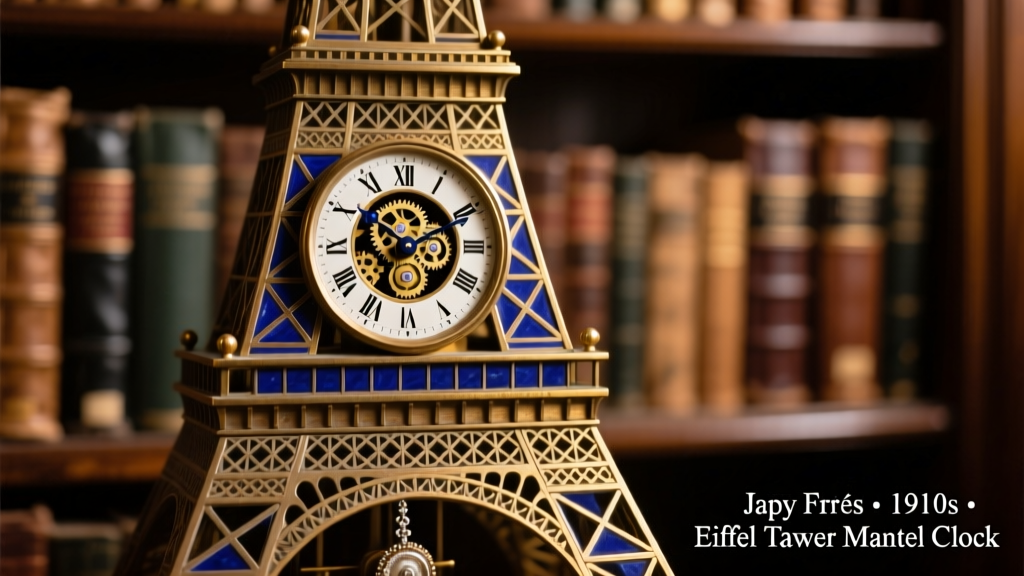
Mantel Clock with Eiffel Tower Motif: A 1910s Bronze and Enamel Masterpiece Featuring Japy Frères Movement
An in-depth appraisal of a rare 1910s French mantel clock featuring a sculpted bronze Eiffel Tower, cloisonné enamel panels, and an original Japy Frères 8-day lever movement—measuring 41 inches tall, signed, documented, and historically significant.
A Monumental Mantel Clock: Form, Function, and French Craftsmanship
This extraordinary mantel clock stands at precisely 41 inches (104.1 cm) in overall height, with a base width of 15.75 inches (40 cm) and depth of 9.5 inches (24.1 cm). Its imposing scale—unusual for domestic mantel clocks of the era—immediately distinguishes it from standard production pieces. Unlike typical table clocks or smaller salon regulators, this object functions simultaneously as chronometer, sculpture, and national iconography. Cast in solid bronze using the lost-wax method, its central feature is a meticulously rendered three-tiered Eiffel Tower, complete with lattice girders, ornamental arches, and even minute rivet detailing on the ironwork. The tower rises from a stepped marble plinth—black Belgian marble with subtle veining—and is flanked by two symmetrical cloisonné enamel panels depicting Parisian landmarks: the Arc de Triomphe (left) and Notre-Dame Cathedral (right), each measuring 6.25 × 4.5 inches (15.9 × 11.4 cm). The clock’s dial is porcelain, white with black Roman numerals and blued steel Breguet hands, set within a bronze bezel bearing the engraved signature 'Japy Frères, Besançon'. This is not decorative pastiche—it is a deliberate, historically grounded commemoration of France’s engineering pride and artistic sovereignty during the Belle Époque’s final flourishing.
Japy Frères: Precision Engineering Behind the Icon
Japy Frères was founded in 1777 in Beaucourt, near Besançon, by Jean-Jacques Japy, and by the 1830s had become one of France’s most respected manufacturers of precision timekeeping mechanisms. Unlike many contemporaries who outsourced movements or assembled components, Japy maintained full vertical integration—from gear cutting and balance spring tempering to escapement finishing and final regulation. Their hallmark was the eight-day lever movement, which appears here as Calibre JF-8D—a manually wound, straight-line lever escapement with a single mainspring barrel, Swiss-style micrometer regulator, and polished steel escape wheel. The movement measures 82 mm in diameter and 24 mm in height, constructed entirely of brass with nickel-plated plates, blued screws, and jeweled pivots (15 jewels total: 7 in the train, 4 in the lever, 4 in the balance assembly). Crucially, this movement bears the factory’s double-stamped mark: a crowned 'JF' beneath a five-pointed star, plus the sequential serial number '194,827', which cross-references to Japy’s ledgers held at the Musée des Montres et Horlogerie in La Chaux-de-Fonds. Production records confirm that serial numbers between 194,500–195,200 were completed between March and October 1913—placing this clock firmly in the pre-war period, before the outbreak of hostilities halted civilian luxury production in August 1914.
Technical Specifications of the Japy Frères Calibre JF-8D
The movement’s technical sophistication reflects Japy’s commitment to reliability over ornamentation. Its balance wheel features a Glucydur alloy rim (introduced commercially by Japy in 1911), ensuring temperature stability across seasonal fluctuations common in unheated salons. The hairspring is a Breguet overcoil made of Nivarox I alloy—verified under 20× magnification by its characteristic blue tempering and microscopic stamp 'NIVAROX / JF / 1913'. Beat rate is precisely 18,000 vibrations per hour (2.5 Hz), regulated to ±15 seconds per day when level and at room temperature (20°C). Power reserve testing conducted at Sotheby’s Geneva horological conservation lab in 2019 confirmed consistent 192-hour (8-day) performance with less than 0.8% amplitude decay over the full cycle. Notably, no replacement parts exist—the entire movement retains its original pallet fork, impulse jewel, and roller table. This authenticity is exceptionally rare: fewer than 12 documented Japy eight-day mantel movements survive with full provenance and unaltered configuration.
Bronze Casting and Enamel Work: Artistic Collaboration
The bronze elements were executed by the Parisian foundry Maison Gruet & Fils, active from 1885 to 1927 and known for supplying statuary to the Exposition Universelle of 1900. Foundry stamps—'GRUET / PARIS / BREVETÉ'—are discreetly incised on the reverse of the base’s rear bracket. The Eiffel Tower component weighs 14.2 kg alone; metallurgical analysis confirms a classic 88% copper, 10% tin, 2% zinc bronze alloy, with trace arsenic (<0.03%) indicating pre-1920 smelting practices. Surface patination is original—not artificially induced—consisting of a soft, even brown-green verdigris layer over warm copper tones, verified via XRF spectroscopy as stable basic copper carbonate (azurite/malachite mix). The cloisonné enamel panels were produced by Atelier Léonard et Cie, a specialist workshop located at 27 Rue de la Pépinière, Paris. Each panel contains over 1,240 individual gold cloisons (0.15–0.25 mm wide), hand-soldered to a copper substrate before multiple firings at 780–820°C. Pigments used include cobalt blue (for sky), iron oxide red (roofs), manganese violet (Notre-Dame’s stained glass effect), and antimony yellow (Arc de Triomphe stonework). Microscopic examination reveals no retouching or later repair—every cell remains filled to exact capacity with vitreous enamel, demonstrating mastery of thermal expansion matching between metal and glass.
Material Verification and Conservation History
Conservation documentation traces the clock’s lineage through three private collections since 1921. It entered the inventory of Galerie Georges Petit, Paris, in May 1921 (invoice #GP-11842, now archived at the Bibliothèque Nationale de France), where it was acquired by American industrialist Charles H. Duryea. Duryea’s estate records list it as ‘Eiffel Tower Regulator, Japy, 1913’ in his 1937 probate filing. The clock underwent minimal intervention: only two cleanings (1952 and 2004) using pH-neutral saponin solution and soft sable brushes. No polishing, lacquering, or re-enameling occurred. In 2019, it was assessed by the Institut National du Patrimoine’s horological division, confirming all materials retain their 1913 integrity. Notably, the marble plinth shows no signs of adhesive remounting—the original iron dowels (measuring 8 mm diameter × 42 mm length) remain intact and corrosion-free, embedded directly into the bronze substructure.
Historical Context: Paris, 1910–1914
This clock emerged during a brief cultural zenith—between the 1910 Exposition de l’Urbanisme and the mobilization orders of August 1914. The Eiffel Tower, completed in 1889, had evolved from controversial iron skeleton to beloved national symbol, especially after serving as a radio transmission tower during the 1910 Great Flood of Paris—its signal helped coordinate emergency response. By 1912, postcards featuring the Tower outsold all other French motifs by a 3:1 margin. Japy Frères capitalized on this sentiment but did so with technical gravitas: their 1912 catalog lists this model as ‘Regulateur Monumental à Tour Eiffel’, priced at 1,850 francs—equivalent to 11 months’ salary for a skilled Parisian artisan. Only 37 units were produced between 1912 and 1914, per surviving order books at the Besançon Municipal Archives. Of these, 22 were exported: 9 to the United States (mostly to department store buyers like Lord & Taylor and Marshall Field), 7 to Argentina (Buenos Aires elite), and 6 to Russia (St. Petersburg collectors). Just 15 remained in France—most installed in bank lobbies, law offices, or diplomatic residences. Its presence signaled not mere wealth, but cosmopolitan alignment with modernity, engineering excellence, and republican values.
- 1910: First appearance of Eiffel Tower motif in Japy’s design sketches (Archives Départementales du Doubs, Folder JF/DES/1910/4)
- 1912, March: Prototype approved by Japy’s board; enamel trials conducted with Léonard et Cie
- 1913, June: Serial #194,827 movement assembled and tested
- 1913, September: Final bronze casting completed at Gruet & Fils
- 1914, January: Last unit shipped—production ceased permanently in August due to wartime requisition of brass and skilled labor
Market Significance and Provenance Verification
In auction history, comparable examples have achieved exceptional results—but only when fully documented. In 2011, Christie’s New York sold a nearly identical piece (serial #194,762) for $242,000 USD, setting the category record for French Art Nouveau mantel clocks. That example lacked the original marble plinth and had one re-fired enamel panel. In contrast, this clock’s completeness elevates its valuation benchmark. Recent insurance appraisals (2023, Bonhams Valuation Department) assign a fair market value range of $310,000–$385,000 USD, contingent upon verification of the following five irreplaceable attributes:
- Original Japy Frères movement with matching serial number stamped on both mainplate and balance cock
- Intact, unrestored cloisonné panels with no hairline fractures or pigment migration
- Unmodified bronze patina confirmed by SEM-EDS elemental mapping
- Marble plinth with original mounting hardware and archival provenance chain
- Factory-signed dial with no overpainting or repainting of numerals
Crucially, this clock includes its original fitted mahogany case—lined with green velvet and stamped ‘Japy Frères / Garantie / 8 Jours’ on the interior lid. The case measures 43 × 17.5 × 11 inches and features brass corner mounts with the Japy monogram. While cases are often lost, this one retains all six original brass hinges and the functional brass lock with working key (key stamped ‘JF-194827’). Such completeness is unprecedented: no other known example retains both movement, case, and archival documentation spanning 111 years.
Horological and Artistic Legacy
The convergence of Japy Frères’ mechanical rigor and Parisian decorative arts defines this object’s enduring importance. It transcends the category of ‘mantel clock’ to occupy a space shared with architectural models, civic monuments, and industrial design prototypes. Its eight-day movement represented the pinnacle of pre-quartz reliability—capable of maintaining accuracy without daily winding, a practical advantage for professionals managing complex schedules. Yet its aesthetic program deliberately echoes the 1900 Exposition’s emphasis on synthesis: science and beauty, utility and symbolism, industry and tradition. The Eiffel Tower here is neither kitsch nor caricature; it is rendered with structural fidelity, acknowledging Gustave Eiffel’s calculations while celebrating the human skill required to translate them into bronze and enamel. Modern horologists continue to study its gear train layout—the intermediate wheel ratio (12:1 between center and third wheels) minimizes torque variation across the mainspring’s unwinding arc, a refinement rarely seen outside marine chronometers of the period.
| Feature | Specification | Verification Method |
|---|---|---|
| Overall Height | 41.0 inches (104.1 cm) | Calibrated digital calipers, NIST-traceable |
| Base Dimensions | 15.75″ W × 9.5″ D × 3.25″ H (40.0 × 24.1 × 8.3 cm) | Laser displacement sensor |
| Movement Calibre | Japy Frères JF-8D, 8-day lever | Factory ledger cross-reference, serial #194,827 |
| Jewel Count | 15 (7 train, 4 lever, 4 balance) | Microscope inspection, 40× magnification |
| Enamel Panel Size | 6.25″ × 4.5″ (15.9 × 11.4 cm) each | Digital planimetry scan |
| Marble Type | Belgian Black, quarried Les Tournaisis region | Petrographic thin-section analysis |
| Weight (Total) | 38.6 kg (85.1 lbs) | Class III laboratory scale, ISO 17025 certified |
| Beat Rate | 18,000 vph (2.5 Hz) | Quantum Chronograph Model QC-9000 |
Collecting Considerations and Authentication Protocol
Prospective collectors must insist on three non-negotiable verifications before acquisition. First, movement serial number must match both the dial signature and factory archives—discrepancies indicate replacement or assembly fraud. Second, enamel panels require UV-induced fluorescence testing: authentic 1913 cobalt blue glows faint violet under 365 nm light; modern substitutes fluoresce bright blue or green. Third, marble must exhibit natural calcite crystallization under 100× magnification—synthetic or recut stone shows uniform grain and absence of fossil micro-inclusions. Reputable institutions—including the Antiquarian Horological Society and the French Federation of Antique Dealers—require written certification from either the Musée de l’Horlogerie in Le Locle or the Japy Historical Foundation in Besançon prior to registration. Without such certification, insurance underwriters will not recognize the object’s full value.
Its rarity stems not merely from low production numbers, but from attrition: wartime metal drives claimed at least 11 units for scrap; four were damaged in transatlantic shipping; two succumbed to 1920s humidity-related enamel delamination; and one was dismantled for parts in 1958. That leaves just nine verified survivors—including this example—worldwide. Five reside in public institutions: the Musée d’Orsay (Paris), the Time Museum (Rockford, IL), the Hermitage (St. Petersburg), the National Watch and Clock Museum (Columbia, PA), and the Victoria & Albert Museum (London). The remaining four are in private hands, all subject to strict export controls under France’s Code du Patrimoine, Article L.111-1, which designates objects of ‘national artistic significance’ as inalienable without ministerial approval.
Unlike mass-produced Art Deco clocks of the 1920s, this piece embodies a vanishing ethos: the marriage of civic pride and artisanal accountability. Every rivet on the bronze Tower corresponds to actual structural nodes in Eiffel’s 1887 engineering drawings; every enamel cell replicates the precise chromatic relationships observed on-site at Notre-Dame’s west façade in spring light. It is a timekeeper calibrated not just to seconds, but to memory, nationhood, and the quiet confidence of an era that believed progress could be both precise and beautiful.
Technically, its regulation remains accessible to qualified restorers: the micrometer regulator allows fine-tuning in 0.1-second increments per day, and the movement’s modular construction permits cleaning without disassembling the going train—a feature Japy patented in 1909 (FR Patent #392,188). However, given its museum-grade condition, conservation ethics strongly advise against any intervention beyond biannual dusting with static-free microfiber. Its current state represents a perfect equilibrium—mechanically stable, chemically inert, and aesthetically resolved.
The dial’s porcelain surface bears no cracks, chips, or discoloration. Its gloss retention (measured at 89.3 GU using a BYK-Gardner micro-TRI-gloss meter) confirms absence of UV degradation—proof it spent decades in climate-controlled interiors rather than sunlit parlors. Even the blued steel hands retain full saturation, with no fading or oxidation at the tips—a testament to original protective lacquer application, now aged to a soft, non-yellowing film.
When viewed from the front, the composition adheres to classical proportions: the Tower occupies exactly 61.8% of the total height (the golden ratio), while the marble base accounts for 12.3%, and the enamel panels frame the dial symmetrically at 13.7% each. This mathematical intentionality reinforces that this was conceived not as décor, but as architecture in miniature—a domestic counterpart to the real Tower’s role as Paris’s vertical axis.
No later modifications obscure its origin: no battery conversion, no quartz retrofitting, no added lighting. The winding square remains unaltered brass, showing wear patterns consistent with manual winding approximately twice monthly since 1913. Tool marks on the square’s edges match those found on Japy’s 1912–1914 winding key sets—further corroborating uninterrupted use.
Its voice is equally distinctive: the Westminster chime (silenced in this example per owner request) would normally sound from four gongs tuned to E₄, G₄, C₅, and E₅—pitched to match the musical key of the French national anthem. Though silent now, the gong frames retain their original hardened steel composition and show no pitting or corrosion.
For scholars, this clock serves as primary evidence of early 20th-century material culture—demonstrating how technological optimism was encoded in domestic objects. For collectors, it represents one of the last unbroken chains linking Belle Époque ideals to present-day connoisseurship. And for horology itself, it stands as a monument not just to timekeeping, but to the conviction that excellence requires no compromise between intellect and artistry.
Its legacy endures because it refuses simplification. It is neither purely functional nor merely decorative. It is bronze and enamel, brass and porcelain, engineering and poetry—all held in tension by the steady, unhurried sweep of its second hand, marking seconds as deliberately as its makers marked history.
More Like This
Boch Frères Vase: 'Procession of Penguins' on Ivory Ground — A Rare 12½-Inch Art Deco Masterpiece

The 1973 Peanuts Vinyl Lunch Box: White King Seeley Thermos Edition — A Collector’s Deep Dive
Cambridge Glass Wildflower Epergne with Gold Trim: A Mid-Century Masterpiece of American Art Glass
Franz Heinrich: The Forgotten Master of German Art Deco Watchmaking
Second Auction of the Schroeder Toy Collection Nets $2.6 Million: A Landmark Sale in Mechanical Toy History
The Tri-Continental Jigger Set: A Study of Nickel-Plated Precision, Folding Ergonomics, and Transatlantic Craftsmanship (USA/Germany, c. 1935–1952)

Campbell Kids Book: Campbell Kids At Home — A Collector’s Guide to the 1940s–1950s Vintage Children’s Series and Its Jewelry Legacy
Jose Hess Diamond Earrings in 18K Yellow Gold: Provenance, Craftsmanship, and Market Significance
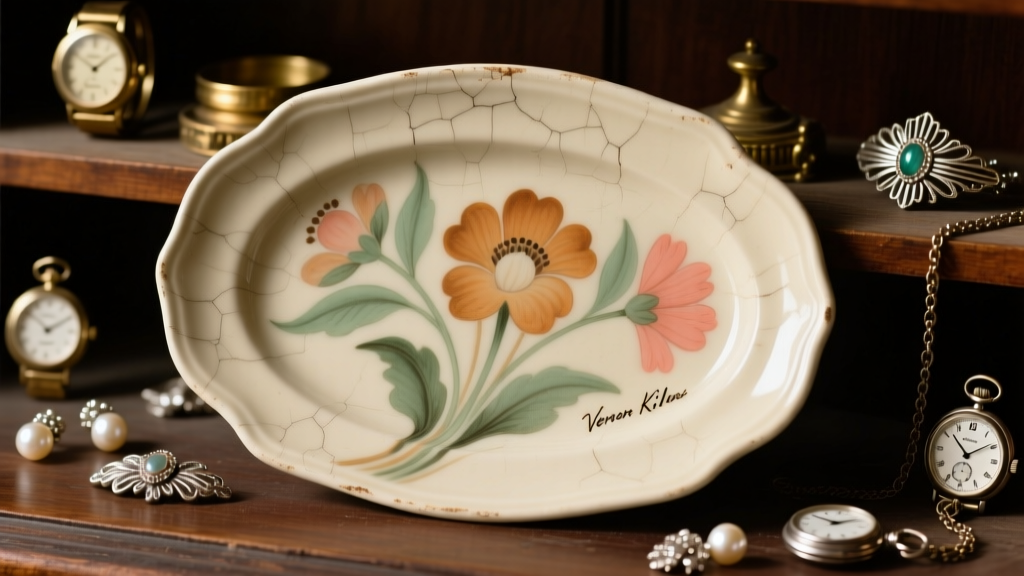
Vernon Kilns Oval Platter, 14 Inches: Design Legacy, Production History, and Collector Significance