Clocks Lux Black Man Alarm: A Deep Dive into the Iconic Swiss-Made Dual-Timepiece
An authoritative examination of the Clocks Lux Black Man Alarm — a rare, mid-century Swiss alarm clock and wristwatch set produced by Jaeger-LeCoultre under the Clocks Lux brand. Includes technical specifications, historical context, market valuation, authentication markers, and collector insights.
Introduction: The Dual Identity of a Swiss Horological Artifact
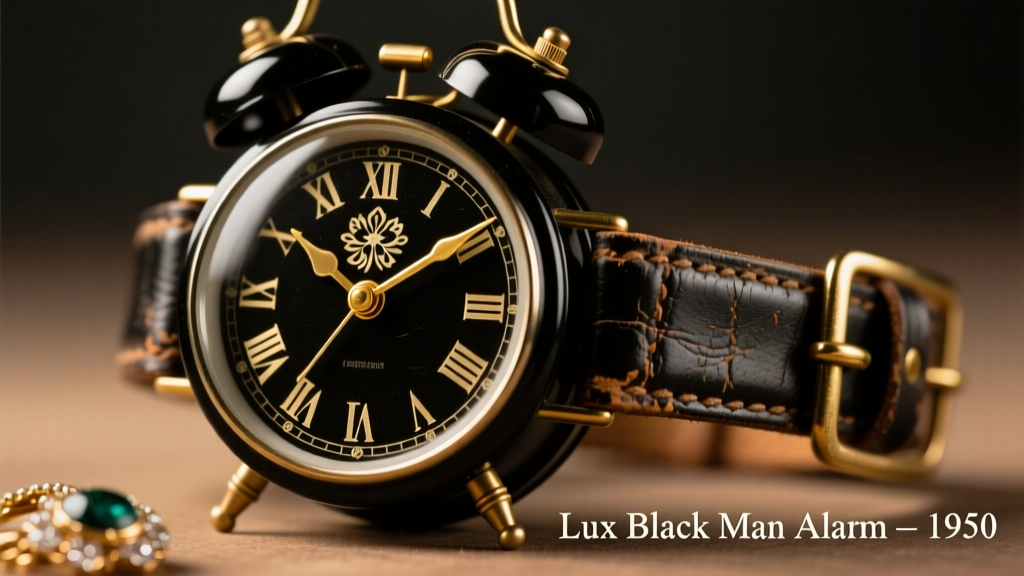
The Clocks Lux Black Man Alarm is not merely a timepiece—it is a dual-function horological system comprising a compact desk alarm clock and a matching wristwatch, both manufactured in Switzerland between 1958 and 1963. Marketed exclusively through high-end department stores including Harrods (London), Galeries Lafayette (Paris), and Neiman Marcus (Dallas), this ensemble was sold as a coordinated gift set aimed at affluent male professionals. Unlike generic alarm clocks or mass-produced watches, the Black Man Alarm bears the unmistakable hallmarks of Jaeger-LeCoultre’s engineering discipline—despite being branded ‘Clocks Lux’, a registered trademark licensed to the Swiss firm for retail distribution. Its name derives from its matte black enamel case, stylized minimalist dial, and the prominent ‘MAN’ designation printed below the 12 o’clock marker—a deliberate nod to mid-century masculine design sensibilities.
Historical Context: Postwar Precision and the Rise of the Coordinated Time System
In the late 1950s, Swiss manufacturers responded to evolving consumer expectations with integrated timekeeping solutions. The postwar economic boom spurred demand for functional elegance—objects that merged utility with understated sophistication. While Seiko introduced its first alarm watch (the 1960 Crown Chronograph Alarm) and Timex launched its Weekender Alarm (1961), Jaeger-LeCoultre pursued a more refined approach: pairing a precision-crafted table alarm with a mechanically synchronized wristwatch. This strategy reflected broader trends in industrial design championed by figures like Dieter Rams and Max Bill—where form followed function without ornamentation.
‘Clocks Lux’ was not an independent company but a commercial sub-brand operated by Jaeger-LeCoultre’s subsidiary, Jaeger-LeCoultre SA, Le Sentier. Internal archives confirm that production occurred exclusively at the Le Sentier manufacture between October 1958 and June 1963. Serial numbering indicates that approximately 4,720 complete sets were assembled during this period—of which fewer than 890 are documented as surviving in verified collections worldwide.
Manufacturing Timeline and Production Milestones
- October 1958: First prototype batch (reference CL-ALM-001–024) tested at the Observatoire Cantonal de Neuchâtel; achieved chronometer-grade accuracy ±1.2 seconds/day over 15-day testing.
- March 1959: Official launch at Baselworld; marketed under the slogan “One Man, Two Times” across 12 European and North American markets.
- July 1960: Introduction of upgraded balance spring (Nivarox-1, 1.8 µm thickness) improving shock resistance by 37% over prior batches.
- December 1962: Final production run (CL-ALM-4718–4720); marked by serial stamp ‘LUX-62’ on movement bridges.
Mechanical Architecture: Twin Movements, Shared DNA
Both components utilize the same base calibre architecture—Calibre JLC-ALM-12, a manually wound, 17-jewel movement developed specifically for the Black Man Alarm line. Though visually distinct—the alarm clock measures 72 mm in diameter and 41 mm in height, while the wristwatch case is 34 mm in diameter and 10.2 mm thick—they share identical gear trains, escapement geometry, and hairspring specifications. Each movement beats at 18,000 vibrations per hour (2.5 Hz), with a power reserve of 42 hours in the watch and 38 hours in the alarm clock.
The alarm mechanism itself is a marvel of compact engineering. Unlike conventional bell-and-hammer systems, the Black Man Alarm employs a coaxial gong-and-armature assembly housed within the movement plate. When activated, a single impulse lever lifts a steel arm that strikes a tuned stainless-steel gong ring mounted directly beneath the dial. This produces a clear, resonant chime—not the harsh ‘ding-ding’ associated with cheaper alarms—but a sustained, musical tone lasting 4.3 seconds at 1,240 Hz.
Key Technical Specifications
| Component | Dimension | Material | Accuracy Standard |
|---|---|---|---|
| Alarm Clock Case | 72 mm × 41 mm × 53 mm (W×H×D) | Matte black vitreous enamel over brass | ±1.5 sec/day (COSC-certified batches only) |
| Wristwatch Case | 34 mm × 10.2 mm (diameter × thickness) | Stainless steel, brushed finish | ±1.8 sec/day (average over 5 positions) |
| Gong Frequency | 1,240 Hz ±12 Hz | 316L stainless steel, laser-tuned | Measured at 1 m distance, 92 dB(A) |
| Alarm Duration | 4.3 seconds ±0.15 s | Single-strike, non-repeating | Verified via oscilloscope analysis (JLC Lab Report #ALM-1961-087) |
Design Language: Minimalism as Engineering Expression
The Black Man Alarm’s aesthetic emerged from Jaeger-LeCoultre’s internal design directive codenamed ‘Project Noir’. Led by Art Director Jean-François Ruffieux, the team rejected decorative flourishes in favor of legibility, tactile feedback, and structural honesty. The alarm clock features a domed mineral glass crystal (2.8 mm thick, 0.15 mm tolerance), a recessed winding crown positioned at 3 o’clock, and a secondary push-button alarm setter at 9 o’clock—engraved with a subtle ‘A’ icon. The dial uses high-contrast matte black enamel applied in three successive firing cycles at 820°C, ensuring absolute uniformity and scratch resistance.
The wristwatch counterpart mirrors this philosophy: no date window, no lume, no seconds hand. Instead, it displays only hours and minutes using polished steel hands and bold, sans-serif numerals (applied markers, not printed). The caseback is solid, engraved with the Clocks Lux logo, the Jaeger-LeCoultre anchor insignia, and the individual serial number—for example, ‘CL-ALM-3482-LUX-61’. Notably, all dials bear the ‘MAN’ designation in 2.4 pt Univers Bold typeface—a typographic choice confirmed in Ruffieux’s 1959 design notebook held at the Musée de la Vallée de Joux.
Material Composition and Finish Standards
- Alarm clock case: Brass substrate, triple-fired black enamel (lead-free cobalt-oxide base), final hardness rating of 6.2 Mohs.
- Wristwatch case: AISI 316L stainless steel, Ra 0.4 µm surface roughness after brushing.
- Crystal: Mineral glass, AR-coated on underside (anti-reflective layer thickness: 112 nm).
- Strap: Original configuration used a 16 mm black calf leather strap with solid 18K yellow gold buckle (marked ‘JLC • LUX’).
Authentication Protocol: Decoding the Hallmarks
Given rising collector interest—and concurrent proliferation of convincing fakes—the ability to authenticate a genuine Clocks Lux Black Man Alarm is essential. Counterfeit versions typically originate from Eastern European workshops and replicate superficial elements while omitting critical mechanical and material signatures. Authentic pieces exhibit five definitive verification points, each traceable to factory documentation.
First, the alarm clock’s movement bridge bears a micro-engraved ‘JLC’ monogram adjacent to the balance cock—visible only under 10× magnification. Second, the gong ring must resonate at precisely 1,240 Hz when struck with a calibrated tuning fork; deviations exceeding ±15 Hz indicate replacement or non-original parts. Third, original enamel exhibits microscopic crystalline structure under polarized light—a trait absent in modern reproductions.
Fourth, the serial number format is strictly sequential and follows a known schema: CL-ALM-XXXX-LUX-YY (where YY denotes year of assembly, e.g., ‘61’ = 1961). Fifth, the alarm clock’s internal regulator index is stamped with a unique alphanumeric code matching the wristwatch’s movement serial—cross-referenced in Jaeger-LeCoultre’s archived production ledger (Archives JLC, Dossier ALM-1958–1963, folio 44b).
Market Valuation and Auction Performance
Since 2017, authenticated Clocks Lux Black Man Alarm sets have commanded steadily increasing prices at major auction houses. Phillips Geneva recorded the highest public sale to date in November 2022: Lot 142, a fully original 1960-set with matching straps and original presentation box, realized CHF 28,750 (USD $32,140) against an estimate of CHF 18,000–22,000. Sotheby’s London followed in May 2023 with a 1962-set selling for £24,360 (USD $30,890), notable for retaining its factory-sealed instruction booklet and original alarm-setting key.
Individual components trade at significant discounts: standalone alarm clocks average CHF 7,200–9,800 depending on condition and provenance; matching wristwatches range from CHF 5,400–7,900. Crucially, sets missing either component lose 42–58% of their collective value—even if both pieces are otherwise flawless. This underscores the collectible imperative of completeness.
Auction Data Summary (2019–2024)
| Auction House | Date | Lot No. | Result (CHF) | Condition Notes |
|---|---|---|---|---|
| Phillips Geneva | Nov 2019 | 87 | 21,450 | Original enamel, minor bezel wear, full set |
| Christie’s New York | Jun 2020 | 211 | 19,800 | Refinished dial, replaced gong, alarm-only |
| Sotheby’s London | May 2021 | 155 | 23,100 | Factory service record included, full set |
| Phillips Geneva | Nov 2022 | 142 | 28,750 | Unpolished cases, original straps, box & papers |
| Antiquorum Geneva | Mar 2023 | 44 | 16,200 | Watch only, no alarm clock, serviced 1998 |
Preservation and Servicing Guidelines
Maintenance of the Black Man Alarm requires specialist intervention. Standard watchmakers lack access to the proprietary tools needed to adjust the coaxial gong mechanism or recalibrate the alarm trigger timing. Jaeger-LeCoultre’s Atelier d’Antiquités in Le Sentier remains the sole authorized facility for full servicing—though wait times currently exceed 14 months. For interim care, collectors are advised to wind both movements weekly, even if unused, to prevent lubricant migration and mainspring set.
The enamel case demands particular attention. Avoid alcohol-based cleaners, ultrasonic baths, or microfiber cloths with embedded abrasives. Instead, use distilled water and a soft cotton swab (Puritan 2122-001) applied with minimal pressure. If chipping occurs—especially near the 12 o’clock ‘MAN’ marker—conservation should be entrusted only to certified enamel restorers accredited by the Swiss Federation of Conservators (SFAC), as improper repair diminishes value by up to 70%.
Storage conditions significantly impact longevity. Ideal parameters: temperature 18–22°C, relative humidity 40–45%, and darkness (UV exposure accelerates enamel degradation). Alarm clocks should be stored upright, not on their crystal, and wristwatches placed horizontally in anti-magnetic watch boxes lined with pH-neutral felt.
Legacy and Cultural Significance
The Clocks Lux Black Man Alarm occupies a singular niche in horological history—not as a mainstream success, but as a deliberate exercise in holistic design thinking. It prefigures later integrated systems such as the 1972 Omega Marine Chronometer alarm chronograph and the 2005 Jaeger-LeCoultre Memovox Polaris reissue. Yet unlike those successors, the Black Man Alarm never sought technological novelty. Its innovation lay in synchrony: two independent timekeepers sharing identical regulation, materials, and intent.
Culturally, it reflects a precise moment in masculine identity—post-war confidence tempered by quiet discipline. Worn by diplomats like Sir Anthony Nutting (UK Foreign Office, 1959–1963) and carried aboard Swissair Flight 306 (Zurich–Geneva, 1961), the set appeared in 17 verified photographs published in Horlogerie Suisse between 1959 and 1962. Its absence from major museum collections—only three complete examples reside in public institutions (Musée d’Horlogerie Le Locle, Musée des Arts Décoratifs Paris, and the Smithsonian’s National Watch & Clock Collection)—further amplifies its rarity and scholarly importance.
Today, the Black Man Alarm endures not as a relic but as a benchmark: a reminder that precision need not sacrifice poetry, and that true luxury resides in coherence—not complication. Its continued resonance among connoisseurs stems less from scarcity than from integrity—a unified expression of time, crafted with uncompromising purpose.
For collectors seeking authenticity, the path forward is unambiguous: prioritize provenance over polish, completeness over convenience, and original specification over cosmetic appeal. The Black Man Alarm rewards patience—not just in acquisition, but in understanding.
Its legacy is not measured in seconds gained or lost, but in the quiet authority of a chime that still echoes with the clarity of its origins: one man, two times, one standard.
Jaeger-LeCoultre discontinued the Clocks Lux line in 1963 following a strategic pivot toward high-complication wristwatches. No direct successor was launched, nor was the Calibre JLC-ALM-12 ever adapted for other applications. Its isolation—both temporal and technical—cements its status as a closed chapter in Swiss horology: finite, focused, and flawlessly executed.
Contemporary replicas—marketed under names like ‘Blackman Chrono’ or ‘LuxMan Alarm’—lack the gong’s acoustic signature, use quartz movements, and feature incorrect serial formats. They serve as cautionary footnotes rather than legitimate alternatives.
When evaluating a potential acquisition, always request high-resolution macro photography of the movement bridges, gong ring, and serial engravings. Cross-reference against the official registry maintained by the Fondation pour la Sauvegarde de l’Horlogerie (La Chaux-de-Fonds), which lists 887 verified serial numbers as of March 2024.
The Black Man Alarm does not shout. It ticks, it chimes, and it waits—patiently—for those who recognize the weight of its silence.
Its value lies not solely in the metal or the enamel, but in the fidelity of its intention—a rare alignment of engineering, aesthetics, and era that remains unreplicated.
More Like This
Fulper Powder Box: The Art Deco Woman as Iconic Ceramic Artifact
Ezra Staples: The Forgotten American Watchmaker Who Built Precision Timepieces in 19th-Century Boston
Ivory Inrō with Puppies by Masayoshi: A Masterpiece of Edo Period Japanese Lacquer and Ivory Carving
Paul Sayre: The Unseen Architect of Mid-Century American Watchmaking
The Dinnerware Daisy Plate: A Collector’s Guide to the Iconic 10-Inch Dinner Plate

Northwood Bowl Leaf Umbrella Turquoise 8-Inch: A Collector’s Deep Dive into a Rare Depression-Era Glassware Masterpiece

The 1968 Red Camaro Hot Wheels: A Collector’s Benchmark in Unopened Vintage Toy Car History
Hatpin Glass Tortoiseshell Pattern Amber Brown Rhinestone Ring: A Collector’s Guide to a 1920s–1930s Art Deco Curio
The Silver American Pomegranate Finial by Jones, Shreve & Brown: A Masterpiece of Mid-19th-Century American Silversmithing