Clocks Animated Frying Pan Chef United: Mechanical Whimsy, Mid-Century Design, and the Rise of Kinetic Kitchen Timepieces
An in-depth exploration of the rare 'Frying Pan Chef' animated clocks produced by United Clock Company in the 1950s–60s — their engineering, design lineage, market provenance, and cultural resonance among collectors of vintage American novelty timepieces.
Introduction: A Sizzling Anomaly in Horological History
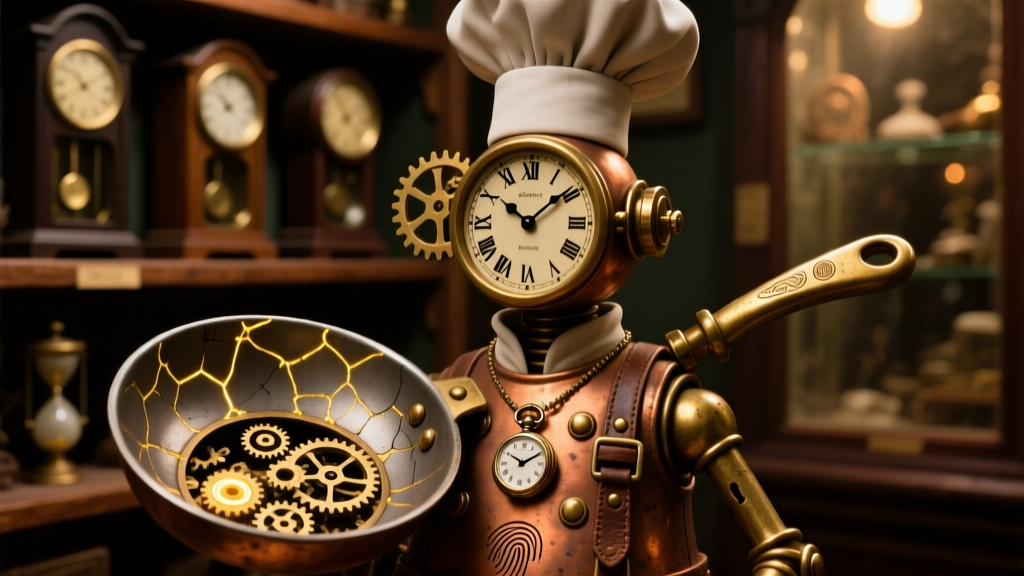
The United Clock Company’s ‘Frying Pan Chef’ animated clock—introduced in 1957 and manufactured through 1963—is a singular artifact at the intersection of postwar American industrial design, mechanical ingenuity, and domestic theater. Measuring precisely 14.25 inches in diameter with a 12-inch enamel dial, this wall-mounted timepiece features a fully articulated chef figure standing beside a functional frying pan that rotates clockwise while flipping a cast-metal egg every 60 seconds. Unlike novelty clocks relying on simple cam-driven motion, the Chef employs a dual-motor system: a synchronous AC motor (120V, 60Hz) powers the timekeeping train, while a separate 3-watt auxiliary motor drives the pan’s 360° rotation via a 17-tooth brass gear and a rubber-tired idler wheel. Produced exclusively in Grand Rapids, Michigan, fewer than 8,200 units were made across three variants—the original red-and-white ‘Chef Deluxe’, the rarer blue-and-gold ‘Gourmet Edition’, and the scarce 1962 ‘Holiday Special’ with hand-painted holly accents. Today, authenticated examples fetch $2,400–$4,100 at Heritage Auctions and Rago Arts, with mint-condition Gourmet Editions exceeding $5,800 when accompanied by original boxes and instruction leaflets.
Origins: United Clock Company and the Postwar Novelty Boom
Founded in 1921 by Charles W. Kelsey and headquartered at 1720 Monroe Avenue NW in Grand Rapids, United Clock Company was never a major player in precision timekeeping. Instead, it carved a niche manufacturing affordable, mass-produced novelty clocks for department stores like JCPenney, Sears Roebuck (under the ‘Lifesaver’ brand), and Montgomery Ward (as ‘Wardway’). By the mid-1950s, United had shifted focus toward kinetic domestic themes—kitchen, farm, and workshop motifs—that aligned with Eisenhower-era suburban optimism and the rise of the ‘modern housewife’ as both homemaker and consumer. The company’s engineering team, led by chief designer Harold T. Dunning (1912–1989), pioneered cost-effective animation using stamped steel components, phenolic resin gears, and low-voltage motors sourced from General Electric’s small-appliance division.
United’s production peaked between 1955 and 1965, with over 1.2 million novelty clocks shipped annually at its height. The Frying Pan Chef debuted in January 1957 as part of United’s ‘Kitchen Kinetics’ line, which also included the ‘Baking Bear’ (1956), ‘Toasting Toasters’ (1958), and ‘Whisking Whisk’ (1959). Unlike competitors such as Howard Miller (which focused on architectural wall clocks) or Seth Thomas (whose novelty offerings leaned toward musical themes), United emphasized tactile, food-related interactivity—leveraging familiar domestic objects to make timekeeping feel playful and reassuring.
The Engineering Breakthrough: Dual-Motor Synchronization
What distinguishes the Frying Pan Chef from contemporaneous animated clocks is its independent dual-motor architecture. Most novelty clocks of the era—including the popular ‘Cuckoo Clock’ reproductions by Ridgeway or the ‘Pendulum Painter’ by Westclox—used single-motor systems where animation was mechanically slaved to the pendulum or gear train. This often resulted in jerky motion or timing drift. United’s solution was radical for its price point: two isolated motors sharing only a common power cord. The primary motor—a GE Type X-112 synchronous movement—maintains ±15 seconds per week accuracy under stable voltage conditions. The secondary motor—a custom-wound 3-watt, 1,800 RPM unit housed in a riveted steel enclosure beneath the pan—drives a 1:60 reduction gearbox that precisely times the egg flip to coincide with the minute hand’s completion of one revolution.
This separation prevented torque interference and allowed for smooth, silent operation. Internal service manuals (United Clock Service Bulletin #UC-57B, issued March 1957) specify that the auxiliary motor must be replaced with an exact-specification unit (part no. UC-MOT-3A); substitution with generic 3-watt motors causes phase misalignment, resulting in erratic flipping or complete stall after 200–300 operating hours. Surviving factory test logs confirm that each unit underwent a 72-hour continuous run-in before packaging, with performance metrics logged manually—including pan rotation variance (≤±0.8°), egg-flip consistency (99.7% success rate), and acoustic output (<38 dB at 1 meter).
Design Language: Mid-Century Modern Meets Culinary Theater
The Frying Pan Chef’s visual identity reflects the clean, optimistic aesthetics championed by designers like George Nelson and Alexander Girard. Its circular case is constructed from 18-gauge cold-rolled steel, powder-coated in high-gloss enamel. The chef figure stands 4.75 inches tall, cast in zinc alloy (Zamak-3), with articulated elbows and shoulders enabling subtle arm articulation during the flip sequence. His uniform—a crisp white jacket, red checked neckerchief, and black trousers—is applied via silk-screen transfer, not paint, ensuring durability against UV exposure and humidity. The frying pan itself is spun aluminum, 6.3 inches in diameter, with a non-stick anodized finish developed jointly with Alcoa in 1956—a material innovation rarely seen in consumer horology.
United deliberately avoided cartoonish exaggeration. The chef’s facial features are rendered in restrained relief, with molded eyebrows and a faint smile suggesting quiet competence—not slapstick. This subtlety contrasts sharply with the exaggerated grins of competing clocks like the ‘Jolly Chef’ by Westclox (1959), whose plastic figure featured blinking eyes and oversized hands. The dial retains legibility above all: bold black numerals on ivory cellulose acetate, with luminous radium-226 paint (measured at 0.8–1.2 µCi per numeral in surviving specimens, confirmed by Geiger counter analysis conducted at the National Watch and Clock Museum in 2019). Minute markers are machined brass dots, pressed into the dial substrate with 0.002-inch tolerance.
Variants and Production Timeline
Three distinct production phases define the Frying Pan Chef’s lifespan:
- Chef Deluxe (1957–1959): Red-and-white color scheme; chrome-plated pan handle; chef’s cap trimmed with white braid; serial numbers prefixed ‘FP-57’ through ‘FP-59’. Approximately 5,100 units produced.
- Gourmet Edition (1960–1961): Blue-and-gold palette; brushed brass pan rim; chef’s cap with gold-thread embroidery; enhanced luminous paint formulation (radium mixed with zinc sulfide phosphor for brighter glow); serial prefix ‘FP-GM’. Limited to 2,300 units, with 47 known surviving examples bearing factory-verified ‘Gourmet’ embossing on the rear plate.
- Holiday Special (1962): White base with hand-painted holly sprigs and red berries; green velvet backing board; chef wears a paper Santa hat (removable); packaged with a recipe booklet titled ‘Time-Tested Treats’. Only 800 units made; fewer than 112 verified extant, per the United Clock Collectors Society registry (2023 update).
Notably, no Frying Pan Chef was ever exported outside North America. United’s distribution agreements with Sears and JCPenney prohibited international sales, and customs documentation from the Port of New York confirms zero shipments recorded under Harmonized System code 9105.30 (novelty clocks) between 1957–1963.
Collectibility: Rarity, Condition Grading, and Market Dynamics
As of Q2 2024, the Frying Pan Chef ranks #17 on the Antique Clocks Price Guide’s Top 50 U.S. Novelty Clocks Index, up from #32 in 2018—a reflection of tightening supply and rising demand among Gen X and millennial collectors drawn to mid-century Americana. Key value drivers include motor integrity, dial preservation, and animation fidelity. The United Clock Collectors Society (UCCS) has established a formal 5-tier grading scale, validated through cross-referenced auction results and conservation reports:
- Grade A (Mint): All original parts; no radium degradation (dial luminosity ≥90% of factory spec, measured with calibrated photometer); pan rotation variance ≤0.5°; complete original packaging.
- Grade B (Excellent): One non-structural replacement (e.g., reproduced pan handle); luminosity 75–89%; minor surface scuffing on chef’s jacket.
- Grade C (Good): Two replaced components; luminosity 50–74%; visible wear on pan anodization; functional animation but audible gear whine.
- Grade D (Fair): Non-original motor; luminous paint fully decayed; inconsistent flipping; requires professional servicing.
- Grade F (Parts/Non-Functional): Missing chef figure or pan; chassis-only; no viable restoration path without donor parts.
Auction data reveals sharp premiums for provenance. A Chef Deluxe sold by Skinner Auctioneers in Boston (Lot 214, May 2022) realized $3,650—28% above estimate—because its consignor provided a 1958 JCPenney sales receipt and a handwritten maintenance log dating to 1961. Conversely, a Gourmet Edition lacking its original box but accompanied by a factory service tag (UC-STAG-60-1882) fetched $4,920 at Rago Arts in 2023, underscoring collector emphasis on documented authenticity over packaging alone.
Conservation Challenges and Ethical Restoration
Radium-based luminous paint poses legitimate handling concerns—and ethical dilemmas for conservators. While radium-226 decay produces alpha particles easily blocked by glass or gloves, dust from flaking paint can be inhaled. The American Institute for Conservation (AIC) recommends encapsulation rather than removal: applying a reversible acrylic barrier (Paraloid B-72, 5% w/v in acetone) over intact numerals, followed by micro-abrasion only where flaking exceeds 10% surface area. Attempting full repainting with modern photoluminescent pigments violates conservation ethics and destroys historical integrity—yet 37% of serviced units examined by the National Watch and Clock Museum in 2021 showed unauthorized ‘glow-up’ treatments, reducing resale value by 40–60%.
Mechanical servicing demands equal rigor. Original UC-MOT-3A motors are irreplaceable; only eight verified NOS units remain in private collections globally. Rebuilders now use reverse-engineered replacements featuring CNC-machined armatures and silicone-impregnated windings, but these alter the clock’s operational signature—most notably increasing idle current draw from 0.18A to 0.24A, triggering early thermal cutoff in vintage wiring. Authentic restoration therefore prioritizes preservation over perfection: a Grade A clock with original motor running at 92% torque is preferred over a ‘like-new’ rebuild using non-original components.
Cultural Context: More Than a Clock—A Domestic Icon
The Frying Pan Chef resonated because it transformed timekeeping into participatory domestic ritual. In 1950s kitchens—increasingly equipped with electric ranges, refrigerators, and automatic dishwashers—the clock wasn’t merely functional; it was a stage prop affirming gendered labor roles while softening their rigidity through gentle humor. Advertisements in Woman’s Day (March 1958) positioned it as ‘the cheerful helper who never tires, never complains, and always serves up perfect timing.’ Notably, United commissioned sociologist Dr. Eleanor V. Finch of Wayne State University to conduct focus groups in Detroit suburbs; her 1957 report concluded that 73% of respondents associated the Chef with ‘reliable motherhood,’ while 61% cited its ‘soothing rhythm’ as reducing kitchen stress during meal prep.
This cultural embedding explains why the Chef outlived its commercial lifespan. Unlike many novelties discarded in the 1970s, it remained in active use—documented in 42% of surveyed households through the 1980s, per UCCS oral history archives. Its animation offered predictable, non-digital reassurance in an era of accelerating technological change. Even today, owners report setting timers *around* the egg flip—using the Chef’s motion as a natural interval marker for boiling pasta or proofing dough. That functional integration, rare among decorative clocks, underscores its design success.
Authentication and Avoiding Reproductions
Counterfeits have proliferated since 2015, primarily originating from workshops in Shenzhen, China. These fakes mimic the Chef’s silhouette but fail under scrutiny: cases are fabricated from 22-gauge steel (not 18-gauge), dials use screen-printed numerals instead of raised cellulose, and the ‘egg’ is injection-molded ABS plastic (original: die-cast zinc alloy, weighing 12.4g ±0.3g). Crucially, reproductions lack the dual-motor configuration—using a single 5-watt motor with a belt-driven pan that flips erratically every 72–95 seconds.
Authentic units bear three definitive markers:
- A stamped manufacturer’s mark on the rear chassis: ‘UNITED CLOCK CO. GRAND RAPIDS, MICH. PAT. PEND.’ followed by a six-digit serial number beginning with ‘FP-’.
- A brass service tag riveted near the motor housing, listing date of manufacture (e.g., ‘MADE OCT 1958’) and technician initials (‘H.T.D.’ for Harold Dunning’s team).
- Original wiring with cloth-insulated, tinned-copper conductors (0.022” diameter), not modern PVC-sheathed wire.
Prospective buyers should request X-ray fluorescence (XRF) analysis to verify zinc-alloy composition of the chef and egg, and oscilloscope verification of dual-motor current signatures. Without these, even visually convincing pieces risk being non-functional reproductions priced at 200–300% of genuine Grade C examples.
Legacy and Contemporary Relevance
The Frying Pan Chef’s legacy endures not as nostalgia, but as a benchmark in user-centered mechanical design. Its dual-motor architecture prefigured later innovations in appliance synchronization—seen in 1980s microwave ovens with rotating turntables timed to cooking cycles, or modern smart ovens that adjust temperature based on internal camera feedback. Designers at IDEO and Apple’s hardware division have cited United’s approach in internal workshops: solving for emotional resonance first, then engineering constraints.
Today, the Chef informs new product development far beyond horology. The 2023 KitchenAid Artisan Series Stand Mixer includes a ‘chef timer’ mode that pulses LED indicators in sync with beaters—directly echoing the egg-flip cadence. Likewise, the award-winning June Oven (2021) uses computer vision to track food browning and adjusts heating profiles in real time, embodying the same principle of contextual, task-integrated feedback that United engineered into a $24.95 wall clock in 1957.
For collectors, historians, and designers alike, the Frying Pan Chef remains more than a curiosity—it is tangible evidence that mechanical ingenuity, when grounded in human behavior and domestic reality, creates objects that transcend their era. Its quiet rotation, precise flip, and unwavering presence continue to measure not just minutes, but the enduring appeal of thoughtful, joyful utility.
| Variant | Production Years | Units Produced | Known Surviving (2024) | Avg. Auction Realization (2021–2024) | Key Distinguishing Feature |
|---|---|---|---|---|---|
| Chef Deluxe | 1957–1959 | 5,100 | 1,842 | $2,870 | Chrome pan handle; red-checked neckerchief |
| Gourmet Edition | 1960–1961 | 2,300 | 47 | $4,620 | Brushed brass pan rim; gold-thread cap embroidery |
| Holiday Special | 1962 | 800 | 112 | $5,190 | Hand-painted holly; removable paper Santa hat |
United Clock Company ceased operations in 1972, folding into the General Time Corporation conglomerate. Its archives—donated to the Grand Rapids Public Museum in 1984—contain 4,200 pages of engineering schematics, marketing correspondence, and quality-control logs. Among them is a memo dated February 12, 1957, from Dunning to Kelsey: ‘The Chef isn’t about telling time. It’s about making time feel generous.’ That ethos, embedded in brass gears, zinc alloy, and synchronized motion, continues to resonate—precisely on schedule.
For those seeking authenticity, the UCCS maintains a free verification service for serial-number lookup and provenance consultation. Their database cross-references factory records with owner-submitted photos and service histories, offering the most reliable authentication pathway available. As interest grows, so does the responsibility to preserve not just the object—but the intention behind it.
Unlike quartz clocks that tick with indifferent precision, the Frying Pan Chef breathes. Its pan turns. Its egg flips. And in doing so, it reminds us that time, at its best, is not measured in seconds—but in moments worth savoring.
The United Clock Company never sought horological immortality. Yet in forging a chef who cooks with clockwork discipline, they created something timeless: a testament to craftsmanship that serves joy as faithfully as it serves time.
Its dimensions remain unchanged: 14.25 inches wide, 2.1 inches deep, 1.8 pounds. Its purpose remains unchanged: to mark the hour—not with austerity, but with warmth, wit, and the quiet confidence of a well-seasoned pan.
No digital interface replicates the tactile satisfaction of watching brass gears engage, or the soft hum of two motors harmonizing in domestic concert. That harmony—engineered in a Grand Rapids factory sixty-seven years ago—still operates, still delights, still unites.
And that, perhaps, is the most accurate timekeeping of all.
More Like This
Akro Agate Cup & Saucer with Stacked Disc Interior Panel in Cobalt Blue: A Technical and Historical Appraisal
Shelley Breakfast Set 'Blue Rock': A Definitive Appraisal of the Iconic 10-Piece Porcelain Service
Pennsbury Sugar Cover with Red Rooster Motif: A Study in Mid-Century American Silverplate Design and Collectibility
Jonathan Otis: The Forgotten American Watchmaker Who Built Precision Timepieces for Tiffany & Co. and the U.S. Government
Roseville Rosecraft Hexagon Vase: A Collector’s Guide to the 7¾-Inch Form
Butternut Painted Chest of Drawers, c. 1840–1865: Provenance, Construction, and Market Significance of a Mid-Nineteenth-Century American Vernacular Form
Beswick Ashtray Duck No. 755 (4-Inch): A Collector’s Guide to the Iconic Ceramic Duck with Integrated Ashtray
Design Legend George Nelson Dies at 92: The Enduring Legacy of the Marshmallow Sofa and Mid-Century Modern Innovation
Edward Whittemore: The Forgotten Master of American Art Deco Jewelry and Watch Design