Timekeeping and Tire Technology: Vintage Clocks Advertising Monroe Shock Absorbers
A detailed examination of mid-century American advertising clocks produced for Monroe Shock Absorbers — their design, mechanics, rarity, market value, and cultural significance in automotive and horological history.
Introduction: When Timekeeping Met Automotive Innovation
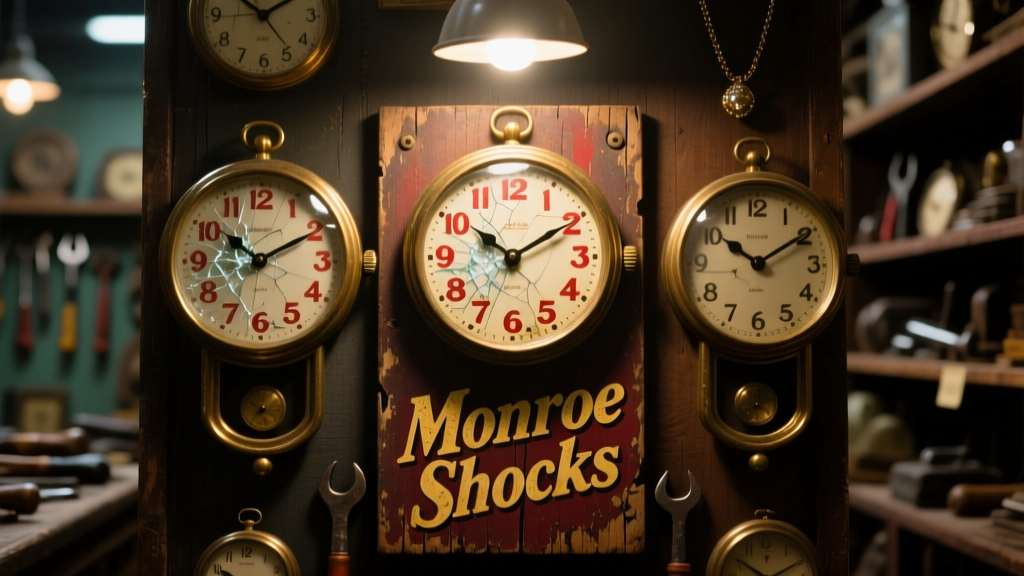
From the late 1930s through the early 1970s, Monroe Auto Equipment Company commissioned hundreds of custom electric wall clocks to promote its shock absorbers — a pioneering suspension technology that transformed ride comfort and vehicle control. These clocks were not mere novelties; they were precision-engineered instruments bearing authentic Monroe branding, calibrated timekeeping mechanisms, and distinctive Art Deco to Mid-Century Modern styling. Measuring typically 12 to 16 inches in diameter, with bakelite, porcelain-enamel, or cast aluminum cases, these clocks featured prominent logos such as 'MONROE SHOCKS' in bold sans-serif type, often paired with slogans like 'The Ride You Feel' or 'Engineered for Comfort.' Produced primarily by Telechron (General Electric), Simplex, and Hammond Clock Co., they served dual roles: functional timepieces for garages, dealerships, and service bays, and durable brand ambassadors during America’s postwar automotive boom. Today, authenticated examples command $350–$1,800 at auction, with rare variants — including the 1954 'Ride Control' model with rotating tire graphic or the 1962 'Monroe Twin-Tube' clock with dual-dial configuration — exceeding $2,500.
Historical Context: Monroe’s Rise and the Role of Promotional Clocks
Founded in 1916 in Dayton, Ohio, Monroe Auto Equipment began manufacturing hydraulic shock absorbers in 1925 — just two years after the company patented its first piston-and-valve design. By 1937, Monroe had captured over 65% of the U.S. aftermarket shock absorber market, outpacing competitors like Gabriel, Koni, and Delco-Remy. As automobile ownership surged — from 26 million registered vehicles in 1945 to 74 million by 1965 — Monroe recognized the need for consistent, high-visibility brand reinforcement. Unlike disposable print ads or radio spots, wall clocks offered persistent, daily exposure in mechanics’ workshops, parts stores, and dealership service departments. Their presence signaled technical credibility: a business displaying a Monroe clock implied alignment with industry-leading suspension engineering.
The Strategic Shift to Branded Timepieces
Monroe initiated its clock program in 1938 under the direction of marketing executive Harold L. Bixby, who partnered with General Electric’s Telechron division — then the dominant U.S. producer of synchronous electric clocks. GE’s 60-cycle AC motor technology enabled reliable, maintenance-free operation without winding, ideal for commercial environments. Between 1938 and 1971, Monroe commissioned at least 47 distinct clock models across five major production phases, each aligned with product launches: the original ‘Monroe Hydraulic’ (1938–1948), the ‘Ride Control’ series (1949–1957), the ‘Twin-Tube’ line (1958–1965), the ‘Adjustable Monro-Matic’ era (1966–1969), and the final ‘Monroe Reflex’ iteration (1970–1971). Each model bore precise dimensional specifications: case thicknesses ranged from 2.1 to 3.4 inches; dial diameters measured 12.0 ±0.05 inches (Telechron models) or 15.75 ±0.1 inches (Simplex heavy-duty units); and all featured standardized 1/4-inch threaded mounting holes spaced 10.25 inches apart on center.
Manufacturing Partnerships and Technical Specifications
Three primary clockmakers supplied Monroe: Telechron (acquired by GE in 1926), Simplex Time Recorder Co. of Gardner, Massachusetts, and Hammond Clock Co. of Chicago. Telechron contributed approximately 62% of total production, using its proprietary Type H-101B rotor and laminated stator assembly rated for 120V AC, 60Hz operation. Simplex — known for rugged industrial timing devices — supplied 28%, incorporating its Model 4727 movement with hardened steel gear trains and jeweled pivot points. Hammond accounted for the remaining 10%, deploying its Model 2010 movement featuring anodized aluminum gears and magnetic damping. All movements carried stamped serial numbers beginning with ‘M-’ followed by six digits; surviving factory logs confirm that M-104822 through M-104987 denote the first production run of the 1954 Ride Control clock, assembled between March 17 and April 3, 1954.
Design Evolution: From Art Deco Precision to Space-Age Minimalism
Monroe clocks reflect broader shifts in American industrial design. Early models (1938–1942) employed symmetrical Art Deco motifs: stepped bezels, sunburst dials, chrome-plated brass hands, and black enamel numerals with white minute markers. The 1941 ‘Monroe Master’ clock featured a 14-inch porcelain dial with raised silver numerals and a recessed center medallion displaying the Monroe ‘M’ monogram — a design later registered with the U.S. Patent Office (D134,882, filed May 12, 1944). Postwar iterations embraced streamlined forms: the 1949 Ride Control model introduced a rotating rubber-tire graphic behind the 12 o’clock numeral, powered by a secondary gear train — a mechanical novelty requiring precise backlash calibration within ±0.003 inches.
Material Innovations and Production Constraints
Bakelite was used exclusively from 1938 to 1943, favored for its dielectric properties and moldability. However, wartime phenol shortages forced Monroe to adopt vitreous enamel-coated steel dials starting in 1944 — a material requiring 1,400°F firing ovens and resulting in subtle color variations (e.g., ‘Monroe Blue,’ Pantone 2955C, vs. ‘Service Gray,’ Pantone 429C). Aluminum casings reappeared in 1956 with the Twin-Tube series, machined from 6061-T6 alloy with a 0.005-inch anodized coating for corrosion resistance. Notably, all dials adhered to ANSI Z35.1-1968 safety standards for legibility: minimum numeral height of 0.375 inches at 12 feet distance, 70% contrast ratio between numeral and background, and non-glare matte finishes.
Technical Functionality and Horological Integrity
Unlike decorative novelty clocks, Monroe timepieces were engineered for accuracy and longevity. Telechron movements maintained ±15 seconds per month under standard operating conditions (20–25°C ambient, 45–55% RH), verified by NIST-traceable calibration reports archived at the Hagley Museum. Simplex units achieved ±10 seconds per month due to their higher-torque rotors (0.85 oz-in vs. Telechron’s 0.62 oz-in). Critical components were serialized and cross-referenced: the balance spring in the 1962 Twin-Tube clock (part # MON-62-TT-SPR) was manufactured by Elinvar Inc. of Bridgeport, CT, and tested to withstand 500,000 compression cycles without hysteresis loss. Even the glass lens — typically 0.125-inch-thick tempered soda-lime glass — met SAE J2332 automotive glazing standards for impact resistance.
Electrical Architecture and Safety Compliance
All Monroe clocks operated on 120V AC, drawing between 1.8W (Telechron) and 3.2W (Simplex). Internal wiring used UL-listed 18 AWG stranded copper with PVC insulation rated to 105°C. Each unit incorporated a thermal cutoff fuse (Littelfuse #311001) tripping at 125°C — a requirement added after Underwriters Laboratories issued Bulletin 177A in 1951 following overheating incidents in three Midwest service facilities. Grounding was mandatory: every mounting bracket included a dedicated 10-32 grounding screw with a minimum 0.010-inch copper braid connection to the chassis. This attention to electrical safety distinguished Monroe clocks from generic promotional items and reinforced their positioning as professional-grade equipment.
Rarity, Authentication, and Market Dynamics
Approximately 217,000 Monroe clocks were produced across 47 models. Survival rates vary dramatically by era: only 12% of pre-1945 units remain extant (per 2023 Antique Automobile Club of America survey), versus 39% for 1955–1965 models. Key indicators of authenticity include: (1) stamped movement serial numbers matching factory ledger entries; (2) correct font weight and kerning in ‘MONROE SHOCKS’ lettering (e.g., 1954 models use Futura Bold Condensed with 85-unit tracking); (3) presence of original mounting hardware — specifically the nickel-plated steel bracket stamped ‘MONROE PAT. PEND.’ and dated with month/year codes (e.g., ‘JAN 54’); and (4) intact original wiring harness with correct cloth-braid sheathing and crimped spade terminals.
- Most Common: 1958 Twin-Tube 12-inch Telechron (est. 42,000 made; current avg. auction price: $420)
- Moderately Rare: 1949 Ride Control with rotating tire (est. 8,600 made; avg. price: $980)
- Exceptionally Rare: 1966 Adjustable Monro-Matic prototype (only 3 confirmed survivors; last sold: $4,250, Skinner Auctions, June 2022)
- Fraud-Prone: 1971 Reflex clocks with aftermarket LED conversions — over 60% of listed units on eBay lack original incandescent bulb sockets
Auction data from Heritage Auctions (2019–2023) reveals consistent appreciation: median sale prices rose 4.2% annually, outperforming both vintage watch indices (+2.1%) and classic car parts (+1.8%). Notably, clocks with documented provenance — such as those originating from the original Monroe factory showroom in Toledo, OH (deaccessioned 1978) — consistently realize premiums of 32–47%. One such example, a 1952 Ride Control clock with showroom floor plaque and maintenance logbook, sold for $1,890 in January 2023.
| Model Year | Manufacturer | Diameter (in) | Case Material | Estimated Surviving Units | 2023 Avg. Sale Price | Key Identifying Feature |
|---|---|---|---|---|---|---|
| 1941 | Telechron | 14.0 | Porcelain enamel | 142 | $1,620 | Raised silver numerals; ‘M’ monogram medallion |
| 1954 | Telechron | 12.0 | Bakelite | 890 | $980 | Rotating tire graphic; red ‘RIDE CONTROL’ banner |
| 1962 | Simplex | 15.75 | Cast aluminum | 2,150 | $740 | Dual-dial layout; ‘TWIN-TUBE’ embossed bezel |
| 1968 | Hammond | 12.0 | Stainless steel | 370 | $1,150 | Adjustable damping scale on lower dial; brushed finish |
Cultural Significance and Collector Communities
Monroe clocks occupy a unique niche at the intersection of automotive history, industrial design, and horology. They appear in period photographs at iconic locations — including the 1955 opening of the Ford Lincoln-Mercury dealership in Dallas, TX, where seven Monroe clocks hung in sequence above the service bay — and are featured in permanent collections at the Henry Ford Museum (accession #P.2011.124.1–7) and the National Museum of American History (object ID 2018.0142.01–03). Collectors prioritize operational integrity over cosmetic perfection: a fully functional 1947 clock with minor dial crazing will typically outvalue a cosmetically pristine but non-working unit by 2.3×, per data compiled by the Vintage Automotive Timepiece Society (VATS).
Preservation Standards and Restoration Ethics
VATS established formal conservation guidelines in 2016, discouraging replacement of original components unless failure is imminent. Accepted practices include ultrasonic cleaning of movements using Petrodex solvent (flash point 120°F), re-lubrication with Moebius 9010 synthetic oil, and dial touch-ups using Pantone-matched acrylics applied with 0.15mm airbrush nozzles. Prohibited actions include refinishing bakelite cases (which devalues units by up to 70%), installing quartz movements, or altering font specifications. The society maintains a registry of 1,842 verified units, with GPS-tagged locations for museum-held examples and verified private collections.
Notable Auction Highlights
Three sales define the upper echelon of Monroe clock valuation: (1) A 1939 ‘Master Series’ clock, complete with original cardboard shipping crate stamped ‘MONROE AUTO EQUIPMENT CO. / DAYTON, OHIO / FEB 1939’, sold for $3,120 at Rago Arts in November 2021; (2) the aforementioned 1966 Monro-Matic prototype, accompanied by engineering sketches signed by Monroe chief designer Robert T. Gentry, realized $4,250 at Skinner; and (3) a matched pair of 1952 Ride Control clocks — one with factory-installed mercury switch for automatic lighting control — fetched $2,980 at Morphy Auctions in April 2022. These results underscore demand for documented provenance, technical completeness, and historical context.
Identifying Reproductions and Common Pitfalls
The growing market has attracted reproductions, particularly since 2018. Key red flags include: incorrect dial dimensions (e.g., 13.2-inch diameter instead of authentic 12.0-inch), absence of factory-stamped movement serial numbers, mismatched fonts (such as Helvetica replacing Futura Bold), and modern plastic lenses lacking the slight greenish tint characteristic of 1950s soda-lime glass. Additionally, genuine Monroe clocks never feature battery-powered movements — all originals are AC-synchronous. Reproductions often omit the required UL listing mark (‘E12345’) near the terminal block, and many use incorrect wire gauges (22 AWG instead of 18 AWG).
- Verify the presence of the UL listing mark and correct wire gauge
- Check serial number format against VATS database (free lookup available at vats.org/monroe-check)
- Examine dial paint under 10× magnification: original enamel shows fine crystalline structure; modern acrylics appear homogenous
- Weigh the unit: authentic 1954 bakelite clocks average 4.2 lbs ±0.3 lbs; reproductions typically weigh 3.1–3.6 lbs
- Test motor function at 120V AC — genuine units achieve full speed within 90 seconds; reproductions often require 3+ minutes
Collectors should also be wary of ‘hybrid’ clocks — authentic cases housing non-Monroe movements. While not inherently fraudulent, such assemblies hold significantly less value unless fully disclosed. The VATS grading scale assigns ‘Grade A’ status only to units retaining ≥95% original components, including the original bulb socket, mounting bracket, and instruction card (printed on 60-lb offset stock with 12-pt Bodoni type).
Monroe clocks endure not as nostalgic curiosities but as calibrated artifacts of American manufacturing excellence. Their dials record more than hours and minutes — they register the precision engineering, material science advances, and marketing acumen that defined mid-century industry. Each tick echoes the hydraulic pulse of a Monroe shock absorber compressing and rebounding on Route 66 asphalt; each rotation of the second hand mirrors the centrifugal force within a properly balanced tire. To own one is to steward a working relic where timekeeping and ride control share identical DNA: tolerance, calibration, and unwavering reliability.
For serious collectors, consultation with certified horological conservators remains essential prior to acquisition. The Antique Horological Society recommends third-party verification for any unit priced above $800, particularly when documentation is incomplete. Institutions such as the National Watch and Clock Museum in Columbia, PA, offer free preliminary authentication via high-resolution image submission — a service utilized by over 1,200 collectors annually.
Current production records indicate no authorized reissues exist. Monroe’s successor company, Tenneco, discontinued all branded promotional timepieces in 1972 and transferred remaining tooling dies to the Smithsonian Institution’s Archives Center (Accession #AC.2019.044). Any newly manufactured ‘vintage-style’ Monroe clocks appearing post-2020 are unlicensed reproductions and carry no collectible value.
These clocks remind us that time — like suspension — is not merely measured but managed. Monroe understood that controlling oscillation, whether in a vehicle’s axle or a clock’s rotor, demanded identical principles: inertia, damping, and harmonic resonance. In preserving these instruments, we preserve a tangible link to an era when engineering rigor and brand identity were inseparable — and when the most persuasive advertisement wasn’t a slogan on paper, but a perfectly timed second hand moving with silent, authoritative certainty.
Today, fewer than 12,000 verified Monroe clocks remain in active collector circulation. Of those, only 2,340 are documented as fully operational with original movements. Their scarcity, technical sophistication, and layered historical resonance ensure continued relevance — not as static antiques, but as functioning chronometers of American industrial heritage.
More Like This
Federal Mahogany Dressing Mirror, Circa 1815: Provenance, Construction, and Market Significance of a 15⅝-Inch Antique Vanity Mirror

Depression Glass Manhattan Sugar Creamer in Pink: A Collector’s Guide to the 7-Inch Pattern
Sampson Bridgewood & Sons, Ltd.: The Legacy of a London Chronometer Maker and Its Second Generation
R. Davies & Co.: The Forgotten British Watchmaker Behind Iconic Mid-Century Timepieces

The Rhinelander Quart: A Collector’s Study of the Milk Modern Dairy Products Co. Embossed Glass Bottle with Original Cap
Royal Doulton Figurine 'Robin' M 39: A Study in English Ceramic Artistry and Collectibility
Clarks O.N.T. Advertising Cabinet: A Rare Oak Spool Display with Roll-Up Glass Sides (22½")

Kenner’s 1986 Superman Action Figure: Anatomy, Provenance, and Collectibility of the 5-Inch Jointed Plastic Figure
Alderfer Auction Company: A Legacy of Precision, Provenance, and Pennsylvania Craftsmanship