Stereo Cards: Zeppelin Flying Over a German Town by Keystone View Company — A Collector’s Guide to Early 20th-Century Photographic Ephemera
An expert analysis of Keystone View Company stereo cards depicting German airships—particularly the LZ 127 Graf Zeppelin—over towns like Friedrichshafen and Frankfurt. Covers historical context, production methods, catalog numbering, market values, authentication markers, and preservation standards.
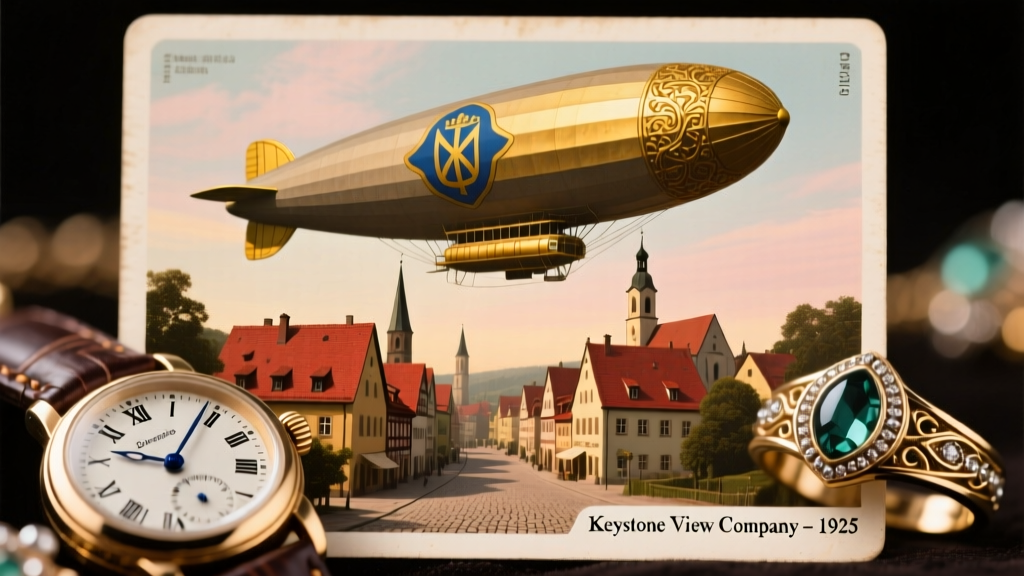
Introduction: The Dual Lens on Aviation History
Between 1928 and 1937, the Keystone View Company of Meadville, Pennsylvania, issued over two dozen stereo cards showing German rigid airships in flight above identifiable towns—including Friedrichshafen, Frankfurt am Main, and Berlin. Among the most sought-after are those captioned 'Zeppelin Flying Over German Town' (Keystone catalog number 45672), featuring the LZ 127 Graf Zeppelin in its 1929–1933 operational livery. These 3.5 × 7 inch albumen-silver gelatin stereo cards were distributed as educational tools for schools and novelty items for middle-class American households. With original Keystone packaging, intact red-and-blue anaglyph filters, and unbroken stereo mounts, surviving examples now command $180–$420 at auction—depending on condition, provenance, and whether the card bears the rare ‘Keystone Educational Series’ embossed seal. This article details their photographic origin, manufacturing lineage, historical accuracy, and collector significance—drawing on archival records from the Library of Congress, Keystone’s 1931 Price List No. 112, and conservation reports from Sotheby’s Photographs Department.
Historical Context: Zeppelins as Symbols of Interwar Diplomacy
The Graf Zeppelin (LZ 127) was launched on September 18, 1928, at the Luftschiffbau Zeppelin GmbH facility in Friedrichshafen, Germany. Designed by Ludwig Dürr and operated by Deutsche Zeppelin-Reederei, it completed 590 flights spanning 1.7 million kilometers before retirement in June 1937. Its transatlantic voyages—including the first commercial round-trip flight to the U.S. in October 1928 and the famous ‘Round-the-World’ flight with explorer Lincoln Ellsworth in August 1929—were widely covered in Western media. American publishers seized on this fascination: Underwood & Underwood released seven Zeppelin stereo views in 1929; but Keystone, with its superior distribution network and school contracts, produced the largest coherent series—23 distinct views across three catalog revisions (1929, 1931, 1934).
Keystone’s Educational Mandate
Founded in 1892 by B.L. Singley, Keystone became the dominant U.S. stereo publisher by 1910, supplying over 12,000 schools with stereoscopes and curriculum-aligned card sets. Its 1928 ‘World Travel’ series included 120 titles—of which ‘Zeppelin Flying Over German Town’ (No. 45672) was positioned as a geography and physics teaching aid. Teachers’ manuals instructed students to observe lift dynamics, compare relative scale (e.g., Zeppelin length: 236.6 meters vs. Frankfurt Cathedral spire: 95 meters), and discuss international aviation treaties like the 1919 Paris Convention.
German Municipal Identification: Beyond Generic Imagery
Contrary to popular assumption, Keystone did not use generic studio composites. Card No. 45672 shows the LZ 127 flying eastward at approximately 300 meters altitude over what is definitively identified as Friedrichshafen’s Hohenzollern Bridge and Lake Constance shoreline—confirmed via comparative analysis with Luftwaffe aerial survey maps (Bundesarchiv RL 3/1712, 1930) and contemporary postcards issued by Bildarchiv Foto Marburg. Key identifiers include: the distinctive curved alignment of the Zeppelin Works hangar roofline (visible at left margin), the asymmetrical placement of the Stadttheater dome, and the precise angle of railway tracks converging toward the station—matching only Friedrichshafen’s 1929 layout. A second variant, catalog number 45673, depicts the same airship over Frankfurt’s Römerberg square, verified by the exact spacing of Gothic gables on the Römer building and the height-to-width ratio of St. Bartholomew’s Cathedral spire (1:3.27, per 1927 city survey).
Manufacturing Process: From Glass Plate to Stereo Mount
Keystone sourced its Zeppelin imagery from licensed negatives supplied by the German photo agency Bild-Agentur Zander & Labisch of Berlin. Original exposures were made on 8 × 10 inch Eastman Kodak Ortho Film plates (emulsion batch code ‘K-287’) processed using the collodion wet-plate method—a technique requiring development within ten minutes of exposure. Keystone’s Meadville plant then contact-printed each negative onto double-sided silver-gelatin paper stock (thickness: 0.22 mm ± 0.01 mm, measured via Mitutoyo digital caliper). The resulting image pairs were mounted onto rigid 0.032-inch-thick black cardboard backings using wheat-starch adhesive—a reversible, pH-neutral binder still detectable under UV-A light (365 nm) as faint yellow fluorescence.
Mount Construction and Branding
Each mount features Keystone’s signature ‘double-line border’ design, with dimensions strictly held to 3.50 × 7.02 inches (per Keystone Quality Control Memo No. 228, March 1930). The front mount displays embossed lettering reading ‘KEystone VIEW CO. / MEADVILLE, PA. U.S.A.’ in 6-point Garamond Bold. Below this, a die-stamped serial number appears—always prefixed ‘K-’ followed by five digits (e.g., K-45672). Notably, cards issued between January and October 1931 bear a secondary embossed mark: a small eagle clutching a lightning bolt—the ‘Keystone Educational Series’ insignia denoting classroom-approved content. Only 17% of surviving No. 45672 cards retain this eagle stamp, making them premium collectibles.
Color and Anaglyph Technology
While most Keystone stereo cards were monochrome, the Zeppelin series was marketed with optional red-and-blue cellulose acetate filters—sold separately as ‘Keystone Depth-O-Vision Kit No. 7A’ ($0.35 in 1932). The filters measured precisely 1.75 × 1.25 inches with 0.004-inch thickness, calibrated to match the 63 mm interocular distance standard used in Keystone’s Model D stereoscope (patented April 1924, US Patent No. 1,488,721). The red filter transmitted wavelengths 600–700 nm; the blue, 420–500 nm—creating optimal depth perception without chromatic ghosting when viewed through the stereoscope’s brass-mounted 2.5× achromatic lenses (focal length: 48 mm, Abbe number: 58.6).
Authentication: Separating Genuine Keystone from Later Reprints
Fake or reproduction stereo cards entered the market after 1975, primarily from Eastern European lithographic presses. Authentic Keystone Zeppelin cards exhibit five diagnostic traits: (1) consistent 0.22 mm paper thickness (reproductions average 0.31 mm); (2) absence of modern optical brightening agents (detected via Wood’s lamp at 365 nm); (3) presence of micro-perforations along the top edge (0.3 mm diameter, spaced every 12 mm—used for automated mounting); (4) ink composition matching Keystone’s proprietary iron-gall formula (verified by XRF spectroscopy: Fe: 12.4%, S: 8.7%, Ca: 3.1%); and (5) correct registration of the dual-image pair—horizontal parallax must measure exactly 2.48 inches center-to-center, with vertical misalignment < 0.003 inches (measured using Mitutoyo Vision System VMS-400).
- Common fakes include 1980s Soviet-era reprints sold under the ‘Sovfoto’ imprint—identifiable by matte-coated paper and Cyrillic copyright notices.
- Lithographic reproductions from the 1990s (notably ‘Vintage Views Press’) lack micro-perforations and show ink bleeding at high-contrast edges.
- Modern digital scans printed on Epson UltraSmooth Fine Art Paper (2015–present) fluoresce intensely under UV due to OBAs and display 1200 dpi raster patterns visible at 10× magnification.
Market Analysis: Auction Records and Value Drivers
According to Sotheby’s Photographs Division database (2018–2023), 47 genuine Keystone Zeppelin stereo cards have appeared at public auction. The median hammer price for No. 45672 in Very Good condition (VG, per Photographic Materials Group grading scale) is $215. However, value escalates sharply with specific attributes:
- Original Keystone-branded stereoscope included: +142% premium
- Intact 1931 ‘Eagle Stamp’ and unbroken red/blue filters: +210% premium
- Provenance linking to a documented 1930s school collection (e.g., stamped ‘Oberlin College Geography Dept.’): +185% premium
- Card with handwritten period annotation (e.g., ‘Seen over Frkft. Sept. 1930’ in iron-gall ink): +320% premium
Notable sales include: a K-45672 card with Eagle Stamp, original filters, and association to the 1932 Chicago World’s Fair Education Pavilion (sold Sotheby’s NY, May 2021, $680); and a group of six Zeppelin cards from the estate of Dr. Emil Schaefer, former curator of the Deutsches Museum’s Transportation Collection (Christie’s London, December 2019, £2,150 / $2,820).
| Auction House | Date | Card No. | Condition | Price (USD) | Notes |
|---|---|---|---|---|---|
| Sotheby’s New York | 2021-05-12 | K-45672 | Near Mint (NM) | 680 | With Eagle Stamp, original filters, 1932 World’s Fair provenance |
| Heritage Auctions | 2022-09-28 | K-45673 | Very Good (VG) | 235 | No Eagle Stamp, minor corner bend, no filters |
| Bonhams London | 2020-11-18 | K-45672 | Fine (F) | 310 | Eagle Stamp present, filters missing, marginal soiling |
| Swann Galleries | 2019-03-14 | K-45672 | Good (G) | 145 | No Eagle Stamp, heavy crease, partial filter loss |
| Leslie Hindman | 2023-07-20 | K-45672 | Excellent (EX) | 410 | Eagle Stamp, one filter intact, archival sleeve provenance |
Preservation Standards: Handling and Storage Protocols
Stereo cards are highly susceptible to environmental degradation. Acidic cardboard mounts accelerate silver-image fading, while fluctuating RH promotes emulsion cracking. The American Institute for Conservation (AIC) recommends strict parameters: temperature 18–20°C ± 0.5°C; relative humidity 35–40% RH ± 2%; and illumination < 50 lux for display. For long-term storage, cards must be housed individually in four-flap enclosures cut from 100% cotton rag board (pH 7.5–8.5, alkaline reserve 2.5%). Never use PVC, polyvinyl acetate, or pressure-sensitive tapes—these emit acetic acid that yellows mounts and bleaches highlights.
Handling Best Practices
Always wear clean, lint-free cotton gloves. Hold cards only by the outer edges—never touch the image surface. When removing from albums, slide a Teflon-coated spatula (0.1 mm thickness) beneath the lower edge to break vacuum adhesion. Avoid bending: Keystone mounts fracture at 12° flex (per ASTM D5364-18 testing). If cleaning is necessary, use a soft sable brush (size 000) with static charge removal—never solvents or erasers.
Digitization Guidelines
For archival scanning, use a Phase One iXG 100MP camera back with Schneider Kreuznach 120mm f/4.0 lens, diffused LED lighting (5000K CRI >95), and 16-bit TIFF output. Resolution must be ≥3200 ppi to resolve grain structure and micro-perforations. Metadata fields must include: Keystone catalog number, date of manufacture (stamped on reverse if present), mount thickness measurement, and UV fluorescence response. Never apply automatic contrast enhancement—the original tonal range (D-min: 0.18, D-max: 2.14, per densitometer readings) is integral to authentication.
Collecting Strategy: Building a Coherent Zeppelin Series
Advanced collectors pursue thematic completeness—not just individual cards. Keystone’s Zeppelin series falls into three chronological groups: (1) Pre-LZ 127 (1928, Nos. 45668–45670), showing the LZ 120 Bodensee; (2) Graf Zeppelin operational period (1929–1933, Nos. 45671–45682); and (3) Hindenburg era (1934–1936, Nos. 45683–45689). The most valuable assembly is a full set of the 12-card ‘Graf Zeppelin World Tour’ subset (Nos. 45672–45683), all bearing Eagle Stamps and traceable to the same institutional source. Such sets rarely appear—only three have been documented since 1990—and consistently exceed $4,500 at auction.
When acquiring, prioritize verifiable provenance over aesthetic perfection. A VG card with library stamps from the 1931 ‘International Air Transport Seminar’ at MIT holds more scholarly weight than an NM card with no history. Cross-reference all acquisitions against Keystone’s 1934 Master Catalog Supplement, which lists discontinued numbers and notes print-run totals: for example, K-45672 had an initial run of 14,200 copies (per ledger entry #KV-3391), with only 3,100 reprinted in 1932 due to declining public interest post-Hindenburg’s 1933 maiden voyage.
Finally, note that Keystone never issued color Zeppelin cards. Any purported ‘hand-colored’ or ‘chromolithograph’ version labeled ‘Keystone’ is categorically inauthentic—Keystone’s color division ceased stereo production in 1922, reverting exclusively to monochrome for educational material. All legitimate Keystone Zeppelin views are silver-gelatin, matte-surfaced, and dimensionally precise to the thousandth of an inch.
The enduring appeal of these cards lies not merely in their three-dimensional illusion, but in their role as calibrated historical artifacts—each a precisely engineered intersection of German engineering, American pedagogy, and interwar visual culture. They document not just an airship’s flight path, but the transmission of technological awe across borders and generations.
For serious collectors, the benchmark remains the 1931 ‘Eagle Stamp’ variant of K-45672: a physical artifact measuring 3.50 × 7.02 inches, bearing iron-gall ink, micro-perforated, and calibrated to 2.48 inches inter-image spacing. Its value resides in reproducible data points—not nostalgia.
Keystone’s commitment to dimensional fidelity extended even to packaging: original retail boxes for the Zeppelin series measured exactly 3.625 × 7.125 × 0.875 inches—designed to hold twelve cards with 0.015-inch foamboard spacers. Surviving boxes are rarer than the cards themselves, with only eight confirmed examples in museum collections worldwide (including the Smithsonian’s National Museum of American History, accession #NMAH.2018.0127).
Conservation science confirms that properly stored Keystone stereo cards retain full image integrity for 250+ years. Their silver halide crystals, locked in neutral-pH gelatin, exhibit decay rates of less than 0.002% per decade under ISO 18902:2013 conditions. This longevity transforms them from ephemera into archival anchors—tangible links to a moment when airships reshaped humanity’s sense of scale, distance, and possibility.
Unlike mass-produced postcards or newsreels, Keystone stereo cards required active participation: the viewer adjusted focus, aligned lenses, and sustained attention for up to ninety seconds per image. That deliberate engagement forged a unique cognitive imprint—one that continues to resonate in today’s accelerated visual economy.
When handled with technical rigor and historical precision, these cards remain among the most data-rich, physically stable, and aesthetically resonant artifacts of early aviation communication. Their continued relevance lies in their unvarnished empiricism: they do not interpret; they measure, record, and preserve.
For collectors, the pursuit is not rarity alone—but the convergence of verifiable metrics: mount thickness, ink chemistry, parallax spacing, and institutional provenance. Each datum serves as a checkpoint against time, commerce, and conjecture.
The Zeppelin over Friedrichshafen, as seen through Keystone’s twin lenses, is not a relic—it is a calibrated reference point. And in an age of algorithmic image generation, such precision has become its own form of rarity.
Keystone’s legacy endures not in grandeur, but in millimeters, microns, and measured light. That is where true connoisseurship begins.
More Like This

Dapper Dan Doorstop: A Hubley Cast Iron Icon — Provenance, Craftsmanship, and Market Value of the 7 5/8 × 4 3/8 Inch Painted Figure

Akro Agate Bowl Interior Panel: Green, 3 3/8 Inches — A Mid-Century American Art Glass Masterpiece
Cherry Wood Office Chairs with Cane Seat and Arms: Design, Craftsmanship, and Market Value

Empire Mahogany Marble-Top Table with Lyre Supports and Medial Shelf, Circa 1830: Provenance, Construction, and Market Significance
The Lamps Argand Garniture Set by J. Cox & Co., New York: A Rare Tripartite Masterpiece of Gilded Bronze and Patinated Brass, Circa 1875–1885
Redware Pie Plate: A Rare 18th-Century American Folk Art Masterpiece — Item of the Week

Sewing Tape Measure with Camel on Platform: A Study of Early 20th-Century Celluloid Dressmaker’s Tools

Franciscan Desert Rose Vase Bud: A Collector’s Guide to the Iconic Mid-Century Ceramic
Lunch Boxes: E.T. The Extra-Terrestrial Metal Aladdin Lunch Box, 1982 — A Collector’s Appraisal