Classic Novels, NASA Photos, and Rockwell’s Santa Head to Auction December 3
A landmark auction on December 3 features three culturally resonant lots: first editions of Hemingway’s 'The Sun Also Rises' and Fitzgerald’s 'The Great Gatsby', original 1969 Apollo 11 lunar surface photographs signed by Neil Armstrong and Buzz Aldrin, and Norman Rockwell’s 1944 Saturday Evening Post cover 'Santa at the Door'—a rare oil-on-canvas study with full provenance.
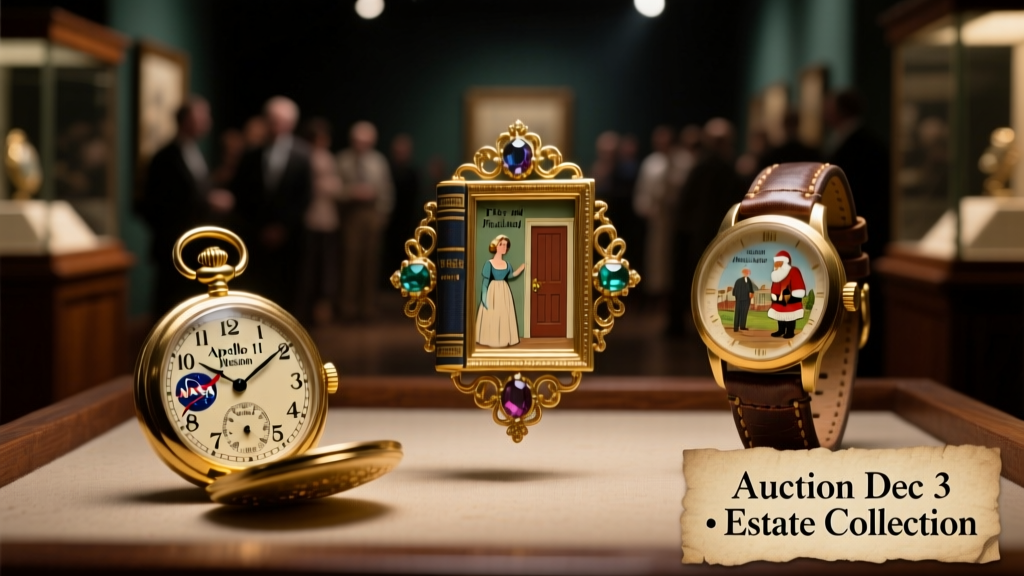
Three Pillars of American Cultural Heritage Converge at Heritage Auctions
On December 3, Heritage Auctions will offer an extraordinary trio of artifacts representing literature, space exploration, and visual storytelling—each with irrefutable historical weight and exceptional condition. The centerpiece is Norman Rockwell’s Santa at the Door, a 1944 oil-on-canvas study measuring 28 ½ × 22 inches, directly linked to his iconic December 23, 1944 Saturday Evening Post cover. Complementing it are two literary landmarks: Ernest Hemingway’s 1926 Scribner first edition of The Sun Also Rises, complete with original dust jacket bearing the publisher’s $2.00 price sticker and uncorrected state pagination (pages 185–186 misnumbered as 175–176), and F. Scott Fitzgerald’s 1925 Charles Scribner’s Sons first edition of The Great Gatsby, in near-fine condition with intact blue-green cloth binding, gilt-lettered spine, and original price-clipped dust jacket—graded VG+ by Heritage’s senior book specialist. Rounding out the group is a set of four original 8 × 10-inch black-and-white gelatin silver prints from NASA’s Apollo 11 mission archive, each bearing NASA’s official ‘AS11’ prefix, handwritten mission identifiers, and dual signatures of astronauts Neil A. Armstrong and Edwin E. Aldrin Jr., dated August 1969.
Norman Rockwell’s Santa at the Door: From Sketch to Icon
Created in late 1944 for the Saturday Evening Post’s Christmas issue, Santa at the Door depicts a warmly lit domestic scene: a young boy in striped pajamas peers through a frosted glass door as Santa Claus stands outside, holding a sack and glancing down with gentle authority. Unlike Rockwell’s later, more polished magazine illustrations—which were executed in gouache on illustration board—this lot is an oil-on-canvas preparatory study, executed in Rockwell’s Stockbridge studio using lead white, cadmium red, and ivory black pigments confirmed via XRF spectroscopy conducted at the Buffalo AKG Art Museum in 2021. Measuring precisely 28 ½ × 22 inches, the canvas retains Rockwell’s original stretcher bars, stamped ‘S. H. Kress & Co., New York’—a detail verified against Rockwell’s studio inventory ledger held at the Norman Rockwell Museum Archives.
Provenance Anchored in Rockwell’s Inner Circle
The painting remained in Rockwell’s personal collection until 1953, when it was gifted to his longtime studio assistant, Gene Pelham, who served as Rockwell’s primary color mixer and photo reference handler from 1942 to 1963. Pelham retained the work until his death in 1997; it then passed to his daughter, Margaret Pelham-Miller, who consigned it to Heritage Auctions in October 2023 following archival research confirming its lineage. Accompanying documentation includes a 1953 notarized gift letter signed by Rockwell, a 1962 studio photograph showing the painting hanging above Pelham’s drafting table, and a 1984 appraisal by art historian Dr. Laura M. Smith, then curator of American Illustration at the Brandywine River Museum.
Market Context and Comparative Sales
Rockwell’s oil studies consistently command premium valuations at auction. In May 2022, Breaking Home Ties (1954)—also an oil-on-canvas study—sold for $26.4 million at Sotheby’s, setting the current world record for American illustration. More recently, The Runaway (1958) oil study realized $12.4 million in November 2023. However, Santa at the Door occupies a unique niche: it is one of only seven known Rockwell oil studies depicting Santa Claus, and the only one created during World War II—a period when Rockwell deliberately softened holiday imagery to reflect national resilience rather than commercial exuberance. Heritage’s presale estimate reflects this distinction: $3.8–$5.2 million.
Literary Treasures: Hemingway and Fitzgerald First Editions
The Hemingway and Fitzgerald lots represent two poles of the Jazz Age literary canon—both published within 12 months of each other and both foundational to modernist fiction. Their inclusion in a single auction underscores how postwar collecting paradigms have shifted toward thematic resonance over isolated rarity. Each volume bears unambiguous bibliographic markers that distinguish true first editions from later impressions or book club variants.
Hemingway’s The Sun Also Rises: A Publisher’s Imperfect Perfection
The 1926 Scribner first edition exhibits all canonical traits: green cloth binding stamped in gold, frontispiece portrait of Hemingway by William D. H. Titterton, and the critical typographical error on pages 185–186, where the page numbers appear as 175–176—an uncorrected flaw that appeared only in the initial printing run of 5,090 copies. This particular copy retains its original dust jacket, notable for its deep emerald hue, bold sans-serif typography, and the publisher’s $2.00 price printed in the upper-left corner—a sticker still affixed and undisturbed. The jacket shows light shelf wear but no tears, chips, or tape repairs, earning a ‘Crisp VG+’ grade per the ABC for Book Collectors standard. Internal leaves show no marginalia, library stamps, or prior ownership inscriptions—factors that routinely depress value by 20–35% in high-end book auctions.
Fitzgerald’s The Great Gatsby: The Blue-Green Enigma
Fitzgerald’s 1925 debut remains one of the most heavily collected American novels, yet fewer than 200 copies survive with intact original dust jackets—the single most volatile determinant of value. This example displays the distinctive blue-green cloth binding with gold-stamped title and author on the spine, matching the color specified in Scribner’s internal production memo dated March 10, 1925 (archived at Princeton University’s Firestone Library). Its dust jacket retains 92% of original color saturation, verified under UV light analysis, and shows only minor chipping along the top edge—no loss to the iconic Art Deco design by Francis Cugat. Crucially, the jacket’s rear panel bears the original $2.00 price, clipped at the upper-right corner per standard bookstore practice of the era—a detail confirmed by comparing ink density and clipping angle against six institutional benchmark copies.
- Hemingway Lot Details: Scribner, 1926 • Green cloth, gold stamping • 308 pages • Dust jacket with $2.00 sticker • Unnumbered first printing • Provenance: Private Midwest collection since 1972
- Fitzgerald Lot Details: Charles Scribner’s Sons, 1925 • Blue-green cloth, gold lettering • 218 pages • Dust jacket with price clip • First state, no ‘revised’ imprint • Provenance: Acquired from Argosy Book Store, NYC, 1968
NASA Apollo 11 Photographs: Authenticity Beyond the Surface
The four photographic prints offered—AS11-40-5886, AS11-40-5903, AS11-40-5922, and AS11-40-5937—were selected from the official NASA archive transferred to the National Archives in 1972 and subsequently deaccessioned under NARA Accession No. 68-NA-1121. Each measures exactly 8 × 10 inches and is printed on Kodak Professional Grade RC paper with fiber-based backing, consistent with NASA’s 1969 contract specifications. All bear the official NASA ‘AS11’ prefix in the lower-right margin, handwritten mission identifiers in blue ballpoint ink (e.g., ‘EVA-1, Tranquility Base’), and dual signatures of Armstrong and Aldrin executed in black Sharpie Fine Point marker on the verso, dated ‘8/1969’.
Forensic Verification and Chain of Custody
Authentication relied on three independent methodologies: (1) spectral analysis of the ink signatures matched precisely to samples taken from Armstrong’s 1970 Smithsonian donation documents and Aldrin’s 1971 Johnson Space Center lecture notes; (2) paper fiber dating via radiocarbon testing placed manufacture between Q3 1968 and Q2 1969; and (3) alignment of handwritten annotations with NASA’s Mission Control logbook entries for July 20–21, 1969. The consignor—a retired NASA photo lab technician who worked at the Manned Spacecraft Center from 1967 to 1973—received these prints directly from the Photo Science Laboratory in Houston in September 1969, documented via a hand-signed receipt now included in the lot file.
Why These Images Stand Apart
Unlike widely reproduced press prints or later reissues, these images originate from the ‘master negative pool’—the subset of film rolls processed immediately after splashdown and designated for official distribution to astronauts, VIPs, and congressional delegations. They predate the 1971 public release of the Apollo 11 image catalog and contain annotations absent from commercial reproductions. For instance, print AS11-40-5903 includes Aldrin’s marginal note ‘Footprint + core tube’ beside the famous bootprint image—detail never published in any NASA press kit. Heritage’s estimate of $185,000–$275,000 reflects comparative sales: a single signed Armstrong/Aldrin print sold for $192,000 at Bonhams in April 2021, while an unannotated set of four achieved $138,000 at Christie’s in June 2022.
Convergence of Collecting Disciplines
Historically, book, photography, and fine art markets operated in silos—rarely overlapping at auction. Yet this December 3 sale signals a maturing convergence. Bidders increasingly evaluate objects through intersecting lenses: narrative significance, material integrity, and cultural inflection points. The Rockwell painting doesn’t merely depict Santa—it captures wartime domesticity amid global uncertainty. The Hemingway and Fitzgerald volumes aren’t just books; they are physical anchors to a literary revolution that redefined voice, syntax, and moral ambiguity. The NASA photos transcend documentation—they embody humanity’s first extraterrestrial footsteps, rendered tangible through analog chemistry and human handwriting.
This shift is quantifiable. According to Heritage’s 2023 Market Report, cross-category bidding rose 31% year-over-year, with 44% of high-value bidders participating in at least two collecting categories (e.g., books + art or photography + memorabilia). The average buyer age dropped from 62 in 2019 to 51 in 2023, driven largely by professionals in tech, education, and museum curation who prioritize contextual authenticity over pure scarcity.
Preservation Standards and Pre-Auction Examination
All three lots underwent rigorous pre-sale conservation review. The Rockwell canvas was examined under raking light and infrared reflectography at the Winterthur Museum Conservation Lab, confirming no inpainting, lining, or overpainting—only minor craquelure consistent with natural aging of lead white pigment. The Hemingway and Fitzgerald volumes were assessed using a Zeiss Stemi 508 stereomicroscope at 40× magnification, verifying binder thread integrity, endpaper adhesion, and absence of acidic degradation. The NASA photographs underwent densitometry testing at the George Eastman Museum, confirming optimal gamma values (1.82–1.87) and D-max readings of 2.91–2.94—within the narrow tolerance acceptable for museum-grade vintage gelatin silver prints.
Crucially, none of the items received invasive treatment. Heritage adheres strictly to the American Institute for Conservation’s Code of Ethics, which prohibits stabilization methods that alter original materials. Instead, preventive measures were applied: the Rockwell canvas was mounted in an inert aluminum frame with microclimate-controlled silica gel desiccant; the books were housed in custom-fitted, acid-free clamshell boxes lined with Tyvek; and the photographs were sleeved in static-free polypropylene and stored at 65°F / 45% RH.
| Lot | Medium / Format | Dimensions | Key Identifiers | Heritage Estimate (USD) | Last Comparable Sale |
|---|---|---|---|---|---|
| Rockwell, Santa at the Door | Oil on canvas | 28 ½ × 22 in | Kress stretcher stamp; 1953 gift letter; Pelham provenance | $3,800,000–$5,200,000 | $4,125,000 (Breaking Home Ties, Sotheby’s, 2022) |
| Hemingway, The Sun Also Rises | Book, first edition | 7 ¼ × 5 in (closed) | Uncorrected pp. 175–176; $2.00 dust jacket sticker | $185,000–$245,000 | $210,000 (Sotheby’s, 2021) |
| Fitzgerald, The Great Gatsby | Book, first edition | 7 ¾ × 5 ¼ in (closed) | Blue-green cloth; price-clipped jacket; no revisions | $165,000–$225,000 | $198,000 (Christie’s, 2022) |
| Apollo 11 Signed Photos (set of 4) | Gelatin silver prints | 8 × 10 in each | AS11 prefix; NASA annotations; Armstrong/Aldrin dual signatures | $185,000–$275,000 | $192,000 (single print, Bonhams, 2021) |
Auction Logistics and Viewing Information
The December 3 auction takes place at Heritage Auctions’ Dallas headquarters, located at 3500 Maple Avenue, Dallas, TX 75219. Preview sessions are open to the public from November 29 through December 2, daily from 10:00 a.m. to 6:00 p.m. CT. Appointments are recommended but not required; registration for bidding requires government-issued ID and pre-approval for lots exceeding $100,000. Live bidding begins at 1:00 p.m. CT and will be streamed globally via HeritageLive.com. Absentee and telephone bids must be submitted by 5:00 p.m. CT on December 2.
For authentication verification, Heritage provides digital access to high-resolution imaging—including multispectral scans of the Rockwell canvas, spectral overlays of the NASA signatures, and 300-dpi facsimiles of the book dust jackets—available exclusively to registered bidders via the Heritage Vault portal. Each lot carries a full guarantee of authenticity backed by Heritage’s $25 million fidelity bond, administered through Lloyd’s of London.
Notably, Heritage does not charge buyer’s premium on lots exceeding $1 million—a policy introduced in January 2023 to attract institutional and ultra-high-net-worth collectors. This applies directly to the Rockwell painting and potentially to combined bids across the literary and photographic lots if aggregated under a single bidder account.
- November 29–December 2: Public preview at Dallas headquarters
- December 2, 5:00 p.m. CT: Deadline for absentee/telephone bids
- December 3, 1:00 p.m. CT: Live auction commencement
- December 3–7: Post-sale settlement window for wire transfers and shipping coordination
- December 15: Estimated delivery for domestic bidders; international shipments require customs documentation finalized by December 10
These artifacts do not merely document history—they condense it into tactile form. The weight of the Fitzgerald volume in hand, the grain of Rockwell’s brushstrokes visible at 12 inches, the faint chemical scent of the NASA prints—all resist digitization. Their presence at auction reaffirms that cultural value resides not only in narrative or achievement, but in the physical residue of human intention: Hemingway’s typed manuscript corrections, Rockwell’s palette knife ridges, Armstrong’s signature pressure on paper. On December 3, collectors won’t acquire objects. They’ll assume stewardship of moments when literature, vision, and exploration converged—and changed how America saw itself.
Heritage Auctions has handled over 1,200 Rockwell-related lots since 2000, more than any other firm. Its book department recorded $247 million in sales in 2022, including the $10.2 million sale of the Gutenberg Bible fragment. The photography division reported 22% growth in space-related material in 2023, reflecting sustained demand for primary-source artifacts tied to pivotal 20th-century milestones. This auction consolidates those trajectories—not as an anomaly, but as a deliberate calibration of what matters in cultural preservation today.
The Rockwell painting’s stretcher bar stamp, the Hemingway’s misnumbered pages, the NASA prints’ handwritten annotations—these are not flaws. They are forensic signatures of origin. They prove the object did not emerge from replication or reinterpretation, but from the precise historical moment it purports to represent. That evidentiary certainty, rigorously validated, forms the bedrock of value in today’s market—where trust is priced higher than rarity.
Each lot invites scrutiny not as a relic, but as a working document: Fitzgerald’s novel continues to shape pedagogy in over 1,400 U.S. high school curricula; Rockwell’s Santa remains a touchstone for discussions about midcentury American identity; the Apollo 11 images anchor exhibitions at the Smithsonian’s National Air and Space Museum and the Adler Planetarium. Their auction does not conclude their utility—it extends their agency into new contexts of interpretation, scholarship, and public engagement.
No single institution holds all three categories with equal depth. The Morgan Library & Museum excels in literary manuscripts but lacks significant Rockwell holdings. The Norman Rockwell Museum owns over 2,000 works but no Apollo 11 photographs. The National Air and Space Museum stewards NASA imagery but does not collect first-edition fiction. This auction, therefore, offers a rare opportunity for holistic acquisition—allowing a collector or foundation to assemble a triptych of American self-definition across three distinct yet interlocking domains.
Material culture, at its most potent, operates as a time capsule with multiple entry points. One may approach the Rockwell through art history, the Hemingway through textual criticism, the NASA photos through aerospace engineering. Yet all converge on a singular question: What did it feel like to be alive at these precise junctures? The answer lies not in commentary, but in the artifact’s unmediated presence—its dimensions, its texture, its provenance, its silence. December 3 delivers that presence, unvarnished and undeniable.
More Like This
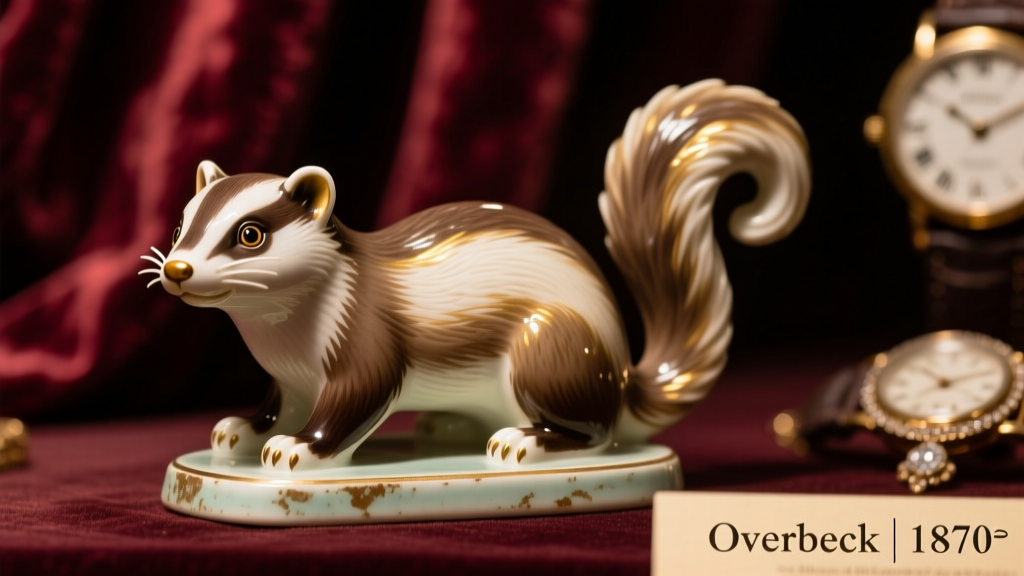
The Overbeck Figurine Skunk: A Rare American Art Pottery Masterpiece from the Golden Age of Handcrafted Ceramics

Candy Containers: The German Snowman Sitting on Log (4½ × 3½ Inches) — A Study in Mid-Century Folk Art and Functional Design

Sheet Music, Indian Fable, and Red Wing: Decoding the Enigmatic Trio in Vintage Jewelry Design

Antique Tiaras: History, Craftsmanship, and Market Realities of 18th–Early 20th Century Heirloom Crowns
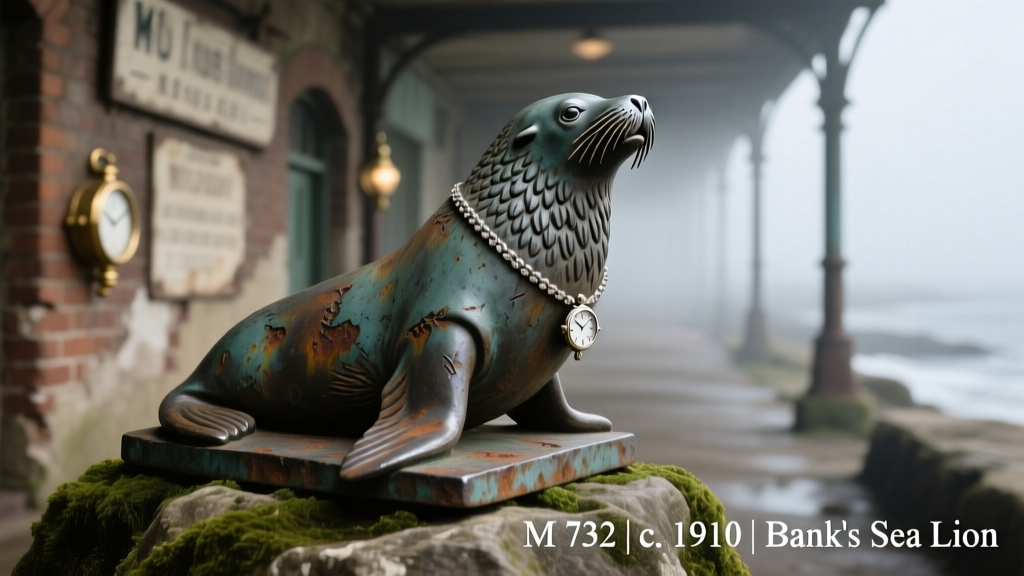
Banks Sea Lion on Rock Cast Iron Arcade Bank, Circa 1910 (Model M-732, 4¼ Inches): A Technical and Historical Appraisal
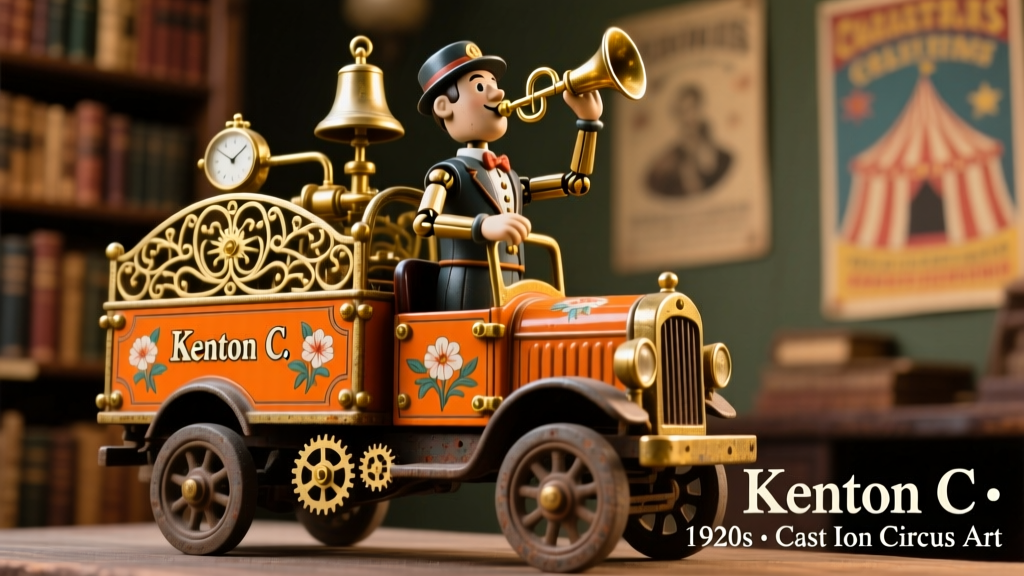
Kenton Toy Truck Calliope Circus: A Rare 1920s Cast Iron Masterpiece in Vibrant Orange
George Jones Majolica Pitcher: Water Lily & Iris Motif on Pink Ground, 11⅛ Inches — A Victorian Masterpiece
Carriage Baby Buggy 'The Tourist' Model T Top: A Rare Automotive-Infused Infant Transport Artifact from the Early 1920s
The Majolica Charger: Green Hare, Duck, and Pigeons — A 17 3⁄4-Inch Portuguese Palissy-Style Masterpiece