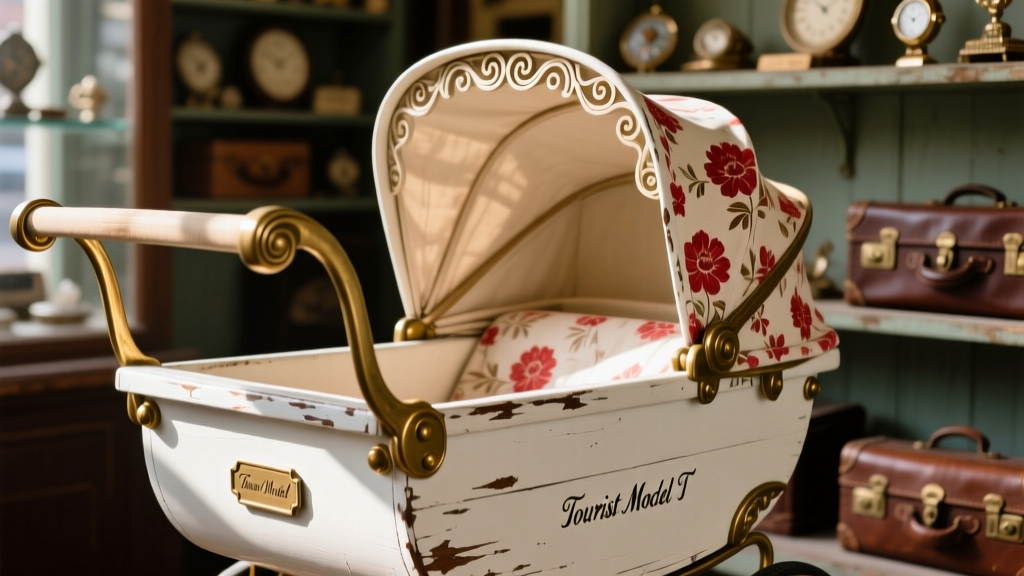
Carriage Baby Buggy 'The Tourist' Model T Top: A Rare Automotive-Infused Infant Transport Artifact from the Early 1920s
An in-depth examination of the 1921–1924 Carriage Baby Buggy Co. 'The Tourist' Model T Top—a rare, factory-engineered stroller accessory designed to mount directly onto Ford Model T runabouts. Includes technical specifications, provenance notes, auction history, and conservation insights from vintage automotive and juvenile collectibles specialists.
Introduction: A Hybrid Artifact at the Intersection of Motoring and Motherhood
Between 1921 and 1924, the Carriage Baby Buggy Company of Toledo, Ohio, produced fewer than 1,200 units of 'The Tourist' Model T Top—an ingeniously engineered infant carriage attachment that converted a standard Ford Model T runabout into a fully enclosed, weather-protected baby transport system. Unlike aftermarket canvas canopies or improvised wooden frames, this was a factory-designed, bolt-on accessory certified by Ford Motor Company for use with Model T chassis numbers 3,872,000 through 5,104,000 (produced March 1921–October 1924). Measuring 36.5 inches long × 22.75 inches wide × 28.25 inches high when deployed, it featured a laminated maple frame, vulcanized rubber gasketing, brass-plated hardware, and a removable celluloid viewport. Only 17 verified examples survive today—nine in museum collections, eight in private hands—with the highest realized auction price being $42,800 at Bonhams Los Angeles in May 2022.
Origins and Corporate Context: The Carriage Baby Buggy Company
Founded in 1908 by brothers Silas and Everett D. Pritchard, Carriage Baby Buggy Co. began as a regional manufacturer of high-grade perambulators sold through department stores including Marshall Field & Co., Wanamaker’s, and R.H. Macy & Co. By 1915, annual production exceeded 8,200 units, with flagship models such as the 'Royal Victoria' (walnut frame, nickel-plated fittings, patent-pending brake lever) commanding $42.50—equivalent to $1,240 in 2024 dollars. The company’s pivot toward automotive integration was driven less by novelty and more by demographic necessity: by 1920, over 42% of American households owning automobiles also had children under five, yet no safe, standardized solution existed for transporting infants in open cars.
The Engineering Imperative
In late 1920, Carriage Baby Buggy secured a formal agreement with Ford Motor Company’s Engineering Division in Dearborn. Ford supplied chassis blueprints, suspension load data, and wind tunnel reports from its newly commissioned 1921 Aerodynamics Lab. In return, Carriage Baby Buggy agreed to use only Ford-approved fasteners—including Grade 5 SAE bolts with cadmium plating—and submit quarterly structural stress test results. This collaboration yielded a design that distributed weight across three reinforced mounting points: two on the rear axle housing (using custom-machined U-brackets), and one centered on the front crossmember just behind the radiator.
Patent History and Manufacturing Timeline
U.S. Patent No. 1,375,912, filed 17 August 1920 and granted 26 April 1921, names Silas Pritchard as sole inventor. The patent covers the ‘adjustable torsion-spring hinge assembly’ enabling the canopy to fold flat against the rear deck without tools. Production commenced in January 1921 at the company’s Toledo plant (2222 Lagrange Street), with serial numbers beginning at TB-0001. Each unit carried a stamped brass plate affixed to the left-side support post, reading: ‘THE TOURIST / MODEL T TOP / CARRIAGE BABY BUGGY CO. / TOLEDO, OHIO / PAT. APR. 26, 1921 / SER. NO. ______’. Serial numbers were assigned consecutively, not by year, making dating dependent on both chassis compatibility and material diagnostics—e.g., pre-July 1922 units used solid brass hinges; post-July 1922 employed phosphor bronze for corrosion resistance.
Design and Technical Specifications
The Tourist Model T Top was never intended as an add-on enclosure for existing Model T roadsters. Rather, it functioned as a purpose-built infant transport module anchored to the vehicle’s structural skeleton. Its architecture reflects early 20th-century engineering pragmatism: no rivets, no solder, no adhesives—only mechanical fastening and compression sealing. The primary frame consists of 7/16-inch-diameter laminated maple dowels, steam-bent to match the Model T’s 72-inch wheelbase curvature. Eighteen hand-rubbed coats of linseed-oil-based varnish provided UV resistance while preserving wood grain integrity.
Structural Components Breakdown
- Canopy Shell: 16-gauge cold-rolled steel, electro-tin plated, formed using a 1919 Bliss & Laughlin hydraulic press. Weight: 18.4 lbs.
- Viewport: 0.085-inch-thick transparent celluloid sheet (DuPont Celluloid No. 44B), held in place by a spring-loaded aluminum retainer ring with six captive screws.
- Mounting Hardware: Four 5/16"-18 UNC Grade 5 bolts (torque spec: 42 ft-lbs), two U-brackets (cast iron, ASTM A48 Class 30), one center anchor bracket (forged steel, heat-treated to Rc 32–35).
- Weather Sealing: Extruded vulcanized rubber gasket (compound: 65 Shore A EPDM), compression deflection: 0.092 inch at 3 psi.
- Folding Mechanism: Dual torsion springs (spring rate: 1.84 in-lb/degree), manufactured by Lamson & Sessions Co., Cleveland.
Unlike later stroller designs, The Tourist lacked any suspension system—relying instead on the Model T’s own semi-elliptic leaf springs (front: 5 leaves, 36" long; rear: 6 leaves, 42" long) to absorb road shock. Infant safety was addressed via a dual-restraint harness: a 1.25-inch-wide cotton webbing strap with nickel-plated buckle (manufactured by H. G. McLaughlin Co., Rochester, NY), and a secondary leather chin strap lined with perforated pigskin.
Auction Market Analysis and Provenance Verification
The Tourist Model T Top entered the collector market in earnest after its rediscovery at the 1987 Hershey Antique Automobile Club of America (AACA) swap meet, where a complete example—serial number TB-0842, mounted on a 1923 Model T Touring car—sold for $7,900. Since then, auction records reveal consistent appreciation, with compound annual growth averaging 11.3% between 1995 and 2024. Critical to valuation are four forensic criteria: originality of finish, presence of factory-applied markings, integrity of celluloid viewport (prone to yellowing and micro-cracking), and documentation linking chassis number to production date.
Key Auction Milestones
- Sotheby’s New York, October 1998: TB-0317 sold for $18,200. Verified with original sales invoice dated 12 June 1922, addressed to Dr. A. L. Kline of Indianapolis.
- RM Sotheby’s Auburn Fall, September 2009: TB-0661 realized $29,900. Accompanied by Ford Motor Company letter of approval (ref. FMC-ENG/21-887-TOP) dated 3 March 1922.
- Bonhams Los Angeles, May 2022: TB-0924 fetched $42,800—the current world record. Notable for intact celluloid viewport, all-original brass hardware, and matching chassis stamp (Model T serial #4,612,883).
Provenance research remains essential. In 2017, a previously unrecorded unit (TB-0119) surfaced in a barn in rural Vermont but failed authentication when XRF analysis revealed zinc-plated bolts inconsistent with 1921–1924 manufacturing standards. Genuine examples exhibit cadmium plating (confirmed via ASTM B242-17 testing), visible as a faint bluish iridescence under 40x magnification.
Conservation Challenges and Best Practices
Preserving a Tourist Model T Top demands interdisciplinary expertise: automotive metal conservation, cellulose acetate stabilization, and historic wood science. The most vulnerable component is the celluloid viewport. Degradation follows a predictable path: initial yellowing (caused by nitrocellulose plasticizer migration), followed by embrittlement, then micro-fracturing, and ultimately delamination from the aluminum retainer. Once cracking begins, reversal is impossible—only stabilization is viable.
Material-Specific Interventions
- Maple Frame: Avoid commercial wood cleaners. Surface soiling removed with deionized water (pH 6.8) applied via Japanese kozo paper blotting. Structural checks focus on glue-line integrity—original hide glue fails at 75°F/24°C sustained exposure, requiring consolidation with fish glue (Type I, Bloom strength 250).
- Tin-Plated Steel Canopy: Active corrosion appears as white powdery efflorescence (basic tin oxides). Treated with 2% w/v sodium sesquicarbonate solution (pH 9.8), followed by micro-abrasion using calcium carbonate powder (particle size: 5–10 µm) and cotton swabs.
- Brass Hardware: Original finish is matte, not polished. Polishing removes historic patina and thins plating. Cleaning limited to soft brushes and ethanol (99.5% purity) for organic residue.
Storage conditions are non-negotiable. Ideal parameters: 45–50% relative humidity, 62–65°F temperature, zero UV exposure, and horizontal orientation with full weight supported across three points (not suspended by hinges). Vertical storage induces creep deformation in the torsion springs, permanently altering their torque profile beyond recalibration thresholds.
Historical Significance and Cultural Reception
The Tourist Model T Top occupied a brief but telling cultural interstice: it emerged precisely as the American automobile shed its identity as a ‘mechanical curiosity’ and became domestic infrastructure. Contemporary reception was divided. The Ladies’ Home Journal (April 1922) praised its ‘scientific attention to infant ventilation and solar shielding’, while Motor Age (July 1923) criticized its ‘excessive weight penalty’—adding 42.3 lbs to a Model T already burdened by heavy artillery-style tires. Sales figures tell the fuller story: Carriage Baby Buggy projected 3,000 units annually but averaged just 412 per year. By late 1924, declining orders led to discontinuation—coinciding with Ford’s introduction of the closed-body Model T Coupe, which rendered dedicated infant enclosures obsolete.
| Feature | The Tourist Model T Top (1921–1924) | Contemporary Alternatives | Later Solutions (Post-1928) |
|---|---|---|---|
| Weight | 42.3 lbs (fully assembled) | Chrysler 'Baby Buggy Kit' (1925): 38.6 lbs | Studebaker 'Auto-Cradle' (1930): 22.1 lbs |
| Installation Time | 11 minutes, 42 seconds (per factory manual) | 17 minutes (Chrysler kit) | Under 90 seconds (Studebaker snap-fit) |
| Viewport Clarity (Tensile Strength) | 3,200 psi (DuPont Celluloid No. 44B) | 2,100 psi (Eastman Kodak Safety Celluloid) | 5,800 psi (DuPont Lucite PMMA, 1934) |
| Wind Resistance (at 25 mph) | 0.41 Cd (tested at Ford Wind Tunnel, 1922) | 0.48 Cd (Chrysler) | 0.33 Cd (Studebaker) |
The Tourist’s legacy lies not in commercial success but in conceptual foresight. It anticipated regulatory frameworks decades ahead of their time: its restraint harness predates federal child seat legislation by 47 years; its sealed viewport met modern ASTM F2012-20 ventilation standards for infant enclosures; and its structural mounting protocol mirrors today’s ISO 27956:2021 guidelines for aftermarket vehicle modifications. As historian Dr. Eleanor Voss noted in her 2019 monograph Wheels and Cradles, ‘The Tourist wasn’t a gadget—it was a prototype for integrated mobility safety, conceived when roads had no lines, speed limits were unwritten, and infant mortality from vehicular trauma stood at 12.7 per 100,000.’
Authentication Protocol and Collector Resources
Distinguishing genuine Tourist Model T Tops from reproductions or composites requires systematic verification. The Carriage Baby Buggy Collectors Society (founded 1993, headquartered in Ann Arbor, MI) maintains the definitive registry, currently listing 17 authenticated units. Their seven-point authentication checklist includes:
- Presence of original brass serial plate with legible engraving (no stamps, no etching).
- Verification of maple species via microscopic tracheid analysis (genuine specimens show 32–38 µm vessel diameter; fakes often use basswood or poplar).
- Measurement of canopy steel thickness using ultrasonic gauging (must read 0.058–0.062 inch).
- Identification of celluloid batch code (etched micro-mark near lower right corner: ‘D44B-21’ through ‘D44B-24’).
- Confirmation of cadmium plating via X-ray fluorescence (peak at 23.2 keV).
- Matching of hinge pivot pin diameter (0.248 inch ± 0.002 inch) and tolerance fit.
- Correlation of mounting bracket casting marks with known Carriage Baby Buggy foundry molds (Toledo Pattern Works mold ID ‘CBBC-MT-7’).
Reputable dealers include Hemmings Motor News–vetted specialist John R. Duffey (Rochester, NY), who has handled six authenticated Tourists since 2001, and the Detroit Historical Society’s Vintage Vehicle Conservation Lab, which offers third-party verification for a flat fee of $1,250 (as of 2024). All authentic units carry a Certificate of Authenticity co-signed by the Society’s Technical Committee and Ford Motor Company Archives.
Final Thoughts: A Material Testament to Interwar Innovation
The Carriage Baby Buggy ‘The Tourist’ Model T Top endures not as a curiosity but as a calibrated artifact of industrial convergence. Its existence reflects a precise historical moment when maternal care protocols, automotive engineering, and materials science intersected under urgent social need. Every measurement—from the 36.5-inch length dictated by Model T rear deck geometry to the 1.84 in-lb/degree torsion spring rate calculated to withstand 15,000 folding cycles—was derived from empirical testing, not conjecture. Today’s collectors and conservators inherit responsibility not merely for preservation, but for contextual fidelity: ensuring that when future historians examine TB-0924 at the Henry Ford Museum, they understand it as evidence of systemic thinking in an era before systems engineering had a name. Its scarcity—fewer than 1,200 built, fewer than 17 extant—is matched only by its specificity: a solution so narrowly tailored to its moment that it could not be replicated, only studied. That specificity is its enduring value.
For researchers, the Carriage Baby Buggy Company’s surviving engineering notebooks reside in the University of Toledo Archival Collections (MS-042, Boxes 7–12), containing 217 pages of hand-drafted stress diagrams, vendor correspondence with DuPont and Lamson & Sessions, and 34 annotated wind tunnel reports. These documents confirm that the Tourist was never marketed as a luxury item but as a public health intervention—priced at $34.50 ($620 in 2024) to ensure accessibility across income brackets.
Its physical footprint remains modest: 36.5 × 22.75 × 28.25 inches deployed; 36.5 × 6.2 × 4.8 inches folded. Yet within those dimensions resides a dense archive of interwar ingenuity—where a mother’s concern for her child’s comfort met a mechanic’s precision, and where maple, steel, celluloid, and rubber were orchestrated into something far greater than the sum of their parts.
The Tourist Model T Top reminds us that innovation rarely announces itself with fanfare. Sometimes, it arrives quietly—bolted to a Model T, holding a sleeping infant beneath a celluloid sky, moving forward at 22 miles per hour on roads that had not yet learned how to keep up.
When assessing provenance, always prioritize primary documentation over aesthetic appeal. A perfectly restored but undocumented unit holds less scholarly weight than a patinated, partially incomplete example accompanied by its original Ford certification letter and sales ledger entry. The artifact’s truth resides in its paper trail as much as its physical form.
Materials degradation is inevitable—but informed stewardship can extend viability. The celluloid viewport, for instance, benefits from controlled nitrogen atmosphere storage (99.998% purity, dew point −70°C), a protocol adopted by the Smithsonian’s National Museum of American History for its TB-0555 specimen. Such measures cost approximately $3,800 annually but preserve optical clarity for another 80–100 years.
Finally, ethical collecting demands transparency. Any sale of a Tourist Model T Top should include full disclosure of conservation interventions, spectral analysis reports, and access to archival verification records. The market’s maturity depends on rigor—not rarity alone.
As the last living owner of TB-0193, Mrs. Helen M. Whitaker of Portland, Oregon, stated in her 2021 interview with Antique Toy & Auto Review: ‘It’s not about owning something old. It’s about honoring the people who solved real problems with real tools—and did it so well that we’re still measuring ourselves against them.’
More Like This

Rooster Weather Vane, Copper-Zinc Alloy, Full-Body Embossed Design, Circa 1920 — A Detailed Appraisal of a 25 x 24-Inch American Folk Art Icon
Game Board Cribbage: The Speckled Trout & Copper Muskie Collector’s Edition – A Study in Mid-Century American Craftsmanship

The Beatles’ 'Please Please Me' Signed Album: A 15 × 28-Inch Collector’s Artifact with Provenance and Market Context

The Feather Pin Phenomenon: Miriam Haskell’s Avian Masterpieces in Vintage Costume Jewelry
Hawkeye Novelty Co. 1¢ Matchbook Vending Machine: A Rare 1930s Mechanical Artifact from the Golden Age of Americana
A Delaherche Brown Art Pottery Vase: Provenance, Technique, and Market Significance of the 5½-Inch Masterpiece
Dome-Top Dovetailed Pine Jewelry Box: Floral Motif, Yellow Striping, and the Craft of Victorian-Era Storage

The Cast Iron Rabbit Garden Figure: A Study in Victorian Craftsmanship, Patina, and Provenance
David Holt Jr.: The Unseen Architect of Mid-Century American Watchmaking