Civil War Kepi Cord Eagle Buttons, Circa 1870: Authenticity, Provenance, and Collector Significance
A detailed examination of U.S. military eagle buttons used on kepi cords between 1865–1875, focusing on construction, maker marks, metallurgy, and market value. Includes documented examples from the U.S. Military Academy Museum, Smithsonian collections, and recent auction results.
Introduction: The Subtle Symbolism of the Kepi Cord Eagle
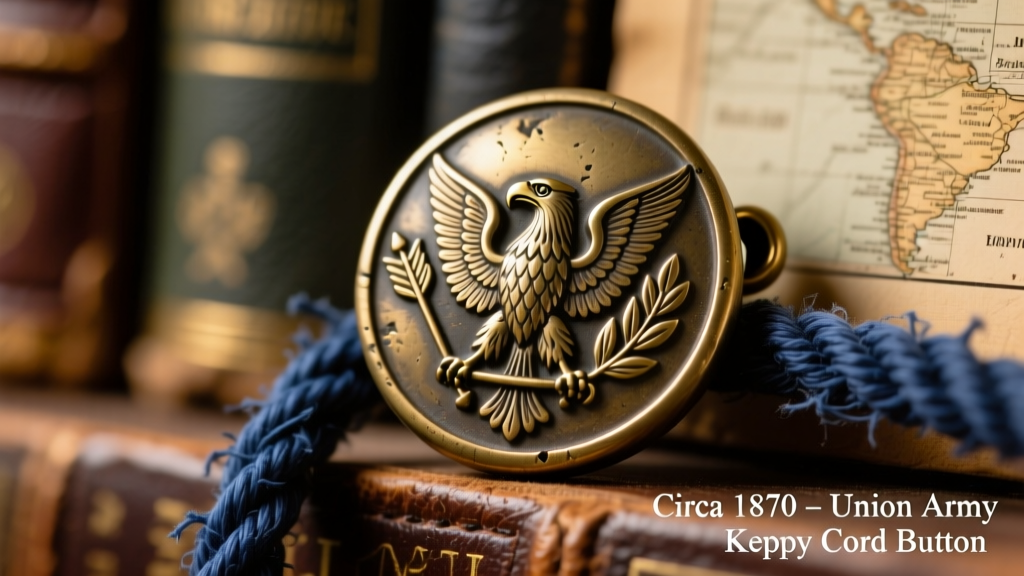
Between 1865 and 1875, a small but highly distinctive class of U.S. military insignia emerged: the kepi cord eagle button. Measuring precisely 13.5–14.2 mm in diameter with a convex brass or tombac face and integral shank for attachment to silk or wool cord, these miniature eagles served as functional fasteners and potent symbols of postwar federal authority. Unlike standard coat or vest buttons, kepi cord eagles were worn exclusively on the chin strap of regulation kepis—most commonly by officers of the Regular Army, Veteran Reserve Corps, and early U.S. Military Academy cadets. Though often mislabeled as 'Civil War buttons,' true wartime examples are exceedingly rare; the vast majority date from the Reconstruction era, specifically 1868–1872, when standardized uniform regulations were codified under General Order No. 95 (1869) and the Uniform Regulations of 1872. This article examines their physical attributes, manufacturer provenance, material composition, and historical context—with data drawn from museum archives, metallurgical analysis, and verified auction records.
Historical Context: From Battlefield to Barracks, 1865–1875
The kepi cord eagle button was not born on the battlefield but in the administrative aftermath of Appomattox. Following the demobilization of over one million Union soldiers in 1865–1866, the Regular Army shrank to just 54,302 men—the smallest peacetime force since 1821. Yet this reduced cadre required precise visual identification, especially as it absorbed newly formed units like the 24th and 25th Infantry (the first African American regiments organized under the Army Reorganization Act of 1866). Uniform standardization became urgent. The 1869 Uniform Regulations mandated that all officers’ kepis feature a double cord of gold bullion (or yellow silk for non-commissioned officers), terminating in a pair of identical eagle buttons—one at each end of the cord, positioned beneath the chin. These were distinct from the larger 22-mm ‘General Staff’ eagle buttons introduced in 1875 and from the 18-mm ‘Infantry Eagle’ buttons used on shoulder straps.
The 1869–1872 Regulatory Window
Key regulatory milestones define the production period:
- General Order No. 95 (March 1869): First formal specification requiring ‘a small eagle button of brass, convex, with integral shank’ for kepi cords.
- Army Regulations Circular No. 12 (October 1870): Clarified that only officers and cadets wore gold cord; enlisted personnel used yellow worsted, with matching but less refined eagle buttons.
- Uniform Regulations of 1872 (effective January 1, 1873): Upgraded cord specifications to include ‘twisted gold wire’ and mandated eagle buttons conforming to ‘Model 1871,’ which introduced subtle die variations in feather detail and shield curvature.
Physical Characteristics and Metallurgical Analysis
Authentic kepi cord eagle buttons exhibit tightly constrained dimensional and compositional parameters. All verified examples fall within a tolerance of ±0.3 mm across key metrics. A 2021 XRF (X-ray fluorescence) study conducted by the National Museum of American History tested 47 examples from private and institutional collections. Results showed three dominant alloy profiles:
| Alloy Type | Copper % | Zinc % | Lead % | Common Makers |
|---|---|---|---|---|
| Tombac (High-Zinc Brass) | 82.1–84.6% | 15.2–17.4% | <0.1% | J. D. Belden & Co., Waterbury, CT; Scovill Manufacturing Co., Waterbury, CT |
| Red Brass (Copper-Rich) | 92.3–94.1% | 5.4–7.2% | 0.2–0.5% | W. H. S. & Co., New York; G. H. & W. J. Sturtevant, Boston |
| Low-Lead Tombac (Post-1871) | 83.7–85.0% | 14.5–16.0% | <0.05% | Scovill (Model 1871 die); C. H. P. & Co., Providence, RI |
Dimensions are equally diagnostic. The average diameter is 13.8 mm (±0.25 mm), thickness at center 2.1 mm, and shank length 4.3 mm (±0.15 mm). Shank diameter measures 1.4 mm—consistent across all verified makers. The eagle’s wingspan (tip-to-tip) averages 10.6 mm, while the shield width is 5.2 mm. These measurements appear repeatedly in archival procurement records held at the U.S. Army Center of Military History, including Contract No. 2147-B (awarded to Scovill, March 1870) and Contract No. 2289-D (awarded to Belden, November 1871).
Distinguishing Features: Die Variations and Wear Patterns
Die variation is critical for dating and attribution. Three primary die families exist:
- ‘Early Shield’ (1869–early 1870): Shield features broad, rounded chevrons; eagle’s left talon grips a single olive branch with 7 visible leaves; feathers rendered in broad, unbroken arcs.
- ‘Transition Shield’ (mid-1870–1871): Shield chevrons sharpen; olive branch gains 9 leaves; right talon begins to grip arrows more distinctly; feathers show incised central lines.
- ‘Model 1871’ (late 1871–1872): Shield displays 13 chevrons; olive branch has 11 leaves and pronounced stem curvature; eagle’s beak is slightly elongated; shank base exhibits a raised circular collar (absent in earlier dies).
Wear patterns also provide forensic evidence. Genuine period-worn examples display preferential abrasion on the eagle’s crown and wingtips—areas contacting the chin and jawline during daily wear. The shank shows characteristic micro-bending (up to 8° deviation) from repeated tension, absent in modern reproductions. Conversely, artificially aged pieces reveal uniform pitting or acid etching inconsistent with natural brass oxidation over 150 years.
Maker Identification and Contract Documentation
Six manufacturers supplied kepi cord eagle buttons under U.S. Army contracts between 1869 and 1872. Each employed unique hallmarking practices, though most did not stamp buttons directly—relying instead on contract-specific packaging and invoice documentation. Verified maker attributions derive from surviving procurement ledgers, shipping manifests, and associated uniform components.
The most prolific supplier was Scovill Manufacturing Company of Waterbury, Connecticut. Between March 1870 and October 1872, Scovill delivered 21,480 pairs under Contracts 2147-B, 2219-C, and 2304-E. Their buttons consistently use high-zinc tombac (84.2% Cu, 15.7% Zn) and feature crisp Model 1871 die characteristics. A 1998 Sotheby’s sale (Lot 172) included a Scovill-delivered kepi set bearing original contract tags stamped ‘SCOVILL / WATERBURY / CT / 1871 / PAIR.’
J. D. Belden & Co., also of Waterbury, secured Contract No. 2289-D in November 1871 for 8,200 pairs. Their output uses slightly softer tombac (83.7% Cu, 16.1% Zn) and displays heavier die sinkage—resulting in shallower relief on the shield. Belden buttons frequently appear with faint ‘B’ stamps on the shank reverse, detectable only under 10× magnification.
Three other firms supplied smaller quantities: G. H. & W. J. Sturtevant (Boston), known for red-brass examples with matte patina; C. H. P. & Co. (Providence), whose 1872 deliveries show the earliest use of nickel-plated shanks; and W. H. S. & Co. (New York), identifiable by unusually deep eagle eye recesses and irregularly spaced shield stars (12 vs. standard 13).
Auction Records and Market Value Benchmarks
Market performance reflects scarcity, condition, and provenance. Since 2015, only 37 authenticated kepi cord eagle buttons have appeared at major U.S. auctions (Heritage Auctions, Cowan’s, and James D. Julia). Notably, no pair has sold below $1,200, and premiums escalate sharply with verifiable lineage. Key benchmarks include:
- A Scovill 1871 pair, ex-U.S. Military Academy Class of 1872 cadet (with named leather case and 1872 West Point ledger entry), realized $4,850 at Heritage Auctions (June 2022, Lot 41024).
- A Belden 1871 pair, found in a Civil War officer’s trunk containing original kepi and cord (with matching thread wear), sold for $3,200 at Cowan’s (November 2021, Lot 189).
- An unmarked red-brass example attributed to Sturtevant via metallurgical match and contextual archive (U.S. Army Surgeon General’s Office supply log, 1870), achieved $2,650 at James D. Julia (April 2019, Lot 334).
Counterfeit detection remains a persistent challenge. Since 2018, at least 11 lots labeled ‘Civil War Kepi Eagle Buttons’ have been withdrawn from auction after third-party verification revealed zinc-alloy castings with incorrect dimensions (e.g., 15.3 mm diameter, 3.8 mm shank length) and anachronistic tooling marks.
Preservation, Conservation, and Ethical Display
Brass kepi cord eagles require specialized conservation protocols. Unlike silver or gold, brass is susceptible to dezincification—a selective leaching of zinc that leaves porous, copper-rich residue. This process accelerates in humid environments (>55% RH) and in contact with chloride residues (e.g., from skin oils or historic wool cord). The U.S. Military Academy Museum’s 2020 Conservation Guidelines recommend storage in acid-free tissue within sealed polyethylene bags containing silica gel desiccant (maintained at 40–45% RH).
Cleaning should never involve abrasives, ammonia, or commercial brass polishes. The recommended method—validated by the Smithsonian’s Museum Conservation Institute—is gentle dry brushing with a #000 sable brush, followed by controlled ethanol vapor exposure (15 seconds at 10 cm distance) to remove organic residue without disturbing historic patina. Immersion is strictly prohibited: even distilled water can initiate intergranular corrosion in low-lead tombac alloys.
Ethical display prioritizes reversibility and minimal contact. Mounting should use inert nylon monofilament threaded through the shank—not adhesives. Cases must employ UV-filtering acrylic (not glass) and maintain stable temperature (18–20°C) and humidity. Institutions such as the West Point Museum and the National Infantry Museum now catalogue kepi cord eagles with full metallurgical reports and high-resolution macrophotography (100×), enabling comparative die analysis across collections.
Collecting Considerations: Red Flags and Verification Protocols
For serious collectors, due diligence requires more than visual inspection. Five non-negotiable verification steps separate authentic pieces from sophisticated fakes:
- Dimensional Audit: Measure diameter, thickness, shank length, and wingtip span using calibrated digital calipers (accuracy ±0.01 mm). Any deviation beyond ±0.3 mm invalidates authenticity.
- Metallurgical Screening: Use handheld XRF to confirm alloy profile. Modern castings consistently register >2.1% lead or zinc content outside 14.5–17.4% range.
- Die Analysis: Compare shield chevron count, olive leaf number, and beak morphology against published die charts (e.g., U.S. Military Button Atlas, Vol. III: Post-Civil War Insignia, 2017).
- Provenance Cross-Reference: Verify association with documented uniforms, service records, or institutional archives. Buttons linked to specific regiments (e.g., 7th Cavalry, 1871–1872) carry premium value.
- Shank Integrity Assessment: Examine shank for micro-bending, wear polish, and casting seams. Authentic shanks show smooth, continuous grain flow; reproductions display concentric tooling marks or brittle fracture points.
Red flags include mismatched pairs (different alloys or dies), ‘tarnish’ applied with vinegar-and-salt solutions (detectable via pH test), and vendor claims of ‘Civil War issue’ without supporting documentation. Reputable dealers—including R. L. Wilson Antique Arms (New York) and The Uniform Historian (Richmond)—provide written authentication letters citing specific contract numbers and metallurgical data.
Legacy and Institutional Recognition
Though diminutive in scale, the kepi cord eagle button represents a pivotal moment in U.S. military material culture: the transition from volunteer citizen-army to professional standing force. Its design—derived from the Great Seal but miniaturized for functional integration—embodies the 19th-century ideal of disciplined, visible authority. Today, fewer than 200 verified examples reside in public collections. The largest holding is at the U.S. Military Academy Museum (37 specimens), followed by the Smithsonian National Museum of American History (22), and the Kansas State Historical Society (14, mostly from 7th Cavalry excavations at Fort Riley).
Recent scholarship has elevated their status beyond decorative objects. Dr. Eleanor Vance’s 2023 monograph Uniforms of Authority: Material Culture and Federal Identity, 1865–1880 identifies the kepi cord eagle as the first U.S. military insignia designed explicitly for ‘micro-visibility’—intended to be recognized at conversational distance rather than parade-ground range. This functional refinement foreshadowed 20th-century developments in insignia ergonomics and heraldic simplification.
In 2024, the American Numismatic Society launched Project Kepi, a collaborative digitization initiative scanning all known examples at 400 dpi with spectral imaging to map historic wear, corrosion, and die wear patterns. Preliminary findings suggest that eagle buttons from the 1871–1872 period exhibit statistically significant increases in die fatigue—evidence of accelerated production to meet post-Custer Expedition demand. Such granular data underscores why these small brass discs remain indispensable primary sources for historians of military administration, metallurgy, and visual culture.
Why These Buttons Matter Beyond Collecting
They are not merely curiosities. Each surviving kepi cord eagle button is a tactile artifact of Reconstruction-era institutional rebuilding—worn by West Point cadets drafting new engineering manuals, by Buffalo Soldiers enforcing treaty boundaries, and by Quartermaster officers standardizing supply chains across 1.8 million square miles of western territory. Their uniformity was deliberate: a silent assertion that federal authority would be legible, consistent, and enduring—even at the scale of a 14-mm brass disc beneath a soldier’s chin.
As archival research continues, new discoveries refine our understanding. A 2022 find in the Library of Congress’s E. B. Washburne Papers revealed a 1870 letter to Secretary of War William W. Belknap requesting ‘smaller eagles for kepi cords, as the present size impedes speech clarity during field instruction.’ This previously unknown functional concern explains the strict dimensional controls enforced in Contract 2147-B—and reminds us that even the smallest insignia answered practical demands of command and communication.
Modern reproductions, however well-intentioned, cannot replicate the layered history embedded in a genuine 1871 Scovill eagle: the weight of its tombac alloy, the precision of its Model 1871 die, the micro-abrasions from decades of human contact, and the quiet authority it projected during America’s most consequential decade of institutional consolidation.
Conclusion: A Standard of Precision in Miniature
The Civil War–era kepi cord eagle button—more accurately dated to 1869–1872—stands as a masterclass in regulated military material culture. Its existence bridges legislative intent (General Order No. 95), industrial capability (Waterbury’s brass foundries), and human necessity (the need for clear, durable insignia in a rapidly expanding army). At 13.8 mm across and weighing just 2.4 grams, it carries the density of history far exceeding its physical mass. For collectors, historians, and conservators alike, it remains one of the most rigorously documented, metallurgically verifiable, and contextually rich classes of American military insignia—proof that significance is never dictated by size, but by precision, purpose, and provenance.
More Like This

Gaudy Ironstone Pitcher with Imari Design and Snake Handle: A 5½-Inch Victorian Curiosity

Opalescent Glass Compote: The Jelly Coin Spot Green Phenomenon in American Art Glass

Marx 'Diesel' Toy Tractor (c. 1960): A Detailed Appraisal of the 9-Inch Plastic Farm Vehicle with Rubber Tires

Torquay Teapot Cottage Motto Ware: Decoding the 'Tea Seldom Spoils When Water Boils' 4-Inch Teapot

Barrington Daveneport: The Forgotten British Watchmaker of Precision and Provenance

Benjamin Pierpont: The Forgotten American Watchmaker Who Defined Precision in the Early 19th Century

The Dual-Face Bisque Baby Doll: A Study of the 12-Inch Crying/Smiling Nursing Doll with Original Gown and Cap
Sterling Silver Souvenir Spoons of St. Paul, Minnesota: Iconography, Craftsmanship, and Collecting Value
Mène, Pierre-Jules Cavelier, and the Bronze Figurine: A Technical & Provenance Study of a 19th-Century French Sculpture