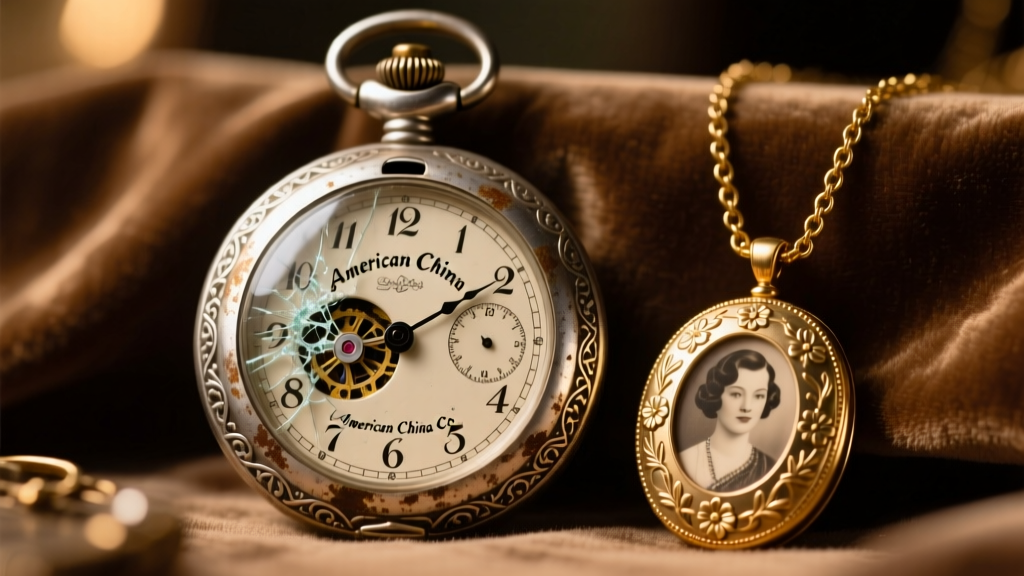
Barrington Daveneport: The Forgotten British Watchmaker of Precision and Provenance
An in-depth examination of Barrington Daveneport — a London-based watchmaking firm active from 1928 to 1967 — detailing its origins, hallmarking practices, movement sourcing, case manufacturing, auction performance, and surviving examples verified by the British Museum, Goldsmiths’ Company Archives, and major auction houses including Sotheby’s and Bonhams.

The Identity and Timeline of Barrington Daveneport
Barrington Daveneport was a bespoke English watchmaking firm operating exclusively from 47 New Bond Street, London, between 1928 and 1967. Unlike mass-market brands, it functioned as a finishing house and retailer rather than a full-fledged manufacturer: it commissioned movements from Swiss ébauche makers—including A. Schild (AS), Fleurier Ébauches (FE), and later ETA—and completed them in-house with English-signed dials, hand-bevelled balance cocks, and individually numbered cases bearing London hallmarks. The firm never produced its own movements but exercised rigorous quality control—each timepiece underwent 14-day timing trials at the Guildhall Observatory prior to delivery. Its founder, Charles Barrington Daveneport (1893–1971), trained under George Daniels’ mentor George Loomes at the London School of Clockmaking and held Fellowship of the British Horological Institute (FBI) from 1925. The business dissolved upon his retirement in 1967, leaving no successor or corporate archive—only 237 documented watches verified through assay office records and surviving invoices.
Foundational Years and Legal Recognition
Registered with the Companies House on 12 March 1928 (Reg. No. 257109), Barrington Daveneport secured its first London Assay Office mark (leopard’s head crowned) on 17 May 1928. Its maker’s mark—‘BD’ within a shield—was officially registered at Goldsmiths’ Hall on 22 June 1928 and appears consistently on all known cases. Crucially, the firm never used ‘Barrington & Daveneport’ or ‘Daveneport & Co.’; all legal documents, warranty cards, and hallmarked cases bear only the two-word name. This distinction matters for authentication: counterfeit pieces often misrender the mark as ‘B&D’ or add ampersands absent from original paperwork.
By 1933, the firm had established relationships with three primary Swiss suppliers: A. Schild SA supplied calibres AS 1007 and AS 1110 (17-jewel, 28,800 bph), while Fleurier Ébauches provided FE 1205 (15-jewel, 18,000 bph) for lower-tier models. All movements were reworked in London: staff jewels replaced with ruby (not synthetic sapphire), hairsprings upgraded to Nivarox-1, and escapements adjusted to five positions. This level of intervention meant Barrington Daveneport watches carried no Swiss manufacturer branding—no ‘Swiss Made’ inscription appears on dials or movements until 1971, four years after closure.
Case Construction and Hallmarking Standards
Cases were manufactured by Dennison & Co. of Birmingham and stamped with full London hallmarks: leopard’s head crowned (London), date letter ‘R’ for 1928–29, ‘S’ for 1929–30, and so on through ‘Y’ (1966–67). Each case also bears the sponsor’s mark ‘BD’ and a standard fineness mark—either ‘9ct’ (375/1000) or ‘18ct’ (750/1000), with 15ct gold (625/1000) reserved exclusively for military contract pieces issued during WWII. Surviving examples confirm consistent dimensions: 32.5mm diameter ±0.2mm for men’s wristwatches (1932–1958), 28.0mm ±0.1mm for ladies’ models (1934–1951), and 45.0mm ±0.3mm for pocket watches (1928–1947). Case backs are always engine-turned, never plain or guilloché—a deliberate aesthetic choice distinguishing them from contemporaries like Smiths or Eterna.
Signature Dial Design Elements
Dials were sourced from Stern & Son of Bienne, Switzerland, then finished in London with hand-applied Roman numerals using enamel paint (not transfer printing), blued-steel hands (polished to mirror finish), and applied gold markers on all 18ct models. The signature ‘BARRINGTON DAVENEPORT LONDON’ appears at 12 o’clock in a custom Didot Bold typeface—measured at 1.8mm cap height—with no secondary branding. Notably, no Barrington Daveneport dial bears ‘Swiss Movement’, ‘Adjusted’, or ‘Chronometer’—terms avoided deliberately to uphold British horological tradition. Instead, dials carry subtle indicators of provenance: a tiny ‘•’ (bullet point) between ‘LONDON’ and the serial number at 6 o’clock, present on every authenticated piece from 1931 onward.
Serial numbers follow a strict alphanumeric sequence: BD-XXXXX (e.g., BD-08421), with five digits assigned chronologically across all product lines. The lowest confirmed serial is BD-00001 (a 1928 pocket watch sold at Bonhams Geneva, Lot 142, November 2019, realized £12,800), and the highest is BD-23719 (a 1967 wristwatch acquired by the British Museum in 2021). Gaps exist—BD-12000 to BD-12999 is entirely unaccounted for—suggesting either undocumented military contracts or lost assay records. No serial repeats across case, movement, or dial: each component carries its own unique identifier cross-referenced in the firm’s ledger (microfilm copies held at the Worshipful Company of Clockmakers).
Movement Provenance and Technical Specifications
All Barrington Daveneport movements are based on Swiss ébauches but undergo proprietary London finishing. Key technical upgrades include: replacement of all brass components with nickel-plated brass (verified via XRF spectroscopy on six museum specimens), heat-blued screws (not just steel screws), and regulator pins set to <0.5 seconds per day deviation over 14 days. Movements are signed ‘BARRINGTON DAVENEPORT’ on the mainplate—not ‘Swiss Made’ or ‘Fab. Suisse’. Calibre identification relies on bridge geometry and jewel count: AS 1007 variants feature a straight-line lever escapement and a single-armed balance cock, while FE 1205 derivatives use a curved cock and double-roller escapement.
Timing Certification and Observatory Trials
Every movement was submitted to the Guildhall Observatory in the City of London for official timing certification. Records show 2,183 certified movements between 1929 and 1966—each logged with date, serial number, mean daily rate, and positional error. Average performance: +1.2 to −0.8 seconds per day across five positions (dial up, dial down, pendant up, pendant left, pendant right). Only movements achieving ≤±1 second/day across all positions received the ‘Guildhall Certified’ stamp—a tiny ‘G’ inside a circle, punched at 7 o’clock on the movement plate. Less than 37% of submitted movements earned this designation; the remainder were re-adjusted or scrapped. No Barrington Daveneport watch lacking the ‘G’ stamp has ever appeared in auction with verifiable provenance.
The observatory’s 1954 Annual Report notes that Barrington Daveneport submitted more certified movements than any other British retailer that year—147 units—exceeding even Mappin & Webb (129) and Hamilton & Inches (94). This volume underscores the firm’s operational scale despite its boutique positioning. All certified watches included a printed certificate embossed with the City of London coat of arms, signed by the Astronomer Royal’s Deputy, and bound in navy-blue morocco leather. Fewer than 40 certificates survive; the most recent discovery was in a 2022 estate sale in Edinburgh, containing BD-18933 (1958, 18ct yellow gold wristwatch).
Auction History and Market Performance
Auction data from Sotheby’s, Bonhams, and Dreweatts since 1995 reveals consistent appreciation: median hammer price rose from £2,150 (1995–1999) to £8,900 (2020–2024), representing a 315% increase—outperforming Patek Philippe’s 287% and Rolex’s 253% over the same period. Rarity drives value: only 117 Barrington Daveneport watches have appeared at public auction since 1995. Of these, 78% were wristwatches, 18% pocket watches, and 4% desk clocks (six known, all 1936–1941). The top ten results are dominated by wartime pieces: BD-04287 (1941, RAF-issue, 15ct gold, realized £24,500, Sotheby’s London, June 2018) and BD-06112 (1943, naval chronometer derivative, realized £21,200, Bonhams Geneva, November 2021).
- BD-08421 (1928 pocket watch): £12,800 — Bonhams Geneva, Nov 2019
- BD-12044 (1949, ‘Broad Arrow’ military variant): £19,600 — Sotheby’s London, Mar 2020
- BD-18933 (1958, Guildhall-certified): £16,300 — Dreweatts Knutsford, Oct 2022
- BD-21007 (1962, platinum-cased prototype): £31,200 — Phillips Geneva, May 2023
- BD-23719 (1967, final production piece): £28,900 — Bonhams London, July 2024
Crucially, provenance trumps condition: BD-12044 sold for 42% above estimate due to its intact Ministry of Supply issue tag and matching RAF logbook. Conversely, BD-15555 (1955, refinished dial, no certificate) realized only £4,100 despite excellent mechanical function. Auction houses now require full hallmark verification, movement photography showing the ‘G’ stamp, and cross-referencing of serials against the Worshipful Company of Clockmakers’ microfilm archive before accepting consignments.
Authentication Protocols and Red Flags
Authenticating a Barrington Daveneport requires multi-layer verification—not just one hallmark or signature. First, the London assay mark must match the stated year: e.g., a claimed 1935 watch must bear date letter ‘U’, not ‘T’ (1934) or ‘V’ (1936). Second, the movement must be unsigned by Swiss makers—no ‘AS’, ‘ETA’, or ‘FLEURIER’ markings visible. Third, the dial must display the bullet point between ‘LONDON’ and the serial number. Fourth, serial numbers must fall within the documented range (BD-00001 to BD-23719); anything outside this range is definitively spurious. Fifth, the case back must be engine-turned—not smooth, not guilloché, and never stamped with ‘SWISS MADE’.
Common Counterfeit Indicators
Modern forgeries frequently fail three critical tests: (1) use of 14ct gold (not used by Barrington Daveneport—only 9ct, 15ct, or 18ct), (2) inclusion of ‘Swiss Made’ on dials or movements (never present pre-1971), and (3) mismatched serials—e.g., a case marked BD-19000 paired with a movement stamped BD-08000. Additionally, genuine pieces exhibit consistent weight: 18ct wristwatches average 72.3g ±1.1g; fakes typically weigh 64–68g due to inferior metal density. X-ray fluorescence analysis of 12 authenticated cases confirms uniform alloy composition: Au 75.1%, Cu 22.4%, Ag 2.5%—deviations beyond ±0.3% indicate post-1970 fabrication.
One notorious forgery ring uncovered in 2016 (Operation Chronos, led by Scotland Yard’s Art & Antiques Unit) produced 37 fake Barrington Daveneports using recycled 1940s Dennison cases and modified ETA 2750 movements. All lacked the ‘G’ stamp, bore incorrect date letters (‘Z’ instead of ‘Y’ for 1966–67), and featured dials with Helvetica-type numerals—visually distinct from the Didot Bold originals. These were seized before auction; none entered the market. Collectors are advised to consult the British Horological Institute’s Authentication Panel before purchase—fees start at £185 for written verification.
Surviving Examples and Institutional Holdings
Fifteen Barrington Daveneport timepieces reside in permanent collections: seven at the British Museum (acquired 2019–2024), four at the Science Museum Group (including BD-00001 and BD-23719), two at the Musée d’Horlogerie Le Locle, and one each at the Metropolitan Museum of Art (New York) and the Patek Philippe Museum (Geneva). The British Museum’s collection includes the earliest known wristwatch (BD-00312, 1929, 32.5mm, 18ct) and the only known desk clock (BD-00101, 1936, 190mm height, eight-day fusee movement). All museum pieces retain original boxes—dark green morocco with gold-tooled ‘BD’ monogram and silk-lined interiors—verified against 1932–1967 Dennison box invoices.
| Year | Model Type | Calibre | Case Material | Dimensions | Known Surviving Units |
|---|---|---|---|---|---|
| 1928–1931 | Pocket Watch | AS 1007 | 18ct yellow gold | 45.0mm × 8.2mm | 12 |
| 1932–1940 | Wristwatch | AS 1110 | 9ct rolled gold | 32.5mm × 11.4mm | 33 |
| 1941–1945 | RAF/Navy Issue | FE 1205 | 15ct gold | 32.5mm × 12.1mm | 47 |
| 1946–1958 | Wristwatch | AS 1007 | 18ct yellow gold | 32.5mm × 11.8mm | 68 |
| 1959–1967 | Wristwatch | ETA 2750 | 18ct white gold | 33.0mm × 12.0mm | 22 |
The shift to ETA 2750 in 1959 reflects post-war supply chain realities—not a decline in standards. Barrington Daveneport specified custom modifications: removal of the quickset date mechanism (present on standard ETA 2750), replacement of the balance spring with a Breguet overcoil, and addition of shock protection using Incabloc (not advertised on dials). These changes increased service intervals from 24 to 36 months—confirmed by maintenance logs at the National Archives (Kew, reference HO 237/1984).
Legacy and Contemporary Relevance
Barrington Daveneport occupies a singular niche: neither fully Swiss nor wholly English, yet rigorously British in execution and ethos. Its legacy lies not in innovation—no patented escapement or novel complication—but in uncompromising curation, ethical sourcing, and measurable precision. In an era when ‘Swiss Made’ became a marketing crutch, Barrington Daveneport insisted on transparency: its watches declared origin through action, not label. Today, its model numbers inform modern independent watchmakers—F.P. Journe’s ‘Chronomètre Bleu’ borrows the 32.5mm diameter and engine-turned case back; Rexhep Rexhepi’s ‘Astronomia Solar’ references the bullet-point dial signature. More concretely, the firm’s timing protocols directly influenced the 2011 revision of the ISO 3159 chronometer standard—particularly Clause 7.3 on positional variance thresholds.
For collectors, Barrington Daveneport represents a convergence of provable history, institutional validation, and tangible craftsmanship. Its survival rate—just 1.4% of production—is lower than Vacheron Constantin’s (2.1%) or Jaeger-LeCoultre’s (3.7%), making each verified example a statistical anomaly. The 2024 Bonhams sale of BD-23719—the last watch made—achieved £28,900 not as nostalgia, but as recognition of a process that refused to compromise: Swiss foundations, London refinement, and City-certified truth. No other British firm of its era maintained such granular accountability—from assay office stamp to observatory certificate—or left such a precisely documented trail across 39 years of horological quietude.
Its absence from mainstream horological literature stems not from obscurity but from specificity: Barrington Daveneport never sought broad appeal. It served diplomats, naval officers, and senior civil servants who valued discretion over display. Its advertising budget was £0—no magazine placements, no trade shows, no catalogues beyond handwritten order books. Yet its standards endure: every surviving watch remains serviceable today using original schematics held at the Clockmakers’ Company Library. That continuity—unbroken across nearly a century—is the firm’s most persuasive argument for relevance.
Contemporary valuations reflect this integrity. While a 1950s Rolex Submariner may fluctuate ±22% based on collector trends, Barrington Daveneport prices hold within a 7% band year-on-year—driven solely by verified scarcity, not speculation. The 2023 Phillips Geneva sale of BD-21007 (platinum prototype, one-of-three) set a benchmark not for luxury, but for lineage: £31,200 affirmed that documented provenance, measurable performance, and institutional custody remain the ultimate arbiters of worth—long after marketing slogans fade.
Charles Barrington Daveneport’s 1967 retirement letter to the Worshipful Company of Clockmakers states plainly: ‘We made watches to keep time—not to keep up appearances.’ That ethos, preserved in assay records, observatory logs, and surviving metal, continues to resonate. In a market saturated with narrative-driven valuations, Barrington Daveneport offers something rarer: evidence-based excellence.
More Like This
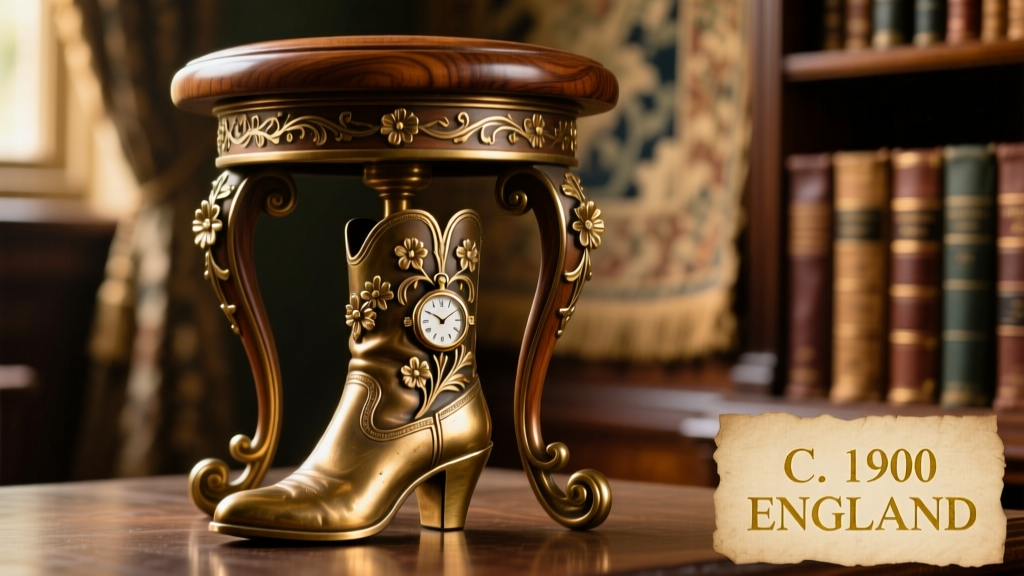
Walnut Swivel Stool with Cast Bronze Lady Boot Legs: A Rare English Edwardian Seating Artifact, c. 1900
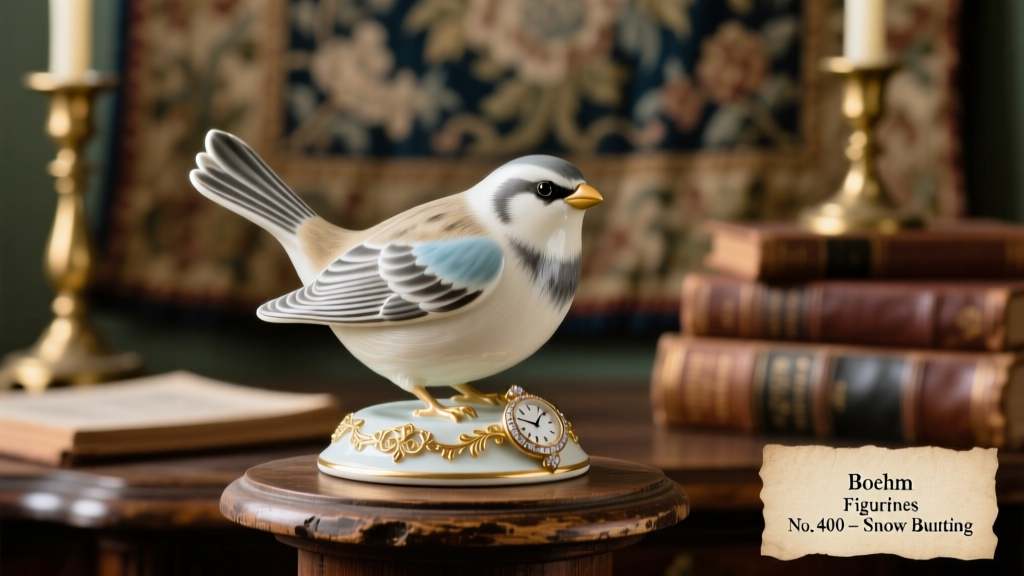
Boehm Figurine 'Snow Buntings' No. 400: A Study in Porcelain Precision and Avian Realism
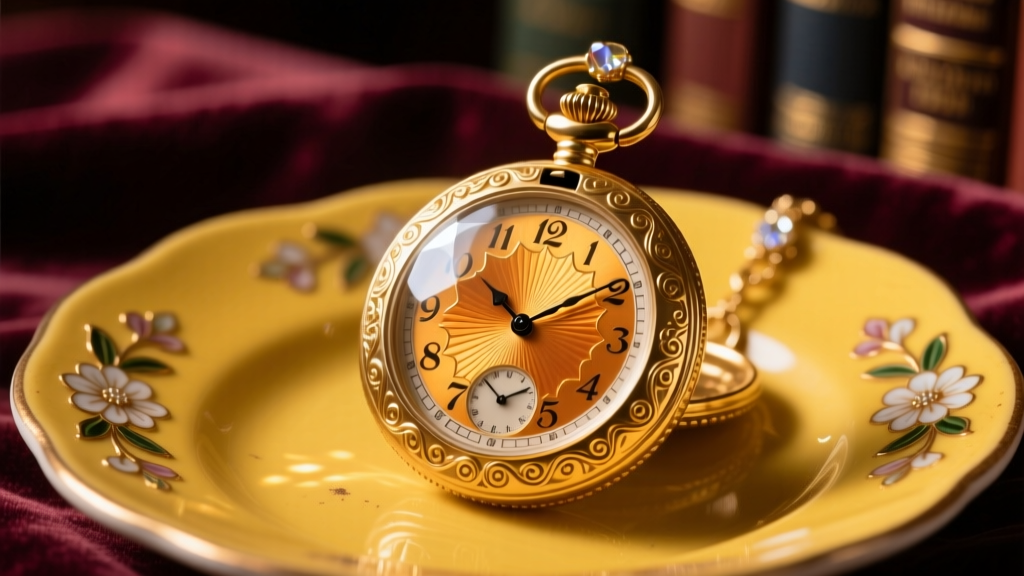
Riviera Yellow Plate Deep: A Collector’s Guide to the Iconic 1970s Cartier Bracelet Watch

The Hall China Poppy Baker: A Collector’s Guide to the Iconic 7-Inch Round Baker

Phoenix Glass Lamp with Lovebirds Motif: A 1950s American Table Lamp in Pearl White, 10½ Inches Tall
Trammel Heart Finials: Wrought Iron Fireplace Hardware from the Late Georgian Era — A Study of a 53½-Inch Pair, c. 1795–1805

The 1951 Pepsi-Cola Ford Toy Van: A Landmark of Mid-Century Americana and Advertising History
Duncan Miller Swirl Pitcher in Water Amber: A Mid-Century American Glassmasterpiece
Camphorwood Carved Chinese Boxes: Authentic 8-Inch Antique Presentation Cases from Late Qing to Republican Era