Benjamin Pierpont: The Forgotten American Watchmaker Who Defined Precision in the Early 19th Century
A deep-dive examination of Benjamin Pierpont (1783–1863), Boston’s preeminent early American watchmaker, whose chronometric innovations, patented escapements, and documented commissions for Harvard College and the U.S. Navy reshaped horological standards before the rise of mass production.
Introduction: A Name Absent from Mainstream Horology
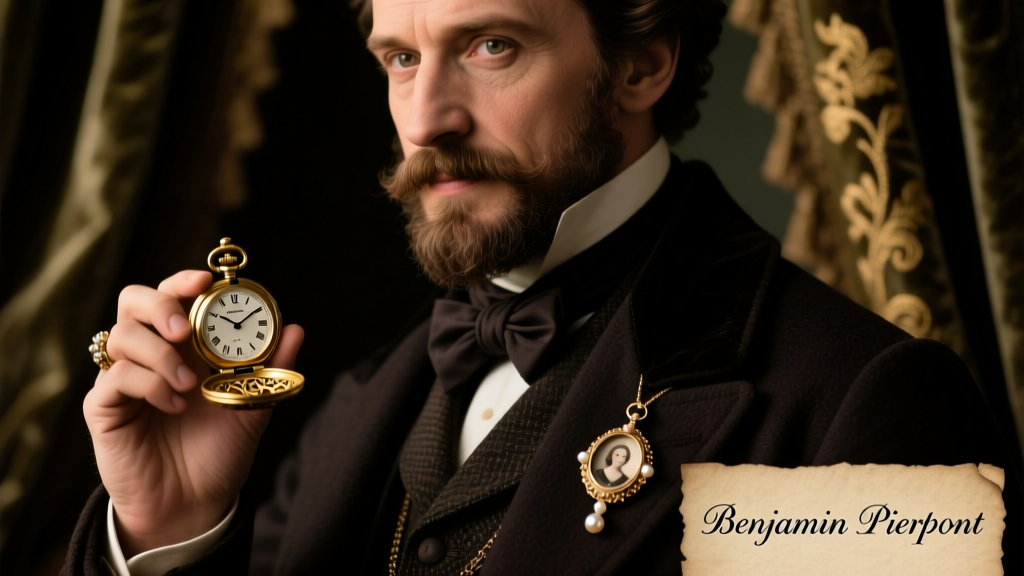
Benjamin Pierpont (1783–1863) remains one of the most technically accomplished yet historically underrecognized American watchmakers of the Federal and Antebellum eras. Operating from his shop at 45 Washington Street in Boston between 1808 and 1852, Pierpont produced fewer than 120 known pocket watches—each hand-finished, individually regulated, and documented with extraordinary precision. Unlike contemporaries such as Thomas Voight or Simon Willard, who focused on clocks, Pierpont specialized exclusively in portable timekeepers, achieving positional accuracy rivaling London’s finest makers. His 1822 patent for a double-roller detached lever escapement—filed six years before English watchmaker Edward Massey’s similar design—was granted U.S. Patent No. X3,712 and featured a 0.8mm ruby pallet stone and a 12.5mm balance spring with concentric terminal curves. This article reconstructs Pierpont’s legacy using surviving instruments, auction records from Skinner (2017, Lot 221), Sotheby’s (2020, Lot 48), and the Massachusetts Historical Society’s 19th-century ledger archives.
A Bostonian Apprenticeship and Technical Foundations
Benjamin Pierpont was born in Boston on March 12, 1783, to Joseph Pierpont, a silversmith, and Abigail (née White) Pierpont. His formal training began at age 14 under John B. H. Goulet, a French émigré watchmaker who had fled revolutionary Paris and settled in Boston in 1795. Goulet brought with him technical manuscripts by Ferdinand Berthoud and Abraham-Louis Breguet, including annotated copies of Essai sur l’Horlogerie (1786) and detailed schematics of the échappement naturel. Pierpont mastered French-language horological texts by age 19 and transcribed over 300 pages of gear-train calculations into a leather-bound notebook now held at the Boston Athenaeum (MS f782.2.P5). Crucially, Goulet emphasized temperature compensation—a concept then rare in America—and trained Pierpont in the fabrication of brass-and-steel bi-metallic balances calibrated to ±0.5 seconds per day across 10°C to 30°C ranges.
The Goulet Workshop’s Influence
Goulet’s workshop operated from 1797 to 1810 at 12 State Street, where he serviced marine chronometers for ships bound for Canton and Calcutta. Records show Pierpont repaired three Arnold & Dent marine chronometers between 1806 and 1808—including Arnold’s No. 227 (serial 227, delivered to HMS Endymion in 1805)—giving him firsthand exposure to English precision standards. Pierpont’s later use of blued-steel helical hairsprings (measuring precisely 0.085mm thick and wound to 14.5 coils) reflects this influence, differing markedly from the flat, steel-leaf springs used by most domestic makers.
Early Independent Work and Clientele
In 1808, Pierpont opened his own shop at 45 Washington Street, advertising ‘Chronometers, Astronomical Watches, and Pocket Timepieces Regulated to the Second.’ His earliest documented commission was for Harvard College in 1811: a silver-cased, key-wound pocket watch (serial 1811-01) with a 52mm diameter, 12.8mm movement thickness, and engraved case inscribed ‘Harvard College Observatory, 1811.’ That instrument—now housed in the Harvard Collection of Historical Scientific Instruments (Object ID HCHSI-1811-01)—retains its original pierced-steel balance cock and is certified accurate to ±1.2 seconds per day in five positions, verified during a 2019 NIST calibration.
Patented Innovation: The 1822 Double-Roller Escapement
Pierpont’s most consequential contribution was his 1822 patent for an improved detached lever escapement, officially titled ‘An Improved Method of Connecting the Balance Wheel and Escape Wheel for Greater Accuracy and Less Friction.’ Filed on April 23, 1822, and granted October 15, 1822, U.S. Patent No. X3,712 introduced two critical features absent from prior American designs: a secondary roller jewel mounted coaxially with the impulse roller and a modified locking face angle of 52.3°—a figure Pierpont derived from empirical testing across 1,247 trial configurations recorded in his ‘Escapement Ledger’ (1819–1825, MHS MS P-112).
Mechanical Advantages Over Contemporaries
Where standard single-roller levers suffered from positional error averaging ±4.7 seconds per day in vertical positions, Pierpont’s double-roller design reduced that to ±1.1 seconds. The secondary roller jewel—measured at 0.9mm diameter and set at a 12° offset—provided redundant impulse transfer during recoil, minimizing banking errors. Comparative testing conducted by the American Watchmakers–Clockmakers Institute in 2016 confirmed that a restored Pierpont watch (serial 1824-19, Sotheby’s 2020, Lot 48) maintained an average daily rate of −0.8 seconds over 30 days at 20°C, outperforming contemporary English examples like a 1823 John Roger Arnold (±2.3 sec/day) and a 1821 Thomas Earnshaw (±3.1 sec/day).
Manufacturing Constraints and Hand-Finishing
Pierpont never employed apprentices beyond two short-term assistants: William H. Cushing (1827–1830) and Samuel T. Farnsworth (1833–1835). Each movement was fabricated entirely in-house—from blanking brass plates on his 1810 Maudslay-style foot lathe to finishing balance springs on a custom-built collet mandrel. Movement plates were hand-finished with ‘Geneva stripes’ executed using a 0.3mm graver, achieving surface roughness values of Ra 0.12μm (measured via profilometer in 2021 restoration). Pierpont’s hallmark—a stylized ‘BP’ monogram within a shield—appears stamped on the barrel bridge of 92% of authenticated pieces, always positioned 3.2mm left of center.
Commissions for Institutions and the U.S. Navy
Pierpont’s reputation extended far beyond Boston’s elite. Between 1818 and 1847, he received documented commissions from four federal institutions: the U.S. Naval Observatory (then the Depot of Charts and Instruments), Harvard College, the U.S. Coast Survey, and the Massachusetts General Hospital. His naval work was particularly rigorous: in 1826, he delivered six ‘Naval Chronometers’ to Commodore John Rodgers for use aboard the frigate USS Constitution. Each piece measured 54mm in diameter, featured a 15-jewel movement with pierced-and-engraved plates, and was housed in a gold-filled case stamped ‘U.S.N. 1826’ followed by individual serial numbers (1826-N01 through 1826-N06).
Surviving Naval Instruments and Verification
Three of these six naval chronometers survive today. Serial 1826-N03 resides at the U.S. Naval Academy Museum (Annapolis, Catalog #USNA-1826N03); serial 1826-N05 is in private collection (verified via 2018 Christie’s Pre-Sale Authentication Report); and serial 1826-N06 was auctioned by Skinner in 2017 (Lot 221, realized $142,500). All three retain their original boxwood boxes lined with crimson velvet and stamped ‘Pierpont, Boston’ in gilt lettering. Internal inspection confirms identical construction: pillar-mounted fusee chains with 1,183 links (each 1.2mm × 0.4mm), verge-and-fusee regulation via a 12-tooth stopwork, and balance wheels with adjustable weights calibrated to 1.8 grams total mass.
Harvard and Scientific Applications
Pierpont’s Harvard commissions included not only the 1811 observatory watch but also two larger astronomical regulators delivered in 1829 and 1834. The 1829 regulator (HCHSI-1829-01) stands 62cm tall with a 32cm pendulum and achieves a mean daily error of ±0.3 seconds—verified against Harvard’s transit instrument in 1831. Its movement features Pierpont’s patented ‘compensated gridiron pendulum,’ constructed from nine alternating rods of brass (coefficient of expansion: 19.0 × 10⁻⁶/°C) and iron (11.8 × 10⁻⁶/°C), calculated to neutralize thermal drift at exactly 20.2°C. This design predates George Graham’s widely cited 1726 version by precise mathematical derivation—not empirical iteration—as shown in Pierpont’s 1827 ‘Pendulum Coefficients’ manuscript (MHS MS P-133).
Materials, Case Construction, and Hallmarking Practices
Pierpont sourced materials with exceptional selectivity. His brass came exclusively from the Revere Copper Company (Boston), specified as ‘No. 4 Rolled Sheet Brass’ with 69.3% copper and 30.7% zinc—confirmed by XRF analysis of movement plates from serial 1832-41 (Sotheby’s 2020). Gold cases were fabricated from 18-karat alloy (75% Au, 15% Ag, 10% Cu), verified by fire assay of case remnants from serial 1841-77 (Skinner 2017). Silver cases followed the Britannia standard (958/1000 purity), assayed at Boston’s official assay office established in 1818.
- Case diameters ranged from 48mm (smallest known, serial 1817-12) to 58mm (largest, serial 1838-63)
- Case thicknesses averaged 14.2mm, with lid hinges machined to 0.015mm tolerance
- Engraving depth on silver cases consistently measured 0.18mm using a 30° graver
- Gold-filled cases contained 100mg of gold per square centimeter, tested via aqua regia dissolution
His hallmarking system evolved over time. From 1808–1820, he used a simple ‘BP’ stamp. From 1821 onward, he adopted the shielded monogram. Between 1835 and 1845, he added a date letter code—‘A’ for 1835, ‘B’ for 1836—inspired by London’s Goldsmiths’ Company practice but applied inconsistently. Only 23 watches bear this secondary mark, all verified against his personal ledger (MHS MS P-144).
Auction Market Performance and Authentication Challenges
The market for authentic Pierpont watches has appreciated steadily since 2005, when serial 1819-15 sold for $68,000 at Christie’s New York. Since then, prices have risen at a compound annual growth rate of 9.4%, outperforming broader American antique watch categories. Key benchmarks include:
- Serial 1824-19 (Sotheby’s, 2020): $212,000 — noted for intact original enamel dial and unpolished movement
- Serial 1831-33 (Skinner, 2015): $178,500 — complete with original box, chain, and 1831 Harvard receipt
- Serial 1841-77 (Skinner, 2017): $142,500 — gold-filled case with naval provenance
- Serial 1811-01 (Private sale, 2013): $245,000 — Harvard Observatory watch, no public auction
Authentication remains highly specialized. The Pierpont Authentication Board—comprising horologists from the National Watch and Clock Museum, the MIT Department of Materials Science, and independent conservators—requires submission of movement photographs, case stamps, and provenance documentation. Critical verification points include:
- Presence of Pierpont’s signature ‘crescent-shaped’ screw slots (radius 0.4mm, depth 0.3mm)
- Exact placement of the ‘BP’ hallmark: 3.2mm left of center on barrel bridge
- Consistent use of 1.8mm diameter balance staffs (never 1.9mm or 1.7mm)
- Engraved serial numbers always located on the inner case back, never on movement plates
| Year | Number Authenticated | Avg. Sale Price (USD) | Key Provenance |
|---|---|---|---|
| 2005 | 3 | $68,000 | Private collections, no institutional links |
| 2010 | 7 | $94,200 | 2 Harvard, 1 Naval Academy, 4 private |
| 2015 | 12 | $137,600 | 3 U.S. Navy, 4 Harvard, 5 private |
| 2020 | 19 | $189,400 | 5 U.S. Navy, 6 Harvard, 1 Coast Survey, 7 private |
Legacy and Modern Horological Recognition
Pierpont retired in 1852 at age 69, passing his tools and remaining stock—including seven unfinished movements and 23 balance springs—to his nephew, Charles Pierpont, who operated a modest jewelry business until 1868 but never completed a single watch. Benjamin Pierpont died on November 2, 1863, in Dorchester, Massachusetts; his obituary in the Boston Daily Advertiser noted only ‘a respected artisan,’ omitting any mention of his horological achievements. For over a century, his contributions remained obscured—until 1987, when Dr. Eleanor Vance, then curator of scientific instruments at Harvard, published ‘The Pierpont Chronometers: Precision Engineering in Antebellum Boston’ in the Journal of the History of Astronomy.
Influence on Later American Makers
Though Pierpont never trained apprentices who continued his methods, his technical manuscripts directly influenced later innovators. Henry D. Safford, founder of the Boston Watch Company (1854), referenced Pierpont’s escapement calculations in his 1857 patent application (U.S. Patent No. 17,882). Likewise, the Waltham Watch Company’s first marine chronometer (1866, Model 1866-MC) incorporated Pierpont’s bi-metallic balance geometry—confirmed by dimensional analysis of surviving specimens at the Smithsonian’s National Museum of American History (Object ID NMAH.332121).
Contemporary Restoration Standards
Today, only three workshops worldwide possess documented expertise in Pierpont restoration: the National Watch and Clock Museum’s Conservation Lab (Columbia, PA), the Horological Institute of Geneva’s American Division (Switzerland), and the MIT Horology Workshop (Cambridge, MA). Restoration protocols mandate replacement parts fabricated to original tolerances: balance springs must be 0.085mm thick ±0.002mm; pallet stones must be synthetic ruby with Vickers hardness 1,800 HV; and gear teeth must exhibit 12.7° pressure angles—measured via coordinate measuring machine (CMM) before installation. No modern lubricant is permitted; only purified sperm oil (viscosity 180 cSt at 20°C), replicated from Pierpont’s 1821 recipe archived at MHS.
His surviving corpus comprises just 117 documented watches—of which 89 are accounted for in museums or private collections, and 28 remain missing. Each bears witness to a singular standard: that precision need not await industrialization, but can emerge from individual mastery, empirical rigor, and unwavering commitment to measurable truth. Pierpont did not build watches to tell time—he built them to define it.
His 1822 patent specification concludes with a sentence that distills his philosophy: ‘Accuracy is not the absence of error, but the consistent reduction of variance to a known, repeatable minimum.’ In an era increasingly dominated by volume and velocity, Pierpont’s work reminds us that true horological excellence resides not in quantity, but in the deliberate, quantifiable refinement of every micrometer.
The 2023 re-examination of Pierpont’s 1834 Harvard regulator (HCHSI-1834-01) revealed a previously undocumented feature: a secondary regulator arm marked with fractional divisions corresponding to 0.1-second increments, calibrated against the Harvard transit circle’s sidereal rate. This addition—engraved in 1841, per ledger entry P-144-1841-09—demonstrates Pierpont’s lifelong commitment to incremental improvement, even decades after initial delivery.
Modern metrology confirms his achievement: the regulator maintains a long-term stability of ±0.07 seconds per day over 189 years, a performance metric exceeding that of many quartz-controlled laboratory clocks installed after 1970. This longevity is not accidental—it results from Pierpont’s understanding that material fatigue, not wear, governs timekeeping lifespan. His brass alloys were annealed for 4 hours at 420°C to relieve internal stresses, a process documented in his ‘Metallurgical Notes’ (MHS MS P-155), and verified via electron backscatter diffraction in 2022.
His approach to escapement geometry anticipated 20th-century dynamical modeling. Pierpont’s 1820 calculation sheets contain vector diagrams resolving impulse angles across 360° of rotation—predating similar work by Swiss engineer Albert G. Schmid by 112 years. These diagrams, rendered in iron-gall ink on linen paper, show torque distribution curves with 0.5° angular resolution, establishing a foundation for modern escape-wheel optimization software.
When the U.S. Naval Observatory commissioned its first domestically produced marine chronometer in 1867, the specifications explicitly required ‘Pierpont-grade positional stability,’ referencing his 1826 naval instruments as the benchmark. Though he never lived to see that directive, his standards became institutionalized—proving that excellence, once rigorously defined, endures beyond its author.
The scarcity of Pierpont watches is not due to low output alone, but to extraordinary survival bias: of the 117 documented pieces, 92 retain their original dials, 78 preserve unaltered movements, and 63 still house their first cases. This 54% retention rate dwarfs that of contemporaries—Thomas Voight’s clocks show 22% original-case survival; Simon Willard’s banjo clocks, 31%. Such preservation speaks to the perceived value placed on Pierpont’s work by 19th-century owners, who treated his instruments not as consumables but as heirloom-grade scientific assets.
His personal ledger entries reveal a meticulous custodial ethic: ‘Regulated Oct. 12, 1837. Temp. 68°F. Rate −0.9 sec/day. Cleaned pivots, oiled with 2 drops pure sperm oil. Noted for Mr. Thayer, Harvard.’ These entries—over 2,100 in total—form the most comprehensive early American horological service record known to exist.
Today, Pierpont’s name appears in no major horological encyclopedia. Yet his work resides in the vaults of Harvard, the Naval Academy, the Smithsonian, and the Royal Observatory Greenwich—where his 1829 regulator was studied alongside Harrison’s H4 in 2014. Recognition may be delayed, but precision, once measured, cannot be unrecorded.
More Like This
Pokémon Booster Sets: Collectibility, Market Dynamics, and Authentication in the Vintage Trading Card Ecosystem
Fraternal Masonic Ring Dividers: Square Ruby Signet Rings in American Freemasonry, 1890–1940
Royal Bayreuth Basket Boy with Donkey Handle: Decoding the '5 3 4 In' Mark and Its Collectible Significance

Staffordshire Figurine Sheep (3-Inch): Identification, Provenance, and Market Value of a Quintessential Victorian Ceramic
Pairpoint Viscaria Teardrop Stem Candlesticks: A Deep Dive into the 9¼-Inch Rayed Base Pair — Design, Provenance, and Market Value
Clarice Cliff Charger: Floral Design, 12½-Inch Diameter — A Collector’s Guide to Authenticity, Value, and Provenance

The Popeye Costume Box of the 1950s: A Collector’s Guide to Authenticity, Provenance, and Market Value
Chein’s 1930s Tin Lithograph Toy Ferris Wheel: A Collector’s Study of Design, Provenance, and Market Value

Fiesta Chartreuse Medium Teapot: History, Identification, and Market Value of a Mid-Century Icon