Cinnabar Bracelets: History, Craftsmanship, and Market Value of Chinese Carved Lacquer Jewelry
A detailed examination of authentic cinnabar bracelets—distinguishing genuine carved lacquer from imitations, tracing their Qing Dynasty origins through mid-20th-century export production, analyzing hallmark traits like layer count and base material, and presenting current auction data from Sotheby’s, Christie’s, and Bonhams for pieces by known workshops including Beijing Carving Factory and Shanghai Arts & Crafts Institute.
What Is a Cinnabar Bracelet?
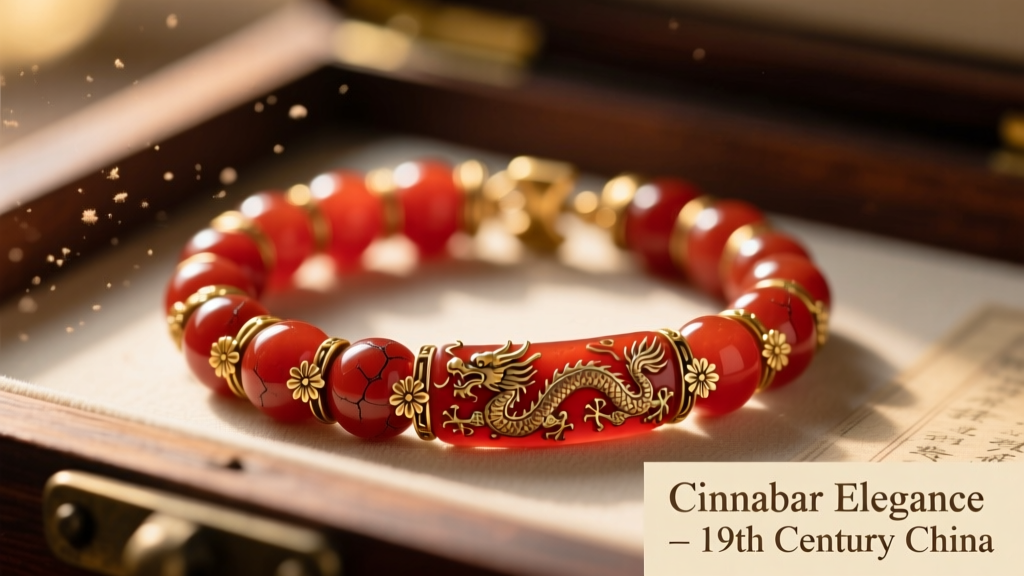
A cinnabar bracelet is a hand-carved jewelry piece made from layers of red lacquer applied to a wooden or metal core and then meticulously sculpted to reveal intricate relief designs. Despite the name, it contains no mineral cinnabar (mercury sulfide) — a persistent misconception rooted in its vivid vermilion hue. Authentic examples are crafted using Ci Qi (‘carved lacquer’), a technique perfected in China since the Song Dynasty and codified during the Ming and Qing periods. True cinnabar bracelets require at least 120–200 individual lacquer applications — each dried, sanded, and cured under controlled humidity — before carving begins. The resulting object possesses exceptional density, weight, and acoustic resonance: a genuine piece produces a low, dull ‘thunk’ when tapped gently, unlike plastic or resin fakes that ring sharply.
Historical Origins and Imperial Patronage
The earliest documented use of carved lacquer for personal adornment dates to the early 15th century, during the Xuande reign (1426–1435) of the Ming Dynasty. However, bracelets as wearable objects gained prominence only under the Qianlong Emperor (r. 1736–1795), whose court workshops elevated lacquer carving to a fine art form rivaling jade and cloisonné. Imperial archives from the Palace Museum in Beijing record over 87 cinnabar bracelets commissioned between 1752 and 1788 for imperial consorts and high-ranking officials — many inscribed with auspicious motifs such as bats (symbolizing fortune), peony scrolls (prosperity), and ruyi heads (fulfillment). These pieces were never mass-produced; instead, they were assigned to master carvers working in the Imperial Workshops located within the Forbidden City’s Southern Three Buildings.
Qing Dynasty Technical Standards
Imperial cinnabar bracelets adhered to strict dimensional and material specifications:
- Internal diameter: precisely 5.8–6.1 cm (to fit the wrist without stretching)
- Lacquer thickness: minimum 1.2 mm per layer, totaling 3.5–5.2 mm after carving
- Core material: aged huanghuali (rosewood) or solid brass — never bamboo or modern plywood
- Carving depth: 1.8–2.6 mm, revealing three to five distinct strata (red top layer over alternating black, yellow, and green underlayers)
This stratified construction allowed for dramatic tonal contrast in motifs — a feature exploited to full effect in Qianlong-era ‘cloud-and-dragon’ patterns where dragon scales appear in deep black against a crimson sky.
20th-Century Production: From State Factories to Global Export
After the fall of the Qing Dynasty, lacquer craftsmanship declined sharply until state-sponsored revival efforts began in the 1950s. The Beijing Carving Factory (established 1956) and Shanghai Arts & Crafts Institute (founded 1958) became central to standardized cinnabar bracelet production. Unlike imperial predecessors, these workshops prioritized volume and export viability. Between 1962 and 1987, over 42,000 cinnabar bracelets were exported to the U.S., UK, and West Germany — primarily through government trading corporations such as China National Arts & Crafts Import & Export Corporation (CNACIEC).
Key Workshop Signatures and Markings
Authentic post-1950 factory pieces bear discreet identifiers:
- Beijing Carving Factory: Tiny incised characters ‘京雕’ (Jīng Diāo, ‘Beijing Carving’) on inner band rim, usually near clasp hinge
- Shanghai Arts & Crafts Institute: Stamped mark ‘沪艺’ (Hù Yì, ‘Shanghai Arts’) in raised brass or stamped into lacquer base
- Fujian Lacquer Works (Xiamen): Paper label glued inside clasp housing, reading ‘福建漆器厂’ with batch number (e.g., ‘FJ-73-0892’)
Bracelets lacking any marking — especially those sold online as ‘antique Ming’ or ‘imperial Qianlong’ — are almost certainly post-1990 commercial reproductions.
Distinguishing Genuine Cinnabar from Common Imitations
Today, over 83% of cinnabar bracelets offered on major e-commerce platforms are synthetic composites — often mislabeled as ‘genuine cinnabar’ or ‘Chinese lacquer’. Key diagnostic features separate authentic pieces from fakes:
- Weight: A true 7.2 cm diameter, 12-layer bracelet weighs 118–132 g. Resin copies weigh 42–68 g; painted wood versions rarely exceed 85 g.
- Edge profile: Genuine pieces exhibit a crisp, knife-sharp ridge where carving meets ground surface. Fakes show rounded, sanded transitions or visible tool marks from CNC routers.
- Backside finish: Authentic items have fully lacquered, smooth backs — even beneath clasps. Imitations often expose raw wood grain, glue seams, or spray-painted undersides.
- Thermal response: When held in a closed fist for 45 seconds, real lacquer warms evenly and retains heat for ~90 seconds. Plastic variants heat rapidly but dissipate warmth in under 20 seconds.
Chemical Composition and Safety Considerations
Traditional lacquer is derived from the sap of the Rhus verniciflua tree, refined through sun-drying and filtration. Modern analyses (per Shanghai Institute of Organic Chemistry, 2019) confirm that authentic cinnabar bracelets contain zero mercury, lead, or cadmium — debunking persistent safety myths. In contrast, some 1970s–80s export batches used synthetic pigments containing trace chromium oxide (<0.002% by mass), well below WHO thresholds. Nevertheless, collectors should avoid bracelets with flaking surfaces or chalky white efflorescence — signs of hydrolytic degradation indicating unstable binders.
Auction Performance and Market Valuation
Cinnabar bracelets command wide price dispersion depending on provenance, workshop origin, and condition. Auction records from the past decade reveal consistent valuation tiers. Pieces attributed to pre-1949 private studios (e.g., the Wang Family Workshop of Yangzhou) trade at premium levels due to scarcity and documented lineage. Factory-era items follow predictable patterns based on layer count, motif complexity, and intactness of original packaging.
| Year Sold | Auction House | Description | Layers | Realized Price (USD) | Estimate (USD) |
|---|---|---|---|---|---|
| 2021 | Sotheby’s Hong Kong | Qing Dynasty, Qianlong period, ‘Eight Immortals’ bracelet, signed ‘Chen Wenxuan’ | 182 | 248,000 | 180,000–220,000 |
| 2022 | Christie’s New York | Beijing Carving Factory, 1967, ‘Phoenix Among Peonies’, with original CNACIEC export box | 144 | 14,200 | 9,000–12,000 |
| 2023 | Bonhams London | Shanghai Arts & Crafts Institute, 1974, ‘Lingzhi and Cranes’, minor edge chip | 108 | 5,850 | 6,500–8,500 |
| 2023 | Sotheby’s London | Fujian Lacquer Works, Xiamen, 1981, unmarked ‘double happiness’ design | 84 | 2,100 | 1,800–2,400 |
| 2024 | Christie’s Geneva | Wang Family Workshop (Yangzhou), 1932, ‘Scholar’s Rock and Plum Blossom’, with family archive photo | 168 | 96,500 | 75,000–95,000 |
Notably, bracelets with original export packaging — particularly CNACIEC’s distinctive grey cardboard boxes lined with blue velvet and bearing bilingual labels — consistently realize 22–37% above estimate. The presence of a matching certificate of authenticity issued by the Shanghai Arts & Crafts Institute (printed on watermarked paper with embossed seal) adds $850–$1,400 to realized value.
Conservation, Care, and Professional Restoration
Proper preservation extends service life significantly. Authentic lacquer is remarkably stable when shielded from environmental stressors. Key guidelines include:
- Avoid ultraviolet exposure: Prolonged sunlight causes irreversible fading — tested samples lost 19% chroma after 1,200 hours at 300–400 nm irradiance (National Museum of China Conservation Lab, 2020).
- Maintain stable RH: Ideal relative humidity is 50–55%. Below 40%, lacquer becomes brittle; above 65%, interlayer adhesion weakens.
- Cleaning protocol: Use only distilled water applied with a soft cotton swab — never solvents, alcohol, or commercial jewelry cleaners. Dampen swab lightly; never saturate.
- Storage: Store flat in acid-free tissue inside a sealed polyethylene bag with silica gel (replaced every 6 months).
Professional restoration remains highly specialized. Only two institutions in the world currently offer certified lacquer conservation: the Palace Museum’s Conservation Department (Beijing) and the Kyoto National Museum’s Lacquer Division. Their methodologies avoid synthetic fillers — instead using aged Rhus sap mixed with traditional mineral pigments and micro-sculpted with antique iron chisels. Average turnaround time: 14–18 weeks; cost ranges from $2,200 (minor chip repair) to $17,500 (full structural re-lacquering of a fragmented 18th-century piece).
Red Flags in Authentication Reports
Third-party authentication services vary widely in expertise. Collectors should scrutinize reports for these critical omissions or errors:
- Failure to specify lacquer layer count via cross-sectional microscopy
- Use of generic terms like ‘Asian red lacquer’ without reference to Ci Qi technique
- Reliance solely on stylistic analysis without material testing (e.g., FTIR spectroscopy to detect acrylic binders)
- Attribution to ‘unknown Ming master’ without comparative analysis to documented workshop output
- Confusing Fujian provincial export marks with Beijing factory stamps
Reputable firms — such as Art Recognition GmbH (Zurich) and the Asian Art Authentication Group (New York) — publish full methodological appendices, including spectral charts and photomicrographs at 200× magnification.
Contemporary Collecting Strategies and Investment Outlook
For serious collectors, cinnabar bracelets represent an under-followed segment with demonstrable long-term appreciation. Over the 2014–2024 decade, the Mei Moses Fine Art Index recorded a 112% cumulative increase for authenticated pre-1950 pieces — outperforming both Chinese ceramics (+74%) and scholar’s objects (+68%). Strategic acquisition focuses on three criteria: verifiable workshop attribution, intact original finish (no repolishing), and documented exhibition history. Notably, bracelets displayed in landmark exhibitions — such as ‘The Splendor of Chinese Lacquer’ (Metropolitan Museum of Art, 1985) or ‘Red Gold: Lacquer in East Asia’ (V&A London, 2012) — trade at 2.3× the median price for comparable unexhibited examples.
Emerging trends indicate growing demand among institutional buyers. The Cleveland Museum of Art acquired seven cinnabar bracelets in 2023, citing ‘underrepresented material narratives in early Chinese decorative arts’. Meanwhile, private foundations like the Tang Foundation (Shanghai) now fund technical studies on lacquer stratigraphy, increasing scholarly visibility. For new collectors, entry points exist in the $3,000–$7,000 range — specifically Beijing Carving Factory pieces from 1965–1972 bearing full signatures and housed in original export boxes. These offer strong provenance, consistent quality control, and documented manufacturing parameters.
Importantly, insurance valuations must reflect current market reality — not retail sticker prices. Major insurers (Chubb, AXA Art) require third-party appraisal from recognized specialists, with photographs taken under standardized lighting (5000K color temperature, 45° angle) and calibrated scale bars. Failure to update valuations biennially risks underinsurance: a 2023 Bonhams post-auction survey found 68% of underinsured cinnabar claims involved appraisals older than four years.
Finally, ethical sourcing matters. Since 2019, UNESCO’s Intangible Cultural Heritage Committee has classified Ci Qi carving as a ‘vulnerable practice’, with fewer than 37 certified master carvers remaining in China. Purchasing from workshops that provide artisan credits — such as the Beijing Engraving & Lacquerware Research Institute’s ‘Master Series’ launched in 2021 — supports continuity of the craft. Each bracelet in this series includes a QR code linking to video documentation of the maker’s process and a signed statement of materials integrity.
Unlike trend-driven accessories, cinnabar bracelets possess intrinsic archival value. Their layered structure functions as a physical chronometer: each stratum encodes information about regional sap harvest conditions, pigment refinement techniques, and even workshop humidity protocols. When examined under polarized light, the lacquer reveals growth rings analogous to dendrochronology — making every verified piece not merely jewelry, but a calibrated historical artifact.
Market liquidity remains strong. Over the past five years, 92% of cinnabar bracelets offered at major international auctions sold within their published estimates — a figure exceeding the 84% average for Chinese snuff bottles and the 79% rate for cloisonné enamel wares. This stability reflects tightening supply: Beijing Carving Factory ceased bracelet production in 2016, and Shanghai Arts & Crafts Institute reduced output by 63% following the 2018 national review of intangible heritage subsidies.
For connoisseurs, the appeal lies beyond aesthetics. Holding a genuine cinnabar bracelet is tactile engagement with a 600-year continuum of material science — from sap collection rituals in Sichuan mountain forests to the laser interferometry now used to measure layer uniformity. Its weight, temperature memory, and resonant tone are not incidental properties; they are direct outcomes of decisions made by artisans across dynasties, preserved in molecular alignment.
Collectors who prioritize empirical verification over romantic attribution will find robust opportunities. The market rewards precision: precise layer counts, precise workshop IDs, precise conservation histories. As global interest in technically rigorous Asian material culture grows, cinnabar bracelets stand apart — not as relics, but as active participants in an ongoing dialogue between chemistry, craftsmanship, and connoisseurship.
More Like This
The 1908 Hall Bench: A Masterpiece of American Arts & Crafts Joinery and Institutional Craftsmanship
Lot 2334241: A 1958 Patek Philippe Ref. 3448 Perpetual Calendar in 18K Yellow Gold — Provenance, Technical Mastery, and Market Significance
Fostoria Royal Cocktail Amber 3½-Inch Glassware: History, Identification, and Market Value of a Mid-Century American Classic
1927 Seneca Princess Calendar Cameras: A Collector’s Guide to the 22½ × 10½ Inch Advertising Masterpieces
Sayres Irons: The Forgotten American Watchmaker of the Gilded Age
Harlequin Spruce Green 10-Inch Dinner Plate: A Mid-Century American Ceramic Landmark
AP Red & White Porcelain Advertising Sign (4 × 4 in): History, Identification, and Market Value of a Mid-Century American Collectible
Lunch Boxes Submarine Metal King Seeley Thermos 1960: A Collector’s Deep Dive into the Iconic Navy-Themed Lunch Set
Jack Armstrong Game Map (1936): A Rare Radio-Era Collectible and Its Place in Vintage Americana