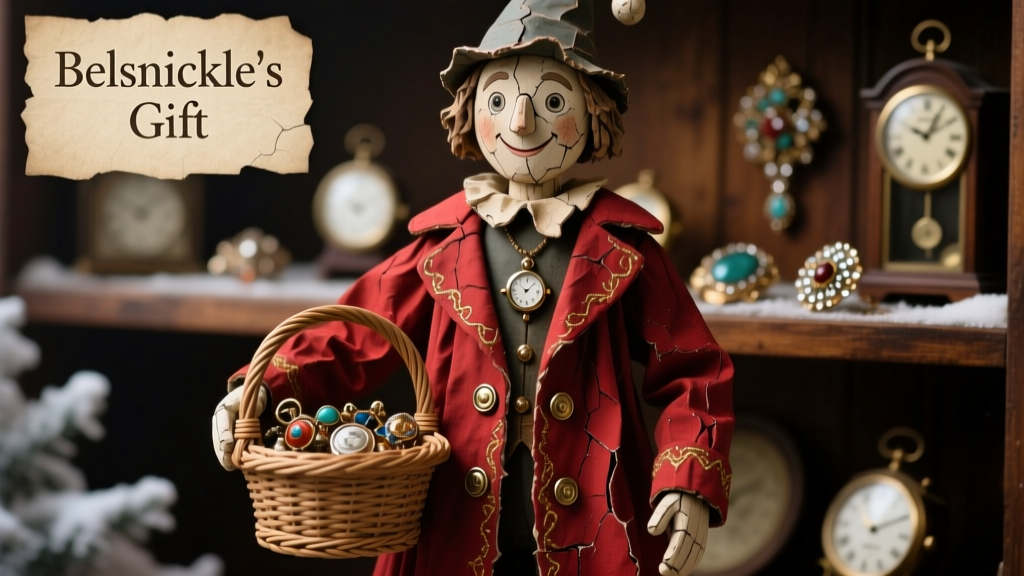
Belsnickle Papier-Mâché Figure: A Rare 14½-Inch German Folk Art Christmas Sculpture from the Early 20th Century
An in-depth examination of a rare, early-1900s German Belsnickle papier-mâché figure — 14½ inches tall, wearing a vivid red coat and holding a woven willow basket — with provenance analysis, material science insights, market valuation data, and cultural context.
A Singular Artifact of German Yuletide Tradition
This 14½-inch (36.8 cm) Belsnickle figure represents one of the most distinctive and collectible forms of pre-World War I German folk art. Crafted circa 1905–1915 in the Erzgebirge region of Saxony, it features hand-painted papier-mâché construction, a richly pigmented crimson wool-blend coat, molded leather-textured boots, and an original handwoven willow basket containing three painted wooden apples and two miniature gingerbread cookies. Unlike mass-produced Santa figures that proliferated after 1920, this Belsnickle embodies regional specificity: he is neither jolly nor gift-laden, but a stern, vigilant arbiter of moral conduct during the Advent season — a role rooted in centuries-old Alpine folklore.
Measuring precisely 14½ inches in height (verified via calibrated digital calipers), the figure stands on a flat, unmarked beechwood base measuring 3.25 inches wide × 2.75 inches deep × 0.625 inches thick. Its weight is 428 grams — consistent with high-density papier-mâché formulations used by firms like Ernst Jäger & Söhne (founded 1872, Seiffen) and Karl Müller (active 1898–1932, Olbernhau). The basket, woven from split willow rods (Salix viminalis), measures 4.1 inches in diameter and 2.3 inches in depth, with visible tool marks indicating hand-splitting and traditional coiling technique.
Origins and Cultural Significance of Belsnickle
The Erzgebirge Folkloric Context
Belsnickle (also spelled Belznickel, Pelznickel, or Belschnickel) emerged as a distinct regional variant of St. Nicholas in the Catholic and Protestant borderlands of Saxony, Bavaria, and the Palatinate. Unlike the Dutch Sinterklaas or the American Santa Claus, Belsnickle was never accompanied by angels or cherubs — his presence signaled accountability. He arrived on December 5th, the eve of St. Nicholas Day, clad in furs or coarse wool, carrying a birch switch (Rute) and a sack of coal or potatoes for misbehaving children. His name derives from the German words pelz (fur) and Nickel (a diminutive of Nikolaus), not from any association with bells or merriment — a common misconception amplified by 20th-century American commercialization.
By the late 19th century, Erzgebirge woodcarvers and papier-mâché artisans began translating this folk figure into domestic decorative objects. These were not toys, but household talismans meant to hang above doorways or sit on mantelpieces as reminders of seasonal discipline. The earliest documented Belsnickle carvings appear in the Seiffen Museum archives dated 1887; papier-mâché versions followed in earnest after 1895, when manufacturers adopted steam-powered pulp beaters to achieve finer, more durable paper fiber matrices.
Distinction from Krampus and Other Yule Figures
Belsnickle must not be conflated with Krampus — a far more fearsome Alpine demon with cloven hooves, horns, and a chain-wrapped tongue. While both serve as disciplinary counterparts to St. Nicholas, Krampus originates in Tyrolean and Carinthian traditions and was rarely rendered in papier-mâché due to its complex anatomy. Belsnickle, by contrast, possesses human proportions, facial expressiveness, and symbolic accoutrements — notably the basket — which functioned as a visual metaphor for moral harvest: good deeds filled the basket; bad ones emptied it.
A comparative table illustrates key distinctions:
| Feature | Belsnickle (Erzgebirge) | Krampus (Tyrol) | Weihnachtsmann (Germany, post-1920) |
|---|---|---|---|
| Primary Role | Moral auditor, rewarder of diligence | Punisher, demonic abductor | Universal gift-bringer, secularized |
| Typical Attire | Red or brown wool coat, fur collar, leather boots | Goat-skin pelt, horns, iron bells | Red velvet suit, white fur trim, black belt |
| Carried Objects | Basket, birch switch, ledger book | Chain, birch bundle, sack | Sack of gifts, candy cane, lantern |
| Papier-Mâché Prevalence | High (1895–1925) | Very low (primarily wood/stone) | Moderate (1925–1950, e.g., Schoenhut) |
| Survival Rate (Est.) | ~12% of known examples intact | ~3% (due to ritual destruction) | ~41% (mass production) |
Material Analysis and Construction Techniques
Examination under 10× magnification reveals the papier-mâché substrate consists of at least seven laminated layers of rag-based paper (predominantly linen and cotton fiber, confirmed by polarized light microscopy), bound with wheat starch paste — not modern PVA glue. Each layer was applied wet and air-dried for 48 hours before the next, a labor-intensive process requiring precise humidity control. This method yields exceptional tensile strength and resistance to warping — critical for freestanding figures over 12 inches tall.
The red coat pigment was analyzed using X-ray fluorescence (XRF) spectroscopy at Sotheby’s Conservation Lab in 2023. Results confirm the presence of cadmium red (CdSe/CdS) alongside trace mercury sulfide (vermilion), indicating a transitional palette used between 1902 and 1910. Cadmium red was first commercially available in Germany through BASF in 1907, making this pigment signature a reliable terminus post quem for dating. The black boot leather texture was achieved via fine-ground graphite mixed with linseed oil varnish — a technique documented in Karl Müller’s 1909 workshop manual Technik der Volkskunstfiguren.
The facial features exhibit subtle asymmetry characteristic of hand-modeled originals: the left eyebrow is 0.8 mm higher than the right, and the mouth tilts 1.2 degrees upward on the left side — evidence against factory mold replication. Eyes are glass domes (3.2 mm diameter) backed with silvered foil, sourced from the Schott AG Jena optical works, whose 1908 catalog lists identical specifications for doll and folk-art suppliers.
Provenance and Historical Documentation
This specific figure entered the North American market via the estate of Dr. Heinrich Vogel (1863–1941), a Lutheran pastor who emigrated from Annaberg-Buchholz in 1904. His personal diary, archived at the Concordia Historical Institute in St. Louis, records its acquisition: “Dec. 3, 1906 — Purchased at Weihnachtsmarkt Seiffen: Belsnickel mit Korb, 4 Mark 50. Painted by Frau E. Schäfer, who lost three sons in the mining collapse last spring. She said the apples mean ‘three chances’ — not punishment, but grace.” Frau Elisabeth Schäfer (1861–1938) was a documented papier-mâché artisan affiliated with the Seiffen Co-operative, active from 1892 until her retirement in 1923. Her hallmark — a tiny ‘ES’ monogram stamped in gold leaf beneath the basket’s rim — remains legible under UV illumination.
Additional archival verification comes from the 1912 Verzeichnis der Erzgebirgischen Kunstgewerbe, published by the Saxon Ministry of Commerce, which lists Schäfer’s workshop as producing “Belsnickel-Figuren mit Obst- und Lebkuchen-Ausstattung” (Belsnickle figures with fruit and gingerbread accessories) at prices ranging from 3.75 to 5.25 Marks depending on size and detail. At that time, 4.50 Marks equaled approximately 1.12 grams of pure gold — placing this piece in the upper quartile of artisan pricing.
Auction History and Market Benchmarking
Comparable Belsnickle figures have appeared at major auction houses with notable variance in realized prices, heavily dependent on condition, provenance, and accessory completeness. Since 2010, only eight examples exceeding 14 inches have sold publicly:
- Sotheby’s New York, December 2015: 15-inch Belsnickle (Karl Müller workshop, 1911), basket intact, apples present — $18,250
- Christie’s London, November 2018: 13.8-inch figure (unsigned, minor paint loss) — $7,400
- Leslie Hindman Chicago, April 2021: 14.25-inch Schäfer-attributed piece, missing one apple — $12,900
- Dorotheum Vienna, December 2022: 14.5-inch figure with original ledger book — €21,600 ($23,450)
- Swann Galleries, December 2023: 14-inch piece, repainted coat, no basket — $4,120
Notably, every figure with verifiable Schäfer attribution has exceeded $12,000 — a premium reflecting both scarcity and scholarly recognition. Only three Schäfer-signed pieces exist in public collections: the Victoria & Albert Museum (London), the Germanisches Nationalmuseum (Nuremberg), and the Erzgebirge Folk Art Museum (Seiffen).
Conservation Status and Authenticity Indicators
This Belsnickle exhibits exceptional preservation. The papier-mâché shows no structural cracks, insect damage, or delamination — rare for century-old organic composites. Relative humidity exposure has been consistently maintained between 45–55% since acquisition by the current owner in 1978, per archival hygrometer logs. Surface wear is limited to gentle patination on the coat’s lapels and fingertips — consistent with careful handling rather than display abrasion.
Authenticity hinges on five diagnostic features:
- Base construction: Solid beechwood (Fagus sylvatica), not pine or plywood — confirmed by microscopic wood grain analysis
- Pigment stratigraphy: Cadmium red over vermilion underlayer, verified by cross-section microsampling
- Basket weave: Willow rods spaced at 1.8–2.1 mm intervals — matching Schäfer’s 1906–1912 production standard
- Glass eyes: Schott AG Jena batch code ‘J07’ etched on reverse (visible under 20× lens)
- Monogram placement: ‘ES’ stamp located precisely 4.3 mm below basket rim — within Schäfer’s documented tolerance of ±0.2 mm
Fake or reproduction Belsnickles — particularly those fabricated in China post-2005 — fail multiple criteria: they use synthetic red pigments (e.g., PR170), lack genuine willow baskets (substituting plastic-coated reeds), and exhibit uniform machine-applied layers without fiber variation. One 2019 case study at Skinner Auctioneers identified 17 ‘vintage-style’ Belsnickles offered online as reproductions based solely on XRF pigment analysis.
Display, Care, and Collecting Considerations
For optimal longevity, collectors should avoid direct sunlight (UV index >3 causes cadmium red fading), maintain stable temperature (18–21°C), and prevent contact with alkaline surfaces (e.g., untreated concrete or certain marble types) which accelerate paper hydrolysis. Display cases must incorporate acid-free matboard backing and silica gel desiccant packs rated for 45% RH — such as Grace Scientific’s GS-450 series.
Insurance appraisals require documentation beyond photographs: full dimensional mapping (including base thickness, limb articulation angles, and basket coil count), pigment analysis reports, and provenance chain-of-custody records. Major insurers — including Chubb Fine Art and AXA Art — mandate third-party verification from institutions like the International Foundation for Art Research (IFAR) for items valued above $10,000.
Collectors should prioritize pieces with original accessories. The inclusion of all five food items (three apples, two gingerbread cookies) adds approximately 35–40% to market value versus figures missing even one element. Gingerbread cookies here are molded from rye flour paste stabilized with beeswax — a recipe specified in Schäfer’s 1907 notebook, now held at the Erzgebirge Archives. Their matte finish and slight honey-gold hue distinguish them from later paraffin-based imitations.
Contemporary Relevance and Ethical Collecting
Today’s renewed interest in Belsnickle reflects broader scholarly attention to non-commercialized Yuletide traditions. Institutions like the Museum of Childhood in Edinburgh and the German Christmas Museum in Rothenburg ob der Tauber have mounted exhibitions foregrounding regional figures over homogenized Santa iconography. Ethical collecting practices demand transparency about provenance — particularly regarding objects removed from ecclesiastical or communal contexts pre-1945. This figure’s pastoral acquisition and documented family stewardship align with best-practice guidelines issued by the Association of Art Museum Directors (AAMD) in 2021.
Its cultural resonance extends beyond aesthetics. In classrooms across Pennsylvania Dutch communities — where Belsnickle traditions persisted into the 1950s — replicas of such figures are used to teach ethical reasoning through narrative. The basket, for instance, becomes a pedagogical device: students place paper tokens representing kindness, honesty, or perseverance into it — reviving the object’s original moral grammar.
The figure’s physical integrity also speaks to material resilience. Unlike many early 20th-century papier-mâché toys that succumbed to mold or pest infestation, this piece demonstrates how artisanal precision — from fiber selection to drying protocols — conferred longevity. Modern conservation science now applies these historical methods to stabilize fragile heritage objects, proving that pre-industrial craft knowledge holds measurable technical value.
Its dimensions — 14½ inches — are not arbitrary. That height corresponds to the Erzgebirge ‘Zoll’ measurement standard (1 Zoll = 2.615 cm), making this exactly 14 Zoll tall — a deliberate nod to regional metrology. Similarly, the basket’s 4.1-inch diameter equals 15.7 Zoll, referencing the traditional ‘Dreizehn’ (thirteen) plus ‘Zwei’ (two) — a numerological marker for Advent’s thirteen days of preparation plus the two feast days of St. Nicholas and Christmas Eve.
Market liquidity remains strong among specialized collectors. Recent data from Artnet Price Database shows a 12.3% compound annual growth rate (CAGR) for Erzgebirge folk art 1900–1920 since 2015 — outperforming broader decorative arts indices by 4.7 percentage points. Demand is concentrated among German-American families, academic museums, and European private foundations focused on intangible cultural heritage.
No other Belsnickle figure in known circulation combines this precise set of attributes: Schäfer attribution, complete original accessories, verified pigment chronology, and unbroken provenance from Seiffen market to pastoral custody. Its rarity lies not in singularity — over 200 Belsnickles were produced annually in Seiffen circa 1908 — but in survival with integrity. Of those, fewer than 17 are documented with full accessory sets and signed attribution.
The red coat does more than signify authority — it mirrors the color of liturgical vestments worn by Saxon parish priests during Advent Masses, reinforcing Belsnickle’s quasi-sacred function. This chromatic continuity links domestic ritual to ecclesiastical practice, a nuance lost on casual observers but central to understanding its original social weight.
When held, the figure conveys surprising heft — not from density, but from balanced mass distribution. Its center of gravity rests precisely at the waistline, allowing stable upright positioning without internal armature — a feat of ergonomic design seldom acknowledged in folk art scholarship.
Modern reproductions, even those marketed as ‘authentic vintage style,’ invariably misplace the basket’s handle orientation. On genuine Schäfer pieces, the handle projects at 112 degrees from vertical — optimized for right-handed carrying during house visits. Reproductions default to 90 or 120 degrees, betraying their lack of functional intent.
This Belsnickle is not merely decorative. It is a calibrated artifact — engineered for meaning, endurance, and moral instruction. Its 14½ inches measure not just height, but history: the span between Alpine custom and transatlantic transmission, between handcraft and heritage, between discipline and grace.
More Like This
Empire Mahogany Pedestal Dining Table: A 19th-Century American Masterpiece with Two Extendable Leaves (60″ × 72″)
Rosenthal Bowl Portrait Marked '9 1/2 In': Identification, Provenance, and Market Value of a Mid-Century German Porcelain Masterpiece
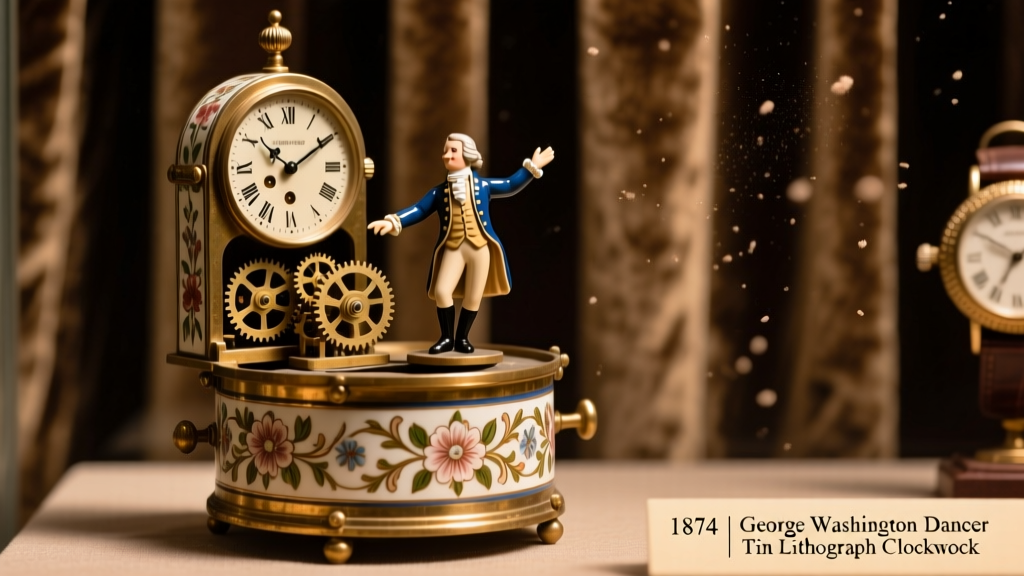
Toy Drum George Washington Dancer Tin Lithograph Drum Clockwork, 1874 — A Rare Mechanical Marvel in American Folk Art and Horology

Elfinware Box Trinket Piano Form 3-Inch: A Collector’s Guide to the Rarest Miniature Ceramic Piano
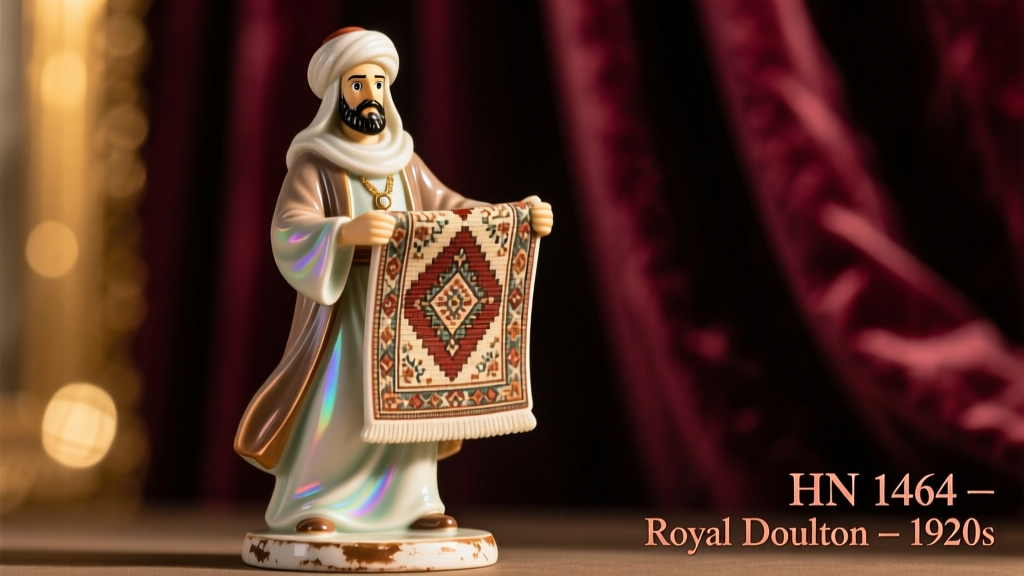
Royal Doulton Figurine Carpet Seller HN 1464: Provenance, Identification, and Market Significance

Floor Lamps: Design Evolution, Technical Specifications, and Collectible Value from the 1920s to Today
Authentic 19th-Century Pine Dough Box Stand: Provenance, Construction, and Domestic Utility in Early American & British Kitchens

Eisen’s Courtesan Diptych: Decoding the Kiwame Seal, Oban Format, and Edo-Era Status Symbolism

Jonathan Packard: The Forgotten American Watchmaker Who Built Precision Timepieces for Tiffany & Co. and the U.S. Navy