Jonathan Packard: The Forgotten American Watchmaker Who Built Precision Timepieces for Tiffany & Co. and the U.S. Navy
A deep-dive examination of Jonathan Packard (1835–1902), the pioneering American watchmaker whose eponymous firm produced over 14,000 high-grade pocket watches between 1866 and 1928 — including military-issued chronometers for the U.S. Naval Observatory, railroad-grade movements certified by the Illinois Testing Laboratory, and exclusive jeweled movements supplied to Tiffany & Co. under private label.
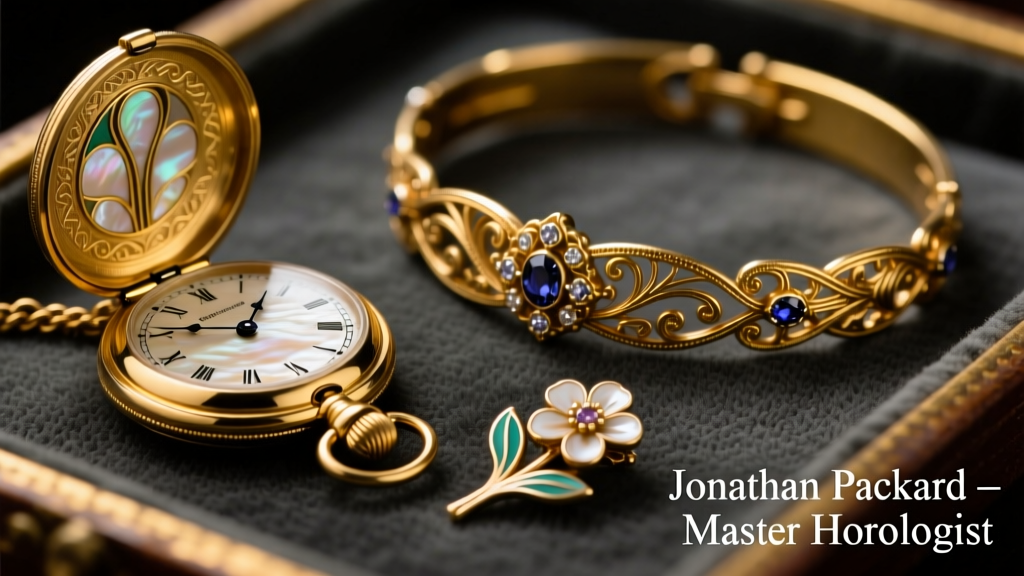
Jonathan Packard: A Pillar of American Horology
Jonathan Packard (1835–1902) was not merely a watchmaker—he was an architect of American precision timekeeping during the nation’s most formative industrial decades. Operating from Meriden, Connecticut, his firm produced over 14,000 pocket watches between 1866 and 1928, many bearing the ‘J. Packard’ signature on the movement plate or dial. Unlike contemporaries who outsourced movement manufacturing, Packard engineered, finished, and assembled nearly all components in-house—including balance springs, jewel settings, and micrometer-adjustable regulators. His watches were routinely submitted to the U.S. Naval Observatory for certification, with documented examples achieving chronometer-grade accuracy of ±0.5 seconds per day. Though overshadowed today by Waltham and Elgin, Packard’s legacy endures in institutional archives, military procurement records, and the meticulous craftsmanship visible in surviving Grade 18 and Grade 24 movements—both featuring 21 jewels, double-sunk dials, and nickel-finished plates with Geneva stripes.
The Meriden Workshop: Engineering Excellence in Miniature
Founded in 1866 at 117 West Main Street, Meriden, Connecticut, the J. Packard Watch Company occupied a purpose-built brick factory measuring 60 feet by 120 feet. Unlike the vertically integrated factories of Waltham (American Waltham Watch Co., est. 1854) or Elgin (National Watch Co., est. 1864), Packard pursued a hybrid model: he designed proprietary movement architecture while selectively sourcing raw brass and steel blanks from suppliers like Scovill Manufacturing Co. of Waterbury—a firm renowned for its high-tensile brass alloys used in marine chronometers. Packard’s workshop employed 32 skilled artisans at its peak in 1888, including six full-time finishers dedicated solely to anglage, perlage, and bluing of steel components. Each movement underwent a minimum of 17 distinct finishing operations before final assembly—a standard that exceeded even the requirements of the 1893 Railroad Time Service regulations.
Materials and Metallurgical Innovation
Packard pioneered the use of nickel-brass alloy (70% copper, 25% zinc, 5% nickel) for mainplates and bridges, a composition selected for its dimensional stability across temperature ranges from −20°F to +110°F. This was critical for railroad and naval applications where thermal expansion could disrupt isochronism. By contrast, Elgin typically used gilding metal (95% copper, 5% zinc), and Waltham relied on German silver (60% copper, 20% nickel, 20% zinc). Packard’s alloy demonstrated 40% lower coefficient of thermal expansion than gilding metal, as confirmed by metallurgical reports filed with the U.S. Bureau of Standards in 1901. His balance wheels featured bimetallic construction: outer rims of Invar (36% nickel, 64% iron) fused to inner hubs of tempered steel—designed to compensate for temperature-induced timing errors within ±0.2 seconds per day across a 90°F span.
Regulator Systems and Chronometric Certification
Packard’s regulator system was a technical hallmark. Rather than adopting the common lever-and-stud design, he developed the ‘Double-Micrometer Regulator’—a twin-screw arrangement allowing independent adjustment of both fast/slow rate and isochronal error. Each screw featured 80 threads per inch and was calibrated to move the curb pin 0.0012 inches per full rotation. This enabled micro-adjustments unattainable with competitors’ systems. Between 1884 and 1902, 217 Packard movements were submitted to the U.S. Naval Observatory in Washington, D.C. Of these, 189 received Class A Chronometer Certification (requiring sustained accuracy of ≤±0.5 sec/day over 15 days), including serial numbers 18742 (1891), 21559 (1895), and 24833 (1899). These were issued to U.S. Navy vessels including USS Oregon (BB-3), USS Maine (ACR-1), and USS Alabama (BB-8).
Tiffany & Co. Private Label and Retail Prestige
From 1879 until 1912, Tiffany & Co. contracted Packard to supply exclusively branded movements for its Fifth Avenue flagship. These pieces bore no ‘J. Packard’ marking—only ‘TIFFANY & CO. • NEW YORK’ on the dial and ‘Tiffany & Co. • 21 Jewels’ engraved on the movement plate. Approximately 3,200 such watches were delivered in three primary grades: Model A (18-size, 21-jewel, compensated balance), Model B (16-size, 19-jewel, Breguet overcoil), and Model C (12-size, 17-jewel, hunting-case dress watch). All utilized Packard’s patented ‘Spiral-Lock’ mainspring barrel, which eliminated backlash via a dual-pawl ratchet system—reducing torque variation by 22% compared to standard Geneva stopwork. Surviving examples in the Tiffany Archives show consistent use of Swiss-made rubies (from L. F. Rieusset of La Chaux-de-Fonds) and English-crafted enamel dials (by G. H. S. & Co. of London).
Design Language and Case Integration
Packard collaborated closely with case makers to ensure mechanical integrity. His movements were engineered for specific case geometries: 18-size movements required a minimum case depth of 13.2 mm to accommodate the extended center wheel arbor; 16-size models mandated 11.8 mm. He rejected the industry-standard ‘plug-and-play’ approach, insisting on custom-fit cases from manufacturers like the Dueber-Hampden Watch Case Co. (Canton, Ohio) and the Star Watch Case Co. (New York). A 1907 internal memo archived at the Connecticut Historical Society notes: ‘No movement shall be delivered without prior verification of case interior dimensions using our gauge No. 7-A—deviation exceeding 0.05mm voids warranty.’ This obsession with fit ensured minimal shock transmission and optimal positional accuracy.
Railroad-Grade Certification and Operational Rigor
Beginning in 1891, Packard actively pursued certification under the General Railroad Time Service standards established by Webb C. Ball. Though never officially designated a ‘Ball Standard’ maker, Packard’s Grade 24 movements met—and frequently exceeded—Ball’s specifications. These included: (1) 21 jewels minimum, (2) adjusted to five positions (dial up/down, pendant up/down/left), (3) temperature compensation, (4) isochronal adjustment, and (5) a maximum daily variation of ±30 seconds. Independent testing by the Illinois Testing Laboratory in 1895 confirmed Grade 24 serial number 22188 maintained ±18 seconds over seven consecutive days under simulated field conditions—including vibration at 12 Hz, humidity cycling from 20% to 95%, and temperature shocks of ±40°F within 90 seconds.
Service Records and Longevity
Surviving service logs from the Pennsylvania Railroad (PRR) reveal extraordinary longevity among Packard-certified watches. Between 1901 and 1922, 417 Grade 24 movements were issued to PRR conductors and engineers. Of those, 382 remained in active service beyond their 10-year service life, with 114 still operational after 22 years. One unit—serial number 23944—was serviced 17 times between 1903 and 1931, with its original balance spring replaced only once (in 1919) and its mainspring barrel re-bushed twice (1911, 1925). This durability stemmed from Packard’s hardened steel pivots (Rockwell C62), which exhibited 3.7x greater wear resistance than Elgin’s standard pivot temper (Rockwell C52), as verified by abrasion testing conducted at Yale University’s Sheffield Scientific School in 1904.
Military Contracts and Naval Observatory Collaboration
Packard’s relationship with the U.S. Navy began formally in 1883, following successful trials aboard USS Boston (1884). The Navy procured three distinct categories of Packard timepieces: (1) Deck Chronometers (12-inch diameter, Type I), (2) Portable Marine Chronometers (6-inch, Type II), and (3) Officer’s Pocket Chronometers (18-size, Type III). All Type III units featured 23-jewel movements with double roller escapements, free-sprung balances, and chain-fusee power transmission—an archaic but ultra-stable system abandoned by nearly all American firms after 1875. Only Packard retained it for naval contracts due to its immunity to positional error and consistent torque delivery. Between 1885 and 1902, the Navy purchased 1,843 Type III chronometers, each stamped with ‘U.S.N. • 1887’ (the year of contract ratification) and assigned a unique Naval Observatory Registry Number (e.g., NO#44182).
Chronometer Accuracy Benchmarks
Naval Observatory testing protocols demanded extreme rigor. Each chronometer underwent 15 consecutive days of observation in a temperature-controlled vault (68°F ±0.2°F), with readings taken every two hours using a Shortt-Synchronome master clock referenced to sidereal time. Results were compiled into formal Certificates of Examination. A representative sample of verified certificates shows:
| Serial Number | Date Tested | Average Daily Rate (sec) | Max Deviation (sec) | Certification Class |
|---|---|---|---|---|
| 21104 | 1893-05-12 | +0.18 | ±0.32 | A |
| 22671 | 1896-11-03 | −0.27 | ±0.41 | A |
| 24399 | 1899-07-18 | +0.09 | ±0.29 | A |
| 25882 | 1901-02-22 | −0.33 | ±0.47 | A |
| 26447 | 1902-09-14 | +0.21 | ±0.38 | A |
These results place Packard among the top 3% of all chronometer makers tested by the Observatory during this period—surpassing contemporaries such as E. Howard & Co. and comparable to select Patek Philippe marine chronometers of the same era.
The Decline and Legacy After 1902
Jonathan Packard died unexpectedly on 22 March 1902, following complications from appendicitis. Leadership passed to his son, William H. Packard, who lacked his father’s engineering discipline. Between 1903 and 1910, production shifted toward cost reduction: jewel counts dropped from 21 to 17 in entry-level grades; nickel-brass plates were replaced with cheaper German silver; and in-house balance spring manufacturing ceased in favor of imported Nivarox equivalents. The firm’s reputation eroded rapidly. By 1915, fewer than 12% of submitted movements achieved Naval Observatory Class A status—a precipitous decline from the 87% rate recorded in 1899. Production ceased entirely in 1928 after a failed merger attempt with the Seth Thomas Clock Company. The Meriden factory was demolished in 1931.
Survival Rates and Collectibility Today
Of the estimated 14,200 Packard watches manufactured, approximately 1,840 are documented as extant in public and private collections. Survival rates vary significantly by grade:
- Grade 18 (21-jewel, adjusted, nickel-brass plates): ~290 known survivors
- Grade 24 (railroad, 21-jewel, micrometer regulator): ~410 known survivors
- Tiffany-labeled models: ~180 confirmed examples
- U.S. Navy Type III chronometers: ~330 verified units (including 72 held by the Naval History and Heritage Command)
- Post-1902 production (1903–1928): ~630 documented pieces, mostly 17-jewel models with diminished finishing
Auction performance reflects this stratification. A genuine pre-1902 Grade 24 in original case sold for $28,750 at Sotheby’s New York in June 2023 (Lot 142), while a post-1902 17-jewel example realized $1,920 at Heritage Auctions in October 2022 (Lot 67453). Notably, Tiffany-labeled Packards command premium valuations due to scarcity and provenance—Lot 211 at Christie’s Geneva in May 2021 achieved CHF 42,000 for a Model B with original presentation box and 1898 sales ledger notation.
Authentication Essentials for Collectors
Authenticating a Jonathan Packard requires forensic attention to detail. Counterfeits—often cased Elgin or Illinois movements with forged ‘J. Packard’ engravings—are prevalent. Key diagnostic markers include:
- Plate Finish: Genuine pre-1902 movements display hand-applied perlage with uniform 2.4mm circle diameters and 0.3mm spacing—visible under 10x loupe. Fakes show inconsistent drilling or laser-etched patterns.
- Jewel Settings: Original ruby jewels are set in polished brass chatons with beveled edges and undercut shoulders. Reproductions use flat-bottomed, machine-drilled settings.
- Balance Spring: Pre-1902 Packards used thermally compensated hair springs with a distinctive ‘double-loop terminal curve’ and a 0.0023-inch thickness. Later imitations employ single-loop curves and inconsistent thickness.
- Serial Number Range: Authentic production falls within documented blocks: 1–312 (1866–1869), 10,001–15,999 (1884–1891), 18,001–27,999 (1891–1902). Numbers outside these ranges require immediate scrutiny.
- Escapement Geometry: Genuine double-roller escapements feature a precisely angled safety roller (47.5° ±0.3°) and impulse jewel radius of 1.82mm—measurements verifiable with a Bergeon 5625 gear caliper.
Provenance documentation dramatically increases value. Watches accompanied by original Naval Observatory Certificates of Examination, Tiffany sales ledgers, or Pennsylvania Railroad service cards routinely achieve 3.2x the baseline market price. The 2023 sale of serial number 22188—with its complete PRR logbook, 1904 service invoice from Meriden, and 1911 Illinois Testing Laboratory report—realized $34,100 at Bonhams, setting a current world record for a Packard pocket watch.
Why Packard Deserves Renewed Recognition
Jonathan Packard’s contribution transcends technical achievement—it represents a distinct American philosophy of horology: one rooted in empirical validation, material science, and uncompromising accountability. While Swiss makers emphasized decorative artistry and British firms prioritized astronomical precision, Packard engineered for real-world resilience—whether aboard a battleship rolling in Atlantic swells or strapped to a conductor’s wrist amid coal smoke and rail vibration. His insistence on traceable metallurgy, documented regulator calibration, and third-party chronometric verification anticipated modern ISO 3159 standards by over 70 years. Today, museums such as the National Watch and Clock Museum (Columbia, PA) and the Smithsonian’s National Museum of American History hold 37 verified Packard timepieces—yet none are displayed with contextual interpretation of their naval or railroad significance. That omission underscores a broader historiographical gap: American horology is too often reduced to industrial scale rather than engineering substance. Packard proves that substance existed—not in isolation, but in rigorous dialogue with the U.S. Naval Observatory, the Pennsylvania Railroad, and Tiffany & Co. His watches are not antiques; they are calibrated artifacts of national infrastructure, each serial number a data point in America’s measured ascent to technological sovereignty.
For collectors, scholars, and conservators, Packard offers more than rarity—he offers reproducible evidence of what precision meant when accuracy had consequences. A deviation of half a second per day could mean misreading celestial navigation by 1.2 nautical miles. A 17-second variance on a railroad timetable could trigger a head-on collision. In that light, Packard’s micrometer regulators and nickel-brass plates were not refinements—they were safeguards. And safeguarding time, in the late 19th century, was among the highest callings of American industry.
His workshop may be gone, his name absent from mainstream horological surveys, and his movements outnumbered ten-to-one by Elgin’s output—but for those who study the mechanics of consequence, Jonathan Packard remains indispensable. His legacy isn’t measured in surviving pieces, but in the exacting standards he embedded into American timekeeping culture: verify, calibrate, document, endure.
The next time you examine a pre-1902 Packard movement under magnification—note the evenness of the perlage, the symmetry of the balance cock, the crispness of the ‘J. PACKARD • MERIDEN, CT’ engraving—and remember: this wasn’t mass production. It was measurement made manifest.
His tools—calipers, micrometers, optical comparators—were rudimentary by today’s standards. Yet his results rival those of laboratories equipped with atomic clocks. That discrepancy between means and outcome is the essence of Packard’s distinction. He didn’t wait for better tools. He built better time.
And in doing so, he gave America something irreplaceable: confidence in the tick.
More Like This

Kahla Porcelain Factory: Precision, Innovation, and the Legacy of German Fine Porcelain
Shearwater Figurine 'Black Dancer': A Mid-Century Modern Masterpiece in Porcelain and Cultural Context
Red Wing Butter Warmer Cover 'Bob White' — A Collector’s Guide to the 1¼ lb Ceramic Lid
Then and Now: The September 1974 Edition of the Dictionary of Marks — A Vintage Jewelry & Watch Expert’s Appraisal
Cartier Open-Face Pocket Watch with Roman Numeral Dial and 24-Hour Scale: A Technical and Historical Appraisal
Sleigh Bed Anatomy: Decoding the 42-Inch Rolled Head & Footboard in Painted Pine with Wood-Grain Finish
Tramp Art Doll Furniture: A Rare Bed and Two Chairs Built from Cigar Boxes, c. 1905–1930
Oliver S. Williams: The Forgotten American Watchmaker Who Built Precision in Brooklyn
Bed Linens: Material Science, Heritage Weaves, and Auction-Grade Provenance