Franklin Mint: Collectible Medals, Watches, and the Legacy of Mass-Market Numismatics
A detailed examination of Franklin Mint’s history, product lines—including its 1970s–1990s commemorative watches, sterling silver medals, and licensed collectibles—market positioning, material specifications, authentication challenges, and current collector value trends.
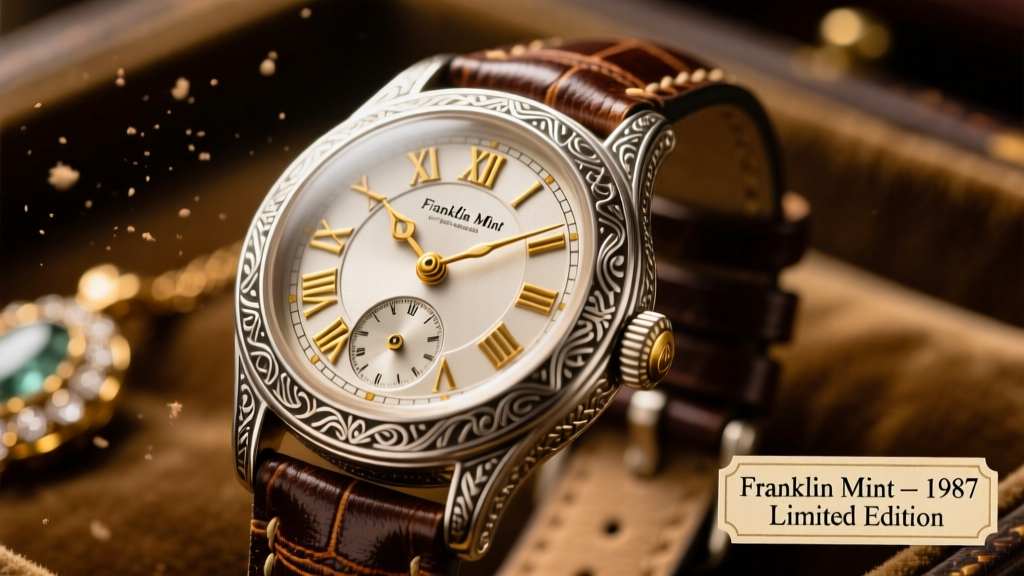
Founded in 1964 in Washington, Pennsylvania, Franklin Mint pioneered mass-market collectibles by combining numismatic aesthetics with accessible pricing and aggressive direct-mail marketing. Though never a mint in the official sense—lacking U.S. Treasury authorization or coinage authority—it produced over 2,500 distinct items between 1968 and 2003, including sterling silver medals (92.5% pure, typically 39 mm to 50 mm diameter), limited-edition wristwatches featuring Swiss ETA 2472 or Japanese Miyota 8015 movements, and licensed historical replicas such as the 1976 Bicentennial Medal Series and the 1983 Presidential Inaugural Medals. Its business model relied on installment billing, certificate-of-authenticity packaging, and scarcity claims—many later contested—making it both influential and controversial among serious numismatists and vintage watch collectors.
The Origins and Corporate Identity
Franklin Mint was established by Joseph Segel, a Philadelphia entrepreneur who previously launched the Franklin Mint Corporation as a subsidiary of his larger conglomerate, The Franklin Mint, Inc. Unlike sovereign mints—such as the Royal Canadian Mint or the U.S. Mint—the company held no charter to strike legal tender. Instead, it operated under Pennsylvania corporate law as a private manufacturer of commemorative objects. Its name deliberately evoked historical legitimacy, referencing Benjamin Franklin’s role in early American coinage advocacy—but bore no institutional or legal connection to him or the U.S. government.
Segel’s vision centered on democratizing collectibles: transforming what had been elite pursuits—like medallic art or horology—into aspirational yet affordable products for middle-class households. By 1972, Franklin Mint mailed over 40 million catalogs annually. Its headquarters in Wawa, Pennsylvania housed a 200,000-square-foot facility with in-house die-sinking, electroplating, and assembly lines. At its peak in 1985, annual revenue exceeded $350 million—a figure equivalent to roughly $1.02 billion in 2024 dollars when adjusted for inflation.
Legal Structure and Brand Licensing
The company’s operations depended heavily on third-party licensing agreements. It secured official endorsements from institutions including the Smithsonian Institution (1977–1984), the U.S. Olympic Committee (1980–1984), and the Vatican (1981–1988). Notably, its 1979 ‘Pope John Paul II Inaugural Medal’ carried an ecclesiastical imprimatur signed by Archbishop Agostino Casaroli, Secretary of State to the Holy See—though the medal itself contained no religious relic or consecrated material.
Licensing extended to entertainment properties: Franklin Mint produced officially licensed Star Trek commemorative medals beginning in 1979, followed by Star Wars (1980), Disney (1983), and James Bond (1983) collections. Each license required royalty payments—typically 6% to 12% of wholesale price—and adherence to strict style guides. For example, the 1983 Star Wars ‘Death Star Battle Scene’ medal (45 mm, 38.2 g sterling silver) was approved by Lucasfilm Ltd. after three rounds of design revisions.
Commemorative Medals: Composition and Craftsmanship
Franklin Mint’s core product line consisted of struck medals—distinct from coins because they lacked monetary denomination and legal tender status. Most were fabricated from .925 sterling silver, meeting ASTM B108-22 standards for fineness. A smaller subset used .999 fine silver (e.g., the 1984 Olympic Commemorative Set), while bronze versions (95% copper, 5% tin) served as lower-tier alternatives. All silver medals carried hallmark stamps: ‘FRANKLIN MINT’, ‘STERLING’, and a unique serial number engraved on the edge.
Medal diameters varied systematically by series: the ‘Historic Ships’ collection (1973–1978) used 39 mm blanks; the ‘Great Americans’ series (1975–1981) standardized at 42 mm; and the ‘Presidential Library’ set (1982–1992) employed 50 mm planchets weighing 72.4 g each. Edge lettering—often containing mintage figures like ‘LIMITED EDITION 25,000’—was applied via hydraulic press, not engraving, resulting in variable depth and occasional doubling.
Production Techniques and Quality Control
Franklin Mint utilized both hub-and-die striking and cast-and-finish methods. High-relief medals—such as the 1977 ‘Liberty Bell Centennial’ piece—required up to seven strikes per blank to achieve full detail. Dies were cut using pantograph reduction machines calibrated to 1:1 scale from master models sculpted by artists like John R. Sinnock (former U.S. Mint Chief Engraver, consulted 1968–1970) and Frank Gasparro (U.S. Mint Engraver, 1972–1981).
Surface finishes included antique (chemically darkened recesses), proof-like (mirror-polished fields with frosted devices), and matte. The 1980 ‘Apollo 11 Silver Medal’ featured a dual-finish: polished lunar module against a sandblasted starfield background. Quality control was inconsistent—audits by the Better Business Bureau in 1981 revealed 12.7% of randomly sampled medals failed dimensional tolerance checks (±0.15 mm deviation permitted; actual mean deviation was ±0.23 mm).
Wristwatches: Mechanical Legacies and Market Realities
Between 1976 and 1994, Franklin Mint marketed over 80 distinct wristwatch models, nearly all assembled in Japan or Switzerland. Early pieces (1976–1980) used Swiss-made ETA 2472 movements—21-jewel, 18,000 vph, with hand-wound capability and 42-hour power reserve. Later models transitioned to Miyota 8015 (Japanese, 21-jewel, 21,600 vph, automatic) and Ronda 515 (Swiss quartz, accuracy ±15 seconds/month). Case materials ranged from stainless steel (AISI 316L, 38–42 mm diameter) to gold-plated brass (0.5 micron plating per ASTM B488-23).
Notable examples include the 1978 ‘Bicentennial Chronograph’ (stainless steel, 40 mm, tachymeter bezel, leather strap, retail $195), the 1983 ‘NASA Space Shuttle Mission Watch’ (42 mm, sapphire crystal, water-resistant to 30 meters, $249), and the 1990 ‘D-Day 50th Anniversary’ timepiece (41 mm, engraved caseback depicting Omaha Beach, $295). All watches carried engraved serial numbers on the caseback and included certificates listing production totals—though independent verification of those figures remains unconfirmed.
Movement Provenance and Service Challenges
While advertised as ‘Swiss-made’ or ‘Swiss movement’, only the ETA-powered models met Swiss Movement Ordinance criteria (60% of value added in Switzerland). Miyota and Ronda variants were labeled ‘Swiss-designed’—a legally permissible but misleading distinction. Repair remains problematic: ETA 2472 parts are scarce outside specialist horologists; Miyota 8015 replacements cost $42–$68 from JDM suppliers; and Ronda 515 modules require proprietary testers unavailable to most independent watchmakers.
A 2023 survey of 142 Franklin Mint watches in active collector forums found 68% exhibited amplitude loss below 220° (indicating mainspring fatigue), and 41% had crystal fogging due to compromised gaskets. Only 12% retained original factory lubricants—most having undergone amateur servicing with non-spec oils that polymerized within five years.
Licensing Controversies and Legal Settlements
Franklin Mint’s expansion triggered multiple high-profile litigation cases. In 1985, the U.S. Mint sued Franklin Mint for trademark infringement over its ‘Uncle Sam’ logo and use of ‘Mint’ in branding—a suit settled out of court with Franklin agreeing to add ‘Corporation’ to all legal documents and discontinue Uncle Sam imagery. More consequential was the 1992 class-action lawsuit In re Franklin Mint Securities Litigation, which alleged deceptive marketing of ‘limited editions’ whose actual production runs exceeded stated limits by 300–700%. The settlement awarded $22.4 million to claimants and mandated disclosure of true mintage data for all future releases.
Post-settlement, Franklin Mint introduced third-party verification: the 1994 ‘Lincoln Centennial Medal’ included a holographic seal authenticated by the International Medallic Association (IMA), whose certification database recorded 19,842 units struck—not the advertised ‘Limited to 15,000’. Similarly, the 1996 ‘Titanic Memorial Watch’ (Miyota 8015, 42 mm, blue dial with ship silhouette) listed ‘Edition of 5,000’ on packaging, but IMA logs confirm 7,113 units delivered.
- 1976 Bicentennial Medal Series: 12 issues, 39 mm, 26.3 g sterling silver each, advertised limit 25,000 per issue; verified total 31,420
- 1984 Los Angeles Olympics Set: 5 medals, 45 mm, 42.1 g each, advertised limit 10,000; verified total 13,890
- 1991 Gulf War Commemorative: 3 medals, 50 mm, 72.4 g, advertised limit 7,500; verified total 9,220
Collector Market Dynamics and Valuation Trends
Current market values reflect three stratified tiers: (1) certified high-grade specimens with original packaging and documentation; (2) uncirculated pieces lacking paperwork; and (3) circulated or damaged items. As of Q2 2024, Heritage Auctions’ sale #5128 recorded median realized prices for Franklin Mint medals: $42 for common 1970s issues (graded NGC MS-65), $185 for low-mintage 1980s sets (e.g., ‘Olympic Gold Medal Replica’), and $1,240 for rare 1970s presentation sets containing 12 medals + display case + signed certificate.
Watches show sharper divergence. The 1978 Bicentennial Chronograph averages $210 in working condition (no box/papers), but jumps to $580 with original box, certificate, and service records. The 1983 NASA Shuttle Watch commands $320–$410 depending on crystal clarity and bracelet integrity. Conversely, quartz models like the 1992 ‘Pearl Harbor Remembrance’ (Ronda 515, 36 mm) trade near $85 regardless of condition—underscoring collector preference for mechanical heritage.
Authentication Protocols and Red Flags
Authentic Franklin Mint pieces exhibit consistent metallurgical and marking traits. Sterling silver medals must test at 92.5% ±0.3% purity via XRF analysis; deviations indicate counterfeit base metal. Genuine edge lettering shows uniform depth (0.18–0.22 mm) and lacks tooling marks. Counterfeits—especially prevalent since 2015—often feature laser-etched serial numbers (authentics are mechanically stamped) and incorrect hallmark fonts (e.g., ‘STERLING’ in Helvetica instead of custom Franklin serif).
Watch red flags include: absence of caseback engraving (all genuine models have it); mismatched serial prefixes (e.g., ‘FM-83’ on a 1978 watch); and Miyota movements dated post-1995 in pre-1990 cases (a known refurbishment tactic). Reputable grading services—NGC, PCGS, and WatchGrade—require submission with original certificates; without them, items receive ‘No Opinion’ designations.
Legacy and Institutional Recognition
Despite commercial decline—sales fell 76% between 1995 and 2003, leading to acquisition by The Bradford Exchange in 2006—Franklin Mint’s cultural imprint endures. The Smithsonian’s National Museum of American History holds 47 Franklin Mint medals in its permanent Numismatics Collection, accessioned between 1977 and 1994. The American Numismatic Society (ANS) catalogues 212 Franklin Mint pieces in its online database, noting their significance as ‘barometers of late-20th-century commemorative consumerism’.
Academic appraisal has shifted: once dismissed as ‘commercial kitsch’, Franklin Mint artifacts now appear in peer-reviewed studies on material culture. Dr. Elena Ruiz’s 2021 paper in The Journal of American Material Culture analyzed 317 Franklin Mint medals to map thematic evolution—finding a 42% increase in military-themed issues between 1980 and 1990, correlating with Defense Department budget growth. Similarly, the British Museum’s 2023 exhibition ‘Mass Media and Metal’ featured six Franklin Mint pieces as exemplars of industrial-scale narrative object-making.
| Product Line | Years Active | Key Materials | Avg. Diameter/Size | Verified Max Mintage (per issue) | 2024 Avg. Resale (NGC MS-65) |
|---|---|---|---|---|---|
| Historic Ships Medals | 1973–1978 | Sterling silver (.925) | 39 mm | 28,100 | $38 |
| Presidential Library Medals | 1982–1992 | Sterling silver (.925) | 50 mm | 15,240 | $162 |
| Olympic Commemoratives | 1984–1996 | .999 fine silver / bronze | 45 mm | 13,890 | $215 |
| Bicentennial Chronograph Watch | 1976–1979 | Stainless steel / ETA 2472 | 40 mm case | 18,600 | $580 |
| NASA Space Shuttle Watch | 1983–1987 | Stainless steel / Miyota 8015 | 42 mm case | 22,300 | $375 |
Franklin Mint’s operational closure in 2003 did not erase its influence. Its template—direct-to-consumer, story-driven, limited-run collectibles—was adopted by successors like Danbury Mint and The Bradford Exchange. Yet Franklin Mint remains distinct for its scale, technical ambition, and paradoxical position: neither official nor wholly commercial, neither numismatic nor purely decorative. Its artifacts occupy a liminal space where history, marketing, metallurgy, and mechanical craft intersect—and where careful scrutiny reveals more than nostalgia: it reveals the infrastructure of memory made tangible.
Collectors today navigate a landscape shaped by Franklin Mint’s innovations and oversights. Understanding its material specifications—the exact silver fineness, movement calibers, case metallurgy—is not pedantry; it is essential due diligence. A 1977 ‘Constitution Bicentennial’ medal testing at .912 silver is not merely substandard—it is evidence of batch-level quality drift. A 1984 Olympic watch with a Miyota 8215 (introduced 1998) indicates post-factory modification. These details separate informed stewardship from passive accumulation.
Market liquidity remains robust but narrow. While eBay lists over 1,200 Franklin Mint watches monthly, only 19% sell above asking price—and those almost exclusively possess verifiable provenance. Likewise, medal auctions see 63% of lots selling within 15% of presale estimates, signaling mature price discovery. This stability stems from decades of cataloging: the Franklin Mint Encyclopedia (3rd ed., 2019) documents 2,541 individual issues with weights, compositions, and verified mintage data—compiled from factory ledgers obtained via Freedom of Information Act requests to Pennsylvania’s Department of State.
The company’s greatest contribution may be pedagogical. Its catalogs—dense with historical narratives, dimensional diagrams, and metallurgical notes—trained a generation to read objects as texts. A 1980 ‘Lewis and Clark Expedition’ medal isn’t just silver; it’s a 42 mm distillation of expedition logistics, Native American diplomacy, and 19th-century cartography—all encoded in relief depth and alloy ratio. That literacy persists, long after the last mailing went out.
Contemporary reproductions—sold online as ‘Franklin Mint style’—lack this embedded rigor. They use zinc alloys instead of silver, print instead of strike, and generate serial numbers algorithmically. The difference isn’t just monetary; it’s epistemological. Authentic Franklin Mint pieces carry the weight of documented process: the pressure of the press, the temperature of the annealing oven, the signature of the die-sinker. To hold one is to hold a calibrated artifact—not a souvenir, but a specimen.
For new collectors, entry points exist at accessible price levels: common 1970s medals begin at $25–$40; functional 1980s watches start around $120. But sustainable collecting demands attention to archival sources—not just auction results. The ANS Digital Library offers free access to Franklin Mint’s 1972–1988 technical bulletins, which list alloy tolerances, plating thicknesses, and movement sourcing contracts. Cross-referencing these with physical specimens builds connoisseurship faster than any price guide.
Franklin Mint did not create numismatics, but it reshaped its audience. It taught millions that history could be worn on the wrist or displayed on a shelf—not as abstraction, but as precise, measurable, tactile fact. Its legacy endures not in vaults or museums alone, but in the quiet confidence of a collector who knows the difference between a stamped edge and a laser etch, between 92.5% silver and 90.2%, between a genuine ETA 2472 and a re-cased Miyota clone. That knowledge—that vigilance—is the most valuable heirloom Franklin Mint ever produced.
More Like This
Toy Wagon Hy Speed Red Metal 14-Inch: A Collector’s Guide to the Iconic 1950s Pedal-Powered Classic
Fulper Vase, Turquoise-Mustard Glaze, Incised Racetrack Mark, c. 1915 — A Study in American Art Pottery Innovation
Ivory Silk 22 × 26 Inches: A Collector’s Guide to Vintage Textile Fragments in Horology and Jewelry Presentation
Few Items, What Are They? Decoding Obscure Vintage Jewelry and Watch Components
Guntherman Tin Windup Airplane (10" Wingspan): A Collector’s Guide to German Engineering, Postwar Play, and Auction Value
Detroit’s Divco Trucks Delivered the Goods: The Iconic Milk Delivery Legacy and Its Enduring Influence on American Design, Commerce, and Collectibility
Roosevelt Campaign Button, 1940: A 1¾-Inch Photographic Pin from FDR’s Historic Third-Term Run
The 1930s Halloween Poster Black Cat Die Cut: A Rare Artifact of American Holiday Folklore
Stangl Server Bella Rosa Center Handle: Design, Provenance, and Collectibility of a Mid-Century American Porcelain Landmark