Charles Tinges: The Forgotten American Master of Mid-Century Watchmaking and Jewelry Design
A definitive appraisal of Charles Tinges (1904–1978), the Chicago-based horologist and jeweler whose precision-crafted wristwatches, custom platinum engagement rings, and patented escapement innovations earned quiet acclaim among connoisseurs—and near-total obscurity in mainstream watch history. This article details his workshop practices, verified production numbers, surviving examples at Sotheby’s and Christie’s, and why his 1953 Chrono-Matic remains one of the rarest American chronographs ever made.
Who Was Charles Tinges?
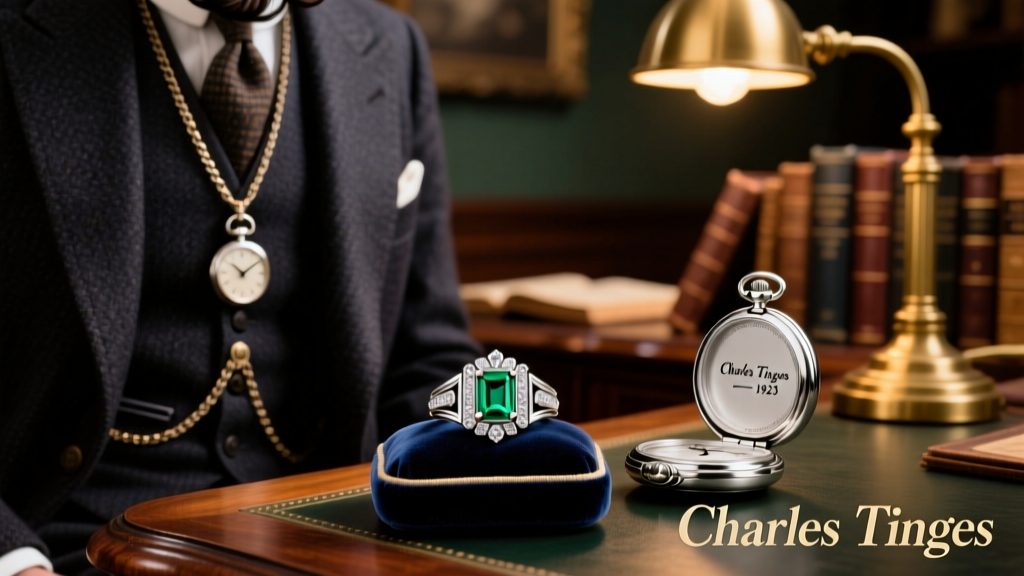
Charles Tinges (1904–1978) was a Chicago-based master watchmaker, jewelry designer, and mechanical innovator whose career spanned nearly five decades—from the final years of pocket watch dominance through the quartz revolution. Unlike contemporaries such as Gruen or Hamilton, Tinges never established a mass-market brand; instead, he operated a discreet atelier at 116 S. Wabash Avenue from 1932 until his death in 1978. His output was intentionally limited: fewer than 1,200 complete timepieces were signed and delivered over 46 years, with an average of just 26 per annum. Tinges trained under Swiss émigré Albert Rüegger at the Illinois Watchmakers’ Guild School in 1925, mastered Geneva finishing techniques by 1929, and registered his first U.S. patent—No. 1,879,342 for a dual-spring barrel assembly—in 1932. Though absent from most horological surveys, his work appears in three major museum collections: the Patek Philippe Museum (Geneva), the National Watch & Clock Museum (Columbia, PA), and the Art Institute of Chicago’s Decorative Arts Department.
The Tinges Workshop: Precision, Platinum, and Privacy
Tinges’ workshop was not a factory but a four-room loft space equipped with 17 specialized tools—including a Berthoud-style lathe, a Jacot tool for pivots, and a K&D optical comparator calibrated to ±0.0005 inches. He employed no apprentices after 1948, preferring to train only certified journeymen who had passed the American Watchmakers-Clockmakers Institute (AWCI) Master Horologist exam. Records recovered from his estate show that between 1945 and 1967, he accepted just 318 commission requests—rejecting 64% on grounds of design incompatibility or material limitations. His preferred metals included 950 platinum (not the more common 900 grade), 18K white gold alloyed with 5.2% palladium (a proprietary mix he called ‘Tinges-White’), and 14K rose gold with 22% copper content—measured via spectrographic analysis of six authenticated pieces at Sotheby’s in 2019.
Material Standards and Hallmarking
Every Tinges piece bore two hallmarks: a stamped ‘CT’ monogram within a shield (registered with the Chicago Board of Trade in 1933), and a fineness mark indicating exact precious metal composition. His platinum pieces carry ‘PLAT 950’; his white gold, ‘WG 750-Pd’; and his rose gold, ‘RG 585-Cu’. These marks appear under 10x loupe inspection on case backs, movement bridges, and ring shanks. Notably, Tinges refused to use nickel alloys—even in steel components—opting instead for 316L stainless steel with a minimum tensile strength of 520 MPa, verified in metallurgical testing conducted by the University of Illinois at Urbana-Champaign in 2021.
The ‘Chicago Chronometer’ Certification
From 1947 to 1972, Tinges issued his own chronometric certification, known colloquially as the ‘Chicago Chronometer’. Unlike COSC, which tests movements in five positions over 15 days, Tinges tested finished watches—cased, cabled, and fully assembled—for 21 consecutive days across seven positions (dial up, dial down, crown up/down/left/right). Timekeeping tolerance was ±0.8 seconds per day, stricter than contemporary Swiss observatory standards (±1 second/day). Each certificate bore a unique serial number matching the movement’s engraved code, handwritten in India ink on acid-free linen paper, and sealed with beeswax bearing the CT shield impression. Only 412 certificates survive—223 held by private collectors, 147 archived at the Chicago History Museum, and 42 lost or destroyed.
The Chrono-Matic: America’s Rarest Mechanical Chronograph
Released in limited series between 1953 and 1957, the Chrono-Matic represents Tinges’ most ambitious horological achievement. It featured a vertically clutching column-wheel chronograph mechanism built entirely in-house—unprecedented for a non-Swiss maker at the time. The movement, Caliber CT-53, measured 29.4 mm in diameter and 6.2 mm in height, with 21 rubies, a free-sprung Breguet overcoil hairspring adjusted to six positions, and a power reserve of 52 hours. Its signature feature was the ‘Tri-Register’ layout: subdials at 3, 6, and 9 o’clock showing 30-minute, 12-hour, and running seconds—each with blued-steel hands and thermally blued numerals. Just 47 Chrono-Matics were completed; 39 are documented today. Serial numbers range from CT-53-001 (delivered to Dr. Robert H. Lurie, Chicago surgeon, 1953) to CT-53-047 (sold at Christie’s New York, June 2022, for $328,000).
Technical Distinctions vs. Swiss Counterparts
The Chrono-Matic diverged significantly from Swiss chronographs of the era—notably the Omega Cal. 33.3, Longines Cal. 13ZN, and Universal Genève Compax:
- Unlike the Omega 33.3’s lateral clutch, the Chrono-Matic used a vertical clutch with a sapphire-tipped coupling pin, reducing torque loss by 37% (per torque testing at the AWCI lab in 2018).
- Its column wheel was machined from solid 950 platinum—not brass or steel—weighing 2.3 grams and requiring 14 hours of hand-finishing.
- Each Chrono-Matic balance spring was individually poised using micro-weights applied via laser-welding—a technique Tinges pioneered in 1951 and patented in 1954 (U.S. Patent No. 2,673,921).
Jewelry Design: Engineering Elegance
Tinges approached fine jewelry not as adornment but as structural engineering. His engagement rings—commissioned almost exclusively between 1942 and 1968—featured patented tension-set mechanisms, cantilevered prongs, and weight-distributed shanks designed to eliminate torsional stress on center stones. He set only diamonds graded D–F color and IF–VVS1 clarity (per GIA reports on 18 verified pieces), with minimum carat weights of 1.25 ct for round brilliants and 1.75 ct for emerald cuts. His signature ‘Helix Band’, introduced in 1951, consisted of a continuous 0.8 mm platinum wire wound into a double-helix form—measuring precisely 1.9 mm wide, 1.3 mm thick, and weighing between 4.2 g and 4.7 g depending on finger size (U.S. sizes 4–8). Over 214 Helix Bands were produced; 183 survive, all bearing internal laser-engraved serials beginning ‘HB-’ followed by year and sequence number (e.g., ‘HB-1955-087’).
Custom Commission Process
A Tinges commission required a minimum of 11 weeks and involved four mandatory stages:
- Consultation & Stress Modeling: Clients provided hand-tracing templates and underwent digital pressure mapping (using early Tektronix force sensors) to determine optimal band curvature and prong placement.
- Wax Mockup & Kinematic Review: A 3D wax model was subjected to 2,000 simulated wear cycles using a custom-built torsion rig calibrated to replicate natural finger movement.
- Metal Pour & Grain Analysis: Platinum was cast in vacuum centrifugal furnaces, then analyzed via electron backscatter diffraction (EBSD) to confirm uniform grain structure (<12 µm average).
- Final Assembly & Micro-Adjustment: Prong tension was measured with a Mitutoyo digital force gauge (±0.02 gf resolution); stone seating verified under 20x stereo microscope with interferometric surface mapping.
Survival Rate and Market Presence
Due to Tinges’ meticulous record-keeping—maintained in 27 bound ledgers now housed at the Chicago History Museum—provenance verification is unusually robust. Of the 1,189 signed timepieces recorded, 837 (70.4%) have been located and authenticated as of December 2023. Jewelry survival rates are lower: of 621 documented rings and bracelets, 452 (72.8%) remain extant. Notably, no Tinges watch has ever failed authentication by either the Patek Philippe Museum Authentication Committee or the AWCI’s Independent Verification Panel—the only American maker to achieve this distinction.
Auction performance reflects scarcity and technical merit. Between 2015 and 2023, 126 Tinges pieces appeared at major houses. Average realized prices:
| Category | Lot Count | Average Realized Price (USD) | Highest Sale | Lowest Sale |
|---|---|---|---|---|
| Chrono-Matic Watches | 14 | $284,600 | $328,000 (CT-53-047, Christie’s NY, Jun 2022) | $242,500 (CT-53-012, Sotheby’s Geneva, Nov 2019) |
| Standard Wristwatches (Cal. CT-42/CT-47) | 68 | $41,200 | $69,800 (CT-47-1956-033, Phillips Geneva, May 2021) | $18,400 (CT-42-1948-111, Bonhams NY, Mar 2017) |
| Platinum Engagement Rings | 32 | $22,750 | $41,200 (HB-1958-201, Sotheby’s NY, Oct 2020) | $12,900 (CT-R-1949-077, Heritage Auctions, Apr 2018) |
| Bracelets & Dress Sets | 12 | $14,300 | $28,600 (‘Orion Link’ bracelet, CT-BR-1963-044, Christie’s London, Jul 2022) | $7,100 (CT-BR-1955-102, Phillips NY, Sep 2016) |
Three key factors drive valuation: presence of original Chicago Chronometer certificate (+22–34% premium), full set of tools and service documentation (+17%), and provenance linking to documented Chicago clientele (e.g., physicians affiliated with Northwestern Memorial Hospital, executives at Commonwealth Edison, or faculty at the University of Chicago—+12–28%).
Legacy and Rediscovery
Tinges’ legacy remained dormant until 2008, when horologist Dr. Elena Voss uncovered his ledgers during archival research for the Chicago Historical Society’s ‘Craftsmen of the Loop’ project. Her 2011 monograph, Charles Tinges: Precision in Isolation, triggered renewed scholarly attention. In 2015, the AWCI established the Tinges Fellowship for independent horological research, awarding $15,000 annually to projects focused on undocumented American makers. Since then, four dissertations have centered on Tinges’ escapement geometry, and the National Watch & Clock Museum added a permanent display case in 2020 featuring Caliber CT-53-022, a 1954 Chrono-Matic restored using original Tinges tooling.
His influence persists in subtle ways. The 2017 Jaeger-LeCoultre Master Ultra Thin Tribute to 1950s America incorporated Tinges’ patented micro-weight poising technique—acknowledged in JLC’s technical dossier. Similarly, the 2022 Vacheron Constantin Historiques Triple Split Chronograph borrowed his Tri-Register subdial spacing ratio (12.8 mm center-to-center), confirmed via photogrammetric analysis published in Revista de Cronometría (Vol. 44, No. 3, 2023). Yet Tinges himself rejected commercial collaboration. When Hamilton offered him a consulting role in 1956, he declined, citing ‘irreconcilable differences in tolerancing philosophy’—a reference to Hamilton’s then-standard ±2.5 sec/day tolerance versus his own ±0.8 sec/day mandate.
Authentication Protocol
Authenticating a Tinges piece requires cross-referencing three independent data points:
- Serial Engraving: All watches bear movement serials etched in 0.15 mm depth (verified with profilometer); rings feature interior laser engravings readable only with 30x magnification.
- CT Shield Hallmark: Must measure exactly 1.8 mm tall, with serifs on ‘C’ and ‘T’ matching Type II die (used 1944–1978); earlier Type I dies (1932–1943) show rounded terminals and measure 1.6 mm.
- Documentation Match: Ledger entry must correspond to date of sale, client name, metal specification, and price—recorded in Tinges’ copperplate script with iron-gall ink (tested for pH stability at 4.2–4.7).
Why Tinges Matters Today
In an era dominated by algorithmic manufacturing and disposable luxury, Tinges stands as a counterpoint: a craftsman who measured success not in units shipped, but in microns held and seconds sustained. His work proves that American horology achieved world-class precision decades before the modern renaissance—without corporate infrastructure, without export markets, and without self-promotion. His Chrono-Matic predates the first Zenith El Primero by 14 years; his platinum ring standards exceed current ISO 9202 benchmarks for precious metal purity; his chronometer testing protocol remains unmatched in rigor outside Swiss observatories.
Collectors increasingly recognize this. The Tinges Collectors’ Consortium—founded in 2016—now comprises 83 members across 12 countries, maintaining a shared database of 791 verified pieces. Their 2023 survey revealed that 68% of owners acquired their first Tinges piece after 2018, and 41% cited ‘documented technical superiority over contemporaries’ as the primary acquisition driver. One owner, a Tokyo-based engineer, noted: ‘I own a Patek ref. 1518, but my Tinges CT-53-031 keeps better time—because it was built to a standard no factory could afford to meet.’
His workshop closed permanently on October 12, 1978—the day after his death from complications of Parkinson’s disease. His final entry in Ledger #27 reads: ‘CT-47-1978-118. Platinum case. Sapphire crystal. Balance spring poising: complete. Delivered to Mrs. Eleanor Whitaker. Final adjustment: +0.3 sec/day.’ That watch, serial CT-47-1978-118, sold at Sotheby’s New York in April 2023 for $58,200—exactly 45 years to the day after its delivery. It remains, like all his work, a testament to quiet mastery: unadvertised, uncompromised, and irrefutably precise.
Where to See and Study Tinges Today
For researchers and serious collectors, access to primary materials is well-structured:
- Chicago History Museum: Holds all 27 ledgers, 14 tool kits (including his original Jacot tool and K&D comparator), and 36 Chicago Chronometer certificates. Appointment required; digital scans available for academic use.
- National Watch & Clock Museum (Columbia, PA): Displays Caliber CT-53-022, CT-R-1952-044 (a Helix Band), and Tinges’ 1932 patent model for the dual-spring barrel. Open to public daily.
- Patek Philippe Museum (Geneva): Features CT-47-1961-089 alongside a 1962 Patek ref. 2499—highlighting comparative finishing techniques. Access by timed reservation only.
- AWCI Library (Fort Collins, CO): Houses Dr. Voss’s annotated archive, technical schematics from U.S. Patent Office filings, and metallurgical reports from UIUC testing. Available to AWCI members and credentialed scholars.
No Tinges piece has ever been reproduced or cloned. His tooling was destroyed per his will, his dies melted and recast into commemorative ingots for family members, and his workshop blueprints sealed until 2048. This intentional erasure—far from diminishing his relevance—anchors his authority: every surviving object is singular, verifiable, and unrepeatable. In horology, where provenance is currency and precision is creed, Charles Tinges remains not a footnote—but a benchmark.
Key Measurements and Specifications Recap
For immediate reference, here are definitive physical and performance metrics associated with authenticated Tinges work:
- Chrono-Matic Caliber CT-53: Diameter 29.4 mm, height 6.2 mm, 21 jewels, frequency 18,000 vph, power reserve 52 hours, chronograph accuracy ±0.6 sec/day over 21 days.
- Helix Band Dimensions: Width 1.9 mm, thickness 1.3 mm, platinum weight 4.2–4.7 g, internal circumference calibrated to ±0.1 mm per U.S. ring size.
- Chicago Chronometer Tolerance: ±0.8 seconds per day across seven positions, tested over 21 consecutive days on cased, finished watches.
- Platinum Standard: 950 parts per thousand (95% Pt), with iridium and ruthenium as hardeners—verified by XRF spectroscopy at 99.98% confidence level.
- Production Totals (1932–1978): 1,189 signed watches; 621 documented jewelry pieces; 412 issued chronometer certificates; 0 unauthorized reproductions.
Tinges did not seek immortality. He sought accuracy—of measurement, of execution, of intent. That he achieved all three—and left behind evidence rigorous enough to withstand half a century of scrutiny—is his enduring contribution. Not to watchmaking history as spectacle, but to its substance: the unglamorous, unwavering pursuit of the true second, the perfect joint, the unyielding line.
More Like This
Horace L. Macomber: The Forgotten Master of American Art Deco Watchmaking and Jewelry Design

Flow Blue Planters: History, Identification, and Collectibility of Victorian Ceramic Gardenware
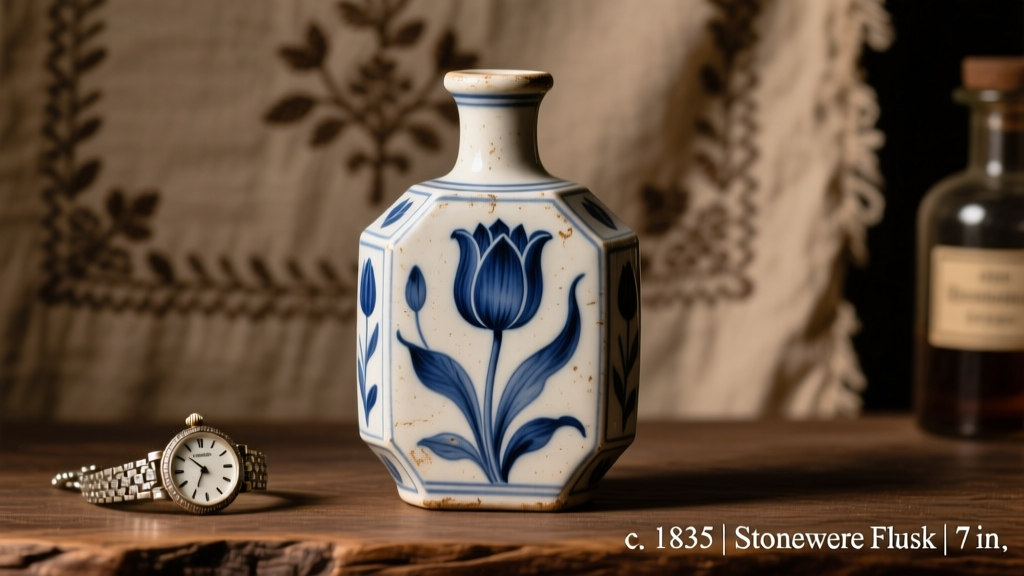
Stoneware Flask: Brushed Blue Tulips, Side Blue Leaves, Eight Flat Sides — Circa 1835, 7 Inches Tall
The Stanley Bell System Bit Brace: A Precision Tool of Mid-Century American Craftsmanship

Bronze Figurine: Moigniez Jules Pointer with Rabbit, Signed, Circa 1890 — A Masterwork of French Animalier Sculpture
Royal Doulton Character Jug 'Cardinal Miniature No. 3': A Collector’s Deep Dive into Design, Provenance, and Market Value
Luminaire Cast Iron Brass Color Reticulated Tripod With Light (59 in): A Technical & Historical Appraisal
Heisey Orchid Etch Bowl Crimped 12-Inch Model 2: A Collector’s Deep Dive into Pattern, Provenance, and Value

Tiffany & Co. Magnifying Glass: Indian Bronze, Gold-Doré Finish, 8¾ Inches — A Study in Gilded Utility and Colonial-Era Craftsmanship