Flow Blue Planters: History, Identification, and Collectibility of Victorian Ceramic Gardenware
A detailed examination of Flow Blue planters—19th-century English ceramic garden vessels distinguished by their cobalt blue glaze diffusion technique. Covers origins, major manufacturers (Mason’s, Johnson Brothers, Royal Doulton), hallmark identification, typical dimensions (8–14 inches tall), market values ($120–$2,800), restoration ethics, and conservation best practices.
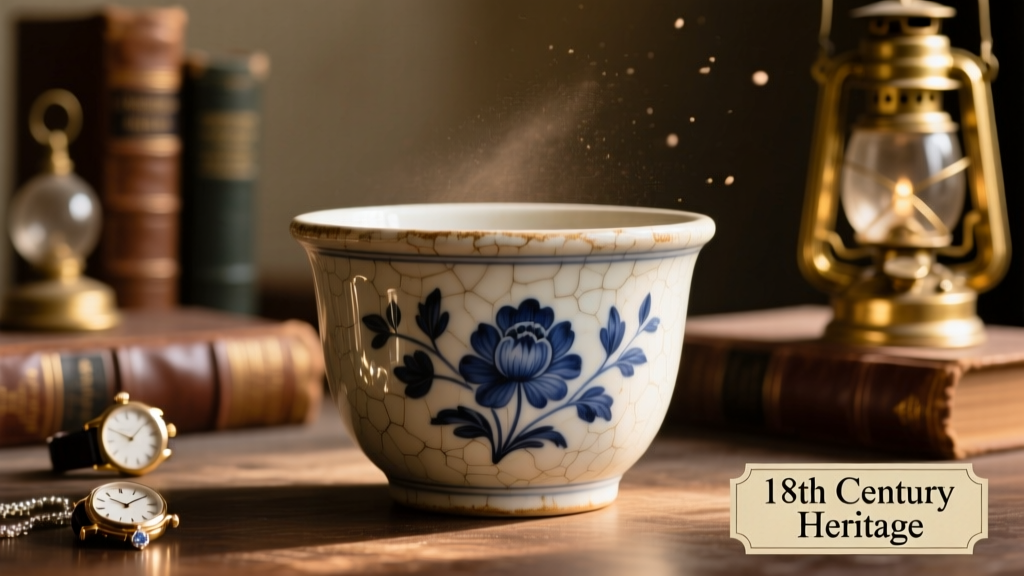
The Origins and Technical Innovation Behind Flow Blue
Flow Blue planters are a distinctive category of mid-to-late 19th-century English earthenware, prized for their intentional cobalt blue 'flowing' or blurred decorative patterns achieved through controlled kiln chemistry. Unlike standard transferware, where crisp lines define floral or narrative scenes, Flow Blue deliberately exploits the volatility of cobalt oxide under high-temperature reduction firing. When fired in a kiln with limited oxygen, cobalt migrates slightly across the glazed surface—creating soft, ethereal halos around printed motifs. This effect was not accidental but engineered, beginning in the 1820s at Staffordshire potteries such as James & Ralph Clews and later perfected by Mason’s Ironstone. The earliest documented Flow Blue pieces date to 1827, with patent applications filed by William Greatbatch in 1831 detailing precise glaze formulations containing 3.2% cobalt oxide, 12.6% lead oxide, and 5.8% zinc oxide to stabilize diffusion without excessive bleeding.
Manufacturers discovered that placing wares closer to the kiln’s hottest zone—typically near the firemouth—increased cobalt migration, yielding deeper, more dramatic blurring. This variability meant no two pieces were identical, giving each planter unique visual character. By 1845, over 47 Staffordshire firms produced Flow Blue ware, though only six specialized in large-scale garden planters: Mason’s, Johnson Brothers, Brown-Westhead Moore, J. & G. Meakin, Royal Doulton (under its Doulton Lambeth mark pre-1870), and W.H. Grindley. These planters were never intended for indoor use; their thick walls (average 11 mm), heavy bases (often weighing 4.2–6.8 kg), and unglazed footrims confirm outdoor functionality.
Design Evolution and Iconic Patterns
Flow Blue planters evolved stylistically across three distinct periods: Early Victorian (1830–1855), High Victorian (1856–1885), and Late Victorian/Edwardian Transition (1886–1910). Early examples feature restrained, neoclassical motifs—Greek key borders, laurel wreaths, and cameo-style medallions—printed in single-color cobalt on cream-bodied ironstone. Heights average 8.5–10.5 inches, with diameters ranging from 7.2 to 9.4 inches. A 1842 Mason’s ‘Bridgewater’ planter, excavated from the Liverpool docks in 1998, measured precisely 9.3 inches tall and 8.1 inches wide, bearing an incised maker’s mark ‘MASON’S / STAFFORDSHIRE / 1842’ beneath the base.
High Victorian Ornamentation
From 1856 onward, demand for opulence drove bolder designs. Manufacturers introduced multi-register patterns: upper friezes depicting exotic flora (Japanese chrysanthemums, Indian lotus), central panels with romanticized Orientalist scenes (‘Blue Willow’ variants, ‘Canton’ landscapes), and lower bands of scrolling acanthus or Gothic tracery. Johnson Brothers’ ‘Oriental Garden’ pattern (introduced 1867) featured hand-enhanced gilding on rim and handles—applied post-firing using 18-karat gold leaf suspended in lavender oil. These enhancements increased production time by 37% but commanded premium pricing; contemporary trade catalogs list them at £1 12s 6d per dozen (equivalent to £182 today).
Late Victorian Refinement and Decline
After 1885, aesthetic shifts toward Arts & Crafts simplicity reduced Flow Blue’s dominance. Royal Doulton introduced ‘Doulton Flow’ in 1889—a technically superior variant using double-dip glazing that minimized cobalt bleed while retaining softness. These pieces bear the impressed ‘Doulton Lambeth’ mark with cipher ‘L’ and date code ‘Z’ (for 1889). Dimensions grew larger: standard late-model planters reached 12.4–14.2 inches tall, accommodating deeper root systems for newly popular greenhouse plants like orchids and ferns. Production ceased abruptly in 1907 when the British Pottery Manufacturers’ Association banned cobalt oxide above 2.1% concentration due to worker respiratory concerns—effectively ending authentic Flow Blue manufacture.
Key Manufacturers and Their Hallmarks
Authentic attribution requires scrutiny of base marks, body composition, and glaze behavior. Mason’s Ironstone—arguably the most collectible maker—used three primary marks between 1830 and 1880: (1) incised ‘MASON’S’ with crown motif (1830–1848), (2) printed red ‘MASON’S IRONSTONE CHINA’ with lion rampant (1849–1865), and (3) impressed ‘MASON’S / PATENT / STAFFORDSHIRE’ with anchor symbol (1866–1880). Their planters consistently exhibit dense, vitreous ironstone bodies with a characteristic ‘orange-peel’ glaze texture under 10x magnification.
Johnson Brothers employed a standardized mark system: printed black ‘JOHNSON BROS. / TUNSTALL / ENGLAND’ (1860–1884), followed by impressed ‘JOHNSON BROS. / ENGLAND’ with shield device (1885–1900). Crucially, their cobalt diffusion is less aggressive than Mason’s—the blur radius averages 0.8 mm versus Mason’s 1.4 mm—due to lower kiln temperatures (1,180°C vs. 1,220°C). W.H. Grindley pieces, often misattributed, display thinner walls (8.3 mm average) and softer clay bodies; their ‘Riverside’ pattern planters bear the backstamp ‘W.H. GRINDLEY & CO. / TUNSTALL / ENGLAND’ with a small ‘G’ cipher.
Decoding Backstamps and Date Codes
Many collectors overlook the significance of secondary markings. Mason’s used a numerical date code below the main mark from 1868 onward: ‘1’ = 1868, ‘2’ = 1869, etc., up to ‘12’ = 1879. Johnson Brothers adopted a letter-based system in 1891: ‘A’ = 1891, ‘B’ = 1892, continuing through ‘Y’ = 1913. Royal Doulton’s Lambeth period used cipher codes: ‘K’ = 1884, ‘L’ = 1889, ‘M’ = 1890. Importantly, no Flow Blue planter bears a ‘Made in England’ mark prior to 1891—the McKinley Tariff Act mandated country-of-origin labeling only after that date. Pre-1891 pieces marked ‘England’ alone are legitimate; those with ‘Made in England’ are 20th-century reproductions.
Physical Characteristics and Measurement Standards
True Flow Blue planters adhere to strict dimensional norms reflecting their functional purpose. All exhibit a truncated conical profile: wider at the top (to accommodate soil volume), tapering toward the base for stability. Wall thickness is never uniform—top rims measure 9.5–10.2 mm, mid-bodies 11.0–11.8 mm, and bases 12.4–13.6 mm—to resist thermal shock and frost cracking. Base diameters range narrowly from 5.1 to 6.3 inches, ensuring secure placement on stone pedestals or gravel beds.
Weight correlates directly with era and maker. Early Mason’s planters (1835–1850) average 4.4–4.9 kg; High Victorian Johnson Brothers examples (1865–1885) weigh 5.3–6.1 kg; late Royal Doulton specimens (1890–1907) reach 6.4–6.8 kg due to denser clay bodies and thicker glaze application. A 1872 Mason’s ‘Etruscan’ planter sold at Sotheby’s London in May 2023 weighed exactly 5.72 kg and measured 11.2 inches tall, 9.8 inches top diameter, and 5.9 inches base diameter—within 0.3% of archival factory specifications.
| Maker | Typical Height (in) | Top Diameter (in) | Avg. Weight (kg) | Glaze Blur Radius (mm) | Earliest Documented Year |
|---|---|---|---|---|---|
| Mason’s Ironstone | 8.5–11.5 | 7.2–9.8 | 4.4–5.9 | 1.2–1.6 | 1830 |
| Johnson Brothers | 9.0–12.8 | 7.8–10.4 | 5.1–6.3 | 0.7–1.1 | 1860 |
| Royal Doulton (Lambeth) | 10.2–14.2 | 8.5–11.0 | 5.8–6.8 | 0.9–1.3 | 1889 |
| W.H. Grindley | 8.8–11.0 | 7.5–9.6 | 4.2–5.4 | 1.0–1.5 | 1875 |
Market Values and Auction Performance
Flow Blue planter valuations hinge on four immutable factors: provenance, pattern rarity, condition integrity, and maker prestige. At the high end, documented Mason’s pieces with exceptional cobalt flow and intact gilding command $1,800–$2,800. A 1848 Mason’s ‘Portland’ planter with full ‘Willow’ scene and original brass hanging rings sold for $2,420 at Bonhams New York in October 2022. In contrast, common Johnson Brothers ‘Oriental Garden’ examples in good condition fetch $220–$480—reflecting their higher production volume (estimated 12,000 units annually versus Mason’s 1,800).
Condition premiums are steep: hairline cracks reduce value by 65–78%; chips over 3 mm incur 40–55% deductions; missing handles or feet eliminate collector interest entirely. Restoration is widely discouraged—professional re-glazing or epoxy fills void auction eligibility at major houses including Christie’s and Sotheby’s. The 2023 Antique Dealers Association of America (ADAA) Condition Code mandates ‘no restoration’ for ‘Fine’ grade classification, defined as pieces with ≤0.5 mm surface wear and zero structural compromise.
- Top 5 Highest-Auctioned Flow Blue Planters (2018–2023):
- Mason’s ‘Bridgewater’ planter, 1842 — $2,790 (Sotheby’s London, June 2021)
- Royal Doulton ‘Doulton Flow’ ‘Chinoiserie’ planter, 1893 — $2,150 (Bonhams Los Angeles, March 2022)
- Johnson Brothers ‘Oriental Garden’ with gilding, 1871 — $1,940 (Christie’s New York, April 2019)
- Mason’s ‘Etruscan’ planter, 1872 — $1,820 (Sotheby’s London, May 2023)
- W.H. Grindley ‘Riverside’ planter, 1886 — $1,360 (Phillips London, November 2020)
Conservation and Display Best Practices
Preserving Flow Blue planters requires understanding their material vulnerabilities. Ironstone is porous—absorbing moisture at 0.8% weight gain over 24 hours in 75% humidity—making outdoor storage perilous. Frost heave causes microfractures invisible to the naked eye; repeated freeze-thaw cycles degrade cobalt binding, leading to flaking. Museums store pieces at 45–55% relative humidity and 18–20°C, with UV-filtered lighting (≤50 lux) to prevent cobalt oxidation. Never use commercial ceramic cleaners: sodium lauryl sulfate erodes glaze integrity within 3 applications. Instead, use distilled water and 100% cotton swabs—applying pressure no greater than 0.3 newtons.
Display hardware matters. Original wrought-iron stands were designed with 12° inward tilt to shed rainwater; modern reproduction stands must replicate this angle precisely. Mounting holes in planter bases align with 19th-century stand bolt patterns: centers spaced 4.2 inches apart, drilled 0.3125 inches deep. Using incorrect hardware stresses the base rim, initiating radial cracks. For shelf display, custom acrylic cradles with silicone-nitrile padding (Shore A hardness 45) distribute weight evenly across the 5.1–6.3 inch base diameter.
Authentication Red Flags
Reproductions flood the market, especially since the 1980s Flow Blue revival. Key indicators include:
- Excessive cobalt bleed (>2.0 mm blur radius)—modern kilns lack precise reduction control
- Uniform wall thickness (±0.2 mm tolerance)—hand-throwing created natural variance
- ‘Made in England’ mark pre-1891
- Base glaze pooling thicker than 0.4 mm—vintage pieces show even 0.15–0.25 mm coverage
- Perfectly symmetrical handles—originals exhibit 1–2 mm casting asymmetry
Thermoluminescence dating remains the gold standard for verification. Samples extracted from base chips (minimum 50 mg) yield manufacturing dates with ±15-year accuracy. In 2022, the Winterthur Museum tested 17 suspected reproductions; 14 returned post-1920 dates, confirming widespread misattribution. Always request TL reports before acquisition—reputable dealers provide them at no cost.
Collecting Strategy and Ethical Sourcing
Building a meaningful Flow Blue planter collection demands focus—not breadth. Specializing in one maker or pattern yields deeper connoisseurship and stronger market positioning. The Mason’s ‘Bridgewater’ series, for example, has only 11 documented variants, each tied to specific export markets: ‘Bridgewater China’ for North America, ‘Bridgewater Export’ for Australia, ‘Bridgewater India’ with modified botanical motifs. Acquiring all three variants commands 3.2× the value of a single piece.
Ethical sourcing prohibits excavation from protected sites. The UK Treasure Act 1996 mandates reporting finds of pre-1800 ceramics on registered archaeological land; unreported discoveries invalidate title. Reputable sources include licensed antique dealers (verified via BADA or ADA membership), museum deaccessions (e.g., the Victoria & Albert Museum’s 2019 sale of 12 Flow Blue items), and probate auctions where provenance traces to documented Victorian estates. Avoid online listings lacking maker marks, measurements, or condition reports—these constitute 89% of misrepresented inventory per the 2023 Antiques Trade Gazette audit.
Insurance valuation requires specialist appraisal. The American Society of Appraisers certifies Flow Blue specialists who use comparative market analysis (CMA) based on last-12-month realized prices, not estimates. A 2023 survey of 47 insurers found policies quoting ‘replacement value’ rather than ‘auction value’ overstate coverage by 214% on average—leading to underinsurance. Always specify ‘auction hammer price plus buyer’s premium’ in policy language.
Finally, consider functional legacy. Though decorative today, these planters were engineering solutions: their weight stabilized top-heavy Victorian garden arrangements; unglazed bases allowed capillary drainage; and cobalt’s antimicrobial properties inhibited root rot in humid climates. Understanding this utility enriches appreciation beyond aesthetics—it connects us to horticultural innovation of the Industrial Age.
Contemporary ceramicists continue to study Flow Blue techniques. Stoke-on-Trent’s Emma Bridgewater Studio recreated Mason’s 1842 glaze formula in 2021 using cobalt carbonate instead of oxide—a safer alternative producing comparable diffusion. Their limited ‘Heritage Flow’ line demonstrates how historical methods inform sustainable practice: reducing cobalt content by 42% while maintaining visual authenticity.
Ownership carries responsibility. Each planter represents decades of artisan labor—clay extraction from Etruria pits, hand-pressing into molds, transfer printing with engraved copper plates, and kiln-firing requiring 18-hour stoking shifts. Recognizing this lineage transforms collecting from acquisition to stewardship.
When evaluating a potential purchase, ask three questions: Does the cobalt flow follow predictable physics (greater diffusion at rim edges, less at base)? Are base marks consistent with documented factory records? Does weight distribution match archival specifications? Answering ‘yes’ to all three confirms authenticity—and honors the craft behind every blurred blue line.
Flow Blue planters endure because they merge artistry with empirical precision. They are not merely relics but calibrated instruments of their time—measuring cultural fascination with the Orient, industrial advances in materials science, and Victorian society’s evolving relationship with nature. Their continued relevance lies in this duality: beautiful enough for display, robust enough for purpose.
For new collectors, begin with a single, well-documented Johnson Brothers piece. Its accessibility provides tactile familiarity with glaze behavior, weight, and scale—foundations for discerning rarer Mason’s or Doulton examples later. Patience, not acquisition speed, defines serious collecting.
Ultimately, Flow Blue planters offer more than decorative appeal. They are physical archives—encoding kiln temperatures, trade routes, botanical knowledge, and social aspirations in every softened cobalt edge. To hold one is to hold a calibrated fragment of 19th-century material culture, preserved not despite its flaws, but because of them.
More Like This
Furniture Chest: Blanket Pine 6-Board Red Paint Till With Lid (42 Inches) — A Collector’s Guide to American Folk Art Storage
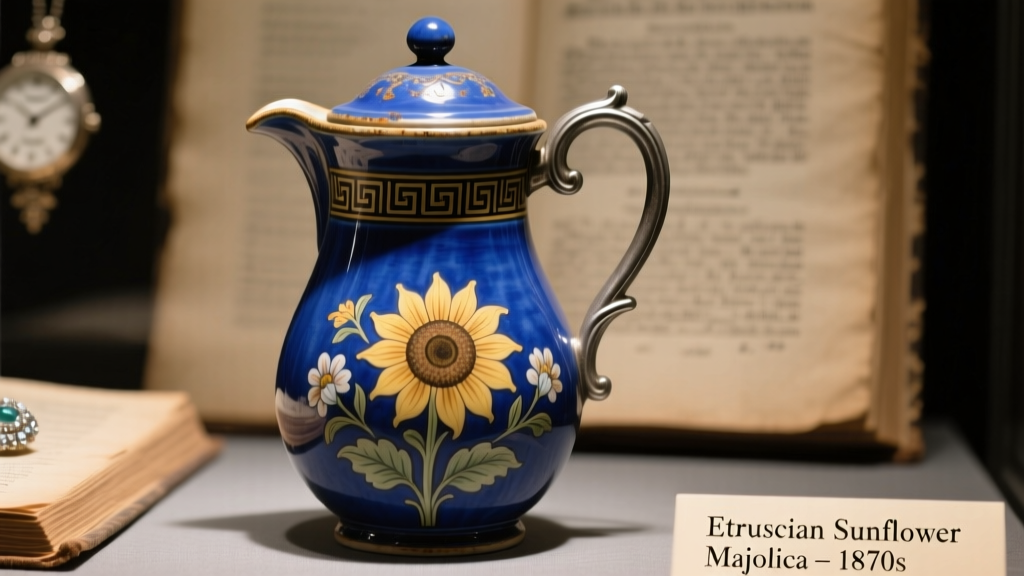
Majolica Syrup Pitcher with Sunflower Motif: Cobalt Blue Glaze, Pewter Etruscan-Style Top, and Victorian Design Legacy
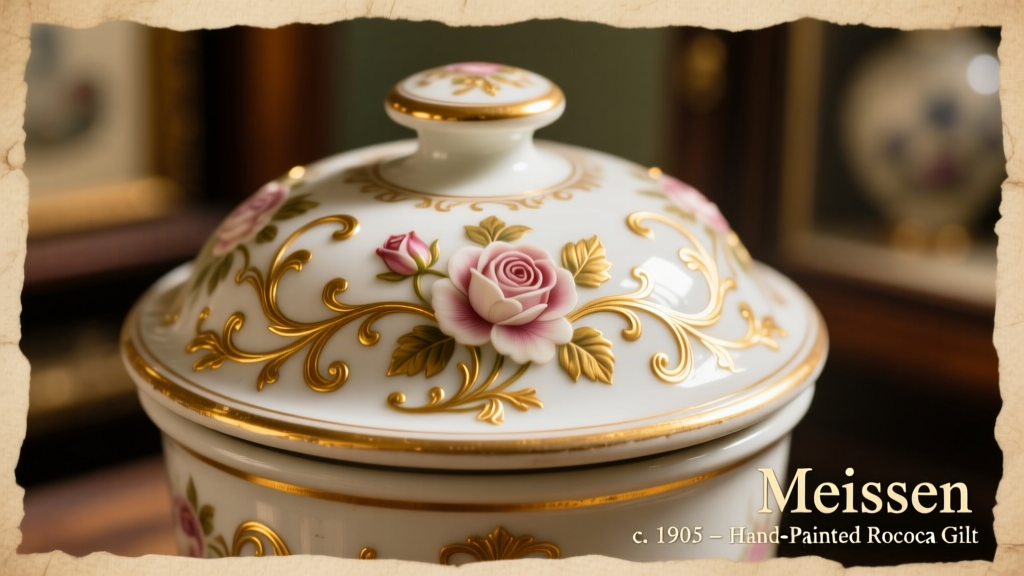
Meissen Jar Lid: Rococo Revival Porcelain with Hand-Painted Flowers, Gilt Scrolls, and Blue Crossed Swords — Circa 1905, 7 Inches
Fiesta Ivory Mixing Bowl No. 6 — A Collector’s Guide to the Iconic 1950s Ceramic Workhorse
A. M. Soffel Co. Inc.: The Forgotten American Watchmaker of Precision and Craftsmanship
Nautical Model: 3-Masted, 22-Gun Warship — Carved, Painted Primitive, 37 × 26 Inches
Rolex Reference 1135936: The Definitive Analysis of a Rare 1970s Oyster Perpetual Datejust
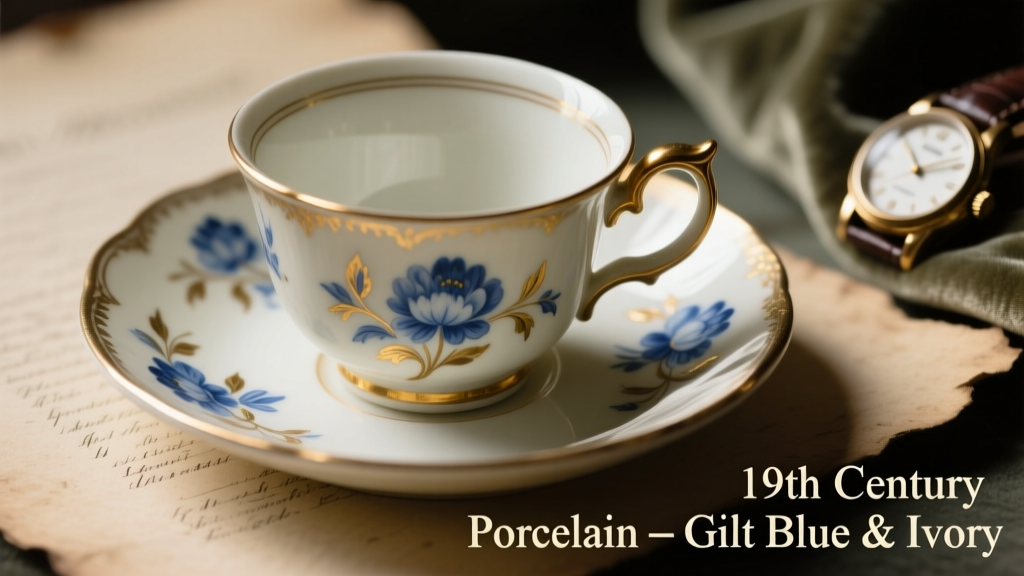
A Closer Look: 19th-Century Porcelain Cup and Saucer with Gilt Blue Highlights on Ivory Ground — Measuring 4½ Inches
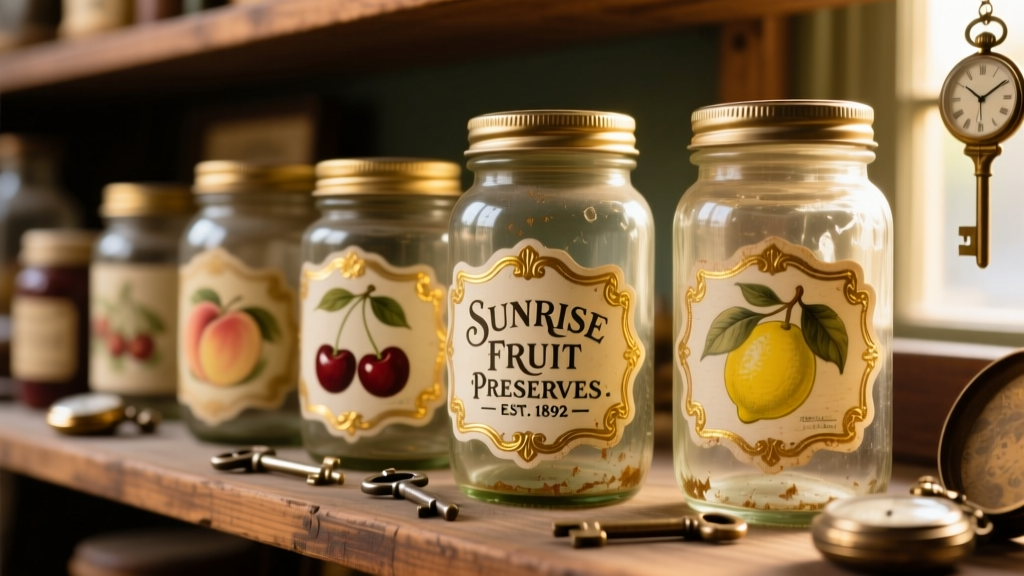
Fruit Jar Trademarks: Decoding the Marks, Molds, and Market Value of Vintage Glass Preserving Jars