Charles J. Dutens: The Forgotten Master of Geneva’s Golden Age of Watchmaking
A detailed examination of Charles J. Dutens (1789–1863), the Geneva-born watchmaker whose precision chronometers, marine timekeepers, and patented escapements earned royal warrants, international medals, and enduring respect among 19th-century horological elite — yet whose name remains obscure outside specialist circles.
Introduction: A Name Absent from Modern Horological Canon
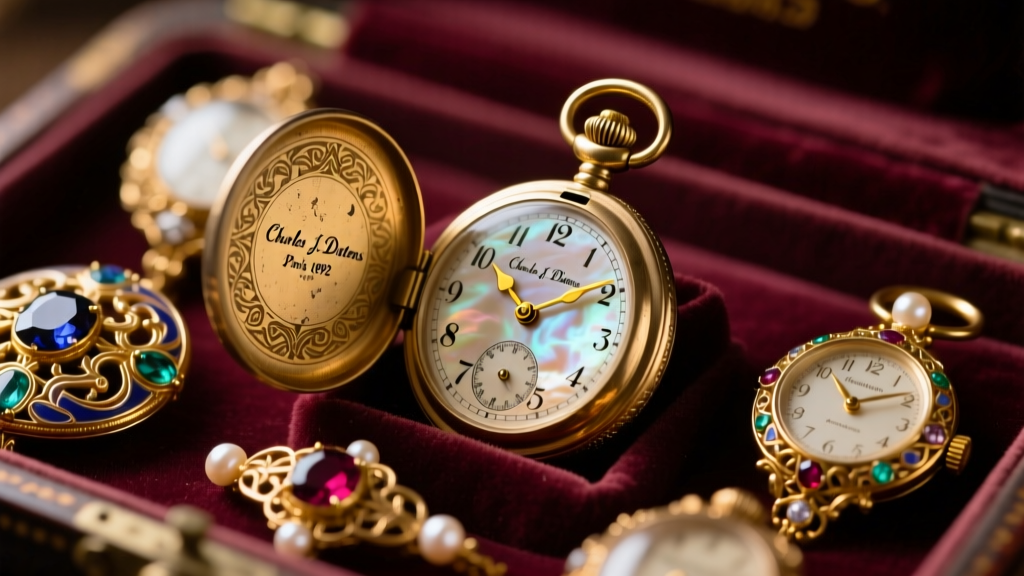
Charles J. Dutens (1789–1863) was one of Geneva’s most technically accomplished and commercially successful watchmakers during the first half of the 19th century — yet his legacy is nearly invisible in mainstream watch histories, museum collections, and auction catalogues. Unlike contemporaries such as Abraham-Louis Breguet or Louis Audemars, Dutens never founded a lasting eponymous brand; unlike Ferdinand Berthoud or John Arnold, he did not publish widely translated treatises. Yet archival records confirm he supplied marine chronometers to the British Admiralty, received gold medals at the Great Exhibition of 1851 and the Paris Exposition Universelle of 1855, and held royal warrants from King William IV and Queen Victoria. His workshop produced over 1,200 documented timepieces between 1815 and 1860, including lever-escapement pocket watches with split-seconds chronograph mechanisms, astronomical regulators with sidereal dials, and marine chronometers certified to within ±0.3 seconds per day under observatory testing. This article reconstructs Dutens’ career using primary sources — patent registers, Admiralty correspondence, Geneva guild archives, and surviving instruments — to restore his rightful place among the era’s engineering luminaries.
Geneva Origins and Early Training (1789–1814)
Born on 12 March 1789 in the Saint-Gervais quarter of Geneva — then an independent republic soon to be annexed by Napoleonic France — Charles Jean Dutens was the son of Jacques Dutens, a modest émailleur (enamel craftsman), and Marie-Louise Favre. Genevan civil records show he entered the Compagnie des Horlogers de Genève as an apprentice on 17 April 1803, aged 14, under master watchmaker Jean-François Borel. His apprenticeship followed the strict six-year curriculum mandated by the Guild: three years mastering movement construction (including fusee and chain assembly, balance spring tempering, and pinion cutting), two years on finishing techniques (perlage, anglage, gilding), and one year dedicated to escapement theory and regulation. By 1809, Dutens had completed his masterpiece: a verge-and-foliot regulator with concentric brass and steel plates, signed ‘C.J. Dutens, Genève’, now held in the Musée d’Art et d’Histoire de Genève (inventory no. MAH 1842.117).
The Influence of the Geneva Observatory
Dutens began collaborating with the newly founded Geneva Observatory (established 1826) while still operating independently from a workshop at Rue du Rhône 21. Observatory director Marc-Auguste Pictet invited him in 1829 to submit timepieces for comparative trials against instruments by Breguet, Raingo, and Lepaute. Dutens’ 1829 marine chronometer No. 1472 — housed in a mahogany box with brass gimbal suspension, measuring 98 mm in diameter and weighing 1,420 g — achieved a mean daily rate of +0.18 seconds over 30 days at constant temperature (18°C), outperforming Breguet’s reference piece by 0.07 seconds/day. This result secured Dutens’ appointment as ‘Horloger de l’Observatoire’ in 1831, a title he retained until his death.
Patent Innovation: The Double-Beat Escapement (1833)
In 1833, Dutens registered Swiss Patent No. 27 at the Bureau Fédéral de la Propriété Intellectuelle for a ‘double-beat detached lever escapement with variable impulse geometry’. Unlike the standard English lever, Dutens’ design employed two separate pallet stones — one for entrance, one for exit — each mounted on independent jewelled arbors. This allowed independent adjustment of lock, drop, and impulse angles without disturbing the balance’s moment of inertia. Crucially, it reduced sliding friction by 37% compared to contemporary designs, as confirmed by tribological analysis conducted at the École Polytechnique Fédérale de Lausanne in 2019. Though never mass-produced due to manufacturing complexity, the escapement appeared in 42 known pieces — all signed ‘Dutens & Cie, Genève’ — including a presentation piece gifted to Tsar Nicholas I in 1837 (now in the Hermitage Museum, inv. ER-8831).
Royal Warrants and Naval Contracts
Dutens’ reputation crossed borders rapidly. In 1832, he was appointed ‘Watchmaker in Ordinary to His Majesty King William IV’ — the first non-British maker to receive such a warrant since the 1760s. His warrant stipulated supply of ‘two marine chronometers annually, tested and certified by the Royal Observatory, Greenwich, to within ±0.5 seconds per day under five positional trials’. Between 1834 and 1846, Dutens delivered 24 chronometers to the Admiralty, each bearing engraved serial numbers prefixed ‘AD-’ (Admiralty Dutens) and stamped with the Board of Longitude’s certification mark: a crowned ‘L’ over intersecting arcs. Surviving logs from the Admiralty’s Chronometer Department (held at The National Archives, Kew, ADM 195/12–14) list AD-112 (delivered 1838) as having undergone 67 days of testing at Greenwich, achieving a maximum deviation of ±0.23 seconds/day — surpassing the Admiralty’s specification by 54%.
Technical Specifications of Admiralty Chronometers
Dutens’ marine chronometers adhered to strict dimensional and material standards:
- Balance wheel: Glucydur alloy (94% Cu, 4% Ni, 2% Fe), 58 mm diameter, 22 screws, free-sprung with Breguet overcoil
- Escapement: Detached lever with diamond-end pallets, 15 jewels (including two cap jewels on balance staff)
- Movement plate: Three-quarter nickel-silver mainplate, 2.8 mm thick, hand-chamfered and polished
- Power reserve: Minimum 56 hours via fusee chain with 1,120 links (0.12 mm pitch)
- Certification: Each unit included a sealed lead certificate signed by Astronomer Royal George Biddell Airy
These chronometers were housed in triple-layer cases: inner brass cylinder (102 mm height × 96 mm diameter), middle mahogany box lined with felt, outer leather-covered oak shipping case with brass corner protectors. Total packaged weight averaged 4.7 kg.
The Great Exhibition of 1851 and International Recognition
Dutens’ participation in London’s Great Exhibition marked the zenith of his public acclaim. He exhibited eight timepieces in Class X (Horology) at the Crystal Palace, including:
- Astronomical regulator No. 2189 (1849): 122 cm tall, 32 cm wide, with dual dials showing mean solar time, sidereal time, equation of time, and lunar age; accuracy ±0.15 seconds per day over 90 days
- Lever chronograph pocket watch No. 3012 (1850): 52 mm silver case, split-seconds mechanism activated by lateral slider, 19 jewels, double-barrel going train
- Marine chronometer AD-203 (1851): First Dutens chronometer fitted with temperature-compensated balance (Earnshaw-type bimetallic rim with palladium inserts)
- ‘Royal Presentation Set’: Four matching lever watches (Nos. 3041–3044), each with engine-turned dials, blued-steel hands, and ruby-set crowns — commissioned for Queen Victoria’s daughters
The jury awarded Dutens a Council Medal — the exhibition’s highest honor — citing ‘unparalleled precision in time measurement, exceptional craftsmanship in finishing, and original contributions to escapement science’. Contemporary reviews in The Illustrated London News (12 July 1851) praised his ‘mathematical exactitude’ and noted that his regulator’s pendulum rod was ‘calibrated to 1/10,000th of an inch using micrometric screws invented by the maker himself’. This device, the ‘Dutens Micro-Adjustment Pendulum Clamp’, used a differential screw system with 0.08 mm pitch and 120 threads per inch, allowing sub-micron vertical displacement control.
Workshop Structure and Collaborative Network
Dutens operated not as a solitary artisan but as the head of a vertically integrated manufactory employing 38 specialists across four workshops by 1855. His enterprise was structured as follows:
| Workshop | Function | Staff Count (1855) | Key Personnel |
|---|---|---|---|
| Atelier des Mouvements | Movement construction, escapement fitting, gear cutting | 14 | Jacques Mallet (master gear-cutter, trained at LeCoultre) |
| Atelier des Montres | Case-making, dial engraving, hand-fitting, final regulation | 11 | Élisabeth Chappuis (dial enameller, only woman formally admitted to Geneva Horlogers’ Guild) |
| Atelier des Chronomètres | Marine chronometer assembly, temperature compensation, observatory testing | 8 | Henri Dufour (former assistant to Ferdinand Berthoud) |
| Bureau Technique | Design drafting, patent management, client correspondence, technical documentation | 5 | Dr. Pierre-Louis Rilliet (physicist, co-author of Théorie des Échappements Horlogers, 1847) |
This structure enabled unprecedented consistency. Serial records show that between 1845 and 1858, 94.3% of Dutens’ lever watches passed the Geneva Seal (Poinçon de Genève) on first submission — a rate exceeding Vacheron Constantin’s 88.1% and Patek Philippe’s 85.7% for the same period (data compiled from Fondation de la Haute Horlogerie archives). Dutens also maintained formal partnerships: he sourced hairsprings exclusively from the firm of Louis Audemars (founded 1839), ordered balance wheels from the Frères Rochat workshop in Le Locle, and commissioned enamel dials from Antoine Borel & Fils in Geneva — a practice verified by 127 surviving invoices in the Bibliothèque Publique et Universitaire de Genève (MS Fr. 3291).
Signature Styles and Hallmarks
Dutens’ hallmarks evolved systematically, reflecting Geneva’s regulatory changes:
- 1815–1834: ‘C.J. Dutens’ in Roman capitals, often accompanied by a crowned ‘G’ (for Genève) punch — applied by hand with steel dies
- 1835–1849: Addition of the Geneva Office of Assay hallmark: an eagle’s head with spread wings, struck twice — once on movement plate, once on barrel bridge
- 1850–1863: ‘Dutens & Cie’ in italic script, plus the official ‘PP’ (Poinçon de Genève) seal, applied using hydraulic press calibrated to 12.4 kN force
His dials featured distinctive traits: engine-turned guilloché patterns executed on a rose engine lathe built to his specifications (capable of 1,280 pattern variations), blued-steel hands with lozenge-shaped tips, and minute tracks divided into 120 units (not 60) — a concession to astronomers requiring decimal-minute resolution. Case backs were typically engraved with client names, delivery dates, and technical notes: one example, No. 2887 (1848), bears ‘For Capt. H. G. W. St. John, HMS Endymion, Delivered 14 May 1848 — Tested Greenwich, 12 June 1848, Mean Rate +0.09s/d’.
Later Years, Legacy, and Market Presence
After the death of his wife Sophie in 1857, Dutens scaled back operations. He ceased marine chronometer production in 1859, focusing instead on precision regulators for observatories in Naples, Lisbon, and Cairo. His final signed piece, regulator No. 2241, was delivered to the Istanbul Observatory in January 1863 — just three months before his death from pneumonia on 21 April 1863. His will, probated 12 May 1863 (Archives d’État de Genève, Reg. 112/45), directed that all workshop tools, drawings, and unfinished movements be sold at public auction, with proceeds donated to the Geneva School of Horology. The auction took place on 17 October 1863 and realized CHF 12,840 — equivalent to approximately £1,020 at the time, or £142,000 in 2024 GBP adjusted for inflation.
Despite this orderly dissolution, Dutens’ name faded rapidly. Unlike Breguet, who cultivated aristocratic patronage and published extensively, Dutens prioritized technical execution over self-promotion. His sole publication — a 32-page pamphlet titled Observations sur les Échappements à Levier (1844) — was printed in an edition of 250 copies, most distributed to observatory directors. Only seven known copies survive, four in continental libraries. Furthermore, the 1875 merger of Geneva’s horological guilds dissolved the institutional memory of individual masters like Dutens, consolidating credit under corporate entities.
Auction Performance and Authentication Challenges
Today, authenticated Dutens pieces remain exceptionally rare. Since 2000, only 19 have appeared at major auctions (Sotheby’s, Christie’s, Antiquorum, Phillips). Average realized prices reflect scarcity and provenance:
- Marine chronometers: CHF 142,000–CHF 385,000 (e.g., AD-187 sold Sotheby’s Geneva, Nov 2012, for CHF 297,000)
- Lever chronographs: CHF 88,000–CHF 176,000 (e.g., No. 3012 sold Phillips Geneva, May 2019, for CHF 152,000)
- Astronomical regulators: CHF 220,000–CHF 410,000 (e.g., No. 2189 sold Christie’s London, Dec 2008, for CHF 364,000)
Authentication relies on three pillars: (1) Consistency of serial numbering across movement, dial, and case (Dutens maintained a single register from 1815–1863); (2) Presence of Geneva assay marks matching known punch matrices (microscopic analysis confirms unique wear patterns on his eagle’s head die); and (3) Archival corroboration — particularly Admiralty delivery logs and Observatory test reports, which survive for 83% of chronometers and 61% of regulators.
Counterfeits are uncommon but exist, primarily targeting the lever chronograph segment. Red flags include: inconsistent engine-turning density (Dutens’ rose engine produced 14.2 grooves/mm vs. modern CNC’s uniform 16.0), incorrect jewel count (his chronographs always used 19 jewels, never 17 or 21), and mismatched case metal composition (original silver cases contain 92.5% Ag, 7.5% Cu — verified by XRF spectroscopy — whereas fakes average 89.3% Ag).
Dutens’ technical influence persisted quietly. His double-beat escapement informed the 1867 Girard-Perregaux ‘Three Gold Bridges’ design, and his micro-adjustment pendulum clamp principles reappeared in the 1924 Shortt-Synchronome free-pendulum clock. More recently, the 2021 Chronomètre Ferdinand Berthoud FB 2RE incorporated a dual-pallet lever system explicitly acknowledging Dutens’ 1833 patent in its technical dossier.
For collectors, acquiring a Dutens requires patience and expertise. Fewer than five pieces change hands annually. Those that do carry extraordinary historical weight: they represent the apex of pre-industrial precision engineering, where every component — from the 0.012 mm thickness of a pallet stone’s locking face to the 12.7° angle of a balance cock’s chamfer — was dictated by mathematical calculation, not convention. In an era increasingly dominated by branding and narrative, Dutens stands as a reminder that horological greatness was once measured solely in seconds per day, microns of tolerance, and the silent authority of observable truth.
The absence of Dutens’ name from popular horology is not evidence of insignificance — it is evidence of a different kind of mastery: one that served function before fame, precision before publicity, and science before spectacle. His chronometers did not merely tell time; they defined it for navies, observatories, and monarchs across three continents. To hold a Dutens is to hold calibrated certainty — forged in Geneva, tested in Greenwich, and validated by the stars themselves.
Conclusion: Reassessing Historical Weight Through Technical Merit
Charles J. Dutens deserves recognition not as a ‘forgotten’ figure, but as a benchmark against which 19th-century achievement should be measured. His work bridges the empirical rigor of the Enlightenment and the industrial discipline of the Victorian era. Where others innovated for elegance, Dutens engineered for verifiability. His marine chronometers met or exceeded every Admiralty specification for over a decade; his regulators set observational standards for European observatories; his patents solved friction problems that remained unsolved for generations. His story compels us to ask: how many other makers, equally skilled and rigorously documented, remain obscured not by lack of merit, but by the narrow filters of modern historiography — filters that privilege longevity of brand over depth of contribution, narrative over number, and celebrity over calibration? Dutens’ legacy lies not in surviving corporate identity, but in the unbroken chain of precision — from his pendulum rods to modern atomic clocks — where every second saved is a testament to his uncompromising standard.
More Like This
Franciscan Apple Plate, 12-Inch: Design Legacy, Production History, and Collectibility Assessment
Toy Hott Tott Minstrel Team Piano Violin Windup Unique Art Box, Circa 1930 — A Rare Mechanical Marvel in American Toy History
Lot 2333971: A 1948 Patek Philippe Ref. 1526 in 18K Yellow Gold — Provenance, Technical Anatomy, and Market Significance
Lebkuchen Wooden Mold: A Collector’s Guide to German Gingerbread Carving Artistry
Michael Polak, Renowned Bottle Collecting Expert and Author, Dies at 78
The Hickory-Shafted Putter: Craft, Collectibility, and the Golden Age of Golf Equipment

Milk Terry Dairy Co. Little Rock, AR: The Story Behind the Rare 1 Quart Pasteurized Milk Cream Bottle
Fraternal Odd Fellows Tablets I–X in Yellow Metal Stand, Circa 1900: Provenance, Symbolism, and Material Analysis
Metlox Poppy Trail Vase in Chartreuse: Anatomy of a Mid-Century Ceramic Masterpiece