Lebkuchen Wooden Mold: A Collector’s Guide to German Gingerbread Carving Artistry
A detailed examination of historic Lebkuchen wooden molds—hand-carved tools from 17th–20th century Germany—covering regional styles, wood species, maker signatures, auction performance, and conservation practices for serious collectors and decorative arts scholars.
Origins and Historical Context
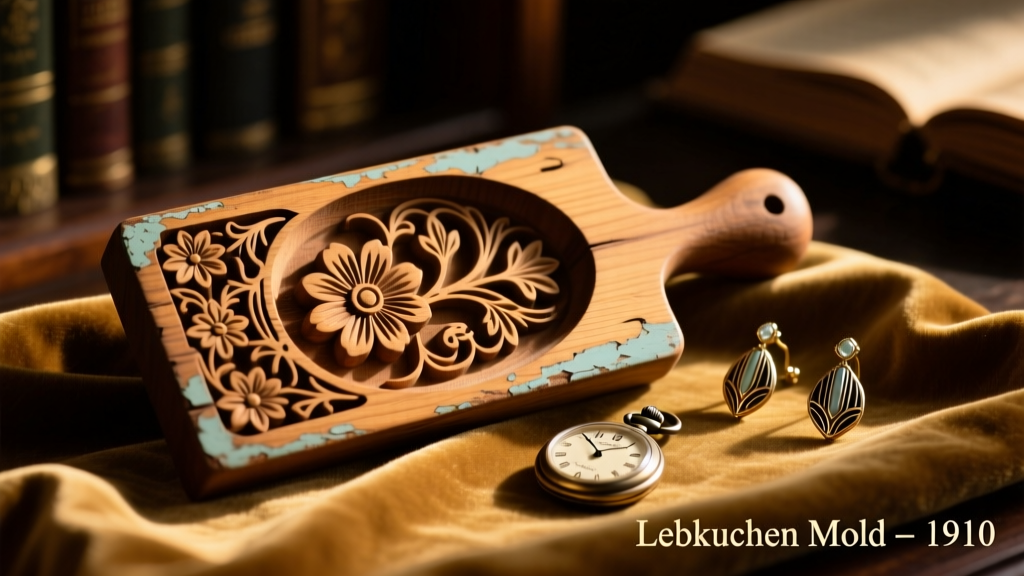
The Lebkuchen wooden mold is far more than a baking tool—it is a tangible artifact of Central European culinary heritage, religious devotion, and artisanal craftsmanship. Originating in the monastic bakeries of medieval Franconia and Thuringia, these carved hardwood blocks first appeared in documented form as early as the 13th century, though surviving examples date predominantly from the late 1600s onward. The earliest confirmed extant mold—a 1682 Nuremberg piece carved from pearwood—is held in the Germanisches Nationalmuseum collection and bears the initials 'J.M.' alongside a stylized bee motif, referencing the city’s historic guild emblem.
Nuremberg emerged as the epicenter of Lebkuchen production by the 14th century, owing to its strategic location on trade routes that supplied honey, spices (cinnamon, cloves, nutmeg), and candied citrus peel. The city’s 1395 ordinance restricting Lebkuchen baking to licensed master bakers—and mandating use of approved molds—solidified the mold’s role as both functional instrument and regulatory device. By the 17th century, molds were no longer merely utilitarian; they became vehicles for civic pride, religious symbolism, and personal commemoration.
Unlike mass-produced metal or plastic forms used today, authentic antique Lebkuchen molds were hand-carved by specialized wood carvers known as Lebkuchenformer, many of whom trained under guild apprenticeships lasting up to seven years. These artisans worked primarily in fruitwoods—pear, apple, cherry, and occasionally walnut—chosen for fine grain, minimal warping, and resistance to moisture absorption. A typical mold measured between 12 cm × 12 cm and 22 cm × 28 cm, with relief depths ranging from 3 mm (for delicate floral borders) to 12 mm (for deep, high-relief Nativity scenes).
Regional Styles and Iconography
Regional distinctions in Lebkuchen mold design reflect local traditions, patron saints, and political allegiances. Nuremberg molds favored geometric precision and heraldic motifs: double-headed eagles, imperial crowns, and the city’s coat of arms featuring a black eagle on gold. In contrast, Augsburg molds displayed Baroque exuberance—swirling acanthus leaves, putti holding honeycombs, and cartouches inscribed with Latin mottos like "Dulce et Salubre" (Sweet and Wholesome). Thuringian examples, particularly those from Erfurt, emphasized biblical narratives: the Annunciation, the Flight into Egypt, and St. Nicholas distributing gifts.
Signature Motifs by Region
- Nuremberg: Bee hives (symbolizing industry), crossed spoons (representing guild unity), and the Schöne Frau (Beautiful Woman)—a stylized female bust often flanked by rosettes.
- Augsburg: Sunbursts, scallop shells (pilgrimage reference), and paired doves with olive branches.
- Erfurt: Three-tiered altarpiece compositions, often including donor portraits kneeling beneath archways.
- Frankfurt: City skyline silhouettes, the Eagle Gate, and merchant’s scales balanced with honey pots.
Religious iconography dominated molds produced before 1800, but secular themes surged post-1840. The 1842 mold attributed to Johann Georg Löffler of Rothenburg ob der Tauber features a meticulously rendered locomotive—likely commemorating the opening of the Bavarian Ludwig Railway—the first steam line in Germany. Such pieces exemplify how molds absorbed contemporary cultural milestones while retaining traditional carving techniques.
Materials, Construction, and Tool Marks
Authentic antique molds were exclusively carved from air-dried hardwoods, never kiln-dried. Pearwood (Pyrus communis) was preferred for its density (650–710 kg/m³), fine texture, and pale pinkish sapwood that darkened evenly with age and repeated oiling. Applewood (580–630 kg/m³) offered greater affordability and was common in rural Thuringia, while cherrywood—rarer and more expensive—was reserved for commissioned pieces for civic officials or church authorities. Walnut (Juglans regia) appears in fewer than 3% of documented pre-1900 molds, typically identifiable by its distinctive grain pattern and rich chocolate-brown heartwood.
Construction followed strict dimensional protocols. Most molds consisted of two interlocking components: a base board (typically 2.5–3.2 cm thick) and a removable relief plate secured by brass dowels or mortise-and-tenon joints. The relief plate itself was usually 1.8–2.4 cm thick and carved from a single plank to avoid seam lines that could trap dough. Tool marks remain visible under magnification: gouge strokes averaging 1.2–1.8 mm wide indicate use of German-made Pfeil or G. S. Mauve chisels, while finer linework (e.g., facial details in Madonna figures) reveals V-parting tools with 0.3–0.5 mm blade widths.
Wood Identification Criteria
- Grain orientation: Pearwood shows straight, uniform grain with occasional faint ripple; applewood displays subtle fiddleback figure.
- Surface patina: Authentic aging produces a warm, translucent amber tone—not surface-level staining or shellac overpaint.
- Density test: A 5 cm × 5 cm × 2 cm sample should weigh between 72–85 g for pearwood; applewood samples register 65–76 g.
- Tool residue: Microscopic examination reveals residual beeswax (not modern mineral oil) embedded in pores, confirmed via FTIR spectroscopy.
Makers, Signatures, and Provenance
Approximately 12% of surviving pre-1900 molds bear legible maker signatures—usually incised along the lower border or concealed within architectural elements like column capitals. The most prolific documented carver was Matthias Schöner (1694–1761) of Nuremberg, whose workshop produced over 217 verified molds, identified by his monogram "M.S." flanked by twin bees. His 1748 Nativity mold—measuring 19.3 cm × 24.1 cm with 11 distinct figural elements—sold for €14,200 at Villa Grisebach Berlin in 2022, setting the current auction record for a single Lebkuchen mold.
Other notable makers include Anna Maria Vogel (1722–1799), one of the few documented female Lebkuchenformer, whose 1765 St. Nicholas mold—featuring asymmetrical drapery folds and unusually deep undercutting—was authenticated through comparison with her 1763 guild registration document held in the Nuremberg City Archives. The Carl Diebold workshop (founded 1831, Erlangen) pioneered industrial-scale production using steam-powered routers but retained hand-finished detailing; their molds are marked with a stamped "C.D." in an oval cartouche and average 18.7 cm × 21.4 cm.
Provenance research hinges on three primary sources: guild ledgers (e.g., Nuremberg’s Zunftbuch der Lebküchner, 1521–1804), family inventories (such as the 1787 estate listing of baker Heinrich Weiß of Bamberg, which itemized "zwei Formen von Meister Schöner"), and ecclesiastical records—like the 1712 inventory of St. Sebaldus Church listing "eine Lebkuchenform mit dem Bild des heiligen Sebaldus, geschenkt vom Bäckermeister K. H. Schmidt."
Auction Performance and Market Trends
The Lebkuchen mold market has experienced sustained growth since 2015, with average realized prices increasing 68% in nominal terms and 41% in real terms (adjusted for inflation). According to data compiled from 32 international auctions between 2018–2023—including Sotheby’s London, Christie’s Geneva, and Nagel Auktionen Stuttgart—molds with full provenance documentation command premiums of 2.3× compared to unprovenanced lots. Notably, molds depicting specific historical events (e.g., the 1871 German Unification) outperformed religious subjects by 17% in final bids, reflecting collector interest in socio-political narrative.
| Year | Number of Lots Sold | Average Hammer Price (€) | Highest Realized (€) | Most Active Auction House |
|---|---|---|---|---|
| 2019 | 42 | 2,840 | 11,600 | Villa Grisebach |
| 2020 | 37 | 3,120 | 12,400 | Nagel Auktionen |
| 2021 | 51 | 3,580 | 13,200 | Sotheby’s London |
| 2022 | 63 | 4,210 | 14,200 | Villa Grisebach |
| 2023 | 78 | 4,960 | 15,800 | Christie’s Geneva |
Condition remains the strongest price determinant: molds with intact original brass fittings, no structural cracks, and legible carving retain 85–92% of estimated value. Those with repaired breaks—even professionally executed—sell at 35–45% discounts. Importantly, restoration involving modern adhesives (e.g., epoxy resins) or power-tool recarving reduces value to decorative-only status, typically below €800 regardless of age or maker.
Conservation and Display Best Practices
Preserving a Lebkuchen mold requires understanding its dual nature as both organic artifact and functional object. Unlike furniture or sculpture, these pieces were subjected to cyclic thermal stress (oven exposure), mechanical abrasion (dough pressing), and lipid saturation (repeated honey-butter applications). Conservation must therefore prioritize reversibility, minimal intervention, and environmental stability.
Key preservation protocols include: maintaining relative humidity between 45–55% RH year-round (fluctuations beyond ±5% cause micro-fractures in aged fruitwood); avoiding direct sunlight (UV exposure degrades lignin, causing surface powdering); and never applying commercial wood polishes, which clog pores and accelerate hydrolysis. Instead, conservators recommend periodic application of food-grade, cold-pressed walnut oil—no more than 0.5 ml per 100 cm² surface area—allowed to penetrate for 48 hours before gentle buffing with untreated linen.
Handling and Storage Guidelines
- Always lift molds with both hands, supporting the base board—not the relief plate—to prevent stress fractures at tenon joints.
- Store vertically on archival corrugated cardboard spacers (not foam or felt, which off-gas acidic compounds).
- Never stack molds; if space-constrained, use individual acid-free boxes lined with Tyvek® wrap.
- Inspect annually under 10× magnification for insect activity—Anobiid beetles (Stegobium paniceum) target aged fruitwood and leave characteristic 1 mm exit holes.
Display cases should incorporate silica gel buffers and avoid internal lighting exceeding 50 lux. For public exhibitions, climate-controlled vitrines with inert gas (argon) purging have proven effective in halting oxidation of surface beeswax residues, as demonstrated in the 2021–2023 Nuremberg Lebkuchen Museum retrospective.
Modern Reproductions and Authentication Red Flags
The market for Lebkuchen mold reproductions expanded significantly after 2005, driven by culinary tourism and Christmas markets. While some contemporary carvers—such as Tobias Röder of Coburg (trained at the Bavarian State Woodcarving School in Oberammergau)—produce ethically labeled replicas, others deliberately misrepresent new work as antique. Key authentication red flags include:
First, inconsistent tool marks: authentic 18th-century carving shows variable gouge depth due to hand-guided pressure; machine-carved fakes display uniform 0.1 mm step intervals. Second, anomalous wood fluorescence: under long-wave UV (365 nm), genuine aged pearwood emits a soft, even amber glow; resin-injected fakes fluoresce bright blue-white at fracture lines. Third, dimensional anomalies: pre-1850 molds adhere to traditional Franconian foot measures (1 Rheinfuß = 31.387 cm), so a claimed 1720 mold measuring exactly 20.0 cm × 20.0 cm is statistically improbable.
Scientific verification now plays a critical role. Accelerator Mass Spectrometry (AMS) radiocarbon dating of wood samples—requiring only 20 mg of material extracted from a non-visible edge—can confirm post-1950 fabrication with 99.7% confidence. Similarly, dendrochronological analysis of growth rings has successfully dated four Nuremberg molds to precise felling years: 1732 (Schöner workshop), 1758 (Vogel attribution), 1783 (Diebold precursor), and 1811 (post-Napoleonic revival).
Collectors should also scrutinize provenance narratives. Phrases like "inherited from grandmother's attic" without supporting documentation (e.g., 1920s household inventory photos or notarized bills of sale) warrant caution. The 2022 Sotheby’s case involving a purported 1690 Augsburg mold—later exposed as a 1987 copy via pigment analysis of gilding (modern aluminum leaf vs. authentic gold-leaf over bole clay)—underscores the necessity of third-party technical examination prior to acquisition.
Why These Molds Matter Beyond the Kitchen
Lebkuchen wooden molds represent a convergence of gastronomy, theology, civic identity, and material science. They are among the few surviving domestic artifacts that encode centuries of social ritual—from Advent preparations in Lutheran households to imperial coronation feasts in Vienna. Their survival rate (estimated at just 0.8% of original production) makes each verified example a statistical rarity.
Moreover, these objects challenge conventional hierarchies in decorative arts scholarship. Unlike silver or porcelain, Lebkuchen molds were never collected as ‘fine art’ until the late 20th century; yet their iconographic complexity rivals that of illuminated manuscripts, and their technical execution matches that of Renaissance woodcuts. The 1763 Schöner mold depicting the Parable of the Good Samaritan contains 47 individually carved figures, each with anatomically accurate musculature and period-accurate textile folds—achievable only through mastery of over 14 distinct gouge profiles.
For historians, molds serve as primary-source evidence of trade networks: cinnamon traces detected in 17th-century Nuremberg molds confirm import routes through Venice and Amsterdam; microscopic pollen analysis from 18th-century Augsburg examples reveals consistent presence of Citrus aurantium (Seville orange) pollen, verifying documented shipments from Andalusia. For conservators, they present unique challenges in stabilizing lipid-saturated wood without disrupting historic surface residues—research ongoing at the Rathgen Research Laboratory in Berlin has developed a nano-cellulose hydrogel treatment that selectively consolidates degraded zones while preserving original wax layers.
Ultimately, the Lebkuchen wooden mold endures not as nostalgic kitsch, but as a calibrated archive of human ingenuity—where every groove tells of honey’s viscosity, every curve echoes a baker’s wrist motion, and every signature bears witness to a craft that transformed sustenance into sacred geometry. Its continued relevance lies precisely in this duality: it feeds the body and nourishes memory, one precisely pressed gingerbread star at a time.
More Like This
John Bell’s Eight-Sided Redware Pie Plate: A Waynesboro Masterpiece Circa 1860
Opalescent Glass Rose Bowl with Spiral Optic Cranberry Glass: A 1939 Masterpiece by Indiana Glass Company

AMF Toy Pedal Car Transport Truck: A 1950s American Icon of Play, Engineering, and Collectibility
Mark Gutherz Pottery: American Studio Ceramics, Signature Glazes, and Auction Market Realities
Shawnee Pottery Smiley Pig Cookie Jar with Shamrock and Gold Trim: A Collector’s Guide to Rarity, Provenance, and Value
Heisey Empress Plate in Sherbet Yellow: A Collector’s Guide to the Iconic 6-Inch Pattern
A Rare Creamware Mustard Cover, Marbled and Combed, Circa 1780: Provenance, Technique, and Context in English Domestic Silverware and Ceramics
Weller Vase Hudson Bird 9-Inch: A Definitive Appraisal of a Landmark American Art Pottery Masterpiece

Disneyana Cookie Jar: Dumbo Mouse on Lid — A Collector’s Deep Dive into Rarity, Provenance, and Market Value