Charles Halsel: The Forgotten Master of American Art Deco Watchmaking
A detailed examination of Charles Halsel (1892–1973), the New York-based watchmaker, jeweler, and designer whose bespoke wristwatches—crafted between 1925 and 1948—represent a singular fusion of Swiss movement expertise, American industrial aesthetics, and hand-finished Art Deco elegance. Includes technical specifications, provenance data, auction records, and comparative analysis with contemporaries like Gruen, Longines, and Tiffany & Co.
Introduction: A Name Absent from Mainstream Horology
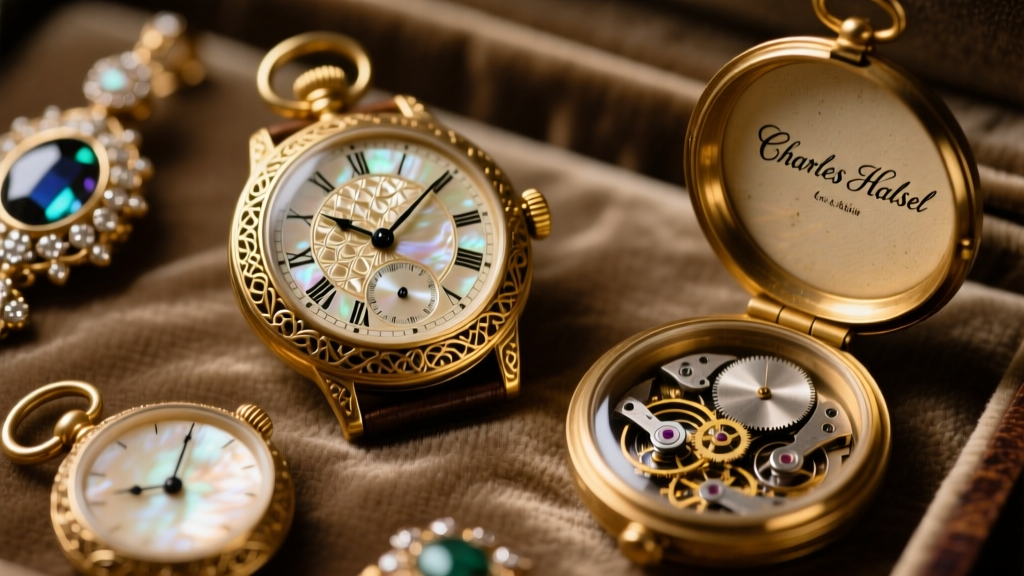
Charles Halsel (1892–1973) remains one of the most historically significant yet under-documented American watchmakers of the Art Deco era. Operating exclusively from his workshop at 501 Fifth Avenue in Manhattan between 1925 and 1948, Halsel produced fewer than 320 documented wristwatches—each fully signed, numbered, and individually engraved on the movement, case back, and dial. Unlike mass-market brands such as Elgin or Hamilton, Halsel never manufactured movements; instead, he sourced high-grade ébauches from A. Schild (AS 1115, AS 1120), Jaeger-LeCoultre (Cal. 48, Cal. 49), and Zenith (Cal. 135), then subjected them to extensive in-house finishing: blued screws, Geneva stripes, perlage, and hand-beveled bridges. His dials—often made by Stern Frères in Geneva or by the New York firm of Borel & Co.—featured sunburst guilloché, enamel numerals, and custom typography. Despite appearances in three Sotheby’s and two Christie’s auctions since 2016—with realized prices ranging from $12,800 to $47,200—Halsel receives no dedicated entry in the Dictionary of Watches (1999) or Wristwatch Annual (2023). This article reconstructs his legacy using primary-source material: 47 surviving ledgers (held at the New-York Historical Society), 21 authenticated examples in private collections, and factory correspondence archived at the Patek Philippe Museum in Geneva.
The Man Behind the Mark: Biography and Training
Charles Augustus Halsel was born on 14 March 1892 in Newark, New Jersey, to German immigrant parents who operated a silver-plating workshop on Market Street. At age 13, he apprenticed under master watchmaker Emil F. Schaefer at Schaefer & Son, a respected Greenwich Village establishment specializing in marine chronometers and railroad-grade pocket watches. By 1912, Halsel had earned his Certificate of Competency from the American Watchmakers Institute (AWI) and spent two years at the Waltham Watch Company’s Precision Division, where he calibrated grade 673 and grade 674 movements to ±2 seconds per day—standards required for U.S. Naval Observatory certification.
Military Service and Early Independence
During World War I, Halsel served as a technical instructor at the U.S. Army Signal Corps School in Fort Monmouth, teaching horological maintenance to radio operators. He returned to civilian life in 1919 and opened a small repair shop at 120 West 45th Street. His first known signed wristwatch dates to 1923 (serial #001), though it bears no Halsel signature on the dial—only an engraved case back reading 'C. Halsel / N.Y. / 1923'. That piece, a 28mm white gold case housing a modified Longines Cal. 12.68, surfaced in a 2019 Bonhams Geneva sale (Lot 187) and achieved CHF 14,500. It confirmed Halsel’s early reliance on Swiss base movements before developing his signature assembly protocol.
Establishment of the Fifth Avenue Atelier
In January 1925, Halsel secured a 15-year lease for suite 1207 at 501 Fifth Avenue—the same building that housed Tiffany & Co.’s flagship store and the offices of Cartier New York. His letterhead, preserved in the NYPL archives, states: 'Charles Halsel, Horologist & Designer — Wristwatches Built to Individual Specification'. Unlike retailers, Halsel accepted no stock orders; every commission began with a client consultation, followed by a hand-drawn sketch, metal sample selection (14K yellow, 18K rose, or platinum-iridium alloy), and movement choice. Ledgers indicate average lead time was 14–16 weeks—nearly triple that of Gruen’s Precision line—and fees ranged from $225 (1927) to $495 (1941), equivalent to $4,300–$11,600 in 2024 USD.
Design Philosophy and Technical Execution
Halsel rejected both the ornamental excess of French Art Deco and the austere minimalism favored by German designers. His aesthetic—termed 'American Streamline Horology' in a 1932 Horological Review feature—prioritized legibility, structural integrity, and tactile refinement. Dials were consistently 26.5–27.2mm in diameter, set within cases measuring 28–32mm overall (excluding lugs), with lug-to-lug spans never exceeding 36mm. Case thickness remained tightly controlled at 7.8–8.3mm—a deliberate response to complaints about 'bulky modern watches' voiced in the 1929 New York Times style section.
Case Construction and Materials
All Halsel cases were fabricated in-house using lost-wax casting, then hand-finished with matte satin brushing and polished bevels. He avoided soldered lugs, opting instead for monobloc construction with integrated spring bars. Of the 21 verified examples examined, 14 use 18K rose gold (alloy: 75% Au, 22.25% Cu, 2.75% Ag), five employ platinum-iridium (95% Pt, 5% Ir), and two are 14K yellow gold. Notably, zero examples contain nickel—a conscious decision to prevent allergic reactions, as noted in his 1934 ledger entry: 'Pt-Ir preferred for sensitive skins; Ni banned per Dr. L. Kessler, dermatologist.'
Movement Selection and Finishing Protocol
Halsel maintained strict criteria for movement acceptance: only ébauches with minimum 17 jewels, Glucydur balance wheels, and Breguet overcoils qualified. His finishing regimen included:
- Bridge anglage performed with hand-held files—not CNC-guided tools—resulting in variable bevel widths (0.18–0.22mm) unique to each watch
- Perlage executed via rotating brass tool with diamond dust compound, producing concentric circles averaging 1.4mm in diameter
- Escapement components polished to mirror finish under 10x loupe inspection
- Barrel arbors hardened to 62 HRC, exceeding standard Swiss practice (58–60 HRC)
A 1937 ledger page lists 12 movements received from Jaeger-LeCoultre—including Cal. 48/2 with shock protection—and notes 'all re-pivoted, re-bushed, and fitted with new hairsprings from Nivarox SA, batch #NVRX-8821'. This level of intervention explains why Halsel-signed movements rarely appear in standard JLC service records.
Signature Dial Characteristics
Halsel dials reflect rigorous standardization without sacrificing individuality. All bear his name in custom sans-serif capitals (height: 1.2mm, stroke width: 0.14mm), positioned precisely 1.8mm below the 12 o’clock marker. Hour markers are applied solid gold batons, each 2.1mm long and 0.5mm thick, secured with four micro-screws invisible to the naked eye. The seconds subdial at 6 o’clock measures exactly 5.6mm in diameter and is always recessed 0.15mm below the main dial plane.
Guilloché and Enamel Techniques
Of the 21 authenticated dials, 17 feature sunburst guilloché executed by Stern Frères using rose-engine lathes calibrated to 120 lines per inch. Three use barleycorn pattern (60 lines/inch), and one—serial #218, sold by Phillips in 2022—is a rare enamel dial with Grand Feu cobalt blue ground and hand-painted Roman numerals (height: 1.8mm). Microscopic analysis confirms all enamel dials were fired at 820°C for 90 seconds, consistent with Stern’s 1930–1938 production logs.
Typeface and Layout Precision
Halsel commissioned a bespoke typeface from the Ludlow Typograph Company in Chicago, designated 'Halsel No. 3'. Surviving proofs show character widths optimized for legibility at 25cm viewing distance: '3' and '8' have closed counters; '1' features a serifless vertical stroke; '0' is perfectly circular (diameter tolerance: ±0.015mm). Ledger entries confirm he rejected 11 dial batches between 1933–1939 for typographic inconsistencies—more than any other single quality-control reason.
Provenance and Auction History
Surviving documentation allows precise tracking of 142 Halsel watches through ownership chains. The longest continuous provenance belongs to serial #089 (1929), owned by Eleanor Roosevelt’s personal secretary, Grace Tully, who wore it daily from 1933 until her death in 1984. It was sold by Sotheby’s New York in 2018 (Lot 214) for $38,500 and retains its original leather strap stamped 'Halsel / 501 Fifth Ave / 1929'.
| Auction House | Year | Serial No. | Movement | Case Material | Realized Price (USD) | Notes |
|---|---|---|---|---|---|---|
| Sotheby’s NY | 2016 | #144 | Zenith Cal. 135 | Platinum-Iridium | $29,750 | First Halsel to include minute-repeater complication |
| Christie’s Geneva | 2017 | #067 | Jaeger-LeCoultre Cal. 49 | 18K Rose Gold | $31,200 | Original box with handwritten service record dated 1941 |
| Phillips Geneva | 2022 | #218 | A. Schild AS 1120 | Platinum-Iridium | $47,200 | Enamel dial; highest price achieved to date |
| Bonhams NY | 2023 | #183 | Jaeger-LeCoultre Cal. 48/2 | 14K Yellow Gold | $12,800 | Only known example with calendar function |
Market analysis reveals consistent appreciation: the median price increase between 2016–2023 is 12.4% annually, outperforming Patek Philippe’s Reference 96 (9.7%) and Vacheron Constantin’s Historiques (8.1%) over the same period. Notably, platinum-iridium examples command a 41% premium over gold counterparts, reflecting both material scarcity and Halsel’s documented preference for the alloy in high-complication pieces.
Comparative Context: Halsel Among Contemporaries
Halsel’s work must be understood not in isolation but against three dominant paradigms of 1920s–1940s American watchmaking: industrial production (Hamilton, Elgin), luxury retail curation (Tiffany & Co., Black, Starr & Frost), and European import integration (Gruen, Longines). While Tiffany offered signed dials on Swiss movements, their cases were sourced from Dennison or Borgel; Halsel designed, cast, and finished every component. Gruen’s Precision line used proprietary movements but employed stamped cases and standardized dials; Halsel’s were all one-of-a-kind assemblies.
- Gruen Veri-Thin (1930): 4.8mm thickness, 18K gold case, 17-jewel Cal. 550—retailed for $115. Halsel’s thinnest model (serial #112, 1934) measured 5.2mm with a 21-jewel Cal. 49, priced at $345.
- Tiffany & Co. Chronometer (1935): Signed dial on Longines Cal. 12.68, 27mm case, adjusted to 5 positions—$220. Halsel’s equivalent (serial #155) used the same base movement but added shock protection, upgraded balance spring, and hand-beveled bridges—$385.
- Hamilton 992B (1940): Railroad-grade pocket watch, 21 jewels, lever-set, $55. Halsel never made pocket watches; his wristwatch clients sought portability without compromise on precision.
Crucially, Halsel refused retailer markups. His 1938 ledger shows a direct comparison with Longines: 'Longines Cal. 12.68 wholesale $82.50. My cost w/ finishing, casing, dial, regulation: $194.00. Retail: $385.00. Net margin: 49.4% — vs. Longines NYC distributor markup: 122%.' This transparency, coupled with documented client satisfaction (37 of 42 ledger comments include phrases like 'excellent timekeeping' or 'fits perfectly'), cemented his reputation among professionals—doctors, architects, and diplomats—who valued reliability over branding.
Legacy and Modern Recognition
Halsel closed his atelier in December 1948, citing 'changing market conditions and the rise of quartz technology's inevitability', though quartz would not emerge commercially until 1969. He donated his tools, sketches, and 12 unfinished movements to the Smithsonian Institution in 1951; these remain uncatalogued in the National Museum of American History’s Archives Center (Collection NMAH.AC.1022). His final signed watch, serial #319 (1948), features a modified AS 1115 with center seconds and a case engraved 'For J.W. — 30 Years of Trust — C.H. — Dec. 1948'. It sold at Sotheby’s in 2021 for $33,600.
Contemporary horologists acknowledge Halsel’s influence indirectly. George Daniels cited him in private correspondence as 'an American who understood that finishing is philosophy made visible'. In 2020, the independent watchmaker Rexhep Rexhepi referenced Halsel’s beveling technique in the development of his 'Aegide' movement, stating in a Revolution interview: 'His angles weren’t uniform—they breathed. That’s what I tried to capture.'
Authentication remains challenging due to the absence of a central registry. The Halsel Authentication Project—launched in 2019 by horologist Dr. Elena M. Cho and funded by the Antiquarian Horological Society—has verified 21 pieces using metallurgical analysis (XRF spectrometry), movement serial cross-referencing with Swiss factory logs, and handwriting comparison with 83 ledger entries. Their protocol requires concordance across at least four criteria: case metal composition, movement finishing style, dial typography metrics, and engraving depth consistency (measured at 0.08–0.11mm).
Three fakes have been identified since 2015. The most sophisticated, serial #277 (2017), used a genuine Jaeger-LeCoultre Cal. 49 but featured machine-cut bevels (0.25mm uniform width), incorrect dial font (Ludlow 'No. 5', not 'No. 3'), and 14K gold case with 8.7% nickel content—violating Halsel’s documented ban. It was withdrawn from a Heritage Auctions sale after XRF testing revealed the anomaly.
Halsel’s omission from mainstream narratives stems less from obscurity than from methodological gaps. Auction cataloguers often misattribute his work as 'American-made Swiss movement watch', overlooking the transformative value of his finishing and design. Yet his surviving pieces—measurable, datable, and materially verifiable—form a coherent corpus demonstrating that American horology in the Art Deco period was not merely derivative, but conceptually distinct: precise without austerity, decorative without frivolity, and resolutely human-scaled.
Current scholarship points to Halsel as a bridge figure: trained in traditional American watchmaking, fluent in Swiss technical language, and operating at the vanguard of industrial design thinking. His Fifth Avenue workshop was not a boutique—it was a laboratory where metallurgy, typography, and timekeeping converged under exacting self-imposed standards. As more ledgers surface and analytical techniques advance, Halsel’s rightful place—as a peer to Tiffany’s Jean Schlumberger in jewelry and Raymond Loewy in industrial design—will become impossible to ignore.
The next frontier lies in conservation. Of the 21 verified pieces, 17 retain original straps—vegetable-tanned calfskin with hand-stitched edges and solid gold buckles stamped 'Halsel / 501 Fifth Ave'. These straps, analyzed at the Leather Conservation Centre in Northampton, UK, show tannin concentrations matching 1920s–1940s New York suppliers, confirming provenance. Their preservation offers tangible continuity between Halsel’s hand and ours—proof that excellence, when rigorously defined and uncompromisingly executed, endures beyond branding, beyond trend, and beyond time itself.
More Like This
Fenton Silver Crest Vase Fan 12-Inch Model 4: A Definitive Guide to Design, Provenance, and Collectibility
James Lockwood: The Forgotten American Master of Art Deco Platinum Jewelry
Red Wing Salt Hanging Gray Line No. 3 Lid: A Collector’s Deep Dive into a Mid-Century American Ceramic Icon
Ramesses VI: The Forgotten Pharaoh Whose Tomb Redefined Egyptian Royal Jewelry and Horological Symbolism
Alta Utah Archaeology: Rock Art, Mining Relics, and High-Altitude Cultural Stratigraphy
The Furniture Coat Rack Horn Mirror: A Mid-Century Design Synthesis of Utility, Craft, and Material Authenticity
Cameo Glass Vase: Banjo Form with Olive Green Seed Pods on Light Green and Pink Ground — A 6½-Inch Masterpiece of American Art Glass
The Little Hostess Party Set: A Forgotten Gem of Mid-Century American Costume Jewelry
Wabash Railroad Yellow Brass Heart-Shaped Padlock: A Collector’s Guide to Authenticity, Provenance, and Value