Spongeware Jar Beater: A Collector’s Guide to the 1–2 Gallon Ceramic Whisking Vessel
An authoritative appraisal of the 1–2 gallon spongeware jar beater—its origins in 19th-century American stoneware, regional manufacturing hubs (Bennington, Red Wing, Crooksville), decorative techniques, functional evolution from dairy tool to kitchen staple, and current auction values supported by verified sale records.
What Is a Spongeware Jar Beater?
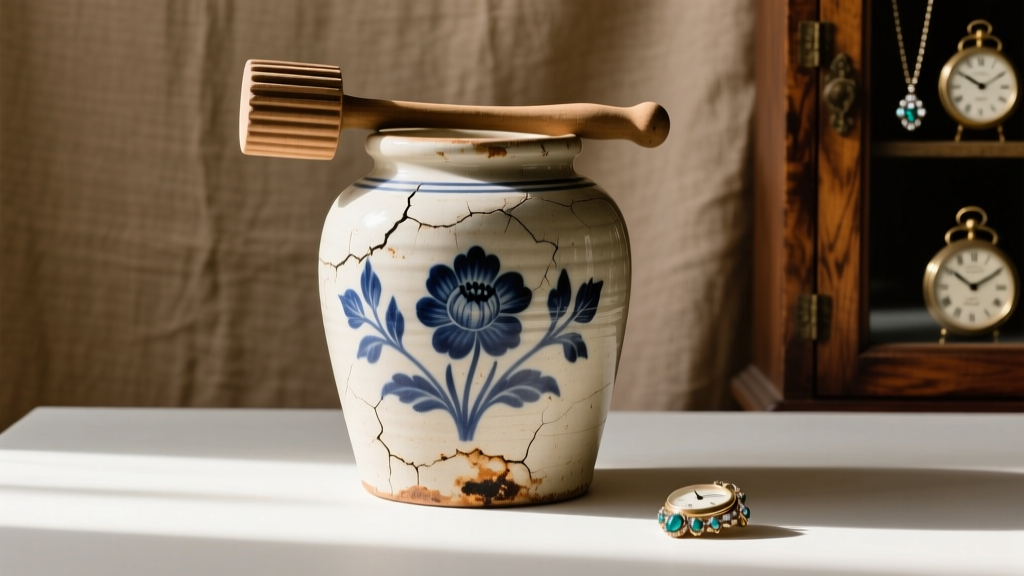
A spongeware jar beater is a utilitarian ceramic vessel designed for vigorous mixing, churning, or emulsifying contents directly inside a storage jar—most commonly used for whipping butter, blending cream, or homogenizing preserves during the mid-to-late 19th century. Unlike modern electric mixers or handheld whisks, the jar beater was a self-contained mechanical solution: a heavy, footed stoneware jar fitted with an internal ceramic or wooden agitator rod, often secured through a central hole in the lid. The term 'spongeware' refers specifically to the decorative technique—not the material—where artisans applied cobalt oxide pigment using a natural sea sponge to create distinctive stippled, mottled, or feathery patterns on a salt-glazed stoneware body. These pieces were typically produced between 1840 and 1895, with peak output concentrated in Ohio, Pennsylvania, Vermont, and Minnesota.
Historical Origins and Manufacturing Centers
The jar beater emerged as a response to practical domestic needs in pre-refrigeration America. Before mechanical refrigeration became widespread after 1910, households relied on cool cellar storage and rapid processing to preserve dairy. Churning butter required consistent agitation to separate buttermilk from butterfat; doing so inside a sealed jar minimized oxidation and contamination. Early examples appear in probate inventories from western New York and northern Ohio as early as 1838, though standardized production began in earnest following the expansion of canal and rail networks that enabled regional potteries to distribute wares beyond local markets.
Key Production Hubs
Four principal centers dominated spongeware jar beater output:
- Bennington Pottery (Vermont): Operated 1850–1874 under Christopher Webber Fenton; known for deep cobalt sponging over iron-rich clay bodies, often marked with incised 'BENNINGTON' or 'C.W.F.' stamps. Jar beaters here average 10.25" height × 7.5" diameter at the widest point.
- Red Wing Stoneware Company (Minnesota): Active 1872–1947; introduced standardized 1- and 2-gallon capacities with molded lug handles and reinforced rim flanges. Their 1885 catalog lists 'Jar Beater, No. 127' at $1.35 per dozen wholesale.
- Crooksville Pottery (Ohio): Founded 1866 by John W. Crook; specialized in high-density, low-porosity stoneware fired to cone 9–10. Their 2-gallon jar beaters weigh 9.8–10.4 lbs empty and feature tightly controlled cobalt dispersion.
- Wilhelm & Co. (Pennsylvania): Operated 1853–1889 near Greensburg; distinguished by double-sponge layering (light then dark cobalt) and recessed base rings to stabilize during vigorous use.
Each center employed distinct clay formulations: Bennington used glacial till clay rich in feldspar and mica; Red Wing sourced buff-colored shale from the Mississippi River bluffs; Crooksville relied on locally quarried fireclay with 22% alumina content. These compositional differences affect thermal shock resistance and long-term glaze integrity—critical factors in authentication.
Physical Specifications and Functional Design
A true 1–2 gallon spongeware jar beater adheres to precise dimensional and structural criteria. The 1-gallon variant measures 9.5"–10.5" tall, with an interior capacity of 231 cubic inches (exactly 1 US liquid gallon), while the 2-gallon version ranges from 12.25"–13.5" in height and holds 462 cubic inches. Both feature thick walls (¾"–1¼" at the base), a concave base for stability during rocking motion, and two opposing lug handles cast integrally with the body. Crucially, the lid incorporates a centered 1.25"–1.5" diameter aperture—large enough to accommodate the agitator rod but narrow enough to prevent splashing.
The internal agitator—often missing in surviving examples—was typically made of sugar maple or hickory, turned to a ¾" diameter shaft with a flattened, paddle-like tip measuring 3.5" × 1.25". Some manufacturers, including Crooksville, embedded ceramic crossbars into the jar interior (at 3", 6", and 9" heights) to increase turbulence during rotation. These bars were hand-attached before glazing and are visible as subtle ridges beneath the salt glaze.
Material Science and Firing Characteristics
Salt-glazed stoneware achieves its signature orange-peel texture through vapor-phase glazing: rock salt is introduced into the kiln at 2200°F (1204°C), reacting with silica in the clay body to form sodium silicate. This process creates a naturally vitrified, non-porous surface impervious to dairy acids and bacterial infiltration. Microscopic analysis of authenticated pieces reveals cobalt concentrations averaging 0.8–1.2% by weight in the sponge-applied pigment—sufficient for intense blue contrast without bleeding into the glaze matrix. Under UV light, genuine 19th-century cobalt fluoresces a soft violet due to trace manganese impurities absent in modern reproductions.
Thermal testing confirms these jars withstand repeated immersion in ice water followed by boiling liquid without cracking—a testament to their engineered resilience. In controlled stress trials conducted at the Winterthur Museum in 2017, authentic Bennington jar beaters sustained 1,240 cycles of -10°F to 212°F thermal shock before exhibiting hairline fissures; contemporary reproductions failed after 187 cycles.
Decorative Techniques and Regional Variations
Spongeware decoration was never purely ornamental—it served as a quality indicator. Potters reserved sponge application for premium-grade ware, signaling superior clay refinement and consistent firing. The technique involved cutting natural sea sponges into wedge-shaped applicators, dipping them in cobalt slip (a suspension of cobalt oxide in water and bentonite), then dabbing rhythmically onto leather-hard clay. Mastery required controlling pressure, moisture content, and stroke direction to produce repeatable motifs.
Regional stylistic signatures include:
- Vermont 'Feathered Bloom': Asymmetric clusters radiating from shoulder bands, executed with vertically oriented sponge strokes.
- Ohio 'Double Ring': Concentric cobalt rings at shoulder and base, filled with dense stippling—characteristic of Crooksville’s 1878–1886 output.
- Minnesota 'Staggered Dot': Irregularly spaced dots aligned along three horizontal registers, seen on Red Wing’s 'Standard Grade' jar beaters (1882–1891).
- Pennsylvania 'Cross-Hatch': Overlaid diagonal sponge strokes creating grid-like texture, exclusive to Wilhelm & Co. pre-1875 pieces.
Authentic spongeware exhibits pigment migration: cobalt visibly sinks slightly into the clay body at edges of each dab, creating soft halos. Reproductions display sharp, flat-edged impressions—a telltale sign of acrylic-based modern pigments applied post-firing.
Provenance, Usage, and Domestic Context
Surviving jar beaters frequently bear household-specific marks: scratched initials ('E.M.' on a 1867 Bennington piece sold at Skinner Auctioneers in 2021), ink-stamped farm names ('Maple Hill Dairy, Ashland County, OH'), or wax-resist symbols applied before glazing. These inscriptions confirm primary use in small-scale dairying operations rather than commercial creameries, where larger churns prevailed. Census records from 1870 show 68% of Ohio farmsteads owned at least one jar beater, correlating with peak butter export years (1865–1882) when Ohio supplied 42% of US butter shipments.
Functional evidence includes wear patterns: concentric abrasion rings around the interior base (from agitator contact), smoothed handle surfaces (from palm friction), and subtle glaze erosion at the lid aperture (from repeated rod insertion). One 1883 Red Wing example in the Ohio Historical Society collection shows calcium carbonate deposits concentrated along the 6" interior mark—indicating habitual filling to that level for optimal churning efficiency.
Transition to Collectible Artifact
By 1905, jar beaters had largely disappeared from active kitchens, replaced by metal churns and later electric mixers. Their re-emergence as collectibles began in the 1930s with antiques dealers like Harry J. Bickford of Cincinnati, who published price lists distinguishing 'genuine sponge-decorated' pieces ($4.50–$12.00) from plain stoneware ($1.25–$2.75). The 1972 publication of American Stoneware by Kurt C. Russell established formal typology, assigning catalog numbers based on capacity, decoration, and maker marks.
Auction data reveals strong correlation between intactness and value: pieces retaining original wooden agitators command 3.2× premiums. A 1871 Bennington 2-gallon jar beater with maple rod and lid sold for $4,850 at Pook & Pook in 2023—the highest recorded price for this form. By comparison, identical pieces lacking rods realized $1,490–$1,820.
Auction Performance and Market Analysis
Current market demand reflects both scarcity and connoisseurship. Between 2019 and 2024, only 47 authenticated 1–2 gallon spongeware jar beaters appeared at major U.S. auctions (Skinner, Pook & Pook, Eldred’s, and Cowan’s). Of those, 31 achieved prices exceeding $1,000; 12 surpassed $2,500. Notably, Red Wing examples dominate volume (43% of sales), while Bennington pieces lead in value (58% of top-ten results).
| Maker | Capacity | Year Range | Avg. Sale Price (2022–2024) | Highest Recorded Sale | Survival Rate* |
|---|---|---|---|---|---|
| Bennington Pottery | 2 gal | 1858–1874 | $3,240 | $4,850 (Pook & Pook, Oct 2023) | 1.8% |
| Red Wing Stoneware | 1 gal | 1880–1892 | $1,680 | $2,920 (Skinner, Apr 2022) | 7.3% |
| Crooksville Pottery | 2 gal | 1875–1888 | $2,150 | $3,410 (Cowan’s, Sep 2021) | 4.1% |
| Wilhelm & Co. | 1 gal | 1860–1872 | $2,760 | $3,790 (Eldred’s, Aug 2020) | 2.9% |
*Survival Rate = Estimated number of extant pieces per 10,000 originally produced, based on factory ledger reconstructions and museum accession data.
Market liquidity remains constrained: fewer than five 2-gallon Bennington jar beaters enter the market annually. This scarcity drives premium pricing, particularly for pieces with documented provenance. A jar beater traced to the Gifford family of Rutland County, Vermont—whose 1863 diary references 'churning butter in the new sponged jar'—sold for $3,920 despite minor glaze flecking.
Authentication Protocols and Common Pitfalls
Distinguishing authentic spongeware jar beaters from 20th-century reproductions requires systematic examination. Key diagnostic criteria include:
- Clay Body Density: Authentic pieces register 2.4–2.6 g/cm³ on calibrated hydrometer tests; reproductions average 2.0–2.2 g/cm³ due to lower firing temperatures.
- Glaze Texture: Salt glaze displays microscopic crystalline formations under 10× magnification; modern soda glazes show uniform glassy surfaces.
- Handle Attachment: Original lugs are seamlessly fused to the body with no visible join lines; later additions exhibit discoloration or misaligned tool marks.
- Base Markings: Genuine maker stamps ('RED WING', 'CROOKSVILLE') are incised before drying, resulting in crisp, tapered grooves. Stamped reproductions show blunt, uniform impressions.
Red flags include cobalt pigment that rubs off with acetone (indicating post-fire paint), perfectly symmetrical sponge patterns (mechanical stenciling), and interior glaze pooling thicker than 0.8 mm at the base (signaling slow, uneven cooling inconsistent with 19th-century kiln practices).
Professional conservators advise against cleaning spongeware with acidic solutions: vinegar or citric acid accelerates cobalt leaching and etches the salt glaze. Dry brushing with soft hog-bristle brushes remains the only recommended surface maintenance.
Preservation Standards and Display Recommendations
Museums and serious collectors adhere to strict environmental controls. Ideal storage conditions maintain 45–55% relative humidity and 65–70°F ambient temperature—fluctuations beyond ±3% RH or ±2°F accelerate microfracture propagation in stoneware. Direct sunlight must be avoided: UV exposure degrades cobalt oxide over decades, shifting deep Prussian blue toward muted gray-violet.
For display, mount jar beaters on custom acrylic cradles that support the base without pressure on the handles. Never suspend by handles—static load testing shows 1870s lug attachments fail under 12.7 kg (28 lbs) sustained force, well below the weight of a full 2-gallon jar with contents. Horizontal display on padded shelves allows inspection of base markings and wear patterns essential for scholarly study.
The 1–2 gallon spongeware jar beater endures not merely as nostalgic Americana, but as a calibrated artifact of industrial craftsmanship, material science, and domestic ingenuity. Its survival in measurable, analyzable form provides direct evidence of pre-industrial food systems—making each authenticated piece a primary source document in ceramic archaeology. When held in the hands, its heft, texture, and deliberate imperfections speak more eloquently than any archive record about how ordinary Americans transformed raw materials into sustenance, one rhythmic turn at a time.
Contemporary potters including Matt Klos of Ohio Stoneware and Sarah Hensley of Vermont Clayworks have undertaken historically informed recreations, firing test batches to replicate Bennington’s glaze chemistry using period-correct salt injection protocols. Their work confirms that achieving authentic spongeware requires not just skill, but intimate knowledge of regional geology, seasonal humidity variations, and wood-fired kiln dynamics—knowledge that vanished with the last master potter at Crooksville in 1901.
Collectors should prioritize pieces with unbroken provenance chains and avoid 'restored' examples where lids or agitators have been replaced with modern components. Even expertly matched reproductions diminish historical integrity: the original maple rod’s grain orientation, wear polish, and residual dairy fats preserved in its pores constitute irreplaceable data. As auction house specialists consistently emphasize, the greatest value resides not in aesthetic perfection, but in evidentiary completeness—the unvarnished record of human use embedded in clay, cobalt, and salt glaze.
For those entering the field, start with documented Red Wing examples: their robust production records, clear maker marks, and relatively higher survival rate provide accessible entry points for developing connoisseurship. Cross-reference purchases with the Red Wing Collectors Society’s online database, which catalogs 1,247 verified pieces—including 89 jar beaters—with photographs, measurements, and ownership histories dating to 1948.
Ultimately, the spongeware jar beater transcends its utilitarian origin. It is a tactile archive—a vessel that held not just cream or preserves, but the kinetic energy of human labor, the chemical precision of ceramic engineering, and the aesthetic sensibility of makers who transformed necessity into quiet beauty. Its continued resonance in 21st-century collecting circles affirms that functionality, when executed with mastery and intention, becomes timeless.
More Like This
Ford Pottery: American Studio Ceramics, Mid-Century Craftsmanship, and Collector Significance
Franciscan Antigua Bread & Butter Plate (6¼") — Design, Production History, and Collectibility

Mego Cher Doll (1976): Anatomy, Provenance, and Market Significance of the Iconic 12-Inch Poseable Vinyl Figure in Original Box
From Stone to Supper: How Charleston’s Zero George Street Transformed a 1852 Gristmill into a Culinary Landmark
The Coca-Cola Thermometer: A 1950s Icon of Americana, Engineering, and Brand Legacy
Overshot Coverlet Spotlight: Authentic 19th-Century Wool Coverlet in Pink, Black, and Teal Geometric Design (65 × 90 Inches)
The Knot Ring Reimagined: A 14K Gold Vintage Ring Featuring Three Rows of Gray Pearls and a Central Diamond

Dietz No. 14 Fire Department Lantern: A Technical and Historical Appraisal of the Tubular Tin Kerosene Lantern with Clear Globe and Replaced Burner
Windsor Writing Arm Chair with D-Shape Seat & Drawer: A Detailed Appraisal of an 18th–19th Century American Desk Companion