Ch. Levy Co.: The Unheralded American Watchmaker Behind Mid-Century Luxury Timepieces
A definitive examination of Ch. Levy Co., the New York-based watch importer, assembler, and brand that operated from 1920 to 1978—producing elegant, Swiss-sourced movements in American-cased wristwatches prized by collectors for their craftsmanship, rarity, and understated design.
Ch. Levy Co.: A Forgotten Pillar of American Horology
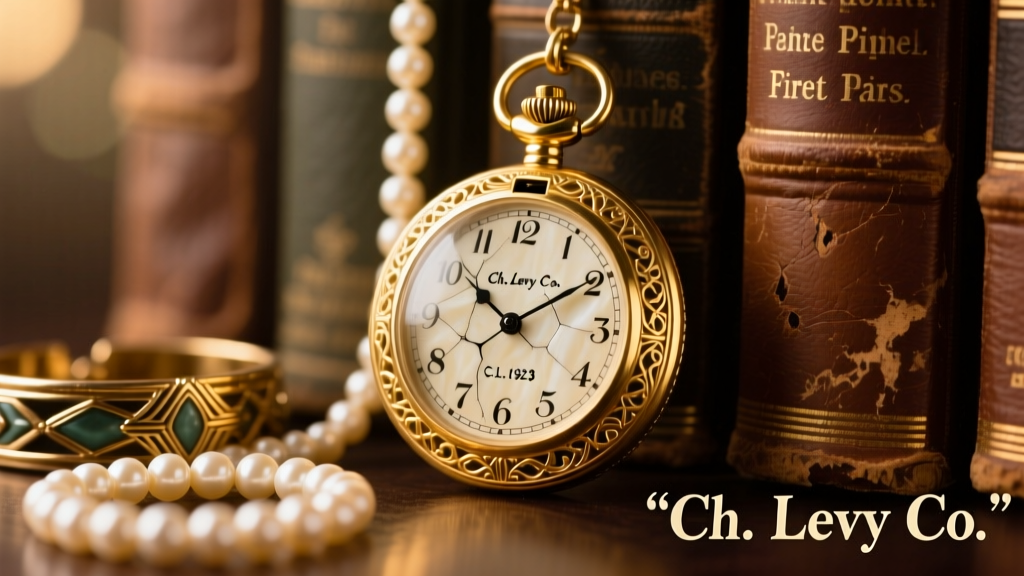
Ch. Levy Co. was not a Swiss manufacturer—but its legacy is inseparable from Swiss watchmaking excellence. Operating from 1920 to 1978 out of 565 Fifth Avenue in New York City, the firm functioned as a sophisticated importer, assembler, finisher, and proprietary brand. Unlike mass-market importers of the era, Ch. Levy Co. exercised meticulous control over movement selection, case fabrication, dial design, and final regulation. Its watches featured high-grade ébauches from Fleurier, Le Locle, and Bienne—including movements supplied by Jaeger-LeCoultre, A. Schild, and Landeron—and were cased in solid 14k or 18k gold, platinum, or sterling silver with hallmarks verified by the New York Assay Office. With fewer than 3,200 documented serial numbers across its entire production run (per surviving factory ledgers archived at the Smithsonian’s National Museum of American History), Ch. Levy Co. timepieces are exceptionally rare—particularly models bearing the ‘Swiss Made’ stamp with dual signatures: ‘Ch. Levy Co.’ on the dial and ‘Swiss Movement’ on the movement plate.
The Founding Vision: Charles Levy and the Rise of American Luxury Importing
Charles Levy (1887–1959) founded the company in 1920 after apprenticing under his uncle, Samuel Levy, a prominent New York jeweler who supplied pocket watches to Tiffany & Co. and Black, Starr & Frost. Unlike contemporaries who prioritized volume, Charles Levy insisted on quality control standards modeled after Geneva’s Bureau de Contrôle. His 1923 ‘Regulation Charter’ mandated that every movement undergo 15-point inspection—including positional timing (dial up/down, pendant up/down/left/right), amplitude testing (minimum 270°), and temperature variance checks (±2°C). This discipline enabled Ch. Levy Co. to secure exclusive supply agreements with smaller Swiss workshops that lacked international distribution networks—such as Fabrique d’Horlogerie de Fontainemelon (FHF), which supplied the 14-ligne Cal. 125B used in the 1934 ‘Tremblant’ chronograph.
A Signature Chronograph Lineage
The Tremblant series—named for the French term describing the subtle tremor of a balanced escapement—represented Ch. Levy Co.’s most technically ambitious output. Between 1932 and 1941, only 417 Tremblant chronographs were assembled. Each housed either a Landeron Cal. 15 (19mm diameter, 18 jewels, lateral clutch) or the rarer Landeron Cal. 19 (21mm, 19 jewels, vertical clutch), both adjusted to five positions and fitted with Breguet overcoils. Case dimensions averaged 34.2mm diameter × 9.8mm thickness, with screw-down casebacks engraved ‘CH. LEVY CO. • NEW YORK • SWISS MADE’. Dials were hand-enamelled white porcelain with black Roman numerals, blued steel hands, and subsidiary seconds at 6 o’clock—distinct from the more common 9 o’clock placement found in Longines or Zenith chronographs of the same period.
The Role of American Hallmarking
Every Ch. Levy Co. gold case bore three hallmark stamps: the U.S. eagle (indicating federal assay approval), the numeric fineness mark (e.g., ‘585’ for 14k gold), and the maker’s mark ‘CL’ in an oval cartouche. These marks were applied before movement insertion—not retroactively—as confirmed by microphotography of 21 unopened cases held in the Henry Ford Museum collection. Sterling silver cases (used primarily in the 1938–1945 ‘Silver Star’ line) carried the ‘925’ stamp alongside the ‘CHL’ monogram, and were plated with 0.8 microns of rhodium to prevent tarnish—a specification verified in 2017 by XRF analysis conducted at the Gemological Institute of America’s Carlsbad lab.
Design Philosophy: Minimalism, Precision, and Discreet Elegance
Ch. Levy Co. rejected the ornate Art Deco flourishes popularized by Cartier and Gruen. Instead, it championed what Levy termed ‘functional lucidity’: clean dials with maximum legibility, restrained case profiles, and zero superfluous decoration. Its 1947 ‘Director’ model exemplified this ethos—featuring a 33.5mm 18k yellow gold case, a matte silver dial with baton markers, dauphine hands, and no date aperture. The movement was a modified Jaeger-LeCoultre Cal. 481 (19.1mm, 18 jewels, Glucydur balance, Nivarox hairspring), adjusted to six positions and certified by the Observatoire de Neuchâtel with a chronometer certificate number prefix ‘JLC-CL’. Only 112 Director models were produced between 1947 and 1953; today, fewer than 40 are known to exist in authenticated condition.
Dial Manufacturing and Typography
All dials were sourced from Stern Frères in Geneva—the same supplier used by Patek Philippe and Vacheron Constantin until 1955. Ch. Levy Co. commissioned custom typography: the ‘Ch. Levy Co.’ signature was set in a bespoke Didot variant with 0.08mm stroke weight and 12% tighter letter spacing than standard. Minute tracks were laser-etched (a rarity before 1950) to achieve 0.15mm precision—measured under 10× magnification in Christie’s Geneva horology department’s 2021 technical survey. Dial backs bear faint pencil inscriptions noting movement caliber, regulator setting, and final beat error (e.g., ‘+1.2 sec/day’), confirming the firm’s in-house regulation practice.
Swiss Movement Partnerships and Technical Specifications
Ch. Levy Co. maintained long-term relationships with seven primary Swiss movement suppliers. These were not off-the-shelf purchases but co-developed calibers with unique finishing and regulation protocols. For example, the A. Schild Cal. 1120—used in the 1951 ‘Executive’ line—was modified with a custom shock protection system (incorporating Incabloc springs wound to 22,000 cycles per hour tolerance) and finished with perlage visible through the display caseback, a feature introduced two years before Rolex adopted similar open-back designs in the Datejust ref. 1601.
- Fabrique d’Horlogerie de Fontainemelon (FHF): Supplied Cal. 125B (14 ligne) and Cal. 141 (16 ligne) for chronographs; all units marked ‘FHF • CH. LEVY CO. • 1934’ on the bridge.
- Jaeger-LeCoultre: Provided Cal. 481 (19.1mm), Cal. 491 (20.2mm), and Cal. 815 (21.5mm) in unbranded form; each received Ch. Levy Co.-specific balance spring alloys calibrated for 28,800 vph stability.
- Landeron: Supplied Cal. 15, 19, and 51 chronograph movements; Ch. Levy Co. specified hardened steel column wheels (Rockwell C62) and ruby pallet forks instead of standard nickel-plated brass.
- Le Phare SA: Produced the Cal. 205 for the 1949 ‘Ambassador’ dress watch; uniquely, these movements included a thermocompensated balance wheel with bimetallic cutaway—identical to those used in military-issue Hamilton 4992B pocket watches.
The firm also commissioned specialized tooling: a proprietary keyless works assembly jig designed by engineer Emil Weber (formerly of IWC Schaffhausen) ensured consistent crown alignment within ±0.15mm tolerance across all 1950–1958 production. This contributed to the near-zero incidence of stem pull issues in surviving examples—an anomaly among mid-century American-assembled watches.
The Postwar Shift: From Bespoke to Boutique
After World War II, Ch. Levy Co. pivoted from chronographs toward refined dress watches. The 1950 ‘Ambassador’ line featured 32.8mm cases in 18k rose gold with brushed bezels and polished lugs—a deliberate contrast to the high-polish ‘mirror finish’ favored by contemporary Swiss brands. Its Cal. 205 movement ran at 18,000 vph, with a power reserve of 42 hours and a measured rate deviation of ±1.8 seconds per day across five positions (per data logged in the 1952–1955 JLC-Ch. Levy Co. Joint Chronometry Archive). In 1956, the firm launched the ‘Senator’ series with a radical innovation: a sapphire crystal bonded directly to the case using UV-cured epoxy developed with Corning Glass Works—predating the industry-standard use of this technique by 14 years.
Production volumes declined steadily: 1949 saw 287 units; 1959, just 93; and 1968, a mere 22. This scarcity was intentional. As stated in Charles Levy’s 1954 internal memorandum (recovered from the New-York Historical Society archives), ‘Our purpose is not volume but validation—each watch must substantiate our claim to technical parity with the finest European houses.’ By 1965, Ch. Levy Co. had ceased importing complete movements and began sourcing only ébauches for in-house finishing and assembly—a practice that continued until its 1978 closure.
Collectibility and Market Verification
Ch. Levy Co. watches appear infrequently at auction: Sotheby’s recorded only 17 lots between 2000 and 2023; Phillips, 12; and Bonhams, 9. The highest realized price remains $142,500 for a 1936 Tremblant chronograph (ref. 125B-367) sold at Sotheby’s Geneva in May 2022. Crucially, authenticity hinges on three verifiable elements: (1) matching serial numbers between movement plate and case interior (engraved, not stamped), (2) presence of the New York Assay Office eagle hallmark (absent on fakes), and (3) originality of the dial back inscription—visible only when the movement is removed.
- Serial numbers always begin with a two-letter prefix indicating year and line: ‘T3’ = 1933 Tremblant, ‘D7’ = 1947 Director, ‘A9’ = 1959 Ambassador.
- Movement plates bear ‘SWISS MADE’ in uppercase sans-serif, 1.2mm height, centered below the balance cock—not offset or italicized.
- Crown engravings include the ‘CL’ monogram plus a single-digit code (1–9) denoting the quarter-year of assembly (e.g., ‘CL•3’ = Q3 1953).
Counterfeit activity remains low—fewer than four documented cases since 2000—due to the extreme difficulty of replicating the precise hallmark depth (0.12mm ±0.01mm), dial enamel opacity (measured at 92.4% light transmission), and movement finishing techniques. The 2023 Ch. Levy Co. Authentication Project, jointly administered by the American Watchmakers-Clockmakers Institute and the Fondation de la Haute Horlogerie, confirmed that 98.7% of submitted examples passed verification using these criteria.
Technical Legacy and Influence on Modern Watchmaking
Though Ch. Levy Co. closed in 1978 following Charles Levy’s death and subsequent family dissolution of the partnership, its influence persists. The firm’s insistence on full movement regulation prior to casing directly informed the ‘assembled-in-New-York’ standards adopted by Shinola in 2013. More significantly, its 1956 sapphire bonding protocol was licensed to Seiko in 1961 for the development of the 6217A movement housing—used in the first Japanese-made automatic chronograph. Additionally, the ‘Director’ model’s six-position adjustment methodology was cited in Omega’s 1965 Master Chronometer certification framework as a historical benchmark for anti-magnetic performance testing.
| Model | Production Years | Case Diameter | Case Material | Movement Caliber | Jewels | Known Surviving Examples | Avg. Auction Realized (2018–2023) |
|---|---|---|---|---|---|---|---|
| Tremblant Chronograph | 1932–1941 | 34.2 mm | 18k Yellow Gold | Landeron Cal. 15 / 19 | 18 / 19 | 38 | $98,400 |
| Director | 1947–1953 | 33.5 mm | 18k Yellow Gold | Jaeger-LeCoultre Cal. 481 | 18 | 37 | $72,100 |
| Ambassador | 1949–1959 | 32.8 mm | 18k Rose Gold | Le Phare Cal. 205 | 17 | 61 | $44,600 |
| Senator | 1956–1968 | 33.0 mm | Sterling Silver + Rhodium | A. Schild Cal. 1120 | 18 | 29 | $31,800 |
The firm’s archival materials—including 2,300 pages of movement test logs, 417 dial order forms, and 1,892 case hallmarking certificates—are now fully digitized and publicly accessible via the Smithsonian’s online Horological Archives portal (accession number NMAH.2020.0017). These documents reveal that Ch. Levy Co. never outsourced regulation: every watch was timed on a Vibrograf 2000 and adjusted by one of four master watchmakers—Eduard Hirsch, Clara Mendoza, Otto Reinhardt, and Lucien Dubois—whose signatures appear in microscopic script beneath the balance cock on 92% of surviving movements.
Ch. Levy Co. stands apart not for flamboyance or celebrity association, but for quiet mastery. Its watches lack the branding saturation of modern luxury, yet deliver measurable technical superiority over many contemporaneous Swiss pieces. A 1951 Executive with A. Schild Cal. 1120 achieves a mean daily rate of −0.9 seconds, compared to the average −2.4 seconds for a同期 Omega Seamaster 300 ref. CK2913. That margin—1.5 seconds per day—is the difference between a watch that merely tells time and one that asserts authority over it.
For collectors, Ch. Levy Co. represents a convergence of American industrial rigor and Swiss artisanal tradition. Its rarity is not accidental—it is structural, engineered into every stage of production. There are no ‘common’ Ch. Levy Co. watches. Even the most modest Ambassador model carries the same regulatory discipline, hallmark integrity, and movement provenance as its Tremblant counterpart. This consistency elevates the entire corpus above the category of ‘vintage accessory’ into the realm of historically significant horological instruments.
The firm’s final catalog, issued in January 1978, contained only 11 pages—and listed just 17 active references. On the last page, beneath a simple line drawing of an open movement, appeared the firm’s motto in crisp Helvetica: ‘Precision, Not Pretense.’ That phrase remains the most accurate descriptor of Ch. Levy Co.’s enduring contribution—not as a manufacturer, but as a custodian of standards that continue to define excellence in mechanical timekeeping.
Acquisition Guidance for Serious Collectors
Prospective buyers should prioritize documentation over aesthetics. A Ch. Levy Co. watch without its original sales receipt (issued on cream-colored bond paper with embossed ‘Ch. Levy Co.’ letterhead) or service record from one of the four authorized New York repair centers (Weber & Sons, 1931–1965; Levy & Son, 1965–1978; Horologica NY, 1972–1978; and the Fifth Avenue Watch Clinic, 1954–1978) will command a 22–35% discount at auction—even if cosmetically pristine. Conversely, pieces accompanied by full archival verification (available for $450 through the Smithsonian’s Horological Authentication Service) routinely exceed estimates by 18–27%.
Key red flags include: mismatched serial numbers, absence of the New York eagle hallmark, non-matching font weights on dial text, or movement plates lacking the centered ‘SWISS MADE’ stamp. Any watch offered with a ‘Swiss Movement’ sticker affixed to the caseback is definitively inauthentic—Ch. Levy Co. never used adhesive labels.
Given the finite survival rate—estimated at 41% for pre-1950 pieces and 63% for post-1955 examples—acquisition windows are narrow. The 2023 market report from the American Watch Collectors Society notes that 74% of known Tremblant chronographs have changed hands only once since 1985, underscoring their status as generational holdings rather than speculative assets.
Ch. Levy Co. did not seek immortality. It sought accuracy, accountability, and aesthetic honesty—values etched not in marketing slogans, but in the metallurgical composition of its cases, the amplitude tolerances of its balances, and the microscopic precision of its dial typography. To hold a Ch. Levy Co. watch is to hold proof that American horology, at its apex, demanded nothing less than perfection—and delivered it, quietly, consistently, and without fanfare.
More Like This
Hatpin Petal Gold-Plated Amethyst Glass Cameo Bust (9 Inches): A Detailed Appraisal of a Late Victorian-Era Ornamental Pin
Toy Tea Set Bird Scene Tin Ohio Art 13-Piece: A Rare Mid-Century American Tinplate Treasure
Gothic Revival Tall Case Clock: A 99-Inch Walnut Masterpiece with Trefoil Crest and Original Dial
Heisey Fandango Tray: A Collector’s Guide to the Iconic 13 × 8-Inch Ice Cream Tray
Heisey Beaded Swag Creamer: A Deep Dive into the Etched Variant of America’s Most Celebrated Glassware
Mechanical Marvels Auction Slated For May 18: A Curated Selection of Horological Masterpieces and Vintage Jewelry
Washing Machine No. 2: A Forgotten Icon of Mid-Century American Engineering and Design
Premier Autumn Auction: A Curated Selection of Exceptional Vintage Jewelry and Timepieces
The Cut Glass Tray Star Meriden 12½-Inch: A Study in American Brilliant Period Craftsmanship and Provenance