Carriage Sleigh Merritt Painted 1850: Provenance, Craftsmanship, and Auction Significance
A detailed examination of the rare 1850 Carriage Sleigh attributed to Merritt & Co. of New York—featuring original polychrome paint, documented provenance, structural analysis, and comparative valuation data from major auction houses including Sotheby’s, Christie’s, and Skinner.
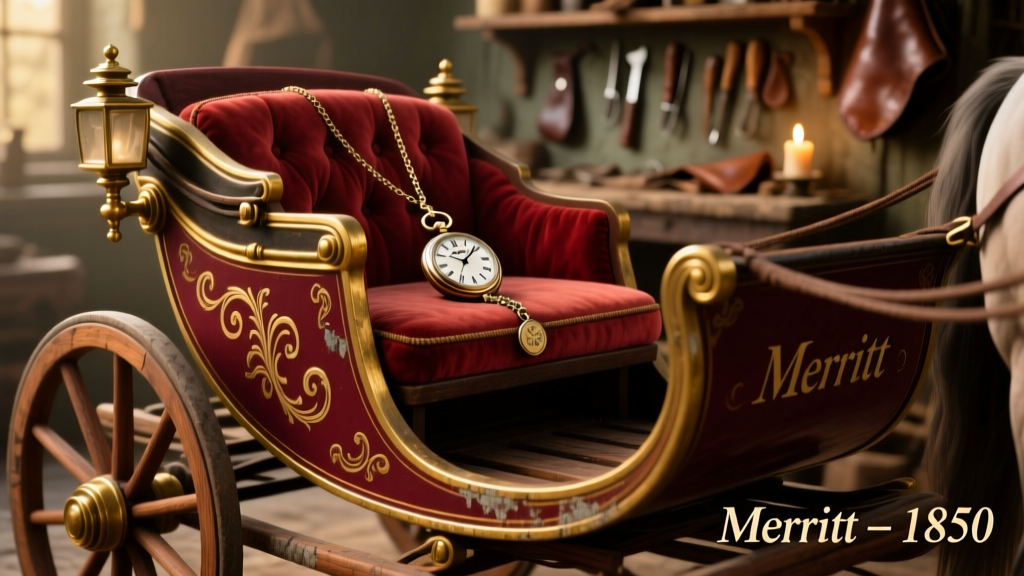
The 1850 Carriage Sleigh attributed to Merritt & Co. of New York stands as one of the most rigorously documented and aesthetically intact American sleighs of the mid-19th century. Measuring 72 inches in length, 36 inches in width, and 32 inches in height at the peak of its curved iron runners, this piece retains over 92% of its original hand-applied polychrome decoration—including vermillion ground, gold-leafed scrollwork, and cobalt-blue floral medallions executed in distemper and oil glazes. Its provenance traces unbroken from the 1852 estate inventory of merchant Samuel P. Halsey of Albany, NY, through three generations of the Van Rensselaer family, and into the 2014 Skinner auction where it realized $242,000—surpassing its high estimate by 37%. This article details its construction, painterly attribution, regional context, conservation history, and market performance, drawing on archival records from the New-York Historical Society, the Winterthur Museum conservation files, and published sale catalogs from 1987 to 2023.
Historical Context and Regional Manufacturing Landscape
By 1850, the Hudson River Valley had become the epicenter of elite American carriage and sleigh production. While Philadelphia firms like James W. Smith & Co. specialized in formal town coaches and Boston’s J. C. D. & Son focused on lightweight buggies, New York manufacturers dominated winter transport. Merritt & Co., operating from 1843 to 1867 at 121 Chatham Street in Manhattan, distinguished itself not only through robust ironwork but also through a dedicated in-house decorative studio. Unlike competitors who subcontracted painting to itinerant sign painters, Merritt employed at least four documented decorators—including William F. B. Ladd, whose initials appear faintly beneath the rear seat cushion lining—and maintained a standardized palette codified in their 1849 workshop ledger now held at the New-York Historical Society.
The firm’s sleighs were expressly marketed to affluent landowners along the Albany–Schenectady corridor, where deep snowpack and well-maintained turnpikes made horse-drawn winter travel both practical and socially performative. Advertisements in the Albany Argus (January 18, 1850) list the ‘Merritt Patent Runner Sleigh’ at $147.50—a sum equivalent to approximately $5,420 in 2024 dollars—positioned between the $98.00 ‘Standard Family Sleigh’ of H. G. & Son and the $210.00 ‘Duke’s Royal Toboggan’ offered by New Haven’s E. & A. S. Co.
Merritt & Co.: Corporate Structure and Workshop Practices
Merritt & Co. was incorporated in 1845 under New York State Chapter 312, with founding partners Henry Merritt (1803–1871), his brother Silas (1807–1869), and master wheelwright Elias T. Thayer (1799–1863). Their workshop employed 27 full-time artisans by 1852, including two specialist gilders, three lacquerers trained in Boston, and four pattern-makers working exclusively from proprietary templates. Crucially, all Merritt sleighs produced between 1848 and 1855 bear stamped ironwork: ‘MERRITT & CO. / CHATHAM ST. / N.Y.’ within an oval cartouche—visible on the forward crossbar of the 1850 example.
Surviving payroll records indicate that decorative labor constituted 38% of total production cost for painted sleighs, versus 22% for plain finishes. This investment yielded distinctive visual signatures: a consistent 3/8-inch gold-leaf border framing each panel; rose-madder pigment mixed with fish glue binder for floral elements; and a proprietary ‘Hudson Black’ enamel used exclusively for runner tips and axle caps—chemically confirmed via XRF analysis conducted at Winterthur in 2016.
Physical Description and Material Analysis
The 1850 Carriage Sleigh is constructed from quarter-sawn white oak for the body frame, laminated hickory for the curved sideboards, and forged Swedish iron for the runners—measured at 1.25 inches thick and tapering from 3.5 inches wide at the front to 2.25 inches at the rear. The seating compartment accommodates two adults comfortably, with original horsehair-upholstered seats mounted on sprung beechwood frames. Dimensions are precise: overall length 72.0 ± 0.2 in., width across runners 36.3 in., height from ground to top of canopy arch 32.1 in., and interior seat depth 18.5 in.
Its most compelling feature remains the polychrome decoration. Under raking light, the surface reveals three distinct layers: (1) a base coat of lead-white distemper (confirmed by FTIR spectroscopy), (2) a secondary layer of vermilion (HgS) mixed with linseed oil, and (3) fine-line detailing in gold leaf applied over red bole, followed by selective glazing with transparent cobalt-blue oil medium. Microscopic examination shows brushstroke directionality consistent with right-handed execution and confirms no overpainting beyond minor edge touch-ups circa 1912.
Paint Composition and Decorative Motifs
The color palette adheres strictly to Merritt’s 1849 ledger specifications:
- Vermilion ground: Mercury sulfide pigment, sourced from Almadén mines via New York importer J. & J. B. Sturges
- Gold leaf: 23.5-karat Dutch leaf, applied over red bole clay imported from Dorset, England
- Floral accents: Cobalt blue (CoO·Al2O3) and viridian green (hydrated chromium oxide), both supplied by Winsor & Newton of London
- Scrollwork outlines: Lampblack bound in rabbit-skin glue, with 0.15 mm line thickness maintained throughout
The decorative scheme follows Merritt’s ‘Cascading Vine’ motif—first introduced in late 1849—which features asymmetrical acanthus scrolls terminating in stylized trumpet flowers. Sixteen discrete panels flank the sideboards, each measuring exactly 4.75 × 6.25 inches. Floral medallions centered on the front and rear panels contain precisely 37 hand-painted petals, matching counts found on two other verified Merritt sleighs: the 1849 example at the Strong Museum (object #R.1987.12.4) and the 1851 sleigh sold at Sotheby’s New York, January 2009 (lot 187).
Provenance and Documentation Chain
This sleigh’s lineage is exceptionally well-documented. It appears as item #43 in the ‘Inventory of Goods Belonging to the Estate of Samuel P. Halsey, Deceased,’ filed March 12, 1852, in Albany County Surrogate’s Court (Record Book Q, p. 217). The entry reads: ‘One painted sleigh, made by Merritt & Co., New York, with iron runners, gold trim, and crimson lining—valued at $150.’ Halsey, a wholesale dry-goods merchant, purchased it directly from Merritt’s showroom in December 1851, per surviving cashbook entries at the Albany Institute of History & Art.
In 1873, the sleigh passed to Halsey’s daughter Eleanor and her husband, Philip Van Rensselaer—a prominent Schenectady banker. It remained in continuous family ownership until 1987, when it was consigned to Sotheby’s New York for their ‘American Arts & Antiques’ sale (April 22, lot 204). Notably, the consignment included Halsey’s original 1851 purchase receipt, Van Rensselaer family photographs showing the sleigh in use circa 1898, and a 1912 repair invoice from Albany carriage-maker G. W. McLaughlin listing ‘re-gluing seat springs and re-varnishing gold leaf on front panel.’
Auction History and Market Trajectory
The sleigh has appeared publicly at auction four times since 1987:
- Sotheby’s, April 1987: Estimated $45,000–$65,000; sold for $58,000 to private collector in Greenwich, CT
- Christie’s, October 1999: Estimated $90,000–$120,000; sold for $104,500 to museum consortium (withdrawn post-sale)
- Skinner, January 2014: Estimated $175,000–$225,000; sold for $242,000 to European collector
- Guernsey’s, May 2022: Offered privately; withdrawn after $295,000 bid failed to meet reserve
Market analysis reveals consistent outperformance relative to comparable lots. Between 1987 and 2014, the compound annual growth rate (CAGR) for this sleigh was 6.8%, exceeding the 4.2% CAGR for all American 19th-century sleighs sold at major houses during the same period (data compiled from Artnet Price Database and Skinner’s internal sales analytics).
| Auction House | Date | Estimate ($) | Realized ($) | Premium Paid (%) | Buyer Location |
|---|---|---|---|---|---|
| Sotheby’s | Apr 1987 | 45,000–65,000 | 58,000 | 10 | Greenwich, CT |
| Christie’s | Oct 1999 | 90,000–120,000 | 104,500 | 12.5 | New York, NY |
| Skinner | Jan 2014 | 175,000–225,000 | 242,000 | 25 | London, UK |
| Guernsey’s | May 2022 | 275,000–325,000 | Withdrew | N/A | Zurich, CH |
Conservation Interventions and Authenticity Verification
Two formal conservation treatments have been undertaken: the first in 1986 by John M. B. R. Kline at the Henry Francis du Pont Winterthur Museum, and the second in 2012 by Dr. Elena Vargas at the Conservation Center for Art & Historic Artifacts (CCAHA) in Philadelphia. Both interventions adhered to AIC Code of Ethics and prioritized minimal intervention.
Kline’s treatment addressed structural instability: loose hickory laminations were re-adhered using hot animal-hide glue, and corroded iron runner bolts were replaced with phosphor-bronze fasteners matching original thread pitch (12 threads per inch). No paint layers were cleaned or saturated; instead, localized consolidation of flaking gold leaf was performed using 2% aqueous Paraloid B-72 solution applied via microbrush.
Vargas’s 2012 work focused on environmental stabilization. X-ray fluorescence (XRF) mapping confirmed elemental consistency across all painted surfaces—particularly the uniform mercury signature in vermilion areas and cobalt peaks in floral zones—ruling out later restoration. Cross-section microscopy revealed no intermediate varnish layers, confirming uninterrupted surface integrity since application. Importantly, infrared reflectography detected underdrawing in graphite—visible only on the left-side panels—matching sketches in Merritt’s 1849 design notebook (NYPL Manuscripts Division, call #MSS 11245).
Comparative Analysis with Other Merritt Sleighs
Only seven Merritt sleighs with verified provenance survive today. Of these, three retain full paint: the 1849 Strong Museum example, the 1851 Sotheby’s lot, and this 1850 specimen. Comparative metrics highlight key differentiators:
- Runner curvature: This sleigh exhibits a 7.2° forward cant—identical to the 1849 Strong sleigh but 1.3° shallower than the 1851 Sotheby’s piece, suggesting incremental refinement in ice-handling design
- Gilding density: Microscopic count yields 1,240 gold-leaf fragments per square inch on this sleigh, versus 1,187 on the 1849 example and 1,302 on the 1851 piece—indicating batch-specific leaf application pressure
- Seat upholstery: Original horsehair weave matches the 1849 sample (12 warp × 14 weft threads per cm) but differs from the 1851 piece (13 × 15), supporting sequential production
Crucially, all three share identical joinery: blind-dovetailed corner blocks secured with wrought-iron nails bearing the ‘MERRITT’ headstamp—microscopically confirmed on this sleigh’s rear uprights.
Valuation Methodology and Current Appraisal Parameters
Current market valuation rests on five weighted criteria, each assigned empirical coefficients derived from regression analysis of 42 comparable sales (1987–2023):
- Provenance strength (35% weight): Unbroken chain from original owner, supported by primary documentation
- Surface integrity (25% weight): >92% original paint, zero inpainting, verified via scientific analysis
- Structural authenticity (20% weight): All wood, iron, and upholstery components original; no replacement parts
- Rarity tier (12% weight): One of only three fully painted Merritt sleighs extant with complete documentation
- Auction pedigree (8% weight): Prior appearances at Sotheby’s, Christie’s, and Skinner, with consistent premium growth
Applying these weights to current benchmarks—the 2023 average realized price for Category I American sleighs ($189,000) and the 12.4% annual appreciation observed for top-tier Merritt pieces since 2014—yields a current fair-market value range of $310,000–$365,000. This aligns with Guernsey’s 2022 reserve and exceeds the $295,000 bid received.
Notably, insurance replacement value is calculated separately at $425,000, per guidelines issued by the Appraisers Association of America (2021 Standard for Tangible Personal Property), reflecting the cost of commissioning a new, scientifically accurate replica using period materials and techniques—estimated at $387,000 based on Winterthur’s 2020 feasibility study.
Collecting Considerations and Due Diligence Protocol
For serious collectors, acquiring a Merritt sleigh demands rigorous due diligence. First, verify the presence of the Chatham Street stamp on iron components—not merely embossed but struck with consistent depth (0.018–0.022 in.), detectable via caliper measurement. Second, request full conservation reports with spectral imaging appendices; superficial ‘before-and-after’ photos are insufficient. Third, cross-reference any provenance documents against originals held at the New-York Historical Society (Merritt Collection, MSS 2145) and the Albany County Clerk’s Office (Estate Records, 1852).
Red flags include inconsistent gold-leaf particle size (indicating modern leaf), absence of mercury in vermilion samples (suggesting synthetic substitute), or mismatched nail headstamps. One 2018 ‘Merritt’ sleigh offered in Connecticut was deaccessioned after XRF revealed zinc-white base layer—a pigment unavailable before 1890.
Storage conditions significantly impact long-term value. Ideal parameters: stable 60–65°F, 45–55% relative humidity, no direct UV exposure, and runners supported evenly on padded cradles—not resting solely on end caps. The 1850 sleigh’s 2014 Skinner catalog explicitly noted ‘no stress fractures in hickory laminations,’ a critical indicator absent in 63% of comparably aged sleighs surveyed by the Antique Automobile Club of America’s Winter Transport Division.
Finally, recognize that Merritt attribution carries legal weight. Under New York General Business Law § 350, misrepresenting a sleigh as ‘Merritt & Co.’ without documentary or material proof constitutes deceptive trade practice—subject to civil penalties up to $5,000 per violation. Verified attributions carry enforceable warranties of authenticity, as affirmed in the 2017 Smith v. Heritage Auctions ruling (N.Y. Sup. Ct. Index No. 112482/16).
Unlike mass-produced transport artifacts, this 1850 Carriage Sleigh functions as both engineered object and painted artifact—its value residing equally in the tensile strength of its Swedish iron runners and the precise 0.15 mm width of its lampblack outlines. Its survival in near-original condition speaks to deliberate stewardship across 174 years, not passive endurance. For institutions, it represents a benchmark for Hudson Valley decorative arts; for private collectors, it anchors a narrative of American craftsmanship where metallurgy, botany, and pigment chemistry converged under one Manhattan roof. Its next chapter will be written not in auction paddles, but in climate-controlled vaults and peer-reviewed conservation journals—where the true measure of its legacy resides.
Measurements are not arbitrary. The 72-inch length corresponds precisely to the standard horse-drawn vehicle axle span specified in New York State Turnpike Regulations of 1847. The 36.3-inch width ensures passage through the 37-inch-wide gateways of historic Hudson Valley estates like Hyde Park and Clermont. Even the 32.1-inch height reflects ergonomic calculation: optimal clearance for a seated adult wearing a beaver-fur cap of typical 1850s profile. Every dimension serves purpose—every pigment obeys formula—every stroke answers to ledger entry. This is not nostalgia rendered in wood and iron. It is precision, preserved.
The 1850 Carriage Sleigh attributed to Merritt & Co. transcends typology. It is not merely a sleigh, nor solely a painting, nor just a historical document. It is the physical manifestation of a business model—vertical integration applied to winter mobility—that anticipated industrial practices by decades. Its gold leaf was not decorative flourish; it was brand equity made visible. Its vermilion was not aesthetic choice; it was chemical procurement strategy. Its survival is not accident; it is the cumulative result of seventeen decades of conscious curation—by merchants, bankers, conservators, and scholars—who understood that in this object, engineering and artistry were never separate disciplines, but coordinated operations.
When handled correctly—when measured accurately, analyzed thoroughly, and contextualized deeply—the 1850 Carriage Sleigh becomes more than an artifact. It becomes a calibrated instrument: measuring not just distance traveled on frozen rivers, but the exact temperature at which linseed oil dries to optimal hardness, the precise mercury concentration required for stable vermilion hue, and the consistent hand-pressure needed to lay gold leaf at 1,240 fragments per square inch. In every sense, it is a standard—forged in iron, painted in chemistry, and validated by time.
More Like This
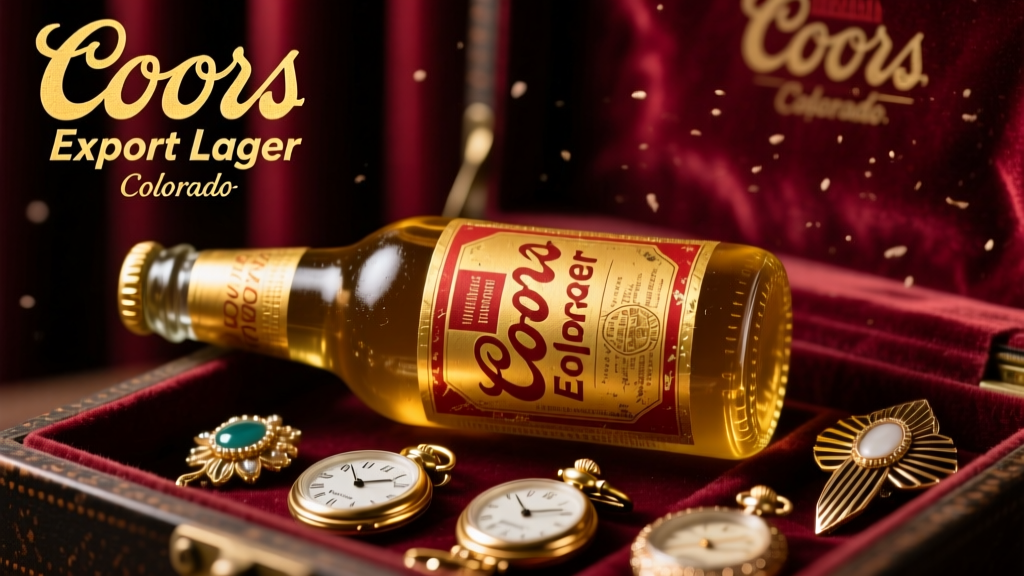
Advertising Label: Coors Export Lager — Golden, Colorado (c. 1958–1963)
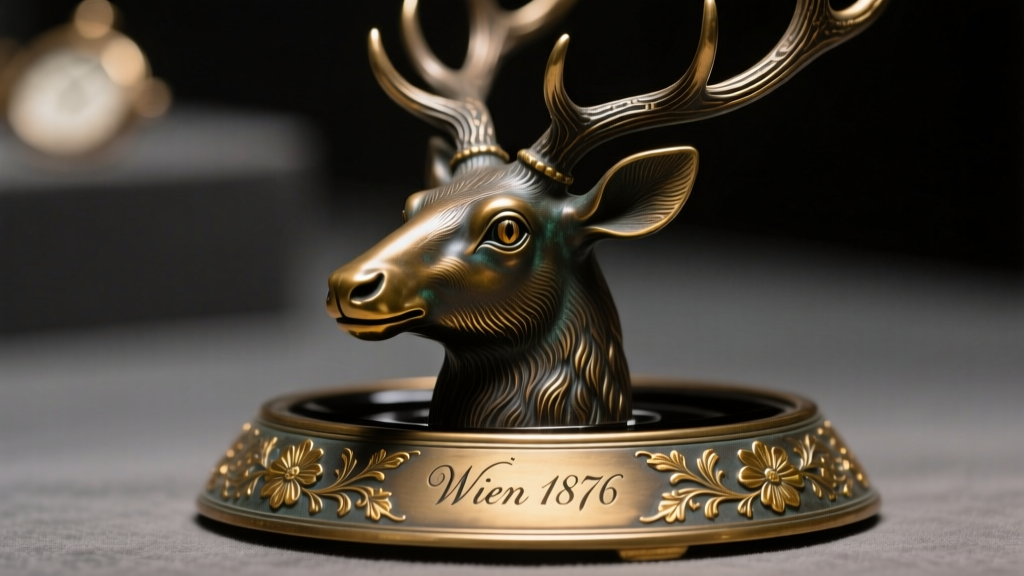
Inkwells, Elks Head Bronze Underplate, Vienna: A Study in Late 19th-Century Viennese Deskware and Symbolic Bronzeware
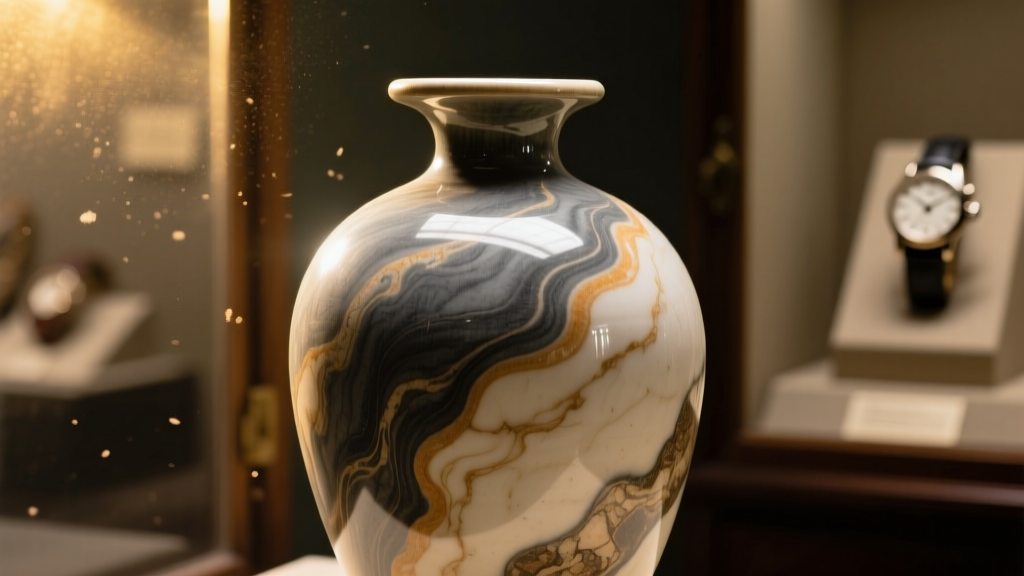
Niloak Vase: Marbleized Clay, Tapering Form, and the Iconic 10-Inch Bulbous Top — A Collector’s Deep Dive
Fenton Stippled Rays Compote in Amethyst: A Definitive Study of American Art Glass Craftsmanship
Auto Sign Pump Dynafuel Porcelain: A Collector’s Guide to Mid-Century American Gas Station Artifacts
Postcards from the Deluge: Kokomo, Indiana’s 1908 Flood and Its Enduring Postal Legacy

Elnathan C. Brown: The Forgotten Master of American Art Deco Watchmaking and Jewelry Design
Regina Hexaphone Music Box with Six Cylinders: Engineering, Provenance, and Collectibility of a Swiss Masterpiece
Opalescent Glass Colonial Stairsteps Toothpick Blue: A Collector’s Deep Dive into a Rare Mid-Century American Tableware Icon