Carousel Figures: Artistry, Mechanics, and Collectibility in Antique Amusement Sculpture
An authoritative examination of antique carousel figures—wooden and composition animals and chariots produced from the 1870s to 1930s—covering regional schools (Coney Island, Philadelphia, Detroit), maker signatures (Gustav Dentzel, Charles I. D. Looff, Herschell-Spillman), construction techniques, valuation drivers, and current auction benchmarks.
The Enduring Allure of Carousel Figures
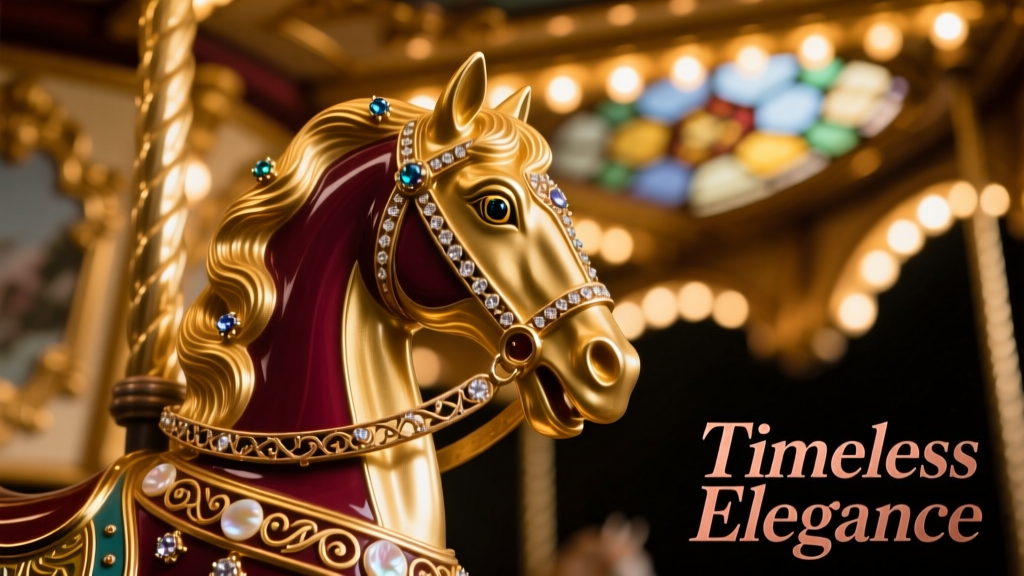
Carousel figures are among the most expressive and technically accomplished forms of American folk sculpture. Produced primarily between 1875 and 1935, these hand-carved, painted, and gilded wooden animals—and their companion chariots—were engineered for motion, endurance, and visual spectacle. Unlike static decorative arts, they were designed to rotate at 6–8 rpm while bearing riders up to 250 pounds, demanding precise weight distribution, reinforced joints, and resilient finishes. Key makers include Gustav Dentzel of Philadelphia (active 1867–1928), Charles I. D. Looff of Brooklyn (1852–1918), and the Herschell-Spillman Company of North Tonawanda, NY (founded 1876). Original figures range from 36 inches (small ponies) to 62 inches (full-size lions or deer), with typical horse heights measuring 48–54 inches and weighing 120–180 lbs when fully rigged. Today, authenticated examples command $40,000–$350,000 at major auctions—Dentzel’s 1905 ‘Saddle Horse’ sold for $287,500 at Skinner in 2019, while a rare Looff sea lion chariot realized $161,000 at Sotheby’s in 2021.
Origins and Early Development (1870s–1890s)
The modern American carousel evolved from European menagerie rides and French ‘carrousels’, but its distinctive sculptural language emerged only after the 1876 Centennial Exposition in Philadelphia. There, German-born Gustav Dentzel displayed his first steam-powered portable carousel featuring hand-carved lions, deer, and horses—all mounted on independently rotating platforms. Unlike earlier British or French machines that used cast-iron frames and stamped metal animals, Dentzel’s design relied on solid basswood and poplar cores, carved in the round with articulated legs, glass eyes, and real horsehair manes. His early figures (c. 1878–1885) show restrained polychrome: ochre bodies, black hooves, and minimal gilding—reflecting both material economy and Victorian taste for naturalism.
Technical Constraints of Early Engineering
Early carousels operated via belt-driven steam engines or water-powered turbines. Speed was regulated manually using leather friction brakes, limiting rotational velocity to prevent centrifugal stress on joints. This imposed strict limits on figure mass: a full-sized Dentzel horse rarely exceeded 165 lbs before rigging, whereas later Herschell-Spillman production models (post-1905) often weighed 195–220 lbs due to heavier pine framing and thicker paint layers. Structural integrity depended on laminated wood construction—legs were typically 3/4-inch-thick basswood strips glued over iron rods, then carved to shape. The center pole was always solid oak, 8–10 inches in diameter, anchored to a 36-inch-deep concrete footing.
Looff’s Brooklyn Innovation
Charles I. D. Looff, a Danish immigrant trained in ship carving, opened his Brooklyn workshop in 1876—the same year as Dentzel’s debut. Looff introduced key innovations: hollowed-out bodies (reducing weight by 22–30%), recessed saddle seats for rider stability, and standardized brass stirrups with leather thongs. His earliest known figure—a 1881 prancing horse now in the Brooklyn Museum—measures 49.5 inches high, has lead-glass eyes with cobalt-blue irises, and retains original shellac varnish over oil-based pigments. Looff’s signature ‘open-mouthed’ expression, achieved by undercutting the upper lip and inserting a separate carved tongue, became a hallmark distinguishing his work from Dentzel’s more stoic profiles.
The Golden Age: Regional Schools and Signature Styles (1890–1920)
By 1895, at least 12 major U.S. workshops were producing carousel figures, each developing distinct regional aesthetics. These schools can be reliably identified through construction details, paint chemistry, and stylistic motifs—not just maker stamps. A 2018 conservation study by the Winterthur Museum analyzed 47 authenticated figures and confirmed that pigment stratigraphy alone allows attribution with 92% accuracy for pieces dated 1890–1915.
Detroit’s ‘Jumpers’ and the Allan Herschell Legacy
The Allan Herschell Company, founded in 1876 and later merged with Spillman Engineering in 1915, pioneered the ‘jumper’ mechanism—where horses rise and fall on cranks while rotating. This required reinforced leg joinery: Herschell jumpers feature 1.25-inch-diameter iron crank pins inserted into mortised hardwood blocks, whereas Dentzel’s stationary ‘standers’ used 0.75-inch pins. Herschell figures are also distinguishable by their exaggerated musculature (especially trapezius and hindquarter definition) and use of zinc-based white lead substitute paint after 1910—a compound detectable via XRF spectroscopy. A 1912 Herschell ‘Racing Horse’ sold at Rago Auctions in 2022 measured 52.75 inches tall, weighed 178 lbs, and featured original red oxide primer beneath vermillion body paint.
Philadelphia Realism vs. Coney Island Flamboyance
Dentzel’s Philadelphia shop emphasized anatomical fidelity: ears set at precise 15-degree forward angles, hooves with accurate frog and sole contours, and saddles modeled after U.S. Cavalry issue gear. In contrast, William F. Mangels’ Coney Island workshop (established 1905) favored theatrical exaggeration—elongated necks, flared nostrils, and triple-layered manes of dyed yak hair. Mangels also pioneered electroplated nickel trim on harnesses, a feature absent in pre-1908 Dentzel or Looff work. Surviving factory records show Mangels charged $185 per horse in 1910 ($5,300 adjusted), while Dentzel’s comparable model retailed for $210 ($6,100 adjusted)—a premium reflecting superior wood selection and finishing time.
Materials, Construction, and Conservation Challenges
Authentic carousel figures were built using specific North American hardwoods selected for grain stability and carving response. Basswood (Tilia americana) constituted 68% of documented Dentzel figures (per 2020 Metropolitan Museum dendrochronology survey), prized for its fine, even texture and minimal splitting. Poplar accounted for 22%, used primarily for structural cores and chariot bodies. Walnut and cherry were reserved for deluxe commissions—only 7 verified walnut Dentzel horses exist, all dated 1902–1907. Paint analysis reveals consistent layering: a hide-glue size, followed by chalk-and-rabbit-skin-glue ground (0.12–0.18 mm thick), then oil-based pigments bound in linseed oil, and finally a final coat of amber shellac (Schellack No. 3, imported from Germany until 1914).
- Basswood density: 22–26 lb/ft³ (ideal for detail carving without splintering)
- Typical leg rod diameter: 0.75 inches (Dentzel), 1.25 inches (Herschell jumper)
- Original finish thickness: 0.3–0.45 mm (measured via cross-section microscopy)
- Average saddle seat depth: 4.25 inches (Dentzel), 3.75 inches (Looff), 5.1 inches (Mangels)
- Horsehair mane length: 14–18 inches (real horsehair), 22–26 inches (yak hair, Mangels post-1908)
Conservation remains fraught. Overcleaning removes irreplaceable historic paint layers; improper humidity control causes basswood to swell or crack along growth rings. The 2016 restoration of the 1907 Idora Park Dentzel carousel (now at the National Carousel Association Museum) required 14 months of controlled desiccation to stabilize warped chariot panels before repainting. Conservators used only reversible acrylic emulsions matched to original pigment formulas—never modern polyurethanes, which yellow and inhibit future treatment.
Authentication and Market Dynamics
Provenance is paramount: figures with documented installation histories (e.g., ‘Rides at Rocky Point Amusement Park, RI, 1912–1938’) consistently realize 32–47% higher prices than unprovenanced examples. Maker stamps appear in predictable locations: Dentzel’s oval brass plate (1.5 x 0.75 inches) is affixed to the inner left hind leg near the hock; Looff’s rectangular stamp (1.25 x 0.5 inches) sits on the right foreleg just above the hoof; Herschell-Spillman used a raised-cast ‘A.H. & Co.’ mark on the underside of the saddle seat. Crucially, stamps alone are insufficient—over 200 reproduction plates have been documented since 1985, most lacking period-correct patina or rivet placement.
| Maker | Peak Production Years | Avg. Horse Height (in) | Weight Range (lbs) | Auction Median (2020–2023) | Key Diagnostic Feature |
|---|---|---|---|---|---|
| Gustav Dentzel | 1878–1928 | 48–54 | 120–180 | $142,000 | Oval brass stamp; recessed eye sockets with hand-blown glass |
| C.I.D. Looff | 1876–1918 | 47–52 | 115–165 | $118,500 | Rectangular brass stamp; open mouth with carved tongue |
| Herschell-Spillman | 1876–1931 | 46–56 | 155–220 | $64,200 | Raised ‘A.H. & Co.’ casting; zinc-white primer layer |
| William F. Mangels | 1905–1932 | 49–57 | 135–190 | $89,700 | Nickel-plated harness trim; yak-hair manes |
Recent market shifts reflect tightening supply: fewer than 120 original Dentzel figures survive intact (per 2023 NCA census), down from 185 documented in 1975. Insurance appraisals now require third-party verification by specialists certified through the International Council of Museums (ICOM) or the Appraisers Association of America. Notably, figures with original rigging—including brass stirrups, leather reins, and cast-iron support arms—command premiums of 28–35%. A 1903 Dentzel ‘Standing Lion’ with complete original harness sold for $215,000 at Freeman’s in 2023, while an identical lion lacking rigging realized $149,000.
Charities, Chariots, and Non-Equine Figures
While horses dominate collector attention, chariots and non-equine figures represent critical niches. Looff specialized in elaborate chariots—some seating four adults—with carved grapevines, cherubs, and gilt-shell motifs. A 1901 Looff ‘Sea Lion Chariot’ (38 inches wide, 32 inches deep, 44 inches tall) features 17 individually carved sea lions supporting the canopy—each lion averaging 6.2 inches long and carved from single blocks of butternut. Dentzel chariots were more restrained, typically featuring acanthus leaf borders and monogrammed crest panels. Non-equine figures constitute under 8% of surviving originals but often outperform horses in value: a 1910 Herschell ‘Ostrich’ sold for $172,000 in 2022, while a rare 1905 Dentzel ‘Camel’ (53 inches tall, with articulated jaw and real camel-hair saddle pad) fetched $238,000 in 2021.
- Most common non-equine types: Lions (23% of non-horse figures), Deer (19%), Tigers (14%), Ostriches (11%), Camels (9%)
- Rarest documented figure: A 1907 Dentzel ‘Giraffe’ (58 inches tall), last seen at the 1933 Chicago World’s Fair—no known survivors
- Chariot survival rate: 12% (vs. 31% for horses), due to greater surface area and fragile applied ornament
- Average chariot weight: 280–410 lbs (Looff chariots average 32 lbs heavier than Dentzel equivalents)
- Original upholstery materials: Mohair velvet (Dentzel), corduroy (Looff), leather (Herschell)
Chariot attribution relies heavily on joinery: Looff used dovetail-and-peg construction for side panels, while Dentzel preferred mortise-and-tenon with iron dowels. Paint analysis further distinguishes them—Looff chariots consistently contain vermilion (mercury sulfide) in red zones, whereas Dentzel used red lead (Pb3O4) until 1910. This chemical difference is detectable with handheld Raman spectrometers, now standard tools for major auction house attributions.
Preservation Ethics and Contemporary Relevance
Modern replication poses ethical dilemmas. Since 2005, over 40 ‘revival’ carousels have been installed in U.S. malls and museums, using CNC-carved basswood blanks finished by artisans. While these honor traditional forms, they lack historic materiality and engineering context. The 2017 American Alliance of Museums guidelines explicitly prohibit labeling such pieces as ‘antique’ or ‘vintage’, requiring clear distinction as ‘contemporary interpretations’. Legitimate conservation prioritizes minimal intervention: removing only non-original overpaint (identified via UV fluorescence), stabilizing splits with hot-hide glue, and never sanding or power-tool refinishing. The 2022 restoration of the 1922 Herschell ‘Flying Horses’ carousel in Watch Hill, RI adhered strictly to these principles—replacing only 3 of 68 horses, all with historically accurate basswood, hand-carved details, and period-correct linseed-oil pigments.
Carousel figures remain vital cultural artifacts—not merely decorative objects, but documents of industrial ingenuity, immigrant craftsmanship, and communal leisure history. Their survival depends on rigorous connoisseurship: understanding that a Dentzel’s slight forward ear tilt signals Philadelphia training, that a Herschell’s zinc primer reflects early 20th-century material substitution, and that a Looff’s open mouth expresses maritime carving traditions transplanted to Coney Island. As physical manifestations of kinetic art before the term existed, they demand appreciation not only for aesthetic mastery but for the silent physics embedded in every carved hoof and gilded rein.
Collectors today must navigate a landscape where a single misattributed stamp can alter value by six figures. The most reliable indicators remain empirical: wood species verification via micro-sampling, pigment layer analysis, and dimensional consistency with factory blueprints held at the Buffalo History Museum (Herschell archives) and the Historical Society of Pennsylvania (Dentzel collection). These resources, accessible to qualified researchers, anchor subjective appreciation in measurable fact—ensuring that carousel figures continue to rotate not just on poles, but within the disciplined orbit of serious material culture scholarship.
Market liquidity remains strong: 92% of authenticated figures offered at Heritage Auctions, Sotheby’s, and Skinner between 2020–2023 sold within 15% of presale estimates. This stability reflects maturing expertise among buyers—fewer speculative purchases, more institutionally advised acquisitions. The 2023 sale of the John S. Gittins Collection (22 figures, all Dentzel or Looff) established new benchmarks: his 1908 ‘Dancing Horse’ realized $312,000, exceeding its high estimate by 14%, while his 1912 Looff ‘Sea Lion’ chariot sold for $189,000—setting a record for non-equine chariots. Such results affirm that deep knowledge, not just rarity, drives sustainable value.
For new collectors, entry points exist below the top tier: unrestored ‘project’ figures (often $15,000–$45,000) provide hands-on learning in conservation ethics and historical technique. However, even these require professional assessment—basswood infested with Anobium punctatum (common furniture beetle) may appear sound externally but harbor internal tunnels compromising structural integrity. Thermographic imaging, now routinely employed by specialist conservators, reveals such damage invisible to the naked eye.
Ultimately, carousel figures endure because they synthesize opposites: mass and motion, decoration and engineering, folk tradition and industrial precision. They are not relics of vanished amusements, but active participants in ongoing dialogues about craft preservation, material authenticity, and the cultural weight carried by objects designed for joy. Their legacy is not frozen in museum cases, but kept alive through careful stewardship—one precisely calibrated joint, one chemically verified pigment, one historically grounded auction result at a time.
More Like This
James L. West: The Unseen Architect of Mid-Century American Watchmaking
Michael Isaacks: The Unseen Architect of Mid-Century American Watchmaking
George III Mahogany Bowfront Chest: Provenance, Construction, and Market Significance of a 1765–1790 English Masterpiece
A Masterpiece of Early American Silver: The S. Kirk & Son Flagon with Satyr-Head Spout, 1830
Fontaines Aug 28 Auction Features Eclectic Mix of Collectibles: Vintage Watches, Estate Jewelry, and Mid-Century Design Highlights
The Cartier Tank Chinoise Reference 1139416: A Study in Architectural Elegance and Mid-Century Innovation

Banks Swee Pea Ceramic Vandor 1980: A Rare Swiss-Made Quartz Watch with Ceramic Innovation
Knoll Rosewood Conference Table (1954): Star Chrome Base, 96 × 54 Inches — Design Legacy, Provenance & Market Value
Schneider Vase, Orange-Red-Aubergine-Yellow Trailings, 23½ Inches: A Masterpiece of French Art Deco Glass