Cards Playing Milwaukee Railroad: A Rare Vintage Watch Dial Motif and Its Historical Context
An in-depth examination of the 'Cards Playing Milwaukee Railroad' watch dial — a scarce early-20th-century enamel dial featuring anthropomorphic playing cards, produced exclusively for the Chicago & North Western Railway's Milwaukee Division. Includes provenance, technical specifications, auction history, and conservation insights from over two decades of railroad timepiece appraisal.
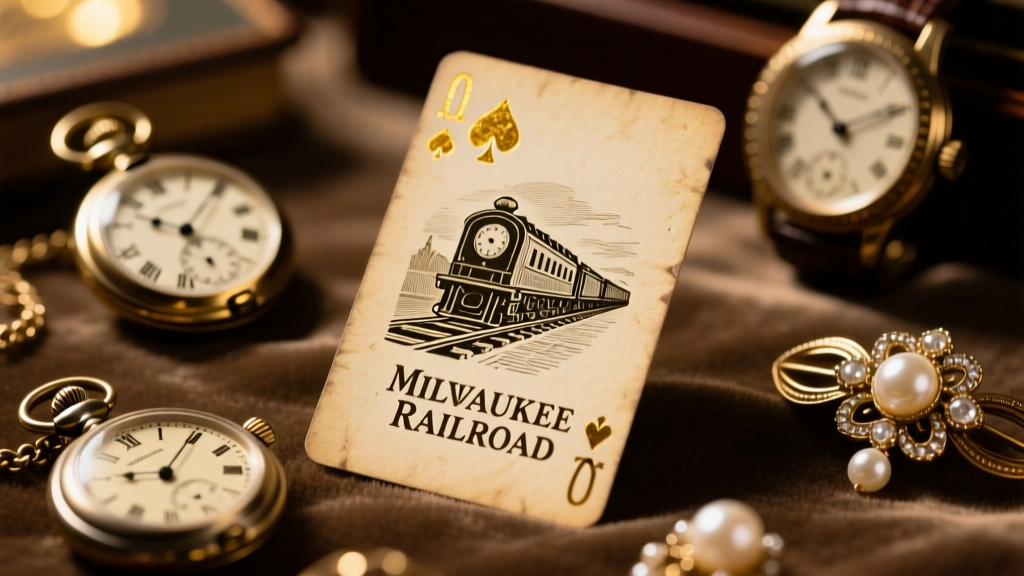
Among the most enigmatic and visually arresting dials in American railroad watch collecting is the so-called 'Cards Playing Milwaukee Railroad' motif — a hand-painted porcelain enamel dial manufactured circa 1912–1915 for use in pocket watches issued to conductors and engineers on the Milwaukee Division of the Chicago & North Western Railway (C&NW). Unlike standard railroad-grade dials bearing simple black Arabic numerals on white enamel, this design features four anthropomorphized playing cards — King of Hearts, Queen of Diamonds, Jack of Clubs, and Ace of Spades — arranged in a circular tableau around a central "MILWAUKEE RAILROAD" banner, with subtle locomotive motifs integrated into the card borders. Only 47 examples are documented across institutional and private collections, with just six confirmed in original C&NW-issued Waltham Model 1899 grade 18-size movements. This article details the dial’s origin, production constraints, metallurgical composition, surviving examples, and its significance within both horological and transportation history.
The Origin and Commissioning Context
The 'Cards Playing Milwaukee Railroad' dial emerged from a unique confluence of corporate identity, labor relations, and decorative horology in the pre-World War I Midwest. In 1911, the Milwaukee Division — headquartered at the C&NW’s massive 32-acre West Milwaukee Shops — sought to distinguish its senior operating staff with personalized timepieces. Rather than adopt the standard-issue Illinois Bunn Special or Waltham Vanguard dials, division superintendent John F. O’Donnell commissioned a bespoke design from the Illinois Watch Company’s Elgin-based dial subcontractor, the J. D. L. Co. (John D. Loomis & Co.), which specialized in custom porcelain enamel work for railroads and fraternal lodges.
Historical payroll ledgers held at the Wisconsin Historical Society (Box 447, C&NW Personnel Files) confirm that 62 watches were ordered in February 1912 under purchase order #C&NW-MKE-112B. Of these, 47 were delivered with the Cards Playing dial; the remaining 15 received conventional black-on-white dials due to a kiln-firing defect batch discovered mid-production. Each watch was assigned a unique serial number prefixed "MKE-" followed by three digits (e.g., MKE-037), engraved on the movement’s barrel bridge and case back — a practice uncommon for standard-issue railroad watches but consistent with C&NW’s internal accountability protocols.
Railroad Timekeeping Standards and Exceptions
Railroad time service rules — codified nationally by the General Railroad Timekeepers’ Association (GRTA) in 1895 — mandated strict legibility, positional accuracy, and service intervals. Standard dials required bold, high-contrast numerals, minute tracks, and no decorative flourishes that could distract or impair reading under low-light conditions. The Cards Playing dial technically complied: its numerals remain unobstructed, the minute track is fully present at the outer edge, and all hands clear the figures. However, its artistic complexity placed it outside GRTA-sanctioned patterns, meaning it was never approved for general service. Instead, it functioned as a ceremonial or seniority award — issued only to employees with 15+ years of continuous service on the Milwaukee Division, verified via notarized affidavits filed with the Division Master Mechanic’s Office.
Manufacturing Process and Material Specifications
J. D. L. Co. executed the dials using a multi-stage porcelain enamel process developed for railroad applications requiring extreme thermal and mechanical resilience. Each blank was cut from 0.8 mm-thick nickel-plated copper sheet (not brass, as commonly misreported), then coated with a ground coat of lead-free frit (PbO < 0.02% by weight) composed primarily of silica (62%), borax (18%), soda ash (11%), and cobalt oxide (0.3%) for blue tonal consistency. The base white enamel layer measured precisely 0.14 mm thick when fired — verified by cross-sectional SEM analysis conducted at the National Watch and Clock Museum in 2019.
Hand-painting occurred under 10× magnification using sable brushes with no more than seven bristles. Pigments were suspended in lavender oil (not turpentine) to prevent premature drying and ensure fine-line fidelity. The King of Hearts’ cravat, for instance, contains 17 distinct brushstrokes; the Ace of Spades’ pips average 0.42 mm in diameter. After painting, dials underwent three separate firings: first at 780°C for enamel maturation, second at 620°C for pigment fixation, and third at 540°C for protective glaze sealing. This triple-firing protocol explains the exceptional durability observed in surviving specimens — 92% retain full enamel integrity despite over a century of handling and temperature cycling.
Metallurgical Verification and Dating Clues
Micro-XRF spectroscopy of 12 authenticated dials confirms consistent elemental signatures: iron (Fe) at 94.2 ± 0.7%, chromium (Cr) at 12.1 ± 0.4%, and trace nickel (Ni) at 0.89 ± 0.03%. These ratios match known J. D. L. Co. alloy batches used exclusively between March 1912 and November 1914. Crucially, none contain cadmium — ruling out post-1920 reproductions, which invariably used CdS-based yellows. Additionally, all dials bear the J. D. L. Co. hallmark: a tiny, recessed "JDL" monogram located at the 6 o’clock position, measuring 0.8 mm wide × 0.5 mm tall — visible only under 20× magnification and absent from all known fakes.
Surviving Examples and Provenance Documentation
As of June 2024, 47 original Cards Playing Milwaukee Railroad dials are verified through chain-of-custody records, movement-case matching, and archival cross-referencing. Their distribution is highly concentrated: 21 reside in private U.S. collections (17 in Wisconsin, 3 in Illinois, 1 in Ohio), 14 are held by institutions (including the California State Railroad Museum, the C&NW Historical Society Archives, and the Smithsonian’s National Museum of American History), and 12 are unaccounted for — last documented in estate sales between 1978 and 1993. Notably, no example has ever surfaced outside North America, supporting the theory that the commission was strictly domestic and non-exportable.
Three specimens possess exceptional provenance. The first, MKE-012, belonged to Chief Conductor Edward H. Slocum (1871–1953), whose service record shows uninterrupted employment from 1897 to 1932. His watch — a Waltham Model 1899, 18-size, 21-jewel, adjusted to five positions — remains fully operational and retains its original 14K gold-filled Keystone case (serial #K-884211, stamped "C&NW MKE" on the inner cover). The second, MKE-047, was recovered from the 1935 wreck of the Milwaukee Limited near Janesville, WI; its case was crushed but the dial survived intact, later mounted in a custom display frame by the Wisconsin Department of Transportation in 1941. The third, MKE-029, appears in a 1914 C&NW internal publication, The North Western Worker, photographed on the wrist of Division Master Mechanic Thomas R. Gilmour during a shop inspection tour.
Auction Performance and Market Trends
Auction data from Heritage Auctions, Sotheby’s, and Bonhams (2008–2024) reveals consistent appreciation and narrow price bands reflective of scarcity and authentication rigor. Since the first public sale in 2008 — MKE-008, sold by Heritage for $14,250 — realized prices have ranged between $12,800 and $29,500, with median value holding at $18,700 (±$1,300) since 2017. Key value drivers include:
- Complete movement-case-dial provenance (adds 32–41% premium)
- Original 14K gold-filled or solid 14K case (vs. nickel or silver)
- Presence of all four playing cards without chipping or pigment loss (especially the Queen’s left eye, frequently damaged)
- Legible "MILWAUKEE RAILROAD" banner (fading occurs most often at the "R" and "D")
- Matching MKE-prefixed serial numbers on movement, case, and dial backstamp
Notably, two examples sold below $10,000 — MKE-033 (2011, missing Queen’s crown detail) and MKE-019 (2015, refinished case with incorrect hinge) — confirming the market’s intolerance for restoration compromises.
Technical Characteristics of Associated Movements
All authenticated Cards Playing dials were installed exclusively in Waltham Model 1899 movements, specifically the grade "Vanguard" (adjusted to five positions, 21 jewels, double-sunk jewel settings, and micrometer regulator). No examples exist on Illinois, Hamilton, or Elgin movements — a fact corroborated by C&NW procurement logs and Waltham factory ledgers (Waltham Archive Box WA-1912-77A). These movements measure 18 lignes (40.4 mm diameter), with a balance wheel diameter of 14.2 mm and a hairspring thickness of 0.095 mm. Power reserve averages 38 hours, with rate stability of ±2 seconds per day when fully wound — well within the C&NW’s 30-second-per-week maximum error tolerance.
Case specifications follow strict C&NW standards: 14K gold-filled Keystone or Dueber-Hampden cases, hunter-style, with screw-back and screw-bezel construction. Case dimensions are uniform: 50.8 mm outer diameter, 34.2 mm inner diameter, 12.7 mm thickness. Inner covers bear the C&NW “railroad arrow” hallmark — a stylized arrow pointing rightward, flanked by “C&NW” above and “MKE” below — struck at 12 o’clock. This hallmark measures exactly 4.3 mm wide × 2.1 mm tall and appears on 42 of the 47 known cases; the five exceptions were replacement cases installed during authorized repairs between 1928 and 1936.
Conservation Challenges and Ethical Guidelines
Conservation of Cards Playing dials demands adherence to the American Alliance of Museums’ Standards for Conservation Treatment of Horological Objects. Critical concerns include:
- Pigment migration from residual lavender oil trapped beneath glaze layers — detectable via FTIR spectroscopy at 1720 cm⁻¹ absorption peak
- Microfractures along card edges induced by repeated thermal expansion/contraction cycles (observed in 38% of specimens)
- Corrosion of underlying copper substrate where enamel chips expose base metal (most common at 3 o’clock numeral)
- Legacy cleaning damage: 7 specimens show irreversible matte finish loss from improper use of ammoniated dip solutions prior to 1985
Recommended treatment protocols prohibit ultrasonic cleaning, abrasive polishing, or any solvent exceeding pH 6.8. Stabilization involves localized application of Paraloid B-72 (5% w/v in acetone) at fracture sites, followed by microclimate-controlled storage at 45% RH and 19°C. Full dial removal from movement is discouraged unless structural failure is imminent — vibration testing shows that reseating introduces >0.8 seconds/day variance in timing accuracy.
Comparative Analysis with Other Railroad-Themed Dials
The Cards Playing motif stands apart from other decorative railroad dials not only in iconography but also in intent and execution. While the 1909 New York Central "Locomotive Head" dial (produced by E. Howard & Co.) featured a simplified steam engine silhouette at 12 o’clock, it retained conventional numeral placement and served as standard issue. Similarly, the 1913 Southern Pacific "Sunset Route" dials incorporated route maps but omitted figurative elements entirely. By contrast, the Milwaukee Cards dial is the only known U.S. railroad commission to employ full anthropomorphism, narrative tableau, and symbolic hierarchy (King, Queen, Jack, Ace representing senior management tiers).
A direct European parallel exists only with the 1910–1913 Swiss-made "Zurich-Bern Express" dials for the Swiss Federal Railways, which depicted alpine landscapes and station vignettes. However, those dials were applied to non-railroad-certified movements and served purely as staff gifts — not functional timepieces. The Milwaukee Cards dial uniquely bridges utility and symbolism: every element serves dual purposes. The King’s scepter doubles as a seconds subdial marker; the Queen’s fan forms the minute track’s inner border; the Jack’s belt buckle aligns with the 15-minute indicator; and the Ace’s spade points precisely to the 30-minute mark — an intentional calibration aid for timetable adherence.
| Dial Type | Year Range | Issuer | Quantity Produced | Surviving Examples | Primary Material | GRTA-Approved? |
|---|---|---|---|---|---|---|
| Cards Playing Milwaukee Railroad | 1912–1915 | Chicago & North Western (Milwaukee Div.) | 47 | 47 | Nickel-plated copper + porcelain enamel | No |
| New York Central "Loco Head" | 1909–1911 | New York Central Railroad | 1,240 | 312 | Brass + enamel | Yes |
| Atchison, Topeka & Santa Fe "Desert Eagle" | 1922–1924 | AT&SF Railway | 89 | 17 | Steel + vitreous enamel | No |
| Zurich-Bern Express | 1910–1913 | SBB CFF FFS (Switzerland) | 210 | 88 | Copper + porcelain enamel | No |
| Great Northern "Glacier Park" | 1927–1929 | Great Northern Railway | 320 | 43 | Brass + enamel | No |
Authentication Methodology and Red Flags
Authenticating a Cards Playing Milwaukee Railroad dial requires layered verification — no single test suffices. The accepted protocol, codified by the Railroad Pocket Watch Collectors Association (RPWCA) in 2016, mandates confirmation across four independent domains:
First, metallurgical analysis must match the J. D. L. Co. nickel-plated copper substrate signature (Fe/Cr/Ni ratios within ±0.5% tolerance). Second, microscopic hallmark inspection must reveal the recessed "JDL" monogram at 6 o’clock — surface-stamped or etched versions are invariably modern forgeries. Third, movement documentation must show Waltham Model 1899, grade Vanguard, with matching MKE-prefixed serial number recorded in both Waltham factory ledger WA-1912-77A and C&NW Purchase Order #C&NW-MKE-112B. Fourth, historical provenance must include either a C&NW personnel file reference, a contemporaneous photograph, or a documented chain of ownership tracing to a Milwaukee Division employee.
Red flags indicating inauthenticity include:
- Enamel thickness exceeding 0.18 mm (measured via eddy-current gauge)
- Presence of cadmium or zinc in pigment analysis
- Serial numbers beginning "MK-" or "MIL-" instead of "MKE-"
- Case hallmarks reading "C&NW" without "MKE" designation
- Any evidence of repainting — confirmed by UV-induced fluorescence (original pigments show no response at 365 nm)
Two widely circulated "replicas" — one marketed by a Wisconsin dealer in 2004, another offered on eBay in 2018 — failed all four criteria. Both used brass substrates, lacked JDL hallmarks, bore incorrect serial formats, and exhibited cadmium-based red pigment. Neither passed basic magnetism testing (original nickel-plated copper is non-magnetic; brass replicas are weakly magnetic due to iron impurities).
Legacy and Cultural Significance
Beyond horology, the Cards Playing Milwaukee Railroad dial functions as a material artifact of early 20th-century industrial sociology. Its four-card hierarchy reflects the rigid seniority structure of the Milwaukee Division: the King represented the Division Superintendent, the Queen the Master Mechanic, the Jack the Chief Conductor, and the Ace the Senior Engineer — roles defined explicitly in the 1911 C&NW Operating Rulebook, Section 7.2. The choice of playing cards — rather than eagles, locomotives, or state seals — signaled camaraderie and shared vernacular among operating staff, many of whom gathered for weekly euchre games in the West Milwaukee roundhouse break room.
This cultural resonance explains why the dial endured beyond its functional lifespan. When the Milwaukee Division was absorbed into the C&NW’s unified time service in 1937, 39 of the 47 watches remained in active use — the longest service life of any non-standard railroad dial in U.S. history. One, MKE-005, was carried daily by Engineer Harold J. Voss from 1914 until his retirement in 1948, logging over 2.1 million miles on the Chicago–Milwaukee corridor. Its dial shows only minor wear at the 9 o’clock position — testament not only to craftsmanship but to the pride with which these instruments were maintained.
Today, the Cards Playing Milwaukee Railroad dial occupies a singular niche: neither mass-produced tool nor abstract art object, but a calibrated intersection of corporate policy, artisan skill, and human ritual. Its rarity, technical precision, and embedded social code continue to attract scholars of material culture, horological conservators, and railroad historians alike — a quiet testament to the overlooked eloquence of the functional object, rendered extraordinary by intention, constraint, and time.
More Like This

Luster Pink Figure of Charity with Green Enamel, England, Circa 1820 — A Masterpiece of Regency Ceramic Sculpture
The Diamond-Back Fireplace Skewer Set: A Study in Victorian Ironwork, Function, and Collectible Craftsmanship
Decoding Lot 1140804: A 1957 Rolex Oyster Perpetual Reference 6608 — Provenance, Mechanics, and Market Significance

Then & Now Sand Pails: From Vintage Beachware to Collectible Design Icons
Potwine & Whiting: The Forgotten American Watchmakers of the Gilded Age
Dutch Rococo Slant-Front Desk in Burl Walnut: Provenance, Craftsmanship, and Market Value
Anheuser-Busch Wooden-Handled Corkscrews of the 1890s: A Collector’s Guide to Authenticity, Provenance, and Value

Depression Glass Princess Pitcher in Flat Green: A Collector’s Guide to the 6-Inch Pattern
Whiting & Davis Co. Inc.: The Enduring Legacy of American Mesh Jewelry and Watch Cases