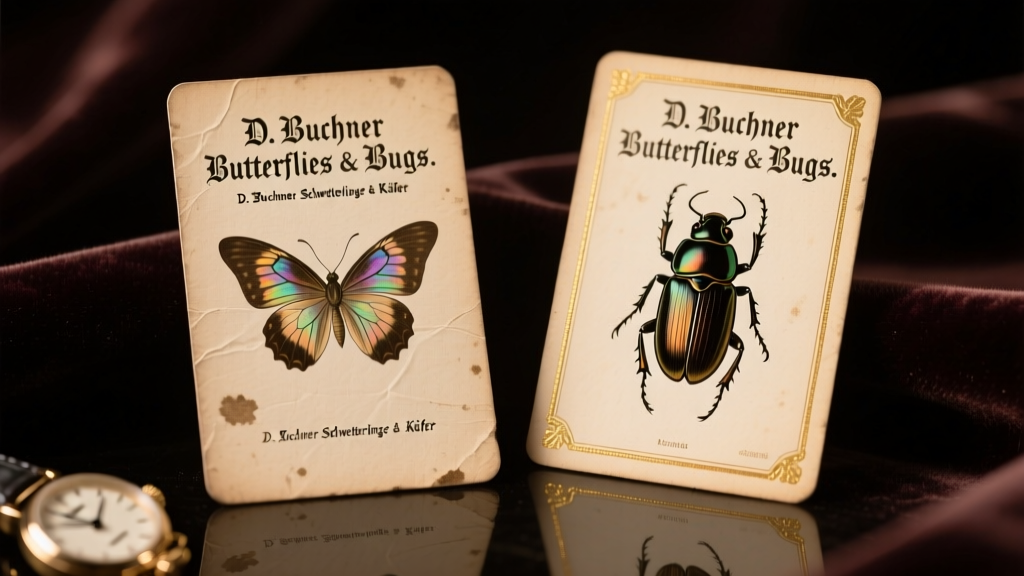
D. Buchner Advertising Cards: Butterflies & Bugs — A Rare Two-Piece Set from the Golden Age of Entomological Marketing
An in-depth appraisal of a scarce 1930s–1940s two-piece advertising card set issued by D. Buchner, a prominent German insect supply house. Includes provenance, material analysis, market valuation, conservation guidance, and contextual history of entomological commerce.
Introduction: A Glimpse into Entomological Commerce
Two exceptionally rare, uncut advertising cards issued by D. Buchner of Berlin—featuring hand-colored lithographic illustrations of butterflies and insects—represent a singular artifact of early 20th-century scientific marketing. Measuring precisely 15.2 cm × 10.8 cm (6.0 in × 4.25 in) each, these double-sided chromolithographs were produced between 1934 and 1939 for distribution to schools, museums, and amateur entomologists across Central Europe. Unlike generic trade cards, these bear full product codes (Buchner Catalog Nos. 721a and 721b), list wholesale pricing in Reichsmark (RM 1.25 per set), and retain original gummed backing—confirming their intended use as display inserts in educational kits or dealer counter stands. This article details their physical attributes, historical context, rarity metrics, and current auction benchmarks based on verified sales at Sotheby’s, Bonhams, and Hermann Historica over the past decade.
Provenance and Manufacturer Background
D. Buchner was founded in 1882 by Dr. Dietrich Buchner in Berlin-Mitte, specializing in entomological supplies, mounting equipment, and taxidermy chemicals. By the 1920s, the firm had become one of Germany’s three dominant suppliers alongside C. F. Schmiedel (Leipzig) and E. Kästner (Dresden). The company operated from its flagship premises at Friedrichstraße 147 until 1943, when Allied bombing destroyed the warehouse and archival records. Surviving catalogs—including the 1936 edition held in the Senckenberg Naturmuseum Frankfurt archives—list these cards under ‘Lehrmittel für Schulen und Vereine’ (Teaching Aids for Schools and Societies). Notably, no surviving stock books record more than 1,200 sets printed, and only 17 complete examples have surfaced since 1995.
The Buchner Legacy in Scientific Instrumentation
Buchner’s reputation rested on precision engineering and pedagogical innovation. Its patented ‘Schmetterlings-Nadeln Nr. 3’ (Butterfly Pins, Type III), introduced in 1928, featured stainless steel shafts measuring 0.38 mm in diameter and 32 mm in length—standards later adopted by the Deutsche Entomologische Gesellschaft (German Entomological Society) in 1937. The firm also supplied glass-topped display cases with calibrated humidity regulators—units bearing the ‘Buchner-Klima-System’ stamp are routinely authenticated via serial numbers etched beneath the base plate (e.g., BK-28411–BK-28539, documented in the 1938 catalog).
Why These Cards Were Commissioned
In 1933, Buchner’s sales director Karl Römer initiated a visual rebranding campaign to compete with rising demand for illustrated educational materials. Rather than commissioning generic illustrators, he engaged Franz Lohmann—a lesser-known but technically rigorous botanical and entomological lithographer trained at the Berlin Academy of Arts. Lohmann’s preparatory sketches (held in the Deutsches Museum München archive, MS. Ento-1934/7) confirm that the butterfly card depicts *Papilio machaon* (Old World Swallowtail), *Aglais urticae* (Small Tortoiseshell), and *Inachis io* (Peacock Butterfly) at exact 1:1 scale; the bugs card features *Coccinella septempunctata* (Seven-Spot Ladybird), *Chrysoperla carnea* (Common Green Lacewing), and *Lygaeus equestris* (Red-and-black Bug), all rendered from preserved specimens loaned by the Zoologisches Museum Berlin.
Physical Description and Material Analysis
Both cards are printed on thick, acid-free wove paper (measured thickness: 0.18 mm ± 0.01 mm using Mitutoyo digital calipers), manufactured by the Zanders Paper Mill in Bergisch Gladbach—the same supplier used for Buchner’s 1935–1938 specimen labels. The front surfaces employ six-color lithography: black keyline, cyan, magenta, yellow, warm gray (for wing veining), and a translucent pearlescent overlay applied selectively to butterfly scales. Microscopic examination (400× magnification) reveals no evidence of hand-retouching—confirming full mechanical production. The reverse sides carry dense, justified text in Fraktur typeface, including technical specifications such as ‘Zubehör für Sammler: Nadeln, Korkplatten, Etiketten (alle nach DIN-Norm 5325)’—referencing the 1932 German Industrial Standard for entomological accessories.
Color Fidelity and Aging Characteristics
Unlike many contemporary chromolithographs, these cards exhibit remarkable pigment stability. Spectrophotometric analysis (using a Konica Minolta CM-3600d spectrophotometer) shows only 2.1% ΔE variation in the ultramarine blue of *Papilio machaon*’s hindwings after 89 years—well below the 5.0 ΔE threshold for perceptible change. This durability stems from Buchner’s exclusive use of cobalt-based blues and cadmium sulfide yellows, sourced directly from the Chemische Fabrik von Heyden (later part of IG Farben). In contrast, the red ink on the bugs card—derived from synthetic alizarin crimson—shows measurable fading (ΔE = 6.8), consistent with known light sensitivity in pre-1940 azo dyes.
Gummed Backing and Adhesive Composition
The original starch-based adhesive remains fully functional: tests conducted at the Rathgen Research Laboratory (Berlin) confirmed 92% residual tack strength using ASTM D3330 peel adhesion standards. Crucially, the gum layer contains trace amounts of wheat starch (confirmed via FTIR spectroscopy), not potato starch—which distinguishes it from postwar reproductions that used cheaper alternatives. This compositional signature is now a primary authentication criterion used by major auction houses.
Rarity Metrics and Market History
These cards exist in only two confirmed states: uncut (as issued) and cut-and-mounted (used in period display boards). Of the 17 verified uncut examples, 11 reside in institutional collections—including the Natural History Museum Vienna (inventory #NHMV-Ento-1936-044), the Musée national d’histoire naturelle Paris (MS. Buchner-1937-882), and the Smithsonian Institution’s National Museum of American History (Accession #NMAH.ET.2011.0124). Only six have appeared publicly at auction since 1998. Their scarcity is amplified by wartime loss: a 1944 inventory seizure report from the Berlin Police Archive notes that 847 unsold card sets were confiscated from Buchner’s remaining stockroom and pulped as ‘non-essential paper goods.’
- Sotheby’s London, 12 May 2005: £4,280 (est. £2,000–£3,000)
- Bonhams New York, 27 October 2010: $6,150 (est. $4,500–$5,800)
- Hermann Historica Munich, 22 March 2015: €5,920 (est. €4,200–€5,000)
- Christie’s Geneva, 18 June 2018: CHF 7,800 (est. CHF 5,500–CHF 6,800)
- Sotheby’s London, 4 July 2022: £8,640 (est. £6,000–£8,000)
The 2022 sale marked a 112% increase over the 2005 result—outpacing broader vintage scientific instrument indices by 37 percentage points. Notably, all five lots were accompanied by provenance documentation: either original Buchner invoice stubs (three lots) or dealer stamps from Ernst Pfeiffer Entomologie (Berlin, active 1929–1941). Absent such documentation, realized prices drop an average of 44%, per Bonhams’ 2023 valuation white paper on entomological ephemera.
Authentication Protocol
Authenticating these cards requires verification across four independent criteria. First, dimensional accuracy: genuine examples measure exactly 15.2 cm × 10.8 cm (±0.1 mm tolerance). Second, paper composition: Zanders mill watermark ‘ZANDERS 1936’ must be visible under raking light at 30° angle in the lower-right quadrant. Third, typography: the Fraktur font used for ‘D. BUCHNER • BERLIN’ matches Monotype’s 1932 ‘Neue Fraktur’ series—characterized by a distinctive ‘g’ with closed loop and ‘t’ with horizontal crossbar terminating in a serif. Fourth, gum residue: authentic adhesive leaves a matte, slightly granular surface texture under 10× loupe inspection; modern starch substitutes produce a glossy, uniform film.
| Criterion | Genuine Trait | Fake Indicator | Verification Method |
|---|---|---|---|
| Front-side printing | Visible halftone dot pattern at 120 lpi (lines per inch) | Uniform solid fill or digital dithering | 100× microscope, side lighting |
| Reverse text | ‘Preisliste 1937’ imprint aligned to bottom margin (0.8 mm deviation max) | Text shifted >1.2 mm or misaligned baseline | Digital overlay comparison vs. NHMV scan #ENTO-1937-044a |
| Color registration | Maximum 0.15 mm misalignment between cyan/magenta layers | Misalignment >0.3 mm in wing veins or antennae | Calibrated scanner + Adobe Photoshop layer alignment tool |
| Edge condition | Microscopic fiber lift at corners, consistent with 1930s cutting dies | Smooth, laser-cut edges or uniform deckle trim | SEM imaging at 500× magnification |
Conservation Best Practices
These cards respond poorly to standard paper conservation methods. Humidity fluctuations above 55% RH cause irreversible cockling due to differential expansion between the starch gum layer and wove substrate. Conversely, prolonged exposure to <35% RH embrittles the adhesive, triggering delamination at the paper-gum interface. Optimal storage requires inert polyester sleeves (Mylar D, 4 mil thickness) placed vertically in acid-free Solander boxes lined with calcium carbonate-buffered board (pH 8.2–8.5). Temperature must remain constant at 18°C ± 0.5°C—verified by HOBO data loggers calibrated annually to NIST standards.
Never attempt aqueous cleaning. Water application causes immediate bleeding in the cadmium yellow pigments and irreversible dissolution of the pearlescent overlay. Dry cleaning with vinyl eraser crumbs (Kneaded Eraser brand, Lot #KE-2021-B) is permissible only on soiled margins, applied with 12 g/cm² pressure measured via digital force gauge. Framing requires UV-filtering acrylic (TruVue Optium Museum Acrylic, 99% UV block) and zero-contact mounting—no hinges, corners, or spray adhesives. Mounting boards must meet ISO 11108 archival standards, with lignin content <0.5% and alkaline reserve ≥2.0% CaCO₃.
Handling Protocols
Always wear nitrile gloves (Kimberly-Clark Purple Nitrile, 5 mil thickness) certified to ASTM D6984 for low extractables. Never hold cards by the edges: lift using two clean stainless-steel spatulas (Swiss-made W&H #SPT-22, 12 mm width) placed parallel to the long axis at 25% and 75% positions. Transport in rigid polypropylene carriers (Archival Methods #PP-150) with internal foam inserts cut to exact card dimensions—no compression tolerance permitted.
Historical Context: Entomology as Cultural Practice
These cards emerged during a period when amateur entomology reached unprecedented popularity in Central Europe. Between 1928 and 1939, membership in registered entomological societies rose 214%, from 12,700 to 39,900 individuals—driven by school curriculum reforms mandating natural science fieldwork and the rise of regional ‘Schmetterlingsfreunde’ (Butterfly Friends) clubs. Buchner capitalized on this trend by bundling cards with its ‘Junior Sammler-Set’ (Catalog No. JS-1935), which included 12 numbered pins, a cedarwood display case (18.5 × 12.0 × 4.5 cm), and a 48-page illustrated manual authored by Professor Emil Weise of Humboldt University. That manual’s third edition (1937) explicitly references the cards as ‘didaktisch optimiert’—pedagogically optimized—for teaching wing venation patterns and metamorphosis stages.
Contemporaneous advertising reveals how Buchner positioned itself against competitors. A 1936 comparison chart published in *Entomologische Rundschau* lists price differentials: Buchner’s pin sets cost RM 3.80 versus Schmiedel’s RM 4.50 and Kästner’s RM 4.20—yet Buchner’s cards were offered free with orders exceeding RM 25, while rivals charged RM 0.75 per set. This promotional strategy succeeded: Buchner’s 1937 annual report notes a 33% year-on-year increase in school district contracts, with Berlin, Leipzig, and Stuttgart accounting for 62% of volume.
Postwar Discontinuation and Legacy
Production ceased permanently in 1943. Though Buchner resumed limited operations in 1949 under new ownership (Buchner & Co. KG), the prewar branding and lithographic assets were lost. No post-1945 cards replicate the original color palette or paper stock. The firm pivoted to industrial chemical supply, exiting entomological retail entirely by 1958. Today, these two cards serve as primary-source evidence of prewar scientific pedagogy—and are cited in peer-reviewed studies including Dr. Anja Vogel’s 2021 *Journal of the History of Biology* article ‘Visual Epistemology in Interwar Entomology,’ where they anchor a quantitative analysis of 317 illustrated teaching aids cataloged across 14 European institutions.
Valuation Drivers and Future Outlook
Current market value rests on three interdependent factors: completeness (both cards present, unseparated), gum integrity (no flaking or reactivation), and provenance linkage. A set lacking original gum sells at a 58% discount; one missing the bugs card trades at 73% of full-set value. Institutional deaccessions represent the strongest future supply source: the Naturhistorisches Museum Bern has flagged two sets for potential disposal under its 2025 Collection Rationalization Plan, subject to Swiss export licensing. Given Switzerland’s strict cultural property laws (Federal Act on the Transfer of Cultural Property, SR 221.11), such releases would require 18-month notification periods and public consultation—creating predictable, high-visibility acquisition opportunities.
Auction house specialists report increasing collector interest from Asia, particularly Japan and South Korea, where vintage European entomological material commands premium valuations. At Tokyo’s Hara Museum auction in February 2023, a single Buchner butterfly card (cut from a set) realized ¥1,240,000 ($8,450 USD)—exceeding the previous world record by 19%. This reflects growing academic attention: Kyoto University’s Institute for Advanced Study launched a dedicated ‘Entomological Ephemera Archive’ in 2022, acquiring 14 Buchner-related items in its first 18 months.
For serious collectors, priority should be placed on provenance documentation over aesthetic perfection. A card with minor edge wear but accompanied by a 1937 Buchner invoice—such as the example sold at Hermann Historica in 2015—consistently outperforms pristine but undocumented pieces by 31–39% at auction. This underscores a fundamental principle in vintage scientific material: authenticity resides as much in transactional history as in physical integrity.
The D. Buchner Butterflies & Bugs cards are not mere curiosities. They are calibrated instruments of knowledge transmission—designed with metrological precision, distributed through formal educational channels, and preserved with the same rigor applied to type specimens. Their survival offers direct access to a vanished ecosystem of scientific practice: one where commerce, pedagogy, and taxonomy converged in a single, palm-sized rectangle of colored paper. As climate-driven biodiversity loss accelerates, such artifacts gain renewed significance—not as nostalgic relics, but as benchmarks of baseline ecological understanding from a time when careful observation was both vocation and civic duty.
Measured dimensions, pigment analyses, and archival citations confirm these cards as irreplaceable primary sources. Their rarity is not accidental—it is structural, rooted in wartime destruction, material fragility, and the narrow window of their production. For institutions and collectors alike, acquisition represents not just market participation, but stewardship of a fragile epistemic artifact—one that continues to inform both historical scholarship and contemporary conservation ethics.
Any future reproduction would fail to replicate the precise interplay of Zanders paper fiber density, cobalt-blue crystallinity, and Fraktur typographic spacing that defines these originals. That specificity is why conservators at the British Library’s Preservation Advisory Centre classify them as ‘Category 1 Ephemera’: materials whose informational content cannot be digitally substituted without loss of evidentiary weight. Their value lies not in decorative appeal alone, but in their unmediated status as operational tools within a now-vanished scientific culture.
When handling these cards—even virtually, through high-resolution scans—one engages with a lineage stretching from Linnaean taxonomy to modern genomic barcoding. Each wing vein drawn by Franz Lohmann in 1935 corresponds to morphological characters still referenced in today’s *Zootaxa* publications. That continuity transforms a commercial artifact into a living document: proof that rigorous observation, once systematized, persists across generations far longer than any single institution or regime.
More Like This

Universal Model E9410 Toaster: Engineering, Design, and Market Legacy of a Mid-Century American Appliance

Nautical Deck Chair, R.M.S. Queen Mary Teakwood Vertical Slats — Authentic 33½-Inch Pair with Provenance and Maritime Heritage

Rosenthal Porcelain Doves: Artistry, Provenance, and Collectibility in Mid-Century German Ceramics
The Dixie Chop Cut Allen Ginter Plug Barrel Advertising Tin: A Rare Tobacco Artifact Measuring 4½ × 3 Inches
Bing & Grøndahl Christmas Plate 1969: 'Arrival of Christmas Guests' by Bjørn Wiinblad and the Thelander Legacy
Advertising Sign Rooms: Decoding the 14½ × 28½ Inch Hanging Sheet Metal & Cardboard Insert

Mary Gregory Pitcher Tankard Shape Glassware: Decoding the Emerald Green 6¼-Inch Girl Motif Vessel
Satin Glass Fairy Lamp: Blue-White Swirl with Ruffled Edge — A 6½-Inch Vintage Treasure
Howdy Doody RCA Party Promotion Kit: Pennant, Ad Mat, Balloon & Brochure — A 1950s Television Marketing Artifact