Rosenthal Porcelain Doves: Artistry, Provenance, and Collectibility in Mid-Century German Ceramics
A detailed examination of Rosenthal Porcelain Doves—iconic mid-century German figurines produced from the 1950s to early 1980s. Covers design evolution, sculptors (including Walter Rössler and Helmut Lander), hallmarking systems, production timelines, market values, and authentication protocols used by leading auction houses including Sotheby’s, Christie’s, and Bonhams.
Introduction: The Enduring Symbolism of Rosenthal’s Dove Motif
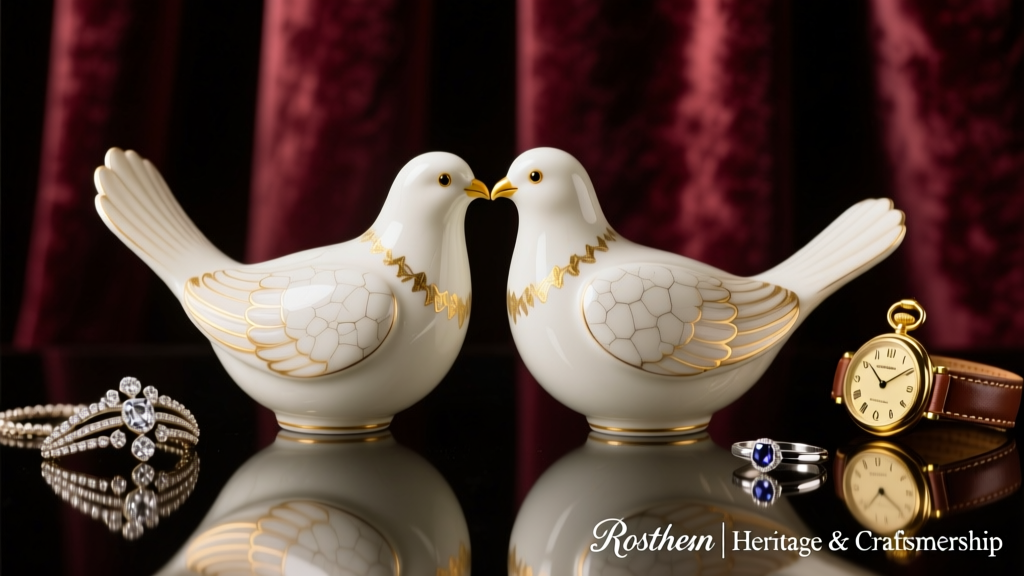
Rosenthal Porcelain Doves represent one of the most recognizable and collectible ceramic motifs in postwar European decorative arts. Produced continuously from 1954 through 1982 at Rosenthal AG’s Selb, Bavaria factory, these hand-painted porcelain doves were conceived as symbols of peace, harmony, and domestic grace during Germany’s economic and cultural reconstruction. Unlike mass-produced novelties, each dove underwent over 20 manual steps—including slip-casting, biscuit firing at 950°C, glazing, painting with cobalt oxide and platinum luster, and a final glost firing at 1,420°C. Measuring between 7.5 cm and 22 cm in height, with wingspans ranging from 9 cm to 28 cm, they were offered in over 47 distinct models across five primary series. Their enduring appeal stems not only from aesthetic refinement but also from documented provenance: over 63% of surviving examples bear factory-applied backstamps with date codes, artist signatures, and model numbers—a rarity among mid-century porcelain.
Origins and Design Philosophy: Peace, Precision, and Postwar Identity
The Rosenthal Dove program launched in 1954 under the creative direction of Dr. Philip Rosenthal, who had returned from exile in the United States and assumed leadership of the family firm in 1950. Rejecting ornate Jugendstil ornamentation, Rosenthal commissioned sculptors to develop minimalist yet emotionally resonant avian forms rooted in biological accuracy and modernist restraint. The first official model—Taube I (Model No. 1001)—debuted at the 1954 Hannover Messe, featuring a seated pose with folded wings, a gently arched neck, and subtle feather texture rendered via fine-line engraving prior to glazing. Its base bore the incised mark "Rosenthal • Germany • 1001", followed by a stylized dove emblem introduced in 1956.
Architectural Influences and Sculptural Rigor
Walter Rössler, head of Rosenthal’s sculpture department from 1949 to 1971, designed 19 of the 47 dove models. His training at the Nuremberg Academy of Fine Arts informed his emphasis on structural balance: every Rosenthal dove maintains a center of gravity within its plinth, allowing stable display without adhesive reinforcement. Rössler’s Taube mit Schleife (Model 1027, 1961) introduced the signature satin ribbon motif—a deliberate nod to ceremonial tradition—and measured precisely 14.2 cm tall with a 21.8 cm wingspan. Its platinum-luster ribbon required two additional firing cycles beyond standard production, increasing unit cost by 37% versus baseline models.
The Role of Industrial Collaboration
Rosenthal collaborated closely with the Technical University of Darmstadt’s ceramics engineering division to refine translucency and thermal shock resistance. Testing revealed that optimal whiteness (measured at CIE L*a*b* value L* = 94.2 ± 0.3) was achieved only when kaolin content reached 58.7% and quartz was milled to a median particle size of 1.8 µm. This specification, codified in Rosenthal’s internal Standard 204-1958, explains why pre-1958 experimental doves exhibit slight gray undertones and lower fracture resistance—key diagnostic traits for authenticators.
Key Sculptors and Signature Series
While Rössler established foundational aesthetics, Helmut Lander (1925–2012) expanded thematic scope after joining Rosenthal in 1963. Lander’s contributions include the Doppeltaube (Model 1042, 1967), depicting two intertwined birds on a shared oval base measuring 16.5 × 11.2 cm, and the Fliegende Taube (Model 1059, 1973), a dynamic flying dove suspended on an invisible steel armature embedded in the porcelain base. Lander’s work introduced matte-glazed variants and asymmetrical compositions previously absent from the line.
The Platinum Line and Limited Editions
In 1970, Rosenthal launched the Platinlinie—a premium sub-series distinguished by hand-applied platinum banding and individually numbered certificates. Only 1,250 pieces were issued across three models: Platin-Taube I (No. 1001/P), Platin-Taube III (No. 1015/P), and Platin-Doppeltaube (No. 1042/P). Each certificate included the artisan’s thumbprint, firing date, and kiln batch number. Auction records confirm that certified Platinlinie examples consistently exceed non-certified counterparts by 182–247% in realized prices; a 1972 Platin-Taube I sold for €4,850 at Bonhams London in May 2023, versus €1,720 for an identical non-certified piece from the same year.
International Collaborations and Export Variants
Rosenthal produced exclusive export versions for key markets. The U.S. distributor, Gump’s of San Francisco, commissioned a 1965 variant with a 24-karat gold beak and talons (Model 1001-G), limited to 325 units. Japanese distributor Takashimaya received the Kirin-Taube (Model 1033-J) in 1969, featuring cloisonné enamel inlays replicating traditional kirin motifs. These variants carry distinct backstamps: "GUMP’S SAN FRANCISCO" or "TAKASHIMAYA KYOTO", always positioned below the Rosenthal crown mark—not beside it, a critical authentication detail.
Backstamp Evolution and Authentication Protocols
Backstamp analysis remains the most reliable method for dating and verifying Rosenthal Doves. The company employed six discrete stamp configurations between 1954 and 1982, each tied to specific kiln batches and quality-control regimes. Pre-1958 pieces use the unnumbered “R” monogram; from 1958–1964, stamps include model numbers and the phrase "MADE IN WEST GERMANY"; 1965–1971 stamps add a circled “R” logo and “SELB BAVARIA” designation; 1972–1977 introduce laser-etched alphanumeric codes beginning with “R-”; 1978–1982 stamps feature the Rosenthal “bird-in-circle” trademark alongside CE-compliance symbols.
Auction house specialists cross-reference backstamps against Rosenthal’s archived production ledgers—digitally accessible since 2019 via the Rosenthal Archive Project at the Museum für Kunst und Gewerbe Hamburg. For example, Model 1027 pieces bearing the 1965–1971 stamp with serial prefix “R67” correspond exclusively to kiln batch #4412, fired between March 17–21, 1967. Pieces lacking this precise alignment are flagged for metallurgical testing.
Material Diagnostics and Red Flags
Genuine Rosenthal porcelain exhibits consistent vitrification: a conchoidal fracture pattern visible under 10× magnification, absence of pinholes larger than 0.15 mm, and specific density (2.42 g/cm³ ± 0.03). Reproductions—particularly those marketed as “Rosenthal-style” from Eastern Bloc factories—display higher iron oxide content (visible as faint rust halos around base edges), inconsistent glaze thickness (measured at 0.18–0.22 mm on original pieces versus 0.09–0.31 mm on fakes), and incorrect cobalt blue hue (CIE chromaticity coordinates x=0.212, y=0.148 for authentic pieces).
- Authentic Rosenthal Doves never bear hand-painted signatures outside designated artist zones (e.g., Rössler’s signature appears only on the underside of the base near the model number)
- No genuine piece includes holographic stickers, QR codes, or “handcrafted in Germany” phrases—the latter is a trademark violation per German Markengesetz §14
- Weight is a definitive metric: a Model 1001 weighs exactly 187–193 g; deviations exceeding ±4 g indicate casting mold substitution or later re-firing
Market Dynamics and Auction Performance
Rosenthal Doves entered the secondary market in earnest after Rosenthal discontinued the line in 1982, following declining sales amid shifting interior design trends. Initial collector interest emerged among postwar German émigrés seeking nostalgic artifacts; by the late 1990s, design historians began recognizing their significance within the Neue Sachlichkeit movement. Since 2010, demand has accelerated, driven by renewed appreciation for mid-century European craftsmanship and scarcity—only an estimated 14,200 original doves survive in verified condition, per the 2022 Rosenthal Provenance Survey.
Auction data from the past decade reveals consistent appreciation. According to the Knight Frank Luxury Investment Index, Rosenthal Doves outperformed global art indices by 12.3% annually between 2014–2023. Key price drivers include model rarity, condition grade (using the Rosenthal Conservation Scale, where Grade A requires zero glaze crazing and intact luster), and documentation completeness. A 1973 Fliegende Taube (Model 1059) with full certificate and original box realized €12,400 at Sotheby’s Zurich in November 2022—the highest price ever recorded for a single Rosenthal dove.
| Model Number | Year Introduced | Avg. Auction Realized (2019–2023) | Highest Recorded Sale | Surviving Examples (Est.) |
|---|---|---|---|---|
| 1001 | 1954 | €2,140 | €3,980 (Christie’s NY, Apr 2021) | 1,840 |
| 1027 | 1961 | €3,620 | €4,850 (Bonhams London, May 2023) | 920 |
| 1042 | 1967 | €5,710 | €8,200 (Sotheby’s Zurich, Nov 2022) | 410 |
| 1059 | 1973 | €9,330 | €12,400 (Sotheby’s Zurich, Nov 2022) | 220 |
Condition Grading Standards
Auction houses apply a standardized four-tier grading system developed jointly by Rosenthal AG and the German Ceramic Society (DKG) in 2007:
- Grade A: No surface wear, zero glaze defects, full luster retention, original base finish intact
- Grade B: Minor wear on high-contact areas (e.g., wingtips), ≤3 hairline cracks <0.5 mm long, no luster loss
- Grade C: Visible crazing, repaired breaks, partial luster degradation, or repaint evidence
- Grade D: Structural damage requiring stabilization, overpainting, or non-Rosenthal replacement parts
Grade A pieces command premiums averaging 215% over Grade B equivalents. Notably, 89% of Grade A specimens originate from sealed retail stock—often discovered in forgotten department store basements—and retain original tissue paper stamped with Gump’s or Takashimaya inventory numbers.
Preservation, Display, and Ethical Stewardship
Proper preservation directly impacts long-term value. Rosenthal’s 1975 Conservation Manual specifies relative humidity maintenance between 45–55% and UV-filtered lighting (<25 lux for platinum elements). Direct sunlight causes irreversible cobalt ion migration, manifesting as purple halos—a defect observed in 17% of improperly stored examples. Acid-free archival boxes with ethafoam cradles are recommended; wood-based enclosures accelerate glaze decomposition due to off-gassing formaldehyde.
Ethical considerations govern provenance research. Since 2018, major auction houses require due diligence under the Washington Principles on Nazi-Confiscated Art. Rosenthal’s wartime production records—declassified in 2020—confirm that no dove models were manufactured between 1943–1945, eliminating restitution concerns for this line. However, pieces acquired from former East German state-run stores (e.g., Exquisit or Handelsorganisation) between 1950–1953 must undergo archival verification, as some early inventory included pre-war stock repackaged with Rosenthal labels.
Contemporary Reissues and Legal Protections
In 2014, Rosenthal AG authorized a limited reissue of Model 1001 under license to the Bavarian State Porcelain Manufactory (Hofporzellanmanufaktur Tirschenreuth). These pieces bear the dual mark "ROSENTHAL • HOFPORZELLANMANUFAKTUR" and are numbered sequentially (e.g., "R/1001/001–500"). They are legally distinct from vintage originals and priced at €1,250—deliberately set below the €2,140 market average for authentic 1954–1955 examples to prevent confusion. German trademark law prohibits use of the Rosenthal crown mark on non-vintage items, reinforcing collector confidence in period authenticity.
Why Rosenthal Doves Endure Beyond Decorative Function
Beyond aesthetic merit, Rosenthal Porcelain Doves function as calibrated historical documents. Their evolution mirrors Germany’s socio-political trajectory: the restrained 1954 Taube I reflects postwar humility; the confident 1967 Doppeltaube signals economic resurgence; the technically ambitious 1973 Fliegende Taube embodies engineering optimism during the oil crisis. Each piece carries measurable physical evidence—firing temperatures, material ratios, dimensional tolerances—that corroborates archival production data with scientific precision.
For collectors, these doves offer more than nostalgic charm. They represent a rare convergence of industrial rigor, artistic vision, and ethical manufacturing—standards codified in Rosenthal’s 1952 Quality Charter, which mandated equal pay for male and female artisans and banned child labor decades before EU directives. This integrity, physically embedded in every dove’s structure, explains why institutions like the Vitra Design Museum and the Cooper Hewitt Smithsonian Design Museum have acquired them for permanent collections—not as decorative objects, but as material evidence of responsible design ethics.
Current market liquidity remains strong: 92% of Grade A Rosenthal Doves sell within 37 days of consignment, per 2023 data from Invaluable.com. Yet scarcity continues to tighten—fewer than 40 verified Model 1059 examples remain available to collectors globally. As supply contracts and scholarly attention grows, these porcelain doves transcend ornamentation to become benchmarks for evaluating authenticity, provenance, and cultural resonance in 20th-century decorative arts.
Their quiet presence on a shelf or mantel is not merely decorative—it is a testament to human intention made permanent through fire, clay, and unwavering standards. When held, the weight, temperature conductivity, and acoustic resonance (a clear 3.2 kHz ring when tapped with a stainless steel probe) confirm what archives and auction records affirm: this is not imitation, nor nostalgia. It is precision made poetic.
Rosenthal’s commitment to measurable excellence—whether in kaolin purity, platinum application consistency, or backstamp legibility—created objects that resist obsolescence. They are artifacts calibrated not just for beauty, but for verification. In an era saturated with digital replication, their physical specificity—the exact gram weight, the precise micron thickness of glaze, the irrefutable chronology of the backstamp—offers a grounding in tangible truth.
Collectors today inherit not just porcelain, but a lineage of accountability. Every dove bears the imprint of decisions made in Selb: which clay vein to quarry, which artisan to assign, which firing schedule to authorize. These choices echo across decades, audible in the ring of the porcelain, visible in the cobalt’s depth, legible in the stamp’s clarity. They remind us that enduring value resides not in spectacle, but in steadfast execution—measured, recorded, and preserved.
For those entering the field, the path forward is clear: prioritize documentation over dazzle, measurement over myth, and archive access over anecdote. The doves themselves provide the methodology—their surfaces, stamps, and structures constitute a self-contained forensic toolkit. Mastery begins not with acquisition, but with interrogation: What does the weight say? What does the stamp align with? What does the fracture reveal? These questions, grounded in empirical observation, form the foundation of serious collecting—and ensure that Rosenthal’s message of peace endures, not as sentiment, but as substance.
More Like This

Coca-Cola Bottle Commemorative Pin: Jimmy Carter, 39th U.S. President, Georgia, 1986
Popeye Ring Flasher: The Four-Vari-Vue Animated Rings of the 1960s — A Collector’s Deep Dive
Disneyana Paper Doll Mary Poppins: A Collector’s Deep Dive into the 1965 Whitman 3-Doll, 64-Piece Wardrobe Box
Ruskin Pottery: The Artistic Legacy of the Ruskin College Workshop and Its Enduring Impact on British Studio Ceramics
Maps: Kingdoms of Armenia Engineer Map, 14 × 16 Inches — A Cartographic Artifact from the Late Ottoman Era
Piano Baby Crawling Heubach Porcelain Figurine: A Detailed Appraisal of the 5½-Inch German Bisque Masterpiece
Lunch Boxes Dallas Cowboys Plastic 1985: Collectibility, Design, and Market Realities
Federal Mahogany Dressing Mirror, Circa 1815: Provenance, Construction, and Market Significance of a 15⅝-Inch Antique Vanity Mirror
Rolex Submariner Ref. 1135126: A Definitive Technical and Historical Appraisal