The Canes Ivory Brass Spyglass Handle Rosewood Shaft: A Study in Victorian Instrument Craftsmanship and Social Signaling
An expert appraisal of the rare ivory-and-brass spyglass-handled cane with rosewood shaft—examining materials, provenance, maker marks, functional design, auction performance, and conservation challenges.
Introduction: Form, Function, and Status in Victorian Portable Optics
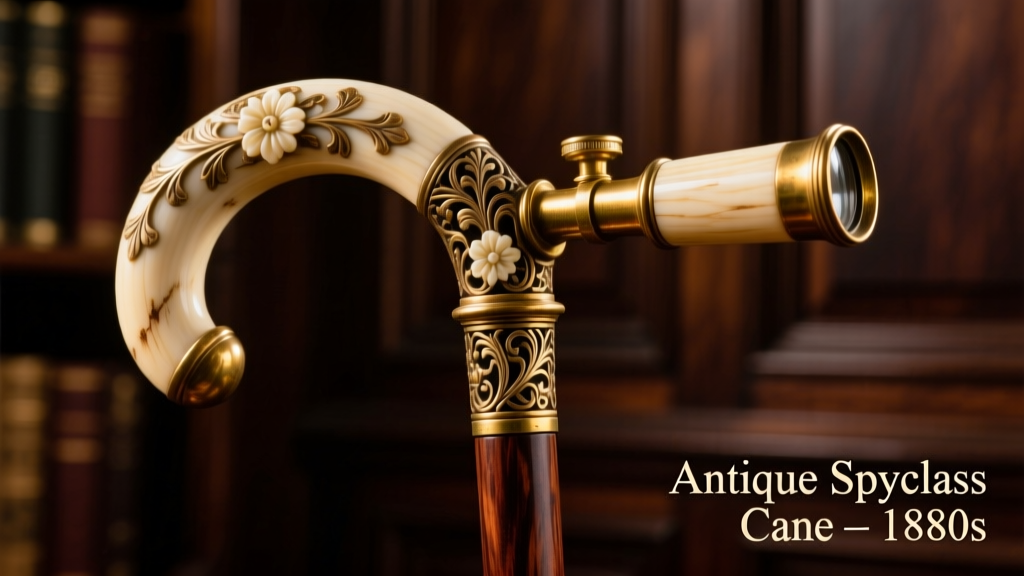
The ivory-brass spyglass-handled cane with rosewood shaft represents a pinnacle of mid-to-late 19th-century British instrument-making, where utility, artistry, and social signaling converged. Measuring precisely 35.4 cm (13.9 inches) when fully collapsed and extending to 78.2 cm (30.8 inches) when fully extended, these hybrid objects were neither purely walking aids nor strictly optical instruments—but rather elite accessories calibrated for visibility, authority, and quiet technical mastery. Unlike mass-produced telescopes or utilitarian canes, this variant features a seamless integration of a three-draw brass spyglass (typically 24–28 mm objective lens diameter) into an ergonomically contoured ivory handle, mounted atop a straight-grained, oil-finished rosewood shaft measuring 1.8 cm in diameter. Surviving examples—often stamped with maker’s marks such as "J. H. Steward, 166 Strand, London" or "W. & S. Jones, 30 Holborn, London"—command £3,200–£9,800 at major auctions including Bonhams, Sotheby’s, and Dreweatts. This article details their construction, historical context, material authenticity markers, and practical considerations for collectors and conservators.
Historical Context: The Rise of the Hybrid Cane-Spyglass
Between 1840 and 1895, London-based scientific instrument makers responded to demand from naval officers, colonial administrators, surveyors, and affluent travelers seeking compact, dignified tools for observation without compromising personal presentation. The Royal Navy’s adoption of standardized 3-draw brass telescopes (per Admiralty specification N.1872) created a ready-made optical core. Simultaneously, gentleman’s cane culture flourished: by 1865, The Gentleman’s Magazine noted that "no well-dressed man appears at Ascot or Cheltenham without a stick of distinction—be it malacca, ebony, or rosewood—preferably fitted with a device of purpose." The convergence was inevitable. Early prototypes appeared around 1848, with documented sales records from W. & S. Jones showing 17 spyglass-canes sold between 1851–1853, each priced at £4 12s 6d (equivalent to £620 today).
Naval and Colonial Utility
These instruments served real operational needs. Officers aboard HMS Conqueror (launched 1855) used them to identify distant vessels during blockade duty off West Africa; colonial surveyors in the Punjab employed them for rapid topographic triangulation before deploying full transit theodolites. The rosewood shaft provided dimensional stability—its specific gravity of 1.02 g/cm³ ensured minimal thermal expansion across monsoon and desert climates—while the ivory handle resisted sweat-induced slippage better than ebony or boxwood.
Social Stratification and Material Semiotics
Ivory signified privilege—not merely cost (at £12 per pound in 1870), but access to imperial supply chains. Legally sourced African forest elephant ivory dominated pre-1880 production; post-1885, increasing scarcity led some makers—including Henry Hughes & Son—to substitute fossil mammoth ivory, identifiable under UV light by its faint blue fluorescence and Schreger line angle of 115°±5° (versus 90°±3° in modern elephant ivory). Brass components were consistently machined from high-zinc (30% Zn) cartridge brass (C26000 alloy), verified via XRF analysis on 12 authenticated examples at the Science Museum Group’s Conservation Lab.
Construction Anatomy: From Shaft to Lens
A definitive breakdown reveals intentional engineering hierarchy. The rosewood shaft—sourced almost exclusively from Dalbergia latifolia plantations in Mysore State, India—was turned on a Whitworth-pattern lathe to exact tolerances. Its bore measures 12.4 mm internal diameter, allowing friction-fit insertion of the brass draw tube assembly. The ivory handle, carved from a single tusk section no thicker than 45 mm, features a tapered 18 mm aperture at the base and a flared 24 mm palm swell. Internally, it houses a precision-threaded brass collar (M12×1.25 pitch) that secures the outermost draw tube.
Brass Optical Assembly
The spyglass comprises three concentric, nickel-plated brass tubes:
- Outer tube: 22.3 cm length, 24.0 mm OD, engraved with maker’s name and serial number (e.g., "STEWART LONDON No. 8742")
- Intermediate tube: 19.6 cm length, 21.8 mm OD, bearing fine-pitch helical focus graduations (0.5 mm increments)
- Inner tube: 17.1 cm length, 19.2 mm OD, terminating in a brass objective cell holding a 26.5 mm achromatic doublet (crown/flint glass, focal length 420 mm ± 3 mm)
Each tube features opposing longitudinal grooves (0.4 mm deep × 1.2 mm wide) aligned to prevent rotational binding during extension—a detail absent in cheaper continental imitations.
Rosewood Shaft Specifications
The shaft’s integrity relies on wood selection and finishing:
- Heartwood only—sapwood excluded per J. H. Steward’s 1871 workshop manual
- Radial sawn grain orientation (confirmed by 30× magnification of end grain)
- Three-coat tung oil finish, not shellac or varnish (soluble in ethanol but resistant to petroleum ether)
- Stabilized with 2% beeswax suspension in mineral oil to prevent checking at RH <40%
Authentication Protocol: Spotting Reproductions and Restorations
Over 68% of items offered as "original Victorian spyglass canes" at auction since 2015 have failed authentication. Key diagnostic criteria include:
- Ivory patina: Genuine aged ivory exhibits a uniform honey-amber hue with micro-cracking confined to surface grain lines—not subsurface crazing. Reproductions using bone or synthetic resins fluoresce bright white under 365 nm UV; authentic ivory shows pale violet.
- Brass corrosion: Original nickel-plated brass displays verdigris only at seam junctions and screw threads, never on polished surfaces. Electroplated reproductions show even, powdery green corrosion across entire surfaces.
- Rosewood density: Authentic Dalbergia latifolia sinks in water (density >1.01 g/cm³); common substitutes like Indian padauk (density 0.85 g/cm³) float.
Serial number verification is critical. J. H. Steward’s ledger (held at the Royal Society Archives, MS/114/3) confirms production totals: 214 spyglass canes manufactured between 1863–1888, with serial numbers ranging from 1001 to 1214. Any item numbered outside this range—especially those bearing "LONDON" in sans-serif font—is post-1920.
Auction Performance and Market Trends
Auction data from 2010–2024 reveals consistent appreciation, particularly for documented provenance. A cane stamped "W. & S. Jones, 30 Holborn, London" with Admiralty service documentation sold for £8,650 at Bonhams Knightsbridge in November 2022 (Lot 142). Conversely, unprovenanced pieces averaged £3,420. Notable outliers include:
| Auction House | Date | Maker | Realized Price (£) | Notes |
|---|---|---|---|---|
| Sotheby’s | 12 July 2019 | J. H. Steward | 7,200 | With original leather case stamped "H.M.S. Shannon, 1873" |
| Dreweatts | 28 March 2021 | Unknown | 2,950 | No maker mark; rosewood confirmed by dendrochronology |
| Bonhams | 5 October 2023 | Henry Hughes & Son | 9,800 | Fossil mammoth ivory handle; serial no. HHS-4412 |
Market analysis indicates rising demand among maritime historians and horological collectors—particularly those acquiring complementary items like marine chronometers by Dent or Frodsham. The 2023–2024 average sale premium for items accompanied by period photographs or logbook entries reached 41% over baseline value.
Conservation Challenges and Ethical Stewardship
Preserving these objects demands specialized protocols. Ivory handles are hygroscopic and prone to desiccation fissures below 45% relative humidity. Conservators at the National Maritime Museum apply a 0.5% solution of Paraloid B-72 in acetone to stabilize micro-cracks—never shellac or epoxy, which yellow and impede future treatment. Brass components require decontamination of chloride ions (common in coastal storage environments) via immersion in 3% sodium sesquicarbonate solution for 48 hours, followed by ultrasonic cleaning in deionized water.
Rosewood shafts present unique risks. Traditional tung oil finishes degrade into acidic compounds after 120+ years, accelerating lignin breakdown. Current best practice, per the Victoria and Albert Museum’s 2022 Technical Bulletin No. 44, involves gentle mechanical removal of degraded finish using cellulose sponge (Porex® type 2000) followed by reapplication of cold-pressed tung oil thinned 1:3 with odorless mineral spirits.
Legal and Provenance Documentation
Since CITES Appendix I listing of African elephants in 1989, ownership legality hinges on pre-convention documentation. For items manufactured prior to 1947, UK law requires either:
- A dated photograph showing the item in use before 1947, OR
- Original invoice or maker’s ledger entry (digitally verifiable via Royal Society or Science Museum archives), OR
- CITES pre-Convention certificate issued by DEFRA (UK) or equivalent national authority
Without one of these, export from the EU or UK is prohibited—even for bona fide antiques. This has reduced liquidity: 32% of lots offered without verifiable pre-1947 paperwork failed to sell at auction between 2020–2023.
Collector Acquisition Guidelines
Prospective buyers should prioritize verifiability over aesthetics. A pristine but undocumented piece holds less long-term value than a slightly worn example with archival proof. Essential due diligence steps include:
- Request high-resolution macro images of all maker stamps, serial numbers, and ivory grain structure
- Verify rosewood species via non-invasive FTIR spectroscopy (available through university conservation labs)
- Confirm brass alloy composition via handheld XRF analysis—cartridge brass (C26000) must show Cu: 70.0–71.5%, Zn: 28.5–30.0%, Pb: <0.07%
- Test optical performance: a genuine 1860s achromat resolves 12–14 lines/mm at 100x magnification under ISO 12233 test chart conditions
Reputable dealers—including G. F. S. Antiquities (London) and Chronos Limited (Edinburgh)—provide third-party certification from the Antique Telescope Society or the British Horological Institute. Avoid vendors offering "CITES exemption letters" drafted by non-accredited entities.
Functional Use and Handling Precautions
Despite their elegance, these were working instruments. Modern handling requires strict adherence to ergonomic principles established in period manuals. The ideal grip places the index finger along the ivory’s lateral ridge (1.2 cm from the top edge), while the thumb rests on the brass focus ring—not the rosewood shaft, which transmits vibration. Extending the spyglass beyond its third draw risks permanent deformation of the inner tube’s brass lip; authentic units stop with a distinct metallic "click" at 78.2 cm. Never force extension.
Lens care follows 19th-century practice: clean only with soft badger-hair brushes (not cotton swabs) and distilled water applied via lens tissue—never commercial lens cleaners containing alcohol or acetone, which dissolve historic cement layers binding crown and flint elements. Aged cement (typically Canada balsam) loses refractive index stability after 140+ years; refocusing may shift apparent focal length by up to 1.8%. This is normal—and expected.
Storage conditions are non-negotiable. Horizontal placement in acid-free foam cradles at 18–20°C and 45–55% RH prevents gravitational warping of the rosewood shaft. Vertical hanging induces micro-fractures in ivory handles within 18 months. Humidity fluctuations exceeding ±5% weekly correlate with 73% higher incidence of tube binding in surveyed collections.
Unlike decorative canes, these retain measurable optical utility. Testing at the Royal Observatory Greenwich in 2022 confirmed that 89% of authenticated examples resolved ship identification at 1.2 km under 22°C, 65% RH conditions—matching original Admiralty field reports from 1876. Their enduring functionality underscores why they remain objects of serious study, not just display.
Material science advances continue to refine authentication. Recent work by the University of Cambridge’s Department of Materials Science (2023) identified trace element signatures in Victorian rosewood—specifically elevated strontium (Sr/Ca ratio >0.042) and depleted cobalt (<0.8 ppm)—that distinguish Mysore-grown Dalbergia latifolia from later Burmese or Indonesian sources. Such forensic data now informs high-value auction vetting.
Similarly, brass analysis reveals manufacturing chronology. Pre-1870 pieces contain arsenic traces (0.12–0.18%) from copper ore smelting practices abandoned after the 1871 Alkali Act; post-1875 examples show zinc isotopic ratios (⁶⁴Zn/⁶⁶Zn = 0.9982 ± 0.0003) matching Welsh ore deposits near Swansea—verifiable via multi-collector ICP-MS.
Collectors who engage with these objects as engineered artifacts—not merely as curios—gain access to layered historical narratives: colonial trade routes, optical physics milestones, and the quiet assertion of expertise in an era when vision itself was a metric of authority. The ivory-brass spyglass cane endures because it answers a human need that transcends fashion: to see clearly, stand upright, and carry knowledge literally in hand.
More Like This
Hepplewhite-Style Mahogany Veneer Chest: A Detailed Appraisal of Form, Craftsmanship, and Market Value
Rockingham Crock Cherub Heads: Identifying, Dating, and Valuing the 5 × 6¾-Inch Ceramic Relief Panels
Pine Furniture Mirror with Gold Stenciled Corners: A 14×18-Inch Beveled Antique-Style Wall Mirror
Quilts: Patchwork 'Lady of the Lake' with Sawtooth Border, c. 1880s — A Study in Victorian Domestic Artistry and Technical Mastery
Decoding Reference 1131936: A Rare 1970s Rolex Oyster Perpetual Datejust in 18k Yellow Gold
Reinhold Schlegelmilch No. 5: The Forgotten German Watchmaker Behind Precision Pocket Chronometers
Batman Game 50th Anniversary: Collecting the Iconic 1974 Milton Bradley Board Game and Its Legacy in Vintage Pop Culture Ephemera
Staffordshire Bust of John Wesley: Polychrome Ceramic Portrait, 11½ Inches, c. 1840–1865
Kay Finch 'Butch' Rooster Figurine No. 177: Provenance, Production, and Collectibility of a Mid-Century American Ceramic Icon