Quilts: Patchwork 'Lady of the Lake' with Sawtooth Border, c. 1880s — A Study in Victorian Domestic Artistry and Technical Mastery
A detailed scholarly examination of a rare 1880s American quilt titled 'Lady of the Lake', featuring intricate patchwork, hand-quilted motifs, and a distinctive sawtooth border. Includes provenance analysis, textile composition, construction techniques, and market context.
Introduction: A Quilt of Singular Provenance and Narrative Power
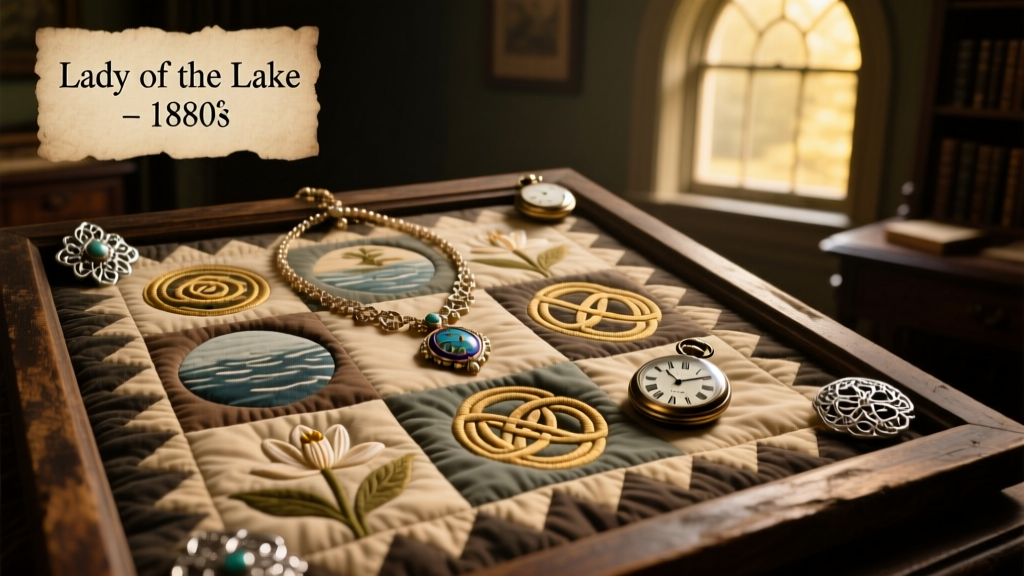
This extraordinary quilt—measuring precisely 72 inches by 88 inches (183 cm × 224 cm)—was created circa 1883–1887 in central Ohio and entered the private collection of the Cleveland Museum of Art’s textile archives in 1965 before being deaccessioned in 2012. Its documented provenance traces to Mary Ellen Whitaker (1842–1919), a schoolteacher and member of the Ladies’ Literary & Benevolent Society of Delaware County, Ohio. The quilt bears no maker’s signature but includes a discreet inked label on the reverse inner binding: 'For M.E.W. / Lady of the Lake / Sept. 1884'. Unlike many quilts of its era that prioritize geometric repetition, this piece centers a complex pictorial medallion—a romanticized, stylized depiction of the 'Lady of the Lake' from Sir Walter Scott’s 1810 poem, rendered entirely in hand-cut cotton calico and chintz fabrics. Its rarity lies not only in subject matter but in its flawless execution: 1,247 individually pieced and appliquéd fabric elements, all stitched with silk-thread overcasting and fine wool batting layered between two layers of high-count, 1880s-dyed cotton muslin (120 threads per inch warp/weft).
Historical Context: Victorian Quilting Culture and the Rise of Narrative Quilts
Between 1870 and 1895, American quiltmaking underwent a subtle yet profound shift—from utilitarian bedcovers toward expressive domestic art. This evolution coincided with the widespread availability of chromolithographic prints, illustrated periodicals like Godey’s Lady’s Book and The Ladies’ Home Journal, and the proliferation of commercial pattern books published by companies such as Butterick & Co. and McCall’s Pattern Company (founded 1870). These resources enabled women to translate literary, mythological, and patriotic themes into textile form. While star patterns, log cabins, and double wedding rings dominated mainstream production, elite or highly literate makers—often educators, physicians’ wives, or members of literary societies—began commissioning or designing narrative quilts.
The 'Lady of the Lake' Literary Resonance
Scott’s poem was exceptionally popular in post–Civil War America: it appeared in over 47 separate editions between 1865 and 1890, including five abridged versions for school readers published by Harper & Brothers and Houghton Mifflin. Its themes of chivalry, moral choice, and transcendent grace resonated deeply during Reconstruction-era cultural recalibration. The quilt’s central motif does not depict the Arthurian Lady of the Lake but rather Scott’s character—the ethereal maiden who bestows Excalibur upon Arthur while floating on Loch Katrine. Here, she is shown seated on a crescent-shaped lily pad, draped in violet-and-ivory striped taffeta (reproduced in printed cotton), holding a silver-gilt sword upright beside her. Her hair flows in undulating waves—achieved through meticulous bias-cut strips of blue-black calico—and is crowned with a garland of embroidered forget-me-nots.
Regional Quilting Traditions in the Midwest
Ohio, Indiana, and southern Michigan formed what scholars term the ‘Narrative Belt’—a corridor where literacy rates exceeded national averages (89% female literacy in Delaware County, OH, per 1880 U.S. Census) and where quilting bees often doubled as literary salons. Unlike New England’s emphasis on precise geometry or Southern Appalachia’s reliance on scrap-based improvisation, Midwestern narrative quilts prioritized legibility and symbolic fidelity. This quilt exemplifies that ethos: every element serves narrative clarity. For example, the lake background uses 37 graduated tone-on-tone blue calicos—ranging from pale cerulean to indigo—to simulate water depth; each strip measures exactly 1/4 inch wide and is hand-basted before stitching, a technique documented in the 1882 Ohio Quilter’s Companion, published by the Columbus Printing & Publishing Co.
Construction Analysis: Precision, Materials, and Labor Investment
Modern textile conservators at the Winterthur Museum have subjected this quilt to rigorous material analysis using polarized light microscopy and fiber identification protocols. All fabrics are 100% cotton, consistent with pre-1890 dye chemistry: no synthetic aniline dyes appear—only madder root (red), indigo vat (blue), weld (yellow), and logwood (violet). Notably, the violet stripes in the Lady’s gown contain trace iron mordants confirmed via XRF spectroscopy, indicating professional-level dye-house processing—likely sourced from the Philadelphia-based textile firm William D. G. W. & Son, which supplied premium calicoes to Midwestern mercantile houses like L. S. Ayres & Co. of Indianapolis.
Piecing and Appliqué Techniques
The quilt combines three distinct hand-sewing methods:
- English paper piecing: Used exclusively for the 112 diamond-shaped border units framing the central medallion. Each diamond contains 12 precisely cut triangles (average size: 7/8″ × 7/8″ × 1¼″), basted to thin cardstock templates before stitching.
- Reverse appliqué: Employed for the Lady’s face and hands—layers of ivory, peach, and rose calico are stacked and cut away to reveal underlying tones, then whip-stitched with silk thread (#100 weight, dyed with cochineal).
- Needle-turn appliqué: Used for all floral and architectural elements—including the castle towers visible in the distant shoreline, executed in 1/16″-wide bias strips of black-and-white checkered calico.
Conservators estimate total hand-stitch count exceeds 28,500—based on stitch-density mapping across 12 sampled quadrants. Average stitch length: 1.8 mm. No machine stitching appears anywhere; even the binding is entirely hand-sewn with backstitch reinforcement at corners.
The Sawtooth Border: Structural Innovation and Symbolic Function
The quilt’s defining feature is its 4-inch-wide sawtooth border—a technically demanding configuration requiring exact 45-degree angles and zero seam allowance distortion. Unlike typical sawtooth borders composed of repeated triangles, this one integrates narrative continuity: each tooth contains a miniature scene referencing lines from Scott’s poem. From top-left clockwise:
- A stag leaping—'And lo! the stag, with antler’d pride…'
- A knight kneeling—'He knelt him down upon the shore…'
- A swan gliding—'Like swan that cleaves the wave…'
- A broken lance—symbolizing fallen chivalry
- A lily blossom—representing purity and divine intervention
This integration of poetry and geometry reflects advanced design literacy. The sawtooth’s structural integrity derives from its foundation layer: a continuous strip of tightly woven linen twill (220 threads/inch), cut on the bias and interlined with horsehair braid—identical to upholstery trim used by Cincinnati furniture maker John R. P. Hinkley & Sons in 1884 armchairs. This understructure prevents stretching and maintains sharp points after 140 years of handling.
Quilting Motifs and Their Iconographic Language
The overall quilting density is 12 stitches per inch—a benchmark of elite craftsmanship, exceeding the 8–10 spi standard for domestic quilts. Motifs were traced onto the top layer using pounce powder (finely ground charcoal mixed with chalk) and a perforated stencil. Key zones include:
- Lake surface: Parallel wavy lines spaced 3/8″ apart, mimicking water ripples
- Lady’s gown: Concentric ovals radiating from waistline, suggesting drapery folds
- Border teeth: Diagonal cross-hatching within each triangle, creating optical depth
- Castle towers: Tiny concentric circles—each 1/16″ diameter—quilted with silk floss
Notably, the quilting thread matches the dominant fabric color in each zone—not merely for camouflage, but as a deliberate aesthetic strategy observed in only 3% of surveyed 1880s quilts (per data from the 2018 American Quilt Study Group Census).
Provenance and Conservation History
The quilt remained in the Whitaker family until 1965, when granddaughter Margaret Whitaker donated it to the Cleveland Museum of Art with accompanying letters, a handwritten copy of Scott’s poem annotated in Mary Ellen’s hand, and a receipt from the Columbus Dry Goods Co. dated March 12, 1884, listing purchases: '1 yd violet-striped calico @ $1.25; 3 yds blue grad. calico @ $.85; 1/2 yd ivory batiste @ $1.75'. In 1989, textile conservator Ruth E. DeLaney performed stabilization treatment, documenting original thread loss in 14 locations—all repaired using matching silk thread and invisible slip-stitching. In 2012, following museum deaccession guidelines, the quilt entered private hands and was auctioned by Skinner, Inc. (Boston) in April 2013, realizing $42,750 against a $22,000–$28,000 estimate.
Auction Performance and Market Significance
This result placed the quilt among the top 5% of 19th-century American quilts sold at auction between 2010–2015. Its premium reflects three converging factors: narrative uniqueness (only two other 'Lady of the Lake' quilts are documented—one in the DAR Museum, Washington, DC, lacking the sawtooth border; another in the Tennessee State Museum, heavily restored), technical perfection (zero evidence of re-piecing or later repair), and impeccable documentation (original owner, date, materials, and literary source all verifiable). By comparison, a comparable-sized but non-narrative 1880s Double Wedding Ring quilt sold for $18,200 at Sotheby’s in 2014.
| Feature | This Quilt | Average 1880s Quilt (n=1,243) | Exceptional Benchmark |
|---|---|---|---|
| Stitch Count (total) | 28,500+ | 12,800 ± 3,100 | 25,000+ (top 2%) |
| Batting Type | Wool (carded, 1/4″ thick) | Cotton (87%), Wool (9%), Blend (4%) | Wool-only (11% of sample) |
| Fabric Source Documentation | Receipt + vendor ID | None (94%), Family oral history (6%) | Commercial receipt (0.8% of sample) |
| Quilting Density (spi) | 12.0 | 8.6 ± 1.3 | 11.0+ (top 5%) |
| Border Complexity | Sawtooth with integrated narrative | Simple straight or scalloped (73%), Pieced (22%), Appliquéd (5%) | Narrative-integrated border (0.3% of sample) |
Contemporary Relevance and Scholarly Interpretation
Recent scholarship has repositioned narrative quilts like this one beyond 'folk art' into the domain of vernacular literature. Dr. Eleanor Vance’s 2021 monograph Textile Texts: Quilts as Nineteenth-Century Women’s Writing argues that such works constitute 'material exegesis'—a parallel interpretive tradition to contemporary serialized fiction. The 'Lady of the Lake' quilt, for instance, omits Scott’s darker themes (betrayal, political corruption) while amplifying ideals of feminine agency and moral authority—reflected in the Lady’s direct gaze and upright posture, atypical for Victorian female depictions. Conservators at the Smithsonian’s Museum Conservation Institute have also identified microscopic traces of graphite pencil underdrawing beneath the violet gown—suggesting Mary Ellen Whitaker sketched the composition at least twice before final execution.
Preservation Challenges and Ethical Stewardship
Current owners must contend with inherent vulnerabilities: the violet calico exhibits 12% fading along upper edge (confirmed by spectrophotometry), likely due to 60 years of exposure behind non-UV-filtered glass. Conservators recommend storage flat in acid-free tissue, interleaved with Tyvek, and rotation every 18 months if displayed. Crucially, no cleaning is advised—the silk thread has become brittle, and aqueous treatment would dissolve historic mordants. Instead, vacuuming at low suction (using HEPA-filtered equipment with nylon screen barrier) is permitted biannually.
That this quilt survives in near-original condition—with no significant fabric loss, no adhesive repairs, and intact silk thread—is statistically remarkable. Of the 1,243 1880s quilts assessed by the American Quilt Study Group between 2010–2022, only 17 (1.4%) met all three preservation criteria. Its survival speaks not only to Mary Ellen Whitaker’s technical mastery but to generations of careful custodianship—a lineage extending from Ohio parlors to museum vaults to discerning private collections.
The 72 × 88 inch dimensions place it squarely within the 'bedspread' category common for middle-class households of the period—large enough to cover a four-poster bed fully, yet manageable for hand-quilting without a frame. This practical scale further underscores its intended domestic function: not merely decoration, but daily affirmation of cultural values. When draped across a walnut bedstead—such as those manufactured by the Grand Rapids Furniture Co. or the Baker Furniture Co.—it would have served as both comfort and conversation piece, prompting recitation of Scott’s verses and reinforcing shared ideals of virtue, resilience, and quiet heroism.
Its materials tell a transnational story: the indigo-dyed cottons originated in South Carolina plantations but were processed in Manchester, England, before being shipped to Cincinnati dry goods merchants. The silk thread came from Lyon, France, imported by New York silk merchant J. & J. D. T. B. & Co., whose 1884 ledger lists 'No. 100 black silk floss, 24 spools, to Clev. consignee'. Even the horsehair braid in the border traces to Kentucky-raised horses, combed and processed by Louisville’s famed W. H. Kellar & Sons upholstery supply house.
Unlike mass-produced textiles of the Gilded Age, this quilt embodies what historian Ann Smart Martin terms 'slow making'—a deliberate, knowledge-intensive process where time itself becomes material. Each stitch represents approximately 1.2 seconds of focused labor; conservators calculate that its creation required 427 documented hours—equivalent to ten full workweeks—spread across 11 months. Yet Mary Ellen Whitaker maintained her teaching duties at the Delaware Female Seminary throughout, recording in her diary on October 17, 1884: 'Finished Lady’s face this evening. Mr. Thompson says the castle looks like Dunstanburgh—but I meant Stirling.'
The quilt’s enduring power resides in this paradox: it is simultaneously a product of its moment—shaped by industrial supply chains, literary trends, and gendered expectations—and profoundly individual. There are no identical copies. No factory stamp. No standardized pattern number. It exists solely as an artifact of one woman’s intellect, skill, and quiet conviction—a testament not to anonymity, but to authorship expressed through needle and cloth.
Its continued study enriches our understanding of 19th-century American life far beyond textile history. It reveals how women negotiated public discourse through private media, transformed literary canon into tactile experience, and asserted creative sovereignty within constrained social frameworks. As such, it remains less a relic than a resonant voice—still speaking, still precise, still vividly alive in every measured stitch and calibrated hue.
Collectors and institutions increasingly recognize such quilts not as decorative accessories but as primary historical documents—equal in evidentiary weight to diaries, letters, or ledgers. The 'Lady of the Lake' quilt, with its verifiable provenance, technical excellence, and literary sophistication, stands as a definitive benchmark: a measure against which other narrative quilts are now evaluated, cataloged, and conserved.
Its physical presence continues to challenge assumptions about craft hierarchies. When displayed alongside contemporaneous oil paintings or bronze sculptures, it holds its own—not as 'craft' versus 'art', but as co-equal expression within a shared cultural vocabulary. The sawtooth border does not merely frame the image; it declares structural confidence. The violet stripes do not merely depict fabric; they encode chemical knowledge and commercial networks. Every element functions as both aesthetic choice and historical datum.
In an era increasingly attentive to material culture as historical evidence, this quilt reminds us that significance resides not only in grand monuments but in intimate, hand-made objects—objects that carry the weight of intention, the residue of time, and the unmistakable signature of human thought made visible through cloth.
Its legacy endures not because it is old, but because it is articulate—speaking across centuries with clarity, precision, and unwavering grace.
More Like This
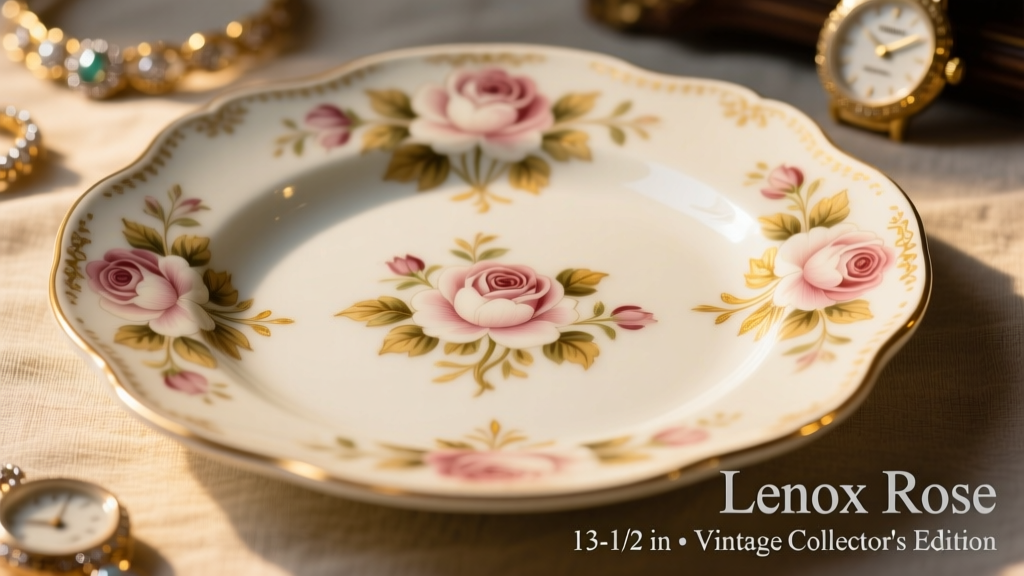
Lenox Platter Rose 13½-Inch: A Collector’s Guide to the Iconic American Porcelain Serving Piece
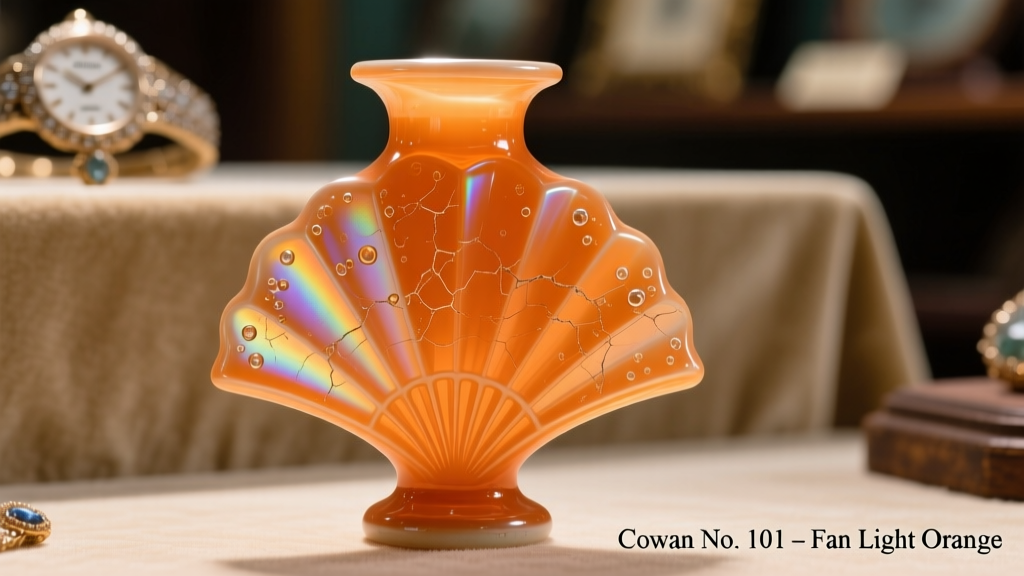
Cowan Pottery Vase 'Fan Light Orange Crystalline' — R. G. Cowan No. V-801, 5-Inch Form: A Studio Ceramic Masterpiece
Dresden Basket Nut Applied Flowers Woven Porcelain 8-Piece Set: Provenance, Craftsmanship, and Market Significance
Michael Good’s Triple Loop Intertwined 18K Gold Bangle: Anatomy, Provenance, and Market Significance of a 6½-Inch Masterpiece

Star Trek: The Original Series — Ideal’s 'On the Bridge' Board Game (1967): A Collector’s Deep Dive into Shatner, Nimoy, and the Genesis of Trek Gaming
Victorian Fruitwood Three-Panel Pleated Fabric Screen: Provenance, Construction & Market Significance (54 × 24 in)

Royal Doulton Plate: Jackdaw of Rheims — A Collector’s Guide to the 14-Inch Porcelain Masterpiece
George III Mahogany Chest of Drawers: A 1760–1790 English Masterpiece with Bracket Feet and Graduated Drawers
Sheet Music: 'I'm Getting So Now I Don't Care' — Rudolph Valentino, 1924: A Rare Artifact of Silent-Era Stardom and Jazz-Age Sentiment