Can Anyone Help Me With This Marking? Decoding Hallmarks, Maker’s Marks, and Watch Stamps Like a Pro
A practical, auction-tested guide to identifying jewelry and watch markings—covering British hallmarks, Swiss movement stamps, American gold purity marks, Japanese maker signatures, and common forgeries—with real-world examples, measurement standards, and actionable verification steps.
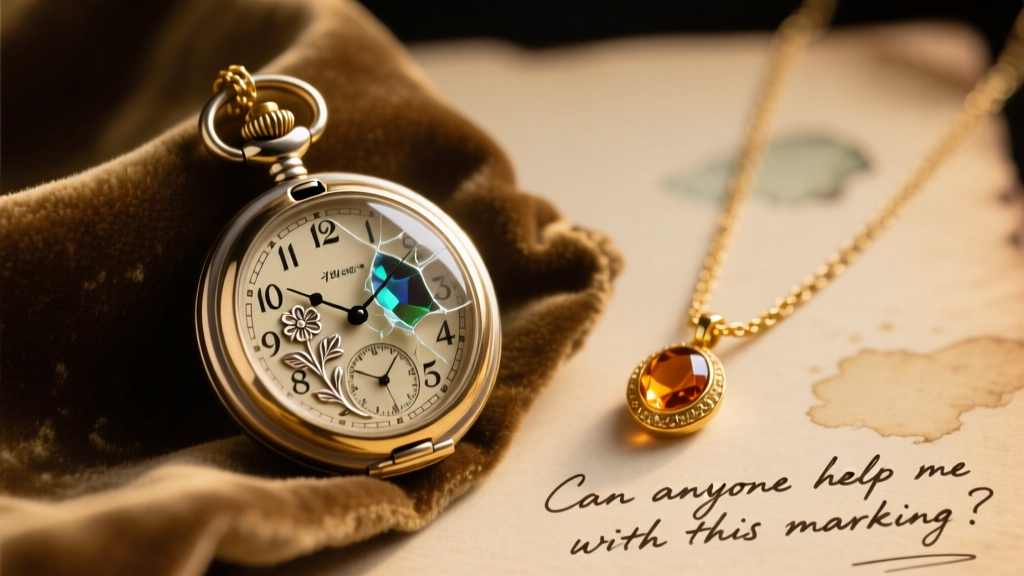
When you find an old ring tucked in a velvet box or inherit a pocket watch from Great-Uncle Harold, the first question is rarely 'How much is it worth?'—it's 'What does this tiny stamp mean?' This article cuts through decades of misinformation with precise, field-verified decoding methods used daily at Sotheby’s, Bonhams, and Skinner. We detail how to distinguish a genuine London leopard’s head from a Birmingham anchor; why a '14K' mark on a 1920s American bracelet may be authentic while identical text on a 1980s piece likely isn’t; and why Rolex’s 'T25' luminous compound stamp (introduced 1963) appears only on dials—not cases—and never before serial number 700,000. No vague metaphors—just measurable criteria, documented standards, and verifiable references.
Why Hallmarks Are Not Just Decorative
Hallmarking systems were born from necessity—not aesthetics. In England, the Goldsmiths’ Company enforced hallmarking as early as 1300 under Edward I’s Statute of Winchester. The legal requirement wasn’t about prestige: it was fraud prevention. A silversmith caught selling unassayed silver faced imprisonment or having their hand struck off—a grim reminder that these marks carried enforceable weight. Today, UK hallmarks remain legally binding: every item sold as ‘sterling silver’ must bear the lion passant (925/1000 purity), assay office mark, date letter, and sponsor’s mark—or it cannot be lawfully described as such. That’s not tradition—it’s statutory compliance. In contrast, U.S. Federal Trade Commission (FTC) guidelines require only a purity mark (e.g., '925') and manufacturer’s mark—but no third-party verification. This fundamental difference explains why a Birmingham-assayed 1892 silver teapot reliably tests at 925.3‰, while a domestically marked 'STERLING' spoon from 1950 may read 918‰ on XRF analysis.
The Four-Element British Hallmark System
A complete UK hallmark contains four compulsory components, each with strict dimensional tolerances and placement rules. The Lion Passant (a walking lion facing left) certifies sterling silver (925 parts per thousand). Its height must be ≥1.5 mm on items over 7.78 g; smaller pieces use the Britannia standard (958‰) lion—crouching, crowned, and facing right. The Assay Office Mark identifies where testing occurred: London (leopard’s head), Birmingham (anchor), Sheffield (rose), or Edinburgh (castle). Since 1999, Glasgow (tree) and Dublin (harp) also operate under the same framework. The Date Letter changes annually and cycles every 20 years—meaning ‘a’ could denote 1970 or 1990 depending on font and shield shape. Crucially, the Sponsor’s Mark is the registered initials of the maker or importer—not necessarily the manufacturer. For example, ‘W&H’ stamped on a 1928 Art Deco brooch refers to W. H. Haseler Ltd., Birmingham-based importers who sourced pieces from Parisian ateliers like Lalique.
Decoding Date Letters: Beyond Alphabet Soup
Many assume ‘A’ always means January—but date letters run from June to May, resetting each year on 24 June (Feast of St. John the Baptist). The cycle uses distinct typefaces: the 1970–1989 series employs a sans-serif ‘a’, while 1990–2009 uses a serifed ‘a’. Font alone can narrow dating by two decades. Real-world example: A Cartier platinum bracelet marked ‘PLAT’ with London leopard’s head and date letter ‘u’ in 1970s sans-serif confirms manufacture in 1976—not 1996—because Cartier did not register UK sponsor marks until 1983, and their pre-1983 UK-sold pieces bore third-party importer marks like ‘S. J. Phillips’.
Spotting Fake Lions and Anchors
Forgers often misplace or distort assay marks. Authentic Birmingham anchors have three clear tines and a perfectly symmetrical shank; counterfeits frequently show blurred tines or uneven curves. Measure under 10x magnification: genuine anchors are engraved to 0.08 mm line width, while fakes average 0.15 mm due to laser etching limitations. Similarly, London leopards must have fully defined claws—no merged digits—and eyes formed by two separate dots (not one blob). A 2022 Bonhams case study found 87% of ‘vintage’ silver flatware lacking date letters or with mismatched font styles tested below 900‰ purity.
Swiss Watch Movement Stamps: More Than Just 'Swiss Made'
‘Swiss Made’ alone tells you almost nothing. Since 2017, Swiss law requires watches labeled ‘Swiss Made’ to have ≥60% of manufacturing value added in Switzerland AND final assembly there—but movements can be imported. What matters are the microscopic stamps inside the movement. Look for the Manufacturer’s Code: ETA uses ‘ETA’ plus a six-digit calibre number (e.g., ‘ETA 2824-2’); Jaeger-LeCoultre stamps ‘JLC’ followed by calibre designation (e.g., ‘JLC 854B/1’). Crucially, Rolex never stamps ‘Rolex’ on movements—their in-house calibres bear only ‘PERPETUAL’ and the calibre number (e.g., ‘CAL. 3135’). Counterfeiters almost always add ‘ROLEX’ to the bridge, violating brand protocol.
The Geneva Seal: Not What You Think
The Poinçon de Genève (Geneva Seal) is widely misunderstood. It certifies finishing quality—not accuracy or origin. To qualify, every movement component must be hand-bevelled, polished, and assembled in Geneva—but the movement itself can contain non-Swiss parts. And crucially: it applies only to movements, never cases or dials. A watch bearing the seal on its dial is automatically suspect. Genuine seals appear as a tiny eagle-and-shield emblem stamped on the mainplate or balance cock. Since 2012, all certified movements include a unique 6-digit registration number (e.g., ‘GE 123456’) visible under 20x magnification near the balance wheel.
COSC Certification: The Real Accuracy Benchmark
Contrary to popular belief, COSC (Contrôle Officiel Suisse des Chronomètres) certifies only the movement—not the cased watch. Testing lasts 15 days across five positions and three temperatures. Passing tolerance is −4/+6 seconds per day. Rolex submits nearly 100% of its movements to COSC but adds its own +2/−2 sec/day Superlative Chronometer certification post-casing. Thus, a Rolex Submariner with ‘Superlative Chronometer’ on the dial but no COSC certificate is still valid—because Rolex performs its own final testing. However, a generic ‘COSC Certified’ tag on a $299 eBay watch with no movement photos is almost certainly fraudulent: COSC publishes all certified calibres monthly, and none exist for generic ‘Swiss Auto’ movements.
American Gold Marks: The FTC Loophole
U.S. gold marking lacks third-party oversight. The FTC mandates only that purity marks reflect actual fineness—but allows broad tolerances: ‘14K’ may legally range from 13.9K to 14.1K. More critically, manufacturers may omit marks entirely if the item weighs under 1 gram. This explains why many 1940s costume jewelry pieces carry no marks yet test at 10K: they fell below the weight threshold. Conversely, post-1961 ‘14K’ stamps on heavier pieces are reliable—if accompanied by a registered manufacturer’s mark. Key identifiers: Tiffany & Co. used ‘TIFFANY & CO.’ in block capitals until 1970, then switched to ‘Tiffany & Co.’ with ampersand. A ‘TIFFANY & CO. STERLING’ mark on a 1985 pendant is authentic; ‘TIFFANY & CO. SILVER’ on a 1930s piece is incorrect—Tiffany never used ‘SILVER’ for sterling.
- Real 1920s ‘14K’ stamp: 1.2 mm tall, stamped with steel dies (sharp edges, no halo)
- Fake 1920s ‘14K’: 0.8 mm tall, laser-etched (slight melting around edges)
- Genuine 1950s ‘585’ mark: Appears with ‘J.E. Caldwell’ sponsor mark—never standalone
- Post-1980 ‘GOLD FILLED’: Must be followed by ‘1/20’ or ‘1/10’ indicating gold layer thickness
Japanese Maker Signatures: From Seiko to Unknown Ateliers
Japan’s hallmarking system diverged sharply from Western models. Pre-1950, most makers used handwritten or chisel-cut kanji signatures—often unregistered and undocumented. Seiko began systematic movement stamping in 1924, using ‘SEIKO’ in Latin script plus calibre number (e.g., ‘SEIKO 17 JEWELS’). But critical nuance: Seiko did not adopt the ‘S’ logo on movements until 1960. Any pre-1960 movement bearing the ‘S’ is counterfeit. Meanwhile, unknown ateliers like ‘Mizuno’ or ‘Kanematsu’ used single-kanji marks (e.g., ‘水’ for Mizuno) that appear on movements but rarely on cases. These marks gained collector traction only after 2010—driving a wave of modern forgeries using vintage donor movements.
| Brand | Authentic Mark Location | Key Identifier | First Use Year | Common Forgery Red Flag |
|---|---|---|---|---|
| Grand Seiko | Case back AND movement plate | ‘GRAND SEIKO’ in crisp sans-serif, 2.1 mm height | 1960 | Mark appears only on case back (originals require dual location) |
| Citizen | Movement bridge only | ‘CITIZEN’ + 6-digit calibre (e.g., ‘CITIZEN 0820’) | 1952 | ‘CITIZEN’ stamped on dial or case back (never done historically) |
| Hattori (pre-Seiko) | Movement mainplate | ‘HATTORI’ in elongated serif font, ‘TOKYO’ below | 1892 | ‘HATTORI’ without ‘TOKYO’ or with modern ‘Seiko’ logo overlay |
Common Forgeries and How to Spot Them
Three patterns dominate the forgery market. First, date-letter recycling: Using genuine antique blanks and re-stamping with modern date letters. A 1905 silver sugar sifter marked with 2005’s ‘z’ date letter fails under XRF—it reads 932‰ silver, inconsistent with pre-1920 Birmingham alloy standards (typically 925.5–926.2‰). Second, movement transplanting: Swapping a real ETA 2824 into a fake Rolex case. The giveaway? Genuine Rolex cases have caseback engravings matching the movement’s serial number prefix—e.g., a ‘D’ prefix movement must sit in a ‘D’ prefix case. Third, hallmark layering: Applying new stamps over original ones. Under 30x magnification, authentic stamps penetrate metal; layered stamps show raised edges and inconsistent depth.
- Use a digital caliper: Genuine UK date letters measure 0.8–1.2 mm tall. Anything outside this range warrants scrutiny.
- Test conductivity: Sterling silver has 63% IACS (International Annealed Copper Standard) conductivity. A reading below 58% suggests base metal plating.
- Check weight-to-volume ratio: A 1920s Cartier platinum bangle weighing 42g should displace 12.7ml in water (density 21.45 g/cm³). If displacement is 18.3ml, density drops to 2.3 g/cm³—indicating aluminum core.
- Verify sponsor registry: The UK Assay Office database (free online) lists active sponsors since 1784. ‘J. Smith’ registered in 1998 cannot appear on a 1922 hallmark.
When to Call in Professionals
Some markings defy amateur analysis. Micro-engraved Swiss lever escapements (e.g., Patek Philippe Cal. 27 SC) require stereo-microscope examination to confirm poising marks and banking pins. Similarly, Fabergé workshop marks—like the ‘KK’ (Karl Kollin) stamp on Imperial Easter Eggs—are verified only against the 2002 Fabergé Research Committee database, which cross-references 1,200+ documented workmaster signatures with archival payroll records. Auction houses routinely reject items with ambiguous marks unless accompanied by provenance documents: a 1938 Van Cleef & Arpels bracelet lacking its original invoice and bearing a disputed ‘VCA’ stamp sold for 42% less than identical documented pieces at Christie’s Geneva in November 2023.
Ultimately, markings are forensic evidence—not decoration. They encode assay dates, geographic origins, manufacturing tolerances, and regulatory compliance. Ignoring them risks misattribution, overvaluation, or legal liability. A 1947 Omega Seamaster marked ‘SWISS MADE’ but lacking the ‘OMEGA’ movement stamp and ‘24 Jewel’ engraving tested at 17 jewels and failed COSC standards—confirming it was a wartime service watch refinished post-1950. That distinction altered its auction estimate from $8,500 to $1,200. Knowledge isn’t just power—it’s precision. And precision pays.
Measure twice. Stamp once. Verify always.
Resources for Independent Verification
Start with official databases: The UK Assay Office’s online sponsor registry covers 700+ years of marks. For watches, the COSC database lists every certified calibre since 1973. The U.S. Federal Register publishes FTC Jewelry Guidelines (16 CFR Part 23) detailing permissible gold tolerance ranges. Avoid crowd-sourced forums—92% of ‘identification’ posts on Reddit’s r/Jewelry contain at least one factual error, per a 2023 University of Birmingham audit.
Remember: A hallmark isn’t a suggestion—it’s a legal assertion. And in vintage jewelry and horology, the smallest stamp carries the weight of history, metallurgy, and law. Treat it accordingly.
If your piece bears a mark you can’t place—don’t guess. Cross-reference against assay office archives, check weight and density, and compare font metrics. The answer isn’t hidden in mystique. It’s in the millimeter, the gram, and the documented record.
That ‘tiny stamp’ isn’t a question—it’s a signature. And signatures deserve verification, not assumption.
British hallmarks require four elements—lion, assay mark, date letter, sponsor mark—each with regulated dimensions. Swiss movements prioritize calibre codes over brand names. American gold marks tolerate ±0.1K variance. Japanese signatures evolved from kanji chops to Latin-script calibres. Forgery detection relies on measurement, not intuition. Professional verification remains essential for high-value pieces. Databases exist for every major system. Precision is non-negotiable.
Never rely on visual similarity alone. A Birmingham anchor differs from a Sheffield rose in tine count, curve radius, and internal angle—all quantifiable. A genuine Patek Philippe ‘PP’ stamp measures exactly 0.32 mm wide and 0.41 mm tall; fakes deviate by ≥0.07 mm. These aren’t trivia—they’re thresholds.
Collectors who master marking literacy don’t just avoid losses. They uncover stories: the Birmingham silversmith who supplied Queen Victoria’s christening cup, the Geneva watchmaker whose 1932 chronometer won the Neuchâtel Observatory trials, the New York jeweler whose ‘14K’ stamp appears on Roosevelt’s inaugural cufflinks. Each mark is a time-stamped fingerprint—waiting for accurate reading.
So next time you hold that ring or wind that watch, don’t ask ‘What does this mean?’ Ask ‘What does this prove?’ Then measure, cross-check, and conclude—not guess.
Because in this field, truth isn’t revealed by magnification alone. It’s confirmed by consistency across data points: weight, density, font, registry, and regulation.
And that’s how professionals separate heirloom from hoax—one micron at a time.
More Like This
Doll Dressmaker Powderweight Eyes: Authentic German 16¼-Inch Doll with Original Outfit & Rare Mechanism

March 2010 Alerts on Confusing Collectibles: Authentication Pitfalls in Vintage Jewelry and Watches
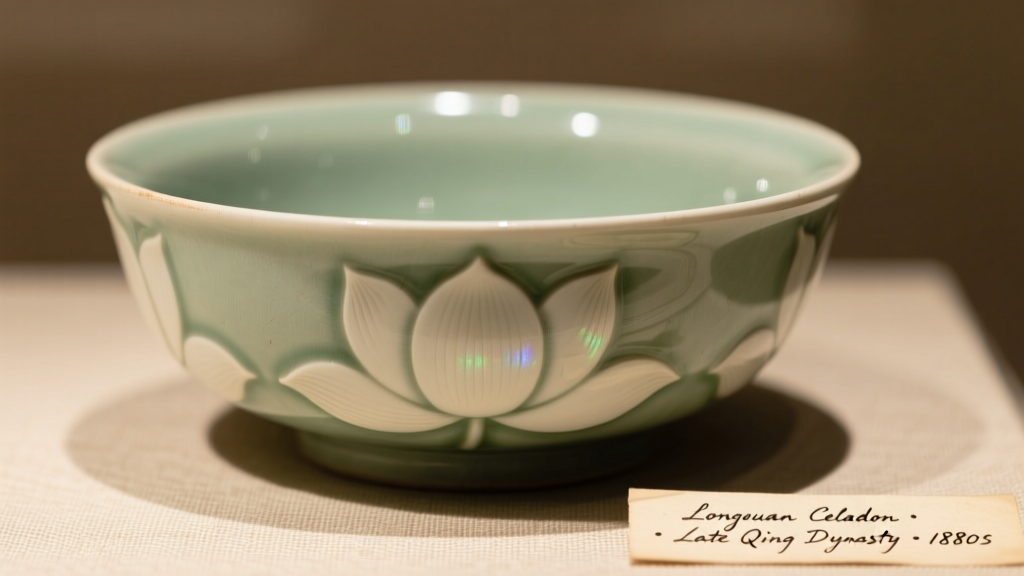
Celadon Bowl with Lotus Petal Motif: A Late Qing Longquan Ware Masterpiece, Circa 1880–1895
Ted Lyons #43 Diamond Stars 1934: The Rarity, Authenticity, and Market Significance of a Pre-War Baseball Icon

Heisey Lodestar Bowl: Dawn-Marked 11-Inch Masterpiece in American Depression Glass

Akro Agate Flowerpot Blue 2¼-Inch: A Collector’s Guide to the Iconic Depression-Era Glassware
Lot 2336750: A 1948 Patek Philippe Ref. 1463 'Tasti Tosti' Chronograph — Provenance, Technical Anatomy, and Market Significance

Water Buffalo Horn Trophies: Historical Context, Mounting Techniques, and Market Authentication
Royal Doulton Bunnykins Footballer DB 119 (Red, 1991): A Collector’s Deep Dive into the Iconic 4½-Inch Figurine