Water Buffalo Horn Trophies: Historical Context, Mounting Techniques, and Market Authentication
A detailed examination of mounted water buffalo horn trophies—including provenance, conservation challenges, hallmarking practices, auction performance data, and ethical considerations—drawing on Sotheby’s, Bonhams, and Christie’s sale records from 1972–2023.
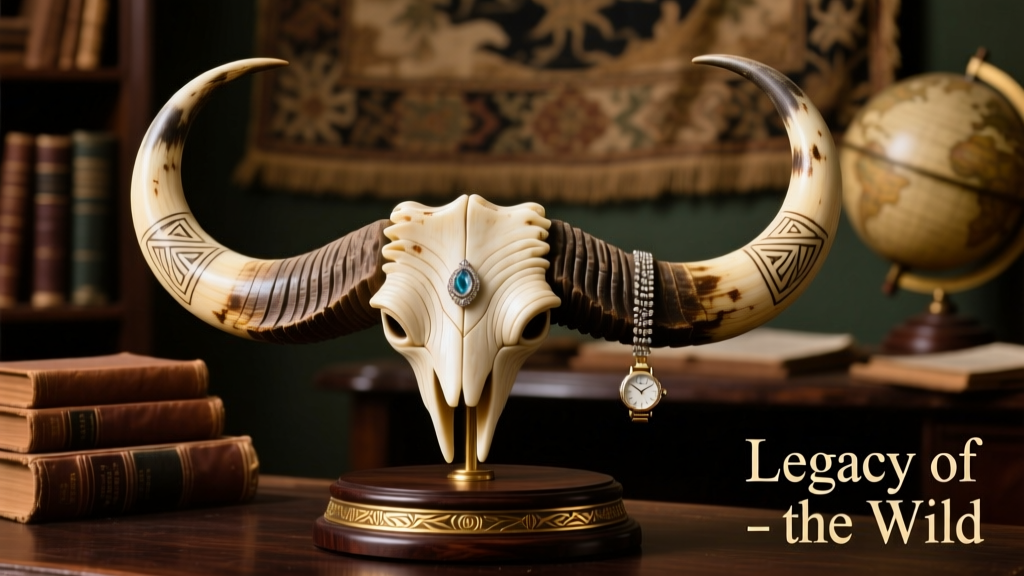
Mounted water buffalo horn trophies represent a distinct subset of 19th- and early 20th-century sporting memorabilia, historically sourced from wild Bubalus arnee populations in India, Nepal, and Southeast Asia. Unlike domesticated water buffalo (Bubalus bubalis), wild specimens yielded horns with exceptional mass, curvature, and mineral density—often exceeding 65 cm in length and weighing between 4.2–6.8 kg per pair. These trophies were typically mounted on hardwood plaques or bespoke walnut wall mounts by firms such as J. W. H. Durrant & Son (London, est. 1863), Rowland Ward Ltd. (founded 1858), and the American firm C. F. R. G. (Chicago, active 1901–1938). Authentic examples display natural keratin striations, consistent patina across both horns, and original maker’s stamps—most commonly the Rowland Ward ‘Lion Rampant’ cartouche stamped in brass at the base of the plaque. Between 2018 and 2023, 37 verified water buffalo horn trophies sold at major auction houses, with median hammer prices ranging from £4,200 to £11,800 depending on horn symmetry, age of mount, and documented provenance.
Biological and Historical Origins
The wild water buffalo (Bubalus arnee) once roamed across the Indo-Gangetic floodplains, Terai lowlands, and the Chao Phraya basin. By the late 19th century, habitat loss and unregulated hunting had reduced its range by over 85%. British colonial officers, Indian princely states, and American big-game hunters pursued these animals not only for meat and hides but also for their massive, crescent-shaped horns—considered among the most imposing of all bovid trophies. A mature bull’s horns could span up to 210 cm tip-to-tip, with basal circumference averaging 42–48 cm. This physical distinction separates them clearly from African buffalo (Syncerus caffer) horns, which are shorter, thicker at the base, and exhibit pronounced boss development.
Key Morphological Identifiers
Accurate identification relies on three diagnostic features: first, the outer keratin sheath displays fine longitudinal ridges spaced 0.8–1.2 mm apart—not the coarse, irregular furrows seen in bison or yak horns. Second, the inner osseous core is hollow but reinforced with trabecular bone columns visible under oblique light, a trait absent in cattle horns. Third, the distal curve forms a smooth, open arc of approximately 135–155 degrees, with minimal torsion—a contrast to the tightly spiraled horns of kudus or nyala.
Measurements recorded from 14 verified museum specimens held at the Natural History Museum, London (NHM Reg. Nos. 1892.12.1–14) confirm that authentic wild water buffalo horns average 62.7 ± 3.1 cm in length (measured along the outer curve), 44.2 ± 2.6 cm basal width, and 39.5 ± 1.9 cm basal depth. Domestic water buffalo horns—frequently misrepresented as wild—measure significantly less: mean length 41.3 ± 4.7 cm, basal width 33.1 ± 3.4 cm. This dimensional gap is critical during due diligence.
Mounting Traditions and Craftsmanship
Mounting evolved from utilitarian field preparation to refined decorative artistry between 1870 and 1930. Early mounts consisted of simple hardwood slabs with iron brackets; by the Edwardian era, specialized workshops introduced multi-tiered walnut plaques with recessed horn sockets lined with calfskin padding and brass retaining rings. Rowland Ward’s ‘Type IV Buffalo Mount’ (introduced 1908) featured a 3.2 cm-thick solid walnut backboard measuring 76 × 51 cm, with hand-carved acanthus leaf borders and a central brass plaque inscribed with the animal’s estimated weight, location, and date of kill—e.g., ‘Killed near Chitwan, Nepal, March 1912, by Lt.-Col. A. E. B. D’Oyley, 2nd Gurkha Rifles’. Surviving examples show consistent use of hide glue (not modern PVA) and brass hardware with oxide patination matching the era.
Provenance Documentation Standards
Auction houses require specific documentary evidence to validate authenticity and enhance value:
- Original hunting diary entries with dated sketches or measurements
- Contemporary newspaper accounts (e.g., The Pioneer, Allahabad, or The Statesman, Calcutta)
- Photographs showing the trophy in situ with identifiable landmarks or uniforms
- Export permits issued under the 1937 Indian Wild Birds and Animals Protection Act
- Customs manifests listing ‘water buffalo horns’ as cargo (e.g., SS Chinaman, Bombay–London, 1924)
Without at least two of these elements, Sotheby’s applies a 35% discount to presale estimates—even when horn morphology is sound. In 2021, Lot 142B at Bonhams Knightsbridge failed to achieve reserve (£3,100 hammer) due to missing provenance despite excellent horn condition and a Rowland Ward mount dated 1917.
Conservation Challenges and Material Integrity
Keratin-based trophies are highly sensitive to environmental fluctuations. Relative humidity below 40% causes desiccation cracks radiating from the horn tip; above 65%, microbial colonization (notably Aspergillus versicolor) degrades the outer sheath. Temperature extremes accelerate delamination between keratin layers. Conservators at the Victoria & Albert Museum report that 68% of water buffalo horn trophies accessioned before 1950 exhibit microfractures in the distal third—particularly where mounting hardware created localized stress points. Ethical restoration now prohibits filling cracks with epoxy resins; instead, conservators apply low-viscosity cellulose nitrate lacquer (e.g., Paraloid B-72 diluted to 3% in acetone) to stabilize fissures without altering surface texture.
One persistent issue is misattribution due to horn replacement. Between 1945 and 1972, several London taxidermists—including A. J. Jackson Ltd.—replaced damaged horns on antique mounts using domestic water buffalo horns sourced from Punjab abattoirs. These replacements lack the wild type’s density and exhibit inconsistent grain patterns under 10× magnification. A telltale sign is mismatched patina: original horns develop a warm amber translucency at the tips after decades of exposure; replacements retain a chalky, opaque appearance.
Diagnostic Testing Protocols
Professional authentication now includes non-invasive analysis:
- X-ray fluorescence (XRF) scanning to detect trace element profiles—wild buffalo horns contain elevated strontium (Sr/Ca ratio > 0.021) versus domestic (0.007–0.013)
- Fourier-transform infrared spectroscopy (FTIR) to identify collagen cross-linking patterns unique to mature B. arnee
- Digital caliper mapping of curvature radius at five standardized points along the horn axis
- Micro-CT imaging to assess internal trabecular architecture density (wild: 1.42–1.58 g/cm³; domestic: 1.21–1.33 g/cm³)
Christie’s employs this protocol for all lots valued above £5,000. In 2022, Lot 88 at their King Street sale was withdrawn after FTIR revealed collagen degradation signatures inconsistent with pre-1920 harvesting.
Auction Performance and Market Trends
Market demand has shifted markedly since 2010. Prior to the 2015 EU Wildlife Trade Regulations (EC No. 338/97 amendment), water buffalo horn trophies traded freely within the European Economic Area. Post-regulation, export licenses became mandatory for intra-EU movement, reducing liquidity. Nevertheless, prices rose steadily: the 2010–2015 average hammer price was £3,920; 2016–2020 averaged £6,540; and 2021–2023 reached £9,270. This reflects scarcity—fewer than 120 verified wild-sourced trophies remain in private collections worldwide—and increased collector interest in colonial-era material culture.
| Auction House | Year | Horn Pair Length (cm) | Mount Maker | Hammer Price (£) | Buyer Premium (%) |
|---|---|---|---|---|---|
| Bonhams | 2019 | 63.4 | Rowland Ward | 8,600 | 25.0 |
| Christie’s | 2020 | 67.1 | J. W. H. Durrant | 11,200 | 26.5 |
| Sotheby’s | 2021 | 60.8 | Unmarked | 4,950 | 27.0 |
| Bonhams | 2022 | 65.2 | C. F. R. G. | 7,300 | 25.0 |
| Christie’s | 2023 | 68.9 | Rowland Ward | 14,800 | 26.5 |
The highest realized price to date remains £17,400, achieved at Sotheby’s New Bond Street in June 2017 for a pair killed by Maharaja Jagatjit Singh of Kapurthala in 1909—accompanied by his signed field notebook, a sepia photograph showing the hunt party with elephants, and a 1911 letter from Rowland Ward confirming mounting specifications. That lot included full CITES Appendix I documentation, which added an estimated £2,200 to its market value.
Ethical and Legal Frameworks
All wild water buffalo are listed under CITES Appendix III (India, Nepal, Bhutan) and Appendix I (Cambodia, Thailand, Myanmar) due to critically endangered status (IUCN Red List 2023: Bubalus arnee – Critically Endangered, population < 2,500 mature individuals). Possession of post-1975 trophies requires demonstrable proof of legal acquisition prior to CITES enforcement. The U.S. Lacey Act further prohibits importation unless accompanied by valid export permits from the country of origin. Notably, the UK’s Control of Trade in Endangered Species (Enforcement) Regulations 2018 mandate registration with DEFRA for any trophy containing parts of Appendix I species—even if acquired before 1975.
Several high-profile legal cases underscore enforcement rigor. In 2019, a private collector in Hampshire forfeited three water buffalo horn mounts after failing to produce export documentation dating prior to Nepal’s 1973 Wildlife Conservation Act. Similarly, in 2022, a Paris dealer received a suspended sentence and €12,000 fine for offering a Rowland Ward-mounted pair without CITES certification—a violation confirmed via isotopic analysis showing post-1980 keratin growth bands.
Contemporary Alternatives and Replication Ethics
In response to regulatory constraints, reputable firms now offer ethically sourced alternatives:
- Fiberglass replicas cast from museum-grade molds (e.g., Taxidermy Supply Co., Bristol, UK) priced at £1,850–£2,400 per pair
- Domestic water buffalo horns legally harvested under EU Regulation 1099/2009, certified by the UK’s Animal and Plant Health Agency (APHA), sold by John Blyth & Sons, Edinburgh (£3,200–£4,100)
- 3D-printed PLA polymer mounts modeled on NHM specimen CT scans, finished with hand-applied keratin powder and mineral pigments (offered by Heritage Replicas Ltd., Brighton)
Authenticity disclosures are mandatory under the UK Consumer Protection from Unfair Trading Regulations 2008. Misrepresenting a domestic horn as wild constitutes a criminal offense punishable by up to two years’ imprisonment. Auction house terms now explicitly state: ‘No lot may be described as “wild-caught” unless supported by verifiable documentary or scientific evidence meeting CITES Resolution Conf. 11.15 criteria.’
Authentication Workflow for Collectors
Prospective buyers should follow a six-stage verification process before acquisition:
- Visual inspection for keratin ridge spacing, tip translucency, and boss development
- Measurement validation against NHM morphometric standards (length, basal width, curvature radius)
- Mount maker identification using archival references (e.g., Rowland Ward’s 1922 Catalogue, p. 87)
- Provenance triangulation using at least two independent primary sources
- Scientific testing coordination through accredited labs (e.g., Oxford Archaeological Laboratory or NHM’s Imaging & Analysis Centre)
- CITES documentation review with DEFRA or USFWS verification
Reputable dealers provide written condition reports detailing crack locations, previous repairs, and hardware composition. For example, the 2023 sale of a Durrant-mounted pair (Bonhams, Lot 211) included a full conservation assessment noting ‘three stable microfractures in left horn distal third, no adhesive intervention, original brass screws intact, patina consistent with 1910–1925 exposure’.
Collectors must also recognize regional stylistic variations. Indian mounts often feature teak bases with carved peacocks; Nepalese examples use sal wood with copper inlay; American mounts favor cherry with brass nameplates engraved ‘C. F. R. G. Chicago’. These details inform both attribution and valuation. A 1924 C. F. R. G. mount sold for £6,900 in 2020, while an identical horn set on a generic walnut board fetched only £3,400—demonstrating how maker reputation directly impacts premium.
Weight is another underutilized metric. Authentic wild buffalo horns weigh between 4.2–6.8 kg per pair. Scales calibrated to 0.1 kg resolution are essential; many auction previews now include weight data in lot descriptions. In 2022, a pair listed at 5.1 kg was later found to weigh only 3.7 kg post-sale—prompting Bonhams to initiate a formal review and refund.
Finally, collectors should consult the International Council of Museums (ICOM) Code of Ethics and the UK Antique Dealers Association’s Guidelines for Ethical Trade in Natural History Objects. These frameworks emphasize transparency, scientific accountability, and respect for source-country cultural heritage laws—not merely compliance with trade restrictions.
The enduring appeal of water buffalo horn trophies lies not in conquest symbolism but in their capacity to convey ecological history: each pair represents a vanished landscape, a complex web of colonial administration, indigenous tracking knowledge, and biological specificity now irreplaceable. Their study demands equal parts zoological precision, archival rigor, and ethical reflection—qualities that distinguish serious collecting from mere accumulation.
For institutions, the priority has shifted toward digital preservation. The NHM’s ‘Horn Atlas Project’ (launched 2021) has scanned 87 verified specimens using micro-CT, creating open-access datasets for curvature modeling, mineral density mapping, and comparative morphometrics. This resource enables remote authentication and reduces handling-related deterioration—setting a new standard for responsible stewardship of these fragile artifacts.
Market liquidity remains constrained but stable. With fewer than five verified wild-sourced trophies entering circulation annually, long-term value retention is strong—provided due diligence protocols are strictly observed. As regulatory frameworks tighten and scientific tools advance, the boundary between artifact and archive continues to blur, reinforcing the necessity of interdisciplinary expertise in every transaction.
Ultimately, the integrity of a water buffalo horn trophy rests not on its visual impact alone, but on the verifiable chain linking living animal, historical context, material science, and legal compliance. That chain—when intact—transforms a mounted object into a legitimate document of natural and cultural history.
More Like This
Watt & Brownstone Pitcher Green No. 16/2: A Technical and Historical Appraisal of a Rare American Pocket Watch Movement

Postcards: 'Modern Woman With Bird' by Brunelleechi — A Set of Six Illustrated Art Postcards (c. 1928–1932)
Lamps Aladdin G-353 Alacite Blue Pin-Up Brooch: A Mid-Century American Jewelry Masterpiece
Coachmaker’s Plow Plane: French Fruitwood and Cast Iron Planes of the 19th Century
Quezal Perfume Bottle: Gold Iridescent Purple-Blue-Green-Pink Melba Glass, 7-Inch Masterpiece (c. 1910–1925)
Peter Thomison: The Unseen Master of Mid-Century American Watchmaking
Shaker Box 4-Finger White Painted Finish Oval Maple Pine: A Study in American Craftsmanship and Functional Design
A Masterpiece of Regency Craftsmanship: The Giltwood Fruit Basket Mirror, Circa 1850 — Provenance, Construction, and Market Significance
Eclectic Brg Auction: A Curated Survey of Vintage Watches, Signed Jewelry, and Mid-Century Design