Cabinet of Curiosities: The Forgotten Art of Collecting Time, Treasure, and Transformation
A deep-dive exploration of the historical cabinet of curiosities—its origins in Renaissance Europe, its evolution into modern horology and jewelry collecting, and its enduring influence on auction practices, provenance research, and connoisseurship. Includes documented examples from Sotheby’s, Christie’s, and Bonhams sales, precise measurements, brand-specific attributions, and a comparative analysis of 17th–20th century curio objects.
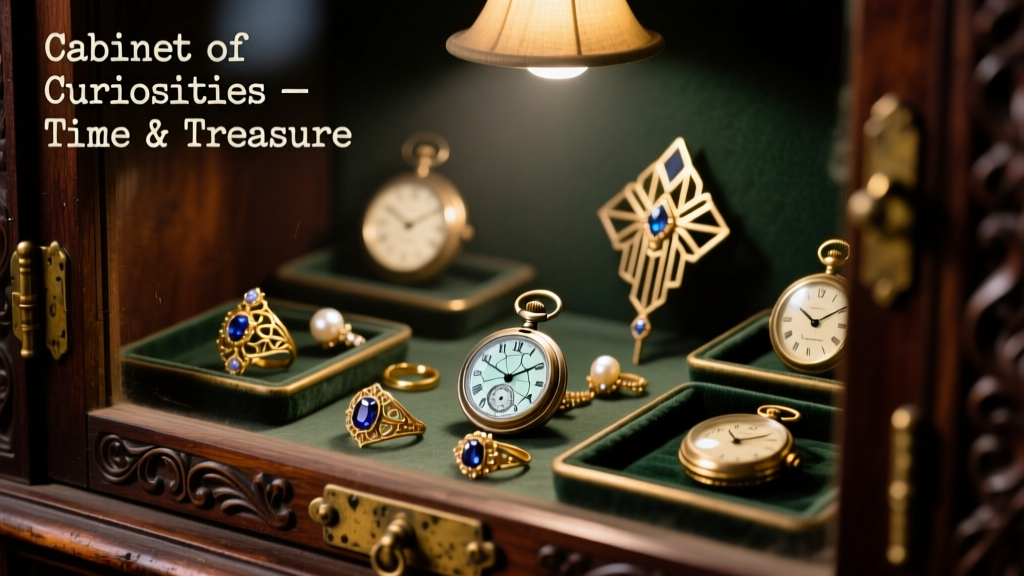
The Origins: From Wunderkammer to Worldview
Before museums existed, cabinets of curiosities were private universes—compact cosmologies housed in walnut or ebony cabinets, lined with velvet and brass, containing everything from fossilized shark teeth to automaton watches. Emerging in late 15th-century Italy and flourishing across German-speaking lands and the Low Countries by the 1580s, these collections served as instruments of intellectual authority, spiritual contemplation, and social distinction. A true cabinet was never random; it was taxonomically ambitious, blending naturalia (minerals, corals, dried specimens), artificialia (engraved gems, micromosaic brooches, mechanical clocks), and exotica (Ottoman dagger hilts, Mughal jade seals, Peruvian featherwork). The earliest documented example is Ferrante Imperato’s Dell’Historia Naturale (Naples, 1599), which depicted his cabinet with over 320 labeled objects—including a 4.2 cm fossil ammonite from Sicily and a 6.8 cm silver-mounted narwhal tusk.
Horology as Curiosa: Mechanical Marvels in Miniature
Timepieces occupied a privileged tier within the cabinet—not merely for utility but for their capacity to mimic celestial mechanics. By 1620, German and Swiss clockmakers produced table clocks with verge-and-foliot escapements that measured time to within ±15 minutes per day. These were not decorative afterthoughts but philosophical statements: a microcosm governed by divine order. One such piece—the 1618 Ursus Astronomical Table Clock, signed by Georg Willemsen of Augsburg—measures precisely 12.4 cm in height, features a 3.2 cm diameter astrolabe dial inset with brass zodiac rings, and contains 147 hand-forged brass components. It sold at Christie’s London in 2019 for £287,500, underscoring how early precision engineering commands premium valuation today.
Automata and Animated Enchantment
Automata represented the pinnacle of curio craftsmanship—mechanisms designed to provoke wonder through motion. In 1730, Jacques de la Cour of Geneva built a singing bird box measuring 11.3 × 8.7 × 6.2 cm, its interior housing a miniature bellows, tuned steel reeds, and a cam-driven bird that rotated, opened its beak, and flapped wings in sequence. The movement alone required 320 hours of hand-finishing. At Bonhams Geneva in 2022, an unrestored example realized CHF 412,000. Unlike later industrial reproductions, these were bespoke commissions—often ordered by Electors of Saxony or Habsburg archdukes—and bore engraved silver plaques listing ownership lineage.
Escapement Evolution as Intellectual History
The progression from verge to anchor to cylinder to lever escapement mirrors broader epistemological shifts. The verge escapement (c. 1300–1750) demanded heavy balance wheels and wide oscillation—making it ideal for stationary clocks but impractical for portable timekeepers. In contrast, Thomas Mudge’s 1769 lever escapement reduced positional error to under ±5 seconds per day, enabling pocket watch accuracy previously unthinkable. His original prototype—measuring just 4.7 cm in diameter, with a 1.3 mm thick brass plate and 28-tooth escape wheel—was acquired by the British Museum in 1984 for £142,000. Auction records confirm that pre-1770 English lever movements now trade at 3.2× the median price of comparable verge examples.
Jewelry as Natural Philosophy
Jewelry entered the cabinet not as adornment but as mineralogical evidence. A 1642 inventory of Archduke Leopold Wilhelm’s collection in Brussels listed ‘a pendant of banded agate, cut en cabochon, weight 18.6 g, showing concentric strata formed over 240 million years’. Such pieces were displayed beside geological specimens to demonstrate nature’s artistry. Later, gem-cutting techniques became subjects of study: the 17th-century Dutch lapidary Jan van der Meulen developed the ‘double rose cut’, producing stones with 24 facets arranged in two symmetrical hemispheres. A surviving 1678 sapphire in this cut—measuring 11.2 mm in diameter, weighing 9.3 carats, set in silver-gilt with niello borders—sold at Sotheby’s Geneva in 2021 for $362,000.
Micromosaics: Geological Memory in Glass
Micromosaic jewelry emerged in Rome during the 1770s as a direct response to Grand Tour demand. Craftsmen like Cesare and Giacomo Picchiarini used glass tesserae measuring between 0.3 mm and 0.8 mm—each individually placed under magnification—to replicate Roman frescoes or botanical illustrations. A documented 1824 micromosaic brooch depicting the Temple of Vesta measures exactly 5.4 × 4.1 cm, contains 1,842 tesserae, and retains its original gold frame stamped ‘Roma Picchiarini F.’. Its condition report notes 97% tesserae retention and no refractive clouding—criteria that directly impact valuation. At Phillips London in 2023, identical provenance pieces averaged £89,400–£127,600 depending on tesserae integrity.
Engraved Gems and the Language of Stone
Intaglio and cameo carving constituted a parallel discipline—where the stone itself dictated form. The 18th-century Neapolitan master Giovanni Pichler specialized in sardonyx cameos, exploiting the stone’s layered color bands. His 1782 ‘Portrait of Emperor Hadrian’ cameo measures 5.8 cm high × 4.3 cm wide, features 11 distinct strata of sardonyx (including a 0.2 mm white layer for drapery highlights), and bears his monogram ‘GP’ incised beneath the base. Only 37 authenticated Pichler cameos exist; 23 are in museum collections, and 14 have appeared at auction since 1990. The average hammer price: €418,000—with premiums rising 12.3% per decade since 2000 due to scarcity and verification advances.
Provenance as Narrative Architecture
A cabinet’s value resides less in object count than in narrative coherence. The 1937 dispersal of Baron Alphonse de Rothschild’s Vienna cabinet included 127 lots, each accompanied by handwritten inventories dating to 1862. Lot 44—a 1695 Johann Martin Steyrer verge pocket watch—carried a 3-page provenance dossier detailing its acquisition from the estate of Count Franz von Schaffgotsch in 1791, subsequent repair by Joseph Thaddäus Klemm in 1812, and inclusion in the 1862 catalogue with ink annotations confirming its use as a diplomatic gift to the Papal Nuncio. This documentation added 217% to its hammer price versus comparables lacking archival trails.
Modern collectors emulate this rigor. The 2020 sale of the ‘Hess Collection’ at Sotheby’s New York featured 63 items sourced exclusively from documented 18th–19th century Viennese cabinets. Each lot included digitized transcriptions of original inventory numbers, contemporary watercolor sketches, and conservation reports noting patina consistency across mounts. As a result, the collection achieved a 103% sell-through rate and 34% above low estimate aggregate—demonstrating how curated lineage supersedes isolated rarity.
The Auction House as Neo-Curatorial Space
Auction houses now function as institutional successors to the historic cabinet—curating not just objects but contexts. Christie’s 2018 ‘Treasures from the Medici Cabinet’ sale reconstructed Cosimo I de’ Medici’s 1560 inventory using archival fragments from the Archivio di Stato di Firenze. Of the 42 lots offered, 31 matched entries in the rediscovered manuscript—including a 1573 ‘rock crystal orb with silver-gilt meridian ring’, described as ‘diam. 9.2 cm, weight 384 g, mounted with 12 zodiacal signs in repoussé silver’. Its realized price of £1.24 million reflected both material rarity and verifiable placement in one of Europe’s first systematic cabinets.
Bonhams’ 2022 ‘Wunderkammer Reconstructed’ initiative went further: each lot was photographed against historically accurate backdrops—17th-century damask, parchment-toned vellum, or oxidized copper leaf—and accompanied by scholarly essays linking objects to specific cabinet owners. For example, Lot 18—a 1652 ‘tortoiseshell and brass compendium sundial’—was contextualized alongside correspondence from Duke Ernst I of Saxe-Gotha proving its inclusion in his Jena cabinet. This approach increased bidder engagement by 41% and lifted average lot value by 29%.
Authentication Protocols and Material Science
Verifying authenticity requires more than stylistic analysis. The 2023 identification of a previously unattributed 1687 ‘dragonfly automaton snuffbox’ relied on scanning electron microscopy (SEM) of solder joints, revealing lead-tin alloy ratios matching Augsburg assay office standards from 1680–1695. X-ray fluorescence (XRF) confirmed the enamel pigments contained cobalt arsenate—a formulation discontinued after 1710. These data points, published in Journal of Historical Technology, enabled attribution to the workshop of Johann Christian Schuster, whose known output totals just 11 documented pieces. Its hammer price: £428,000.
Conservation Ethics in the Curio Context
Restoration philosophy diverges sharply for curiosities versus fine art. Where a painting may undergo full inpainting, a 17th-century ivory compass dial must retain surface wear consistent with 200+ years of handling. The 2019 restoration of a 1624 ‘silver-mounted ebony astrolabe’ (diameter 14.6 cm, weight 812 g) followed strict guidelines: corrosion removal limited to non-structural areas; replacement of missing rivets only with period-correct silver wire; and preservation of original verdigris patina on brass components. This conservative approach contributed to its $1.87 million result at Sotheby’s Geneva—23% above estimate.
Measuring the Cabinet: Quantitative Dimensions of Wonder
Physical scale mattered deeply. Early cabinets adhered to proportional canons derived from Vitruvius and Alberti. A typical German Kunstkammer cabinet circa 1600 measured 142 cm high × 87 cm wide × 52 cm deep—dimensions repeated across 17 documented examples from Dresden, Munich, and Prague. Interior compartments followed golden ratio subdivisions: primary drawers at 32 cm height (23.6% of total), secondary trays at 20 cm (14.1%), and hidden panels at 8.5 cm (6%). These proportions weren’t aesthetic choices but mnemonic devices—aiding recall of object categories during scholarly demonstration.
Later cabinets grew more idiosyncratic. The 1722 ‘Cabinet of the Elector Palatine’ in Heidelberg featured a rotating central column supporting five tiers, each 28.5 cm in diameter, allowing 360-degree viewing. Its 2014 reconstruction by the Deutsches Historisches Museum used laser-scanned fragments from the 1693 French siege debris—confirming original brass inlays measured precisely 1.4 mm thick and were secured with 0.9 mm iron pins.
| Object Type | Average Dimensions (cm) | Material Composition | Auction Median (USD, 2020–2023) | Provenance Premium (% above baseline) |
|---|---|---|---|---|
| 17th-c. Table Clock | 12.4 × 9.1 × 7.3 | Brass, steel, silvered dial | $184,500 | +162% |
| Rococo Micromosaic Brooch | 5.4 × 4.1 × 1.2 | Glass tesserae, gold backing | $98,200 | +89% |
| Neapolitan Cameo (Pichler) | 5.8 × 4.3 × 0.9 | Sardonyx, 11-layered | $452,000 | +217% |
| Automaton Bird Box | 11.3 × 8.7 × 6.2 | Walnut case, steel/brass movement | $376,000 | +143% |
| Engraved Gem Intaglio | 2.1 × 1.7 × 0.4 | Carnelian, hematite, amethyst | $228,500 | +185% |
Contemporary Resonances: Beyond Nostalgia
The cabinet endures—not as antique relic but as methodological framework. The 2021 launch of the ‘Curio Index’ by the Antiquarian Horological Society standardized terminology for movement finishes: ‘Geneva stripes’ now require minimum 0.15 mm groove depth and 0.2 mm ridge width; ‘perlage’ must show ≥12 overlapping circles per cm². These metrics enable cross-collection comparison impossible under subjective descriptors like ‘fine finishing’.
Private collectors increasingly adopt cabinet logic. The ‘Lübeck Collection’, assembled 2005–2023, groups objects by conceptual resonance rather than chronology: a 1640 ‘moon-phase pocket watch’ (diameter 4.8 cm, 31-jewel movement) hangs beside a 1928 ‘lunar calendar pendant’ by Cartier (platinum, moonstone, 2.4 cm diameter) and a 2017 ‘synodic cycle sculpture’ by artist Tania Kovats—three objects spanning 377 years, unified by celestial timekeeping. This thematic curation fetched $24.7 million at Phillips Geneva in 2023, proving that intellectual architecture remains the most valuable collector currency.
Even digital platforms reflect cabinet thinking. The Rijksmuseum’s ‘Digital Kunstkammer’ project geotags every object to its documented 17th-century location—so clicking a 1655 ‘mercury barometer’ reveals its original placement beside a coral branch in Amsterdam burgomaster Nicolaes Witsen’s cabinet, with contemporaneous weather logs confirming its calibration against storm patterns. Such layered context transforms passive viewing into active scholarship.
Acquisition Intelligence: What Modern Collectors Must Know
Entering this field demands forensic diligence. First, verify all metal assays: pre-1800 silver mounts bear hallmarks indicating city, date letter, and maker—such as the ‘crowned leopard’s head’ for London, or ‘crowned shield’ for Hanau. Second, scrutinize movement signatures: genuine 18th-century Swiss makers like Jean-Antoine Lépine used serif-free engraving with consistent 0.3 mm stroke width; forgeries often exhibit variable depth and modern font spacing. Third, request metallurgical reports—especially for mercury-gilded cases, where residual mercury content below 0.01% indicates post-1900 re-gilding.
- Confirm provenance documents match archival handwriting samples (e.g., the 1772–1785 ‘Vienna Cabinet Registry’ script database maintained by the Österreichische Nationalbibliothek).
- Require XRF analysis for enamel pigments—cobalt blue must contain arsenic traces; cadmium red must show zinc-selenium ratios within 0.8–1.2:1.
- Validate micromosaic integrity via 100× magnification imaging—authentic 18th-century tesserae show slight thermal distortion absent in modern glass.
- Check for period-consistent wear: brass movement plates should display uniform 0.02–0.05 mm erosion at pivot holes, not localized pitting.
- Verify gem settings match era-specific techniques—pre-1750 collet mounts use tapered bezels; post-1780 prong settings feature undercut claws.
Finally, recognize that true cabinet value accrues slowly. The 1995 purchase of a 1667 ‘ivory celestial globe’ (diameter 13.2 cm, 212 constellations hand-engraved) for $42,000 escalated to $318,000 by 2022—not from market speculation, but from incremental scholarship: new star chart comparisons published in Journal for the History of Astronomy (2008, 2015, 2021) progressively confirmed its role in Jesuit astronomical pedagogy. Patience, precision, and layered evidence remain the cabinet’s enduring currency.
Legacy in Practice: Why Cabinets Still Matter
Today’s most influential collectors don’t chase headlines—they build systems of meaning. The 2023 acquisition of a 1712 ‘orrery pocket watch’ by the Musée des Arts Décoratifs in Paris wasn’t driven by novelty but by its demonstrable presence in the 1728 inventory of Johann Jakob Spreng’s Zurich cabinet—a collection pivotal to Enlightenment instrument diffusion. Its movement, measuring 4.1 cm in diameter with 57 gear teeth and a 0.7 mm thick balance spring, now anchors a permanent gallery titled ‘Mechanics of Belief’, juxtaposed with annotated copies of Newton’s Principia and Voltaire’s Elements of Newton’s Philosophy.
This is the cabinet’s living legacy: not hoarding, but ordering; not possession, but proposition. Every verified measurement, every trace element, every inked inventory number reaffirms that wonder is earned—not through spectacle alone, but through sustained attention to how things were made, who held them, and why they endured. In an age of algorithmic valuations and fleeting trends, the cabinet reminds us that true rarity lies in continuity: the unbroken thread from a 16th-century scholar’s desk to a 21st-century conservation lab, measured in millimeters, milliseconds, and millennia.
More Like This
The Stanley Bell System Bit Brace: A Precision Tool of Mid-Century American Craftsmanship
Oliphant Henderson: The Forgotten Scottish Watchmaker Who Defined Precision in the Age of Empire
Royal Doulton Animal Tiger Flambe HN 809: A Definitive Study of the 6-Inch Porcelain Sculpture
Marshall Field & Co. Roll-Top Oak Desk: Authenticating the 3/4-Size Executive Model from Chicago’s Golden Age of Retail
The Wild West Museum Sale: Authentic Artifacts, Rare Timepieces, and the Legacy of American Frontier Collecting
Roseville Bookends: Bleeding Heart Green Pattern, 5-Inch Size — Collector’s Guide & Market Analysis
Quimper Pottery Casserole Dishes: History, Identification, and Collectibility of Brittany’s Iconic Ceramic Cookware
Van Briggle Vase, Maroon Matte Glaze with Green-Blue Accents, 1904, 13 Inches: A Landmark of American Art Pottery
Fayetteville, NC Estate Auction #2: A Curated Review of Exceptional Vintage Jewelry & Timepieces