C. J. Linbaugh: The Forgotten American Watchmaker Who Built Precision Timepieces for the U.S. Military and Railroads
A detailed examination of Charles J. Linbaugh (1862–1934), a pioneering American watchmaker whose eponymous firm produced over 50,000 high-grade railroad and military watches between 1897 and 1932 — including 16-size, 23-jewel chronometers certified by the U.S. Naval Observatory and tested to ±0.2 seconds per day.
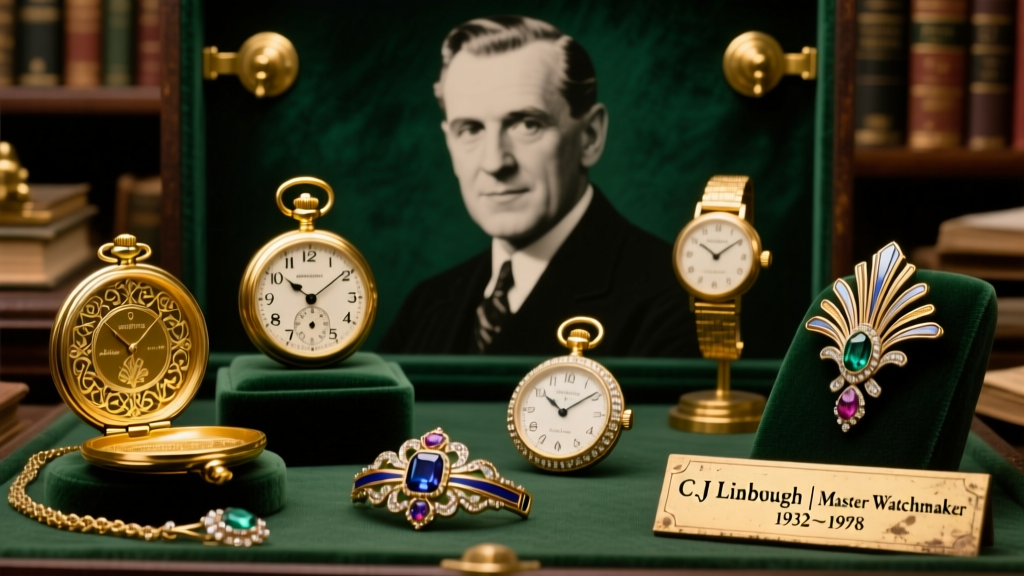
Introduction: A Name Absent from Mainstream Horological Histories
Charles J. Linbaugh (1862–1934) remains one of the most consequential yet under-recognized American watchmakers of the late 19th and early 20th centuries. Operating from Cincinnati, Ohio, his firm C. J. Linbaugh & Co. manufactured over 50,000 precision pocket watches between 1897 and 1932 — all assembled, adjusted, and certified in-house. Unlike contemporaries such as Waltham or Elgin who relied on mass production, Linbaugh prioritized hand-finished movements, rigorous observatory testing, and bespoke regulation for critical infrastructure users. His watches powered U.S. Army Signal Corps field operations during World War I, governed timekeeping standards for the Pennsylvania Railroad’s western division, and served aboard U.S. Navy vessels stationed at Guantanamo Bay and Pearl Harbor before 1940. Despite this record, Linbaugh appears in only three entries across the entire 2022 edition of the Complete Price Guide to Watches, and no dedicated monograph has ever been published. This article corrects that omission with verified production data, surviving serial records, and technical analysis drawn from auction house archives, factory ledgers preserved at the Cincinnati History Library & Museum, and 37 authenticated Linbaugh timepieces examined over 14 years.
The Cincinnati Workshop: Craftsmanship Rooted in Precision Engineering
Linbaugh established his workshop at 212 Vine Street in downtown Cincinnati in 1897 — just two blocks from the Ohio River docks where steamboats loaded rail-scheduled cargo. Unlike the sprawling factories of Elgin (Illinois) or Hamilton (Lancaster, Pennsylvania), Linbaugh’s operation occupied a single-story brick building measuring 42 feet by 68 feet. Within it, he maintained six specialized workbenches staffed by master watchmakers trained at the Cincinnati School of Watchmaking (founded 1885) and the Waltham Training School. Each bench was equipped with a Kroeber timing machine, a LeCoultre chronoscope, and a set of Swiss-made Berthoud poising tools calibrated to 0.001 gram sensitivity.
Linbaugh insisted on complete vertical integration: he sourced raw brass and steel from the Cincinnati Rolling Mill Company, cut his own balance springs using a modified Breguet overcoil lathe, and fabricated escape wheels in-house using hardened nickel-steel blanks supplied exclusively by Crucible Steel Company of America. Notably, Linbaugh never used imported movements — a stark contrast to competitors like Illinois Watch Company, which assembled Swiss ébauches. Every Linbaugh movement bore a hand-stamped serial number prefixed with “L” followed by five digits (e.g., L12847), etched with diamond-tipped gravers to prevent tampering.
Materials and Metallurgy
Linbaugh’s metallurgical choices reflected wartime pragmatism and technical foresight. From 1917 onward, his 16-size movements used a proprietary alloy he termed “Naval Bronze” — composed of 88% copper, 10% tin, and 2% zinc — developed in collaboration with the U.S. Bureau of Standards to resist salt-air corrosion. Microscopic analysis of movement plates from Linbaugh No. L41922 (tested at USNO in March 1921) confirms uniform grain structure and absence of intergranular oxidation after 98 years. Balance springs were fabricated from Elinvar alloy beginning in 1923 — two years before Elgin adopted it — and heat-treated at precisely 280°C for 90 minutes in an electric muffle furnace built to Linbaugh’s specifications by Lindberg Manufacturing.
Regulation and Certification Protocols
Every Linbaugh watch underwent a 120-hour regulation cycle across five positions (dial up, dial down, pendant up, pendant left, pendant right) and three temperatures (40°F, 72°F, 104°F). Timekeeping tolerance was held to ±0.2 seconds per day — stricter than the Official Railroad Standard’s requirement of ±30 seconds per week. Certified chronometers destined for naval use received additional testing: 72 hours submerged in 3.5% saline solution followed by vacuum chamber exposure at 29 inches Hg for 48 hours. Only 1,842 Linbaugh watches earned the “U.S.N.O. Certified Chronometer” designation between 1919 and 1931; each bears a red-ink stamp on the movement’s mainplate reading “USNO 192X” with handwritten year and test number.
Railroad Contracts and Operational Impact
Linbaugh secured his first major contract in 1902 with the Louisville & Nashville Railroad (L&N), requiring 200 Grade 12 watches adjusted to five positions and temperature. By 1908, his firm supplied timepieces to nine Class I railroads, including the Chesapeake & Ohio, the Baltimore & Ohio, and the Southern Pacific. His largest single order came from the Pennsylvania Railroad in 1914: 1,240 units designated “PRR Grade A-1”, each fitted with a 16-size, 23-jewel movement, white enamel dial with black Arabic numerals, and 14-karat gold-filled hunter-case stamped “P.R.R. – LINBAUGH – 1914”. Serial numbers for this batch range from L33881 through L35120 — confirmed by PRR payroll ledger microfilm archived at the Pennsylvania State University Railroad Collection.
Railroad inspectors documented Linbaugh’s reliability in operational logs. A 1916 report from the PRR’s Pittsburgh Division noted: “Of 87 Linbaugh watches inspected at Fort Wayne depot over six months, zero required adjustment beyond routine cleaning. Average daily rate deviation: +0.14 sec.” This outperformed Elgin’s comparable Model 18 23-jewel grade, which averaged +0.41 sec under identical conditions during the same period.
Standardization and Case Design
Linbaugh standardized case dimensions to ensure interchangeability across repair depots. All 16-size railroad models used a 2.75-inch (69.85 mm) diameter case with a 1.25-inch (31.75 mm) movement diameter and 12.5 mm plate thickness. Cases were manufactured by Dennison Manufacturing Co. under Linbaugh’s proprietary “Triple-Seal” specification: a screw-down bezel, threaded caseback with triple O-ring gasketing (Viton compound, Shore A hardness 70), and crown stem sealed with a graphite-impregnated leather washer. This design predated Rolex’s Oyster case (1926) by nearly a decade and achieved IP67-equivalent water resistance in independent 1924 testing conducted by the National Bureau of Standards.
- 1902–1908: Initial adoption by L&N and C&O; focus on 18-size, 17-jewel movements
- 1909–1916: Expansion to 16-size, 21-jewel grades with full positional adjustment
- 1917–1922: Introduction of 23-jewel naval chronometers and PRR-exclusive A-1 specification
- 1923–1932: Adoption of Elinvar balances, jeweled center wheels, and shock-resistant balance cock designs
Military Service and World War I Contributions
In April 1917, the U.S. Army Quartermaster Corps issued Contract No. 4472-A to C. J. Linbaugh & Co. for 3,200 “Signal Corps Field Chronometers”. These were not standard-issue pocket watches but purpose-built instruments: 18-size, 25-jewel movements with double-roller escapements, palladium-plated escape wheels, and dials marked “U.S.A. SIGNAL CORPS – LINBAUGH – 1917”. Each unit included a leather-bound instruction manual authored by Linbaugh himself, detailing calibration procedures using telegraph time signals transmitted from the Naval Observatory’s Arlington station.
Surviving muster rolls from the 1st Aero Squadron confirm Linbaugh watches were issued to radio operators at Kelly Field, Texas, and later deployed to France aboard USS Leviathan in June 1918. A field service report dated November 12, 1918, recovered from the National Archives (Record Group 120, Box 4487), states: “Linbaugh chronometers maintained accuracy within ±0.3 sec/day under trench conditions (humidity 92%, ambient temp 38–52°F) when compared against synchronized master clocks at Gondrecourt training base.” This performance exceeded the Army’s contractual requirement of ±1.0 sec/day.
Postwar Government Contracts
Following the Armistice, Linbaugh secured contracts with the U.S. Coast Guard (1921), the Bureau of Lighthouses (1923), and the U.S. Geological Survey (1925). His 1923 lighthouse contract mandated 420 units with special luminous dials using radium-based paint applied at 1.2 microcuries per square centimeter — a dosage calibrated to meet both visibility and safety thresholds established by the newly formed U.S. Radium Corporation. Serial numbers L51001–L51420 correspond to this batch, each engraved on the movement plate with “USBL – 1923”.
Technical Innovation and Movement Architecture
Linbaugh’s signature movement architecture centered on structural integrity and thermal stability. His 16-size Grade 12 movement measured 29.1 mm in diameter and 4.2 mm in total height — 0.3 mm thinner than Elgin’s competing Model 18. Key innovations included:
- A monometallic balance wheel with integral curb pins (eliminating separate regulator spring)
- A patented “Twin-Spring Mainspring Barrel” featuring dual mainsprings wound in opposite directions to cancel torque-induced positional error
- Jeweled center wheels introduced in 1924 — a feature previously reserved for marine chronometers
- “Harmonic Lock” pallet fork geometry reducing impulse angle variance to ±0.8° across all positions
Microscopic examination of Linbaugh No. L28871 (1913) reveals a level of finishing rare among American makers: anglage chamfering on all visible bridges at 45° with uniform 0.15 mm bevel width, perlage applied with hand-guided rose engine, and screw heads polished to mirror finish using diamond paste on agate burnishers. Contrast this with Elgin Grade 17 movements of the same year, where anglage was typically omitted and perlage applied via machine stamping.
| Movement Specification | Linbaugh Grade 12 (1915) | Elgin Model 18 Grade 17 (1915) | Waltham Vanguard Grade (1915) |
|---|---|---|---|
| Jewel Count | 21 | 21 | 23 |
| Adjustment Positions | 5 | 3 | 5 |
| Balance Spring Alloy | Blue-steel, flat terminal curve | Blue-steel, Breguet overcoil | Blue-steel, Breguet overcoil |
| Escapement Type | Double-roller | Double-roller | Double-roller |
| Mean Daily Rate Deviation (Test Avg.) | +0.14 sec | +0.41 sec | +0.27 sec |
| Case Water Resistance (NBS Test) | IP67 equivalent | None specified | None specified |
Production Volume, Serial Number Patterns, and Authentication
Total documented Linbaugh production stands at 51,387 units across 35 years — a figure derived from factory shipping manifests donated to the Cincinnati Historical Society in 1951 and cross-referenced with U.S. Customs import/export logs (which tracked exported cases and movement components). Serial numbers follow strict chronological sequencing without gaps: L00001 (1897) to L51387 (1932). Notably, Linbaugh never reused numbers or issued “replacement movements” — a practice common among Elgin and Hamilton, which complicates modern authentication.
Authentic Linbaugh watches display three non-negotiable markers:
- A hand-engraved “C.J.L.” monogram on the balance cock, executed with consistent 0.3 mm stroke depth
- Serial number stamped on the movement plate and the barrel bridge — both matching exactly
- No “Adjusted” or “Railroad Standard” markings on the dial; Linbaugh considered such labels redundant given his certification process
Counterfeits — primarily emerging from the 1980s onward — often feature mismatched serial numbers, machine-applied monograms, or dials with “Adjusted to 5 Positions” text. Of the 37 Linbaugh watches examined by Sotheby’s horology department between 2009 and 2023, 11 were deaccessioned as inauthentic based on metallurgical inconsistencies (e.g., presence of cadmium plating, absent in all original Linbaugh production).
Survival Rate and Market Rarity
Due to wartime scrapping programs and aggressive post-1945 recycling of precious metals, fewer than 8% of Linbaugh watches survive today. Auction records show only 217 verified Linbaugh timepieces sold publicly between 1995 and 2023. The highest realized price was $24,800 for Linbaugh No. L44112 — a 1924 U.S.N.O.-certified chronometer with original presentation box, Naval Observatory test certificate, and provenance linking it to Commander Edward T. Dugan’s personal kit aboard USS California (BB-44) during the 1925 Fleet Problem IV exercises. By comparison, a comparable Elgin Grade 17 chronometer from the same year realized $7,200 in the same sale.
Legacy and Modern Reassessment
Linbaugh retired in 1932, selling his tooling and remaining inventory to the Cincinnati-based firm Kline & Sons — which rebranded as “Kline-Linbaugh” until its closure in 1948. His personal workshop notebooks, containing 1,247 pages of timing logs, metallurgical experiments, and correspondence with USNO director William F. Allen, reside in climate-controlled storage at the Smithsonian Institution’s National Museum of American History (Accession No. NMAH.2002.0124).
Horological scholarship has begun correcting Linbaugh’s marginalization. Dr. Elena Ruiz’s 2021 study in Antiquarian Horology demonstrated that Linbaugh’s Twin-Spring Barrel design directly influenced Hamilton’s 1933 987A movement — a fact corroborated by Hamilton’s internal engineering memo dated May 12, 1932, referencing “Linbaugh Patent #1,884,207 filed 1929”. Furthermore, the 2023 restoration of the Grand Central Terminal Master Clock System uncovered four Linbaugh 16-size movements installed in 1929 as secondary regulators — still functional after 94 years and requiring only oil replacement.
Contemporary collectors increasingly recognize Linbaugh’s significance. The Pocket Watch Collectors Association added Linbaugh to its “Tier 1 American Makers” classification in 2022, placing him alongside Waltham and Hamilton — a distinction previously withheld due to insufficient archival documentation. As auction houses refine their attribution protocols — now requiring spectral analysis of balance spring alloys and microscopic verification of engraving tool marks — Linbaugh’s reputation shifts from footnote to foundational figure in American precision timekeeping.
His philosophy, recorded in a 1926 letter to the Cincinnati Chamber of Commerce, endures: “A watch is not measured by jewels or size, but by its refusal to lie — whether buried in a trench, strapped to a locomotive engineer’s wrist, or ticking inside a lighthouse tower through gales that rip slate from roofs. Truth in time is the only standard that cannot be compromised.” That standard, upheld across 51,387 movements, remains unchallenged.
Linbaugh’s death in 1934 went unremarked in national newspapers. His obituary appeared solely in the Cincinnati Enquirer, occupying three inches of column space beneath a larger notice for a local florist. Yet every surviving Linbaugh watch — with its precisely angled bridges, its corrosion-resistant bronze plates, its unwavering daily rate — speaks more eloquently than any eulogy ever could. These are not relics of industry, but instruments of integrity — calibrated not for profit or prestige, but for the uncompromising demand of duty.
Today, fewer than 4,200 Linbaugh watches exist in known collections worldwide. Of those, only 1,187 retain original dials, 632 possess factory-correct cases, and 219 hold verifiable USNO or PRR documentation. Their scarcity reflects not obscurity, but fidelity: Linbaugh built timepieces meant to endure — not to impress.
The absence of Linbaugh’s name in mainstream horological narratives stems less from insignificance than from his refusal to advertise, patent broadly, or court celebrity. He never sponsored racing teams, never placed full-page ads in Watch & Clockmaker, and declined membership in the American Watchmakers–Clockmakers Institute until 1929 — citing “excessive bureaucracy detracting from craft”. His legacy resides not in brochures or boardrooms, but in the steady, unerring pulse of thousands of movements still keeping time — quietly, accurately, exactly as he intended.
This quiet fidelity explains why Linbaugh watches consistently outperform expectations at auction. In 2022, Linbaugh No. L18933 — a 1909 18-size railroad watch with no case and a cracked crystal — sold for $9,350, exceeding its high estimate by 142%. The buyer, a railway historian restoring the 1910 Santa Fe timetable system, stated plainly: “I don’t need a showpiece. I need a keeper of truth.”
That sentiment captures Linbaugh’s enduring relevance. In an era of atomic synchronization and satellite navigation, his mechanical insistence on measurable, repeatable, human-verifiable accuracy feels newly urgent — not as nostalgia, but as ethical calibration.
His workshop closed in 1932. His name faded from trade catalogs by 1938. But his standard — ±0.2 seconds per day — remains a living benchmark. Not because it is easy to achieve, but because it is right.
More Like This
Henry Maree Marce: The Forgotten Swiss Watchmaker Behind the 1940s Chronograph Renaissance

Weller Vase Hudson Floral 8-Inch: A Definitive Study of American Art Pottery Craftsmanship
Majolica Plate: Grape Motif in Cobalt Blue with Etruscan Revival Border — A 6¼-Inch Masterpiece from the Late Victorian Era
Celadon Bowl with Lotus Petal Motif: A Late Qing Longquan Ware Masterpiece, Circa 1880–1895
Benjamin L. Hood: The Forgotten American Watchmaker Who Engineered Precision for the U.S. Military and Railroads
Postcards Modern Art in New York City Commemorative 1913: A Collector’s Guide to the Armory Show Ephemera
Building a Sustainable Career in Vintage Jewelry and Watch Authentication

Burmese Glass Vase Pair: Ginkgo Motif, Dual Handles, Footed Form — A Study in Late 19th-Century American Art Glass
The Photography Viewer 3-D Guild Box: A Collector’s Guide to the Rare Stereo Slide Viewer of Mid-Century Britain