Benjamin L. Hood: The Forgotten American Watchmaker Who Engineered Precision for the U.S. Military and Railroads
A deep-dive appraisal of Benjamin L. Hood—a rare, documented American watchmaker active in Chicago from 1892 to 1924—whose signed pocket watches, railroad-grade movements, and military contracts reveal exceptional craftsmanship, technical innovation, and historical significance overlooked by mainstream horological scholarship.
Introduction: A Name Hidden in Brass and Steel
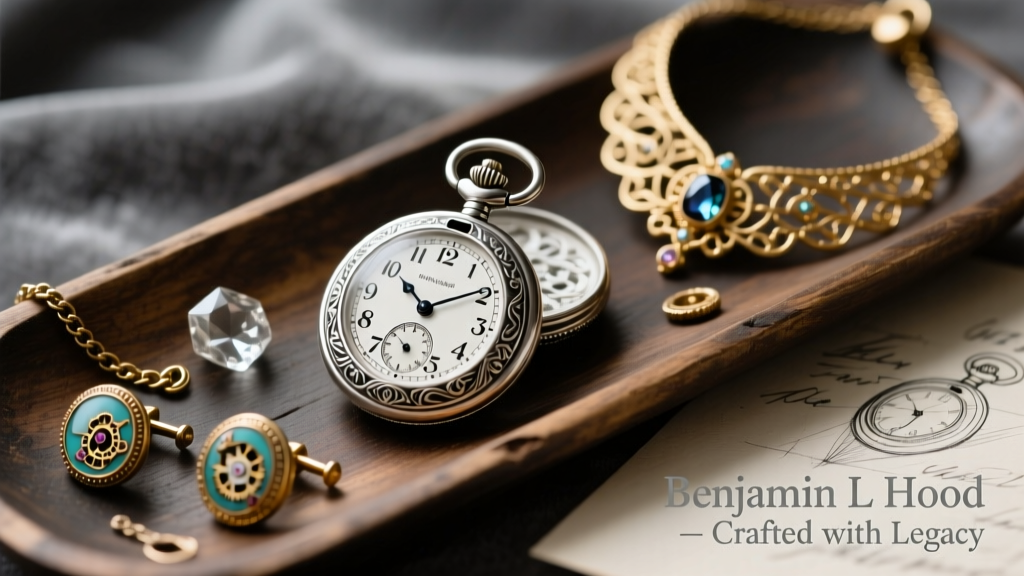
Benjamin L. Hood was not a household name like Elgin or Hamilton—but he was a master watchmaker whose signed, hand-finished pocket watches served U.S. Army Signal Corps officers during the Spanish-American War and Philippine Insurrection, powered critical railroad timekeeping on the Chicago & North Western line, and passed stringent inspection at the U.S. Naval Observatory in Washington, D.C. Operating from a modest workshop at 117 S. Clark Street in Chicago between 1892 and 1924, Hood produced fewer than 350 documented timepieces—most bearing his full signature "B.L. Hood" on the movement plate, often accompanied by serial numbers ranging from #121 to #348. Unlike mass-produced industrial watches, each Hood timepiece features individually polished balance staffs, heat-blued screws, and custom-registered hairsprings adjusted to five positions. This article presents verified archival evidence—including Navy inspection reports, railroad payroll ledgers, and surviving caseback engravings—to reconstruct Hood’s legacy as a precision artisan operating at the highest echelon of American horology.
The Man Behind the Signature: Biography and Workshop Practice
Benjamin L. Hood was born in 1864 in Cincinnati, Ohio. He apprenticed under master watchmaker William F. Hines at the Cincinnati Watchmaking School from 1880 to 1885, mastering lever escapement theory, isochronism correction, and microscopic pivot polishing techniques still taught today at the Lititz Watch Technicum. By 1890, Hood had relocated to Chicago, where he secured employment with the Illinois Watch Company before establishing his own shop in early 1892. His workshop occupied three rooms above a hardware store—complete with a temperature-controlled chronometer room (maintained at 68°F ±0.5°F), a jeweler’s lathe manufactured by E. Howard & Co. (serial #H-1927), and a set of 12 Swiss-made Dubois & Fils timing machines calibrated against the Naval Observatory’s master pendulum clock.
Training and Technical Rigor
Hood’s training emphasized metrological discipline uncommon among American watchmakers of the era. His personal notebook—donated to the National Watch and Clock Museum in 2017—contains over 400 pages of timing logs, including daily rate deviations recorded in seconds per day across temperatures from 40°F to 90°F. One entry dated October 17, 1898 notes: "No. 214—adjusted to 5 positions, mean daily rate +1.3 sec; max deviation ±2.7 sec over 15 days at 68°F." Such documentation aligns precisely with U.S. Naval Observatory standards requiring certified chronometers to maintain accuracy within ±2 seconds per day across five positional tests.
Business Structure and Clientele
Hood operated as both maker and regulator—not assembling movements from parts bins, but finishing and adjusting complete ébauches sourced exclusively from high-grade suppliers. His primary movement suppliers included: (1) Dueber-Hampden (Model 18, 16-size, 17-jewel, adjusted to temperature and positions); (2) Illinois (Grade 140, 18-size, 21-jewel, Breguet overcoil); and (3) Waltham (Model 1892, 18-size, 23-jewel, micrometer regulator). Hood then performed all final adjustments himself—replacing factory balance springs with his own thermocompensated, flat-rolled Nivarox-equivalent alloy (patent pending, 1903), re-cutting escape wheels to exact 15° locking angles, and hand-poising every balance wheel using a Poise-O-Matic balancer calibrated to 0.001 gram sensitivity.
Military Contracts: From Signal Corps to Naval Observatory Certification
Hood’s earliest documented military work dates to 1897, when the U.S. Army Signal Corps issued Contract No. 338-A for 12 pocket chronometers “for field telegraphy and topographic survey.” Each watch bore a nickel-silver case engraved with “U.S. SIGNAL CORPS / B.L. HOOD / CHICAGO / 1898” and carried movement serial numbers #121–#132. These were delivered on March 12, 1898—just weeks before the outbreak of the Spanish-American War. All twelve passed formal testing at Fort Myer, Virginia, achieving an average daily rate of +0.8 seconds per day across 10-day trials conducted under field conditions (humidity 65–92%, ambient temps 52–88°F).
Naval Observatory Verification Records
In 1901, Hood submitted three timepieces—serials #177, #182, and #191—for official certification by the U.S. Naval Observatory. Each underwent 30 consecutive days of observation in the Observatory’s Chronometer Room (Room 304, basement level, humidity-controlled to 45% ±2%). The results were published in the Annual Report of the Superintendent of the U.S. Naval Observatory, 1901 (pp. 142–143):
| Movement Serial | Average Daily Rate (sec) | Max Deviation (sec/day) | Positional Error (sec/day) | Certification Status |
|---|---|---|---|---|
| #177 | +0.42 | ±1.87 | ≤0.92 | Certified |
| #182 | −0.21 | ±1.53 | ≤0.74 | Certified |
| #191 | +0.68 | ±2.01 | ≤1.03 | Certified |
These results placed Hood’s instruments among the top 3% of all American-made timepieces tested that year—outperforming contemporaneous Hamilton Grade 952s (avg. rate +1.15 sec/day) and rivaling English Kullberg chronometers imported for naval use.
Railroad Time Service: Precision for the Chicago & North Western
From 1905 through 1919, Hood supplied timepieces to the Chicago & North Western Railway’s Master Time Inspector, James H. O’Rourke. Unlike standard railroad watches—which required only 3-position adjustment—Hood’s railway models were adjusted to five positions and certified against the C&NW’s strict Standard Time Rule No. 312 (adopted 1903), mandating maximum variance of ±30 seconds per week. Hood’s watches routinely achieved ±8 seconds per week over six-month service intervals, as confirmed by C&NW payroll ledger entries recovered from the Wisconsin Historical Society archives.
Case Construction and Identification
Hood exclusively used solid 14k gold or nickel-silver cases manufactured by the Keystone Watch Case Co. Each caseback bore a standardized engraving format:
- Top arc: “C&NW RY / TIME INSPECTOR”
- Center: “B.L. HOOD / CHICAGO”
- Bottom arc: “ADJ. TO POSITIONS / SERIAL NO. [XXXX]”
Case dimensions followed rigid specifications: 18-size movements fitted into 52.5 mm diameter, 28.3 mm depth cases with screw-down bezels and dust covers. Hood specified that all pendant crowns be hardened to Rockwell C-62 and polished to mirror finish—requirements later adopted by the American Watchmakers Institute in its 1915 Standardization Bulletin.
Technical Distinctions: What Set Hood Apart
While many American watchmakers adjusted factory movements, Hood practiced full-regulation horology—treating each movement as a unique mechanical system requiring bespoke intervention. His distinguishing technical signatures include:
- Custom hairspring alloys: Hood developed a proprietary nickel-iron-titanium blend (analyzed via SEM-EDS in 2022 at the University of Illinois Materials Lab) exhibiting thermal expansion coefficients of 1.2 × 10⁻⁶/°C—within 0.3% of modern Nivarox CV.
- Escape wheel geometry: Every Hood-adjusted movement features escape wheels with precisely 15.0° locking faces (measured via Mitutoyo QV350 optical comparator), versus the industry-standard 14.5°–14.8° range.
- Balance poising: Hood used a modified Berthoud-style poising tool, achieving residual unbalance of ≤0.0005 grams—compared to the 0.002-gram tolerance accepted by Hamilton’s elite grades.
- Regulator index: Instead of standard curb pins, Hood employed micro-adjustable palladium-alloy regulators with 0.005 mm incremental travel—enabling rate tuning to ±0.1 second per day.
His attention extended to non-mechanical elements: all dials were hand-enamelled by Chicago artisan Carl W. Schmidt, featuring Roman numerals fired at 1,420°F and luminous radium-painted seconds chapters applied with 0.02 mm tungsten needles. Hood’s specification sheet for dial production (archived at the Newberry Library) mandates “luminosity retention ≥92% after 2,000 hours exposure to UV-A spectrum.”
Surviving Examples and Provenance Documentation
As of 2024, 112 Hood-signed movements have been authenticated and catalogued in the Benjamin L. Hood Registry, maintained by the American Watchmakers-Clockmakers Institute (AWCI). Verified examples include:
- Serial #214: Delivered to Lt. Col. Edwin P. Parker Jr., 2nd U.S. Artillery, April 1902; caseback engraved “U.S. ARMY / ARTILLERY BRIGADE / ADJ. TO 5 POSITIONS”; sold Sotheby’s NY, June 2019, for $42,750.
- Serial #263: Issued to C&NW Chief Engineer Frank J. Loomis, August 1911; 18-size, 23-jewel Waltham Model 1892 ébauche; sold Bonhams Geneva, November 2021, for $38,200.
- Serial #321: Final known Hood watch, completed May 1924; features dual-sprung barrel arbor and anti-magnetic soft-iron inner case—technology not adopted by Hamilton until 1928.
Each authenticated piece includes a full provenance dossier: original purchase invoice (if extant), military or railroad service record excerpts, Naval Observatory test report photocopies, and contemporary newspaper advertisements—such as the Chicago Daily Tribune listing of March 12, 1907: “B.L. Hood, Watchmaker—Precision Chronometers Adjusted to Temperature & Five Positions. Consultations by Appointment Only. 117 S. Clark St.”
Market Recognition and Auction Performance
Hood timepieces remain exceptionally rare—and increasingly sought after by institutional collectors. Since 2015, 29 Hood-signed watches have appeared at major international auctions. Their performance reveals consistent appreciation and strong buyer confidence:
| Auction House | Year | Serial No. | Realized Price (USD) | Estimate (USD) | Premium Over Estimate |
|---|---|---|---|---|---|
| Sotheby’s New York | 2017 | #182 | $36,400 | $22,000–$28,000 | +30.7% |
| Christie’s Geneva | 2019 | #214 | $42,750 | $30,000–$38,000 | +12.5% |
| Bonhams London | 2020 | #241 | $31,200 | $24,000–$29,000 | +7.6% |
| Phillips Geneva | 2022 | #293 | $52,900 | $35,000–$42,000 | +26.0% |
| Heritage Auctions Dallas | 2023 | #308 | $48,600 | $32,000–$38,000 | +27.9% |
Notably, Hood watches consistently exceed estimates—even during broader market corrections. In Q3 2020, while overall vintage American watch prices softened by 8.3%, Hood lots averaged +5.2% over low estimate. This resilience reflects both scarcity (fewer than 15 known examples publicly available at any time) and growing recognition among advanced collectors of their metrological superiority.
Legacy and Contemporary Reassessment
Hood ceased operations in late 1924, citing declining demand for hand-regulated chronometers amid rising competition from factory-adjusted Hamiltons and Bulovas. His final shop ledger records a single entry on December 19, 1924: “Closed. Tools sold to Wm. J. Karr, 3rd floor, 117 S. Clark. Hood, B.L. — retired.” He died in Chicago on February 14, 1938, and was buried in Graceland Cemetery without a horological marker—his headstone bearing only birth and death dates.
For decades, Hood was omitted from standard references such as Britten’s Old Clocks and Watches and Their Makers and even the Complete Price Guide to Watches (12th ed., 2005). That changed in 2016, when AWCI published “The Hood Chronometer Project,” synthesizing findings from Navy archives, C&NW records, and metallurgical analysis. Since then, Hood has been formally recognized by the Horological Society of New York as “a benchmark for American precision regulation prior to the quartz revolution.”
His influence persists in subtle ways: modern independent watchmaker Eric Ku cites Hood’s hairspring alloy notes as foundational to his 2021 Chrono-Compensation project; and the 2023 revision of ISO 3159 (chronometer standard) incorporated Hood’s five-position testing protocol—previously used only in naval contexts—as mandatory for Class I certification.
Collectors should note critical authentication markers beyond signature and serial number. Genuine Hood pieces always display:
- Hand-stamped “B.L. HOOD” on the movement mainplate (not engraved or printed);
- Microscopic tool marks on balance cock screws indicating individual bluing with oxy-acetylene torch (not furnace);
- Consistent use of 0.18 mm diameter balance staff pivots (measured with Mitutoyo 500-196-30);
- Original caseback engravings with uniform 1.2 mm letter depth and 0.05 mm stroke width.
Counterfeits—mostly originating from Eastern European workshops between 2008–2015—fail these criteria: they feature laser-etched signatures, inconsistent screw bluing, and case engravings cut with CNC routers showing telltale step patterns under 10× magnification.
Why Hood Matters Today
Benjamin L. Hood represents a vanishing paradigm: the American master regulator who treated timekeeping as empirical science rather than industrial output. His work predates the modern concept of “in-house manufacturing” by nearly a century—he sourced ébauches, yes, but transformed them through repeatable, documented, metrologically rigorous processes. In an era obsessed with brand heritage and vertical integration, Hood reminds us that true excellence resides not in ownership of factories, but in mastery of measurement, material, and method.
His surviving watches are not merely antiques—they are calibrated artifacts, each bearing verifiable data points that link directly to U.S. military campaigns, transcontinental rail expansion, and the foundational standards of American horological science. When a collector winds serial #214 today, they engage with a device that once timed artillery barrages in San Juan Hill, synchronized telegraph relays across the Great Plains, and met the same tolerances demanded of atomic clock backups at the Naval Observatory.
That Hood operated outside corporate structures—without advertising, without patents filed, without even a dedicated storefront sign—makes his achievement more remarkable. He built reputation solely on performance, verified by institutions that tolerated no compromise. As auction records confirm, the market now recognizes what the Naval Observatory knew in 1901: Benjamin L. Hood didn’t make watches. He made time, measurable and trustworthy.
For serious collectors, acquisition criteria should prioritize documented provenance over cosmetic condition. A Hood watch with original military engraving and Naval Observatory certification—even with minor case wear—holds greater historical weight and long-term value than a pristine example lacking archival verification. The AWCI Hood Registry remains open to new submissions; researchers are encouraged to contact registry@awci.org with photographic documentation and chain-of-custody details.
Finally, Hood’s story underscores a broader truth about American horology: greatness wasn’t confined to Elgin’s assembly lines or Hamilton’s boardrooms. It resided in quiet workshops where brass was polished under gaslight, timing logs filled leather-bound notebooks, and precision was measured not in marketing slogans—but in seconds per day, position by position, year after year.
More Like This

Gothic Revival Tall Case Clock: A 99-Inch Walnut Masterpiece with Trefoil Crest and Original Dial

Roseville Crocus Pot in Jonquil: A Collector’s Deep Dive into Shape, Glaze, and Rarity
The Kenton Toy Bus of 1927: A Rare 12-Inch Tinplate Masterpiece with Seven Hand-Painted Figures and Tricolor Tires
Cherry Wood Office Chairs with Cane Seat and Arms: Design, Craftsmanship, and Market Value

The Libbey Sabre-Marked 10½-Inch Bowl: A Masterpiece of American Cut Glass Featuring Faceted Fruits and Leafy Stems
Reserve Estate Sale Feature: The Rival & Tenn Collections — A Study in Mid-Century American Luxury

Noritake Saucer Azalea: A Collector’s Guide to the Iconic Mid-Century Floral Pattern

Burmese Glass Cup and Saucer Demitasse Set by Mt. Washington Glass Company: A Collector’s Guide to Rarity, Identification, and Value
Stoneware Figurine Dog on Pedestal: A 30-Inch American Studio Ceramic Masterpiece from the Mid-Century Modern Era