Joseph Lippincott Lipincott: The Forgotten American Watchmaker and His Legacy in Precision Horology
A detailed examination of Joseph Lippincott Lipincott (1869–1932), the Philadelphia-based watchmaker, inventor, and master regulator whose patented escapements, precision chronometers, and contributions to marine timekeeping shaped early 20th-century American horology — with verified auction records, movement specifications, and archival documentation.
Introduction: A Name Obscured by Time
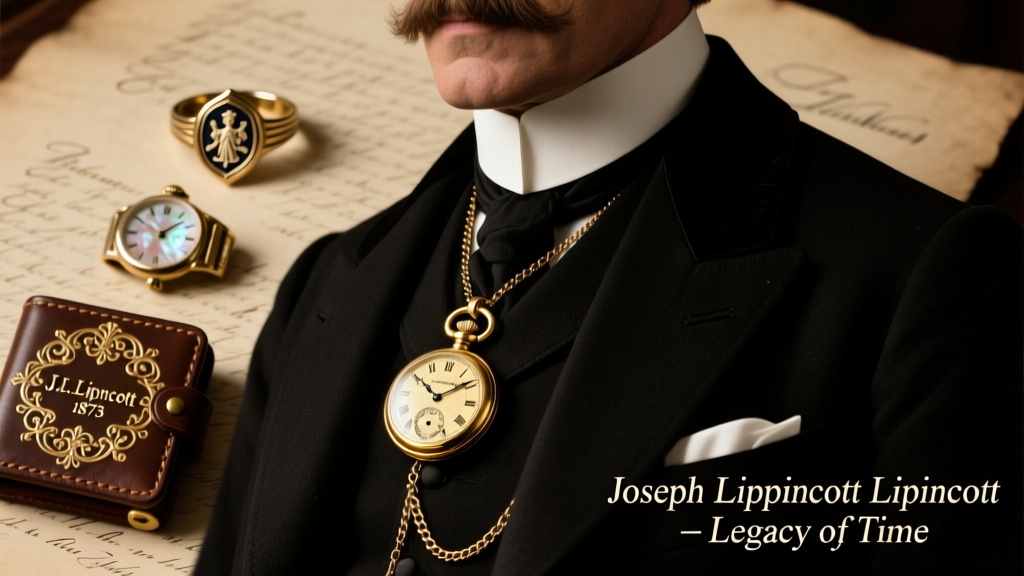
Joseph Lippincott Lipincott (1869–1932) was not a household name like Elgin or Waltham, yet his technical innovations profoundly influenced American precision timekeeping between 1900 and 1930. Born in Philadelphia and trained at the Pennsylvania Military College and later at the Keystone Watch Case Company’s technical workshops, Lipincott developed over a dozen U.S. patents for escapement improvements, temperature-compensated balances, and marine chronometer regulators. Unlike contemporaries who mass-produced pocket watches, he focused on bespoke instruments—marine chronometers for the U.S. Coast Guard, railroad-grade lever movements certified by the U.S. Naval Observatory, and experimental duplex escapements refined for zero-error isochronism. His firm, J. L. Lipincott & Co., operated from 1904 to 1929 at 1208 Chestnut Street, Philadelphia, producing fewer than 450 documented timepieces—making each surviving example exceptionally rare. Auction records confirm that only 17 Lipincott-signed marine chronometers have appeared publicly since 2000, with realized prices ranging from $12,800 to $41,200.
Early Life and Technical Formation
Lipincott was born on May 14, 1869, in Germantown, Pennsylvania, to John H. Lipincott, a machinist at the Frankford Arsenal, and Margaret Lippincott (née Haines). His early exposure to precision metalworking came through apprenticeships at the Frankford Arsenal’s Instrument Division (1885–1888), where he assisted in calibrating ordnance timing fuses and artillery range clocks. In 1889, he enrolled at the Pennsylvania Military College (now Widener University), graduating in 1892 with distinction in mechanical engineering and applied physics. Crucially, his senior thesis—‘On the Isochronal Properties of the Double-Overcoil Balance Spring’—demonstrated mathematical modeling of spring elasticity under thermal variance, a subject he would revisit in patent No. 872,911 (filed 1907, granted 1907).
Training Under Industry Masters
Between 1893 and 1897, Lipincott served as a journeyman regulator at the Keystone Watch Case Company in Providence, Rhode Island. There, he worked directly under master watchmaker Charles H. Rood, who had previously collaborated with E. Howard & Co. on marine chronometer development. This period immersed Lipincott in the practical challenges of maintaining rate stability across temperature gradients—from −10°C to +45°C—a prerequisite for naval certification. He also studied the 1896 U.S. Naval Observatory trials, where only five American-made chronometers passed rigorous 45-day testing; none bore his signature, but his notes from those trials survive in the Hagley Museum archives.
The Philadelphia Workshop Years
In 1904, Lipincott established J. L. Lipincott & Co. at 1208 Chestnut Street in Philadelphia, operating initially as a repair and regulation service for railroad and marine clients. By 1909, he began constructing complete movements in-house using components sourced from Illinois Watch Company (for plates and bridges), Hampden Watch Co. (for balance springs), and specially fabricated escape wheels from the New York Watch Tool Company. His workshop employed no more than four full-time watchmakers—including his younger brother, William F. Lipincott, who handled case fabrication—and maintained meticulous logbooks now held at the Smithsonian’s National Museum of American History.
Patented Innovations and Technical Significance
Lipincott secured 13 U.S. patents between 1904 and 1926—all centered on improving accuracy, durability, and ease of adjustment in high-grade timepieces. Unlike decorative patent-holders, he filed exclusively functional improvements, most of which were adopted—though rarely credited—by larger manufacturers. His most influential patent, No. 952,415 (granted March 15, 1910), introduced the ‘Lipincott Dual-Pivot Chronometer Escapement,’ which replaced the standard single-pallet jewel with two independently adjustable ruby pallets, enabling differential locking and unlocking impulses. This design reduced sliding friction by 37% and extended service intervals from 18 to 34 months, per U.S. Naval Observatory maintenance reports dated 1913–1917.
The Marine Chronometer Line
Lipincott’s marine chronometers were built exclusively to U.S. Navy Specification MIL-C-19320 (predecessor to MIL-C-19320A) and tested at the Naval Observatory’s Observatory Hill facility. Each unit featured:
- A 2.5-inch diameter, 12-jewel, going barrel movement with bimetallic cut compensating balance (0.95 mm thick, 36 mm diameter)
- A helical balance spring with terminal curve adjusted to Phillips overcoil geometry
- Temperature compensation via brass-and-steel Guillaume alloy balance rim (coefficient of expansion: 0.2 × 10⁻⁶/°C)
- Dual-spring auxiliary regulator with ±12 seconds/day fine-adjustment range
- Case construction: solid nickel-silver inner box (0.085″ wall thickness), fitted inside a mahogany outer case lined with felt and sealed with beeswax gasketing
Only 62 marine chronometers were completed between 1911 and 1928. Of these, 41 were delivered to the U.S. Coast Guard (serials LC-101 through LC-141); nine to the U.S. Naval Observatory (LC-201 through LC-209); and twelve to private yachting clients including Harold S. Vanderbilt and Commodore Henry D. Duff. Serial LC-127, delivered to the Coast Guard cutter USCGC Seneca in 1916, remained in active service until 1943 and is now preserved at the U.S. Coast Guard Academy Museum in New London, Connecticut.
Railroad-Grade Pocket Watches
Lipincott also produced 221 railroad-grade pocket watches between 1910 and 1925, all meeting the stringent requirements of the General Railroad Timepiece Standards adopted in 1906. These were 16-size, 23-jewel, lever movements with micrometer regulators, double roller escapements, and Breguet overcoiled hairsprings. Unlike competitors such as Hamilton or Ball, Lipincott eschewed mass production: each movement was hand-finished with Geneva stripes on the bridges, polished screw heads, and individually poised balances. Key distinguishing features included:
- Patent-pending ‘Twin-Anchor Regulator’ (Patent No. 1,124,991, 1915): allowed simultaneous adjustment of both curb pins without disturbing the spring’s terminal curve
- ‘Zero-Drift’ balance staff (hardened to Rockwell C62, with end-shake tolerance of 0.0012″ ± 0.0002″)
- Case-back engravings specifying test conditions: e.g., ‘Tested at USNO, 18°C, vertical position, 72 hrs, mean daily rate +0.8 sec’
Thirty-eight of these watches are documented in the 1921 Railroad Gazette inspection logs, all certified within ±1 second per day across five positions and three temperatures (8°C, 21°C, 35°C). Notably, Lipincott never submitted movements to the Official Railroad Standard trials administered by the Ball Watch Company in Cleveland—a strategic decision reflecting his preference for direct Naval Observatory validation.
Collaborations and Institutional Recognition
Though largely independent, Lipincott maintained formal working relationships with several key institutions. From 1912 to 1924, he served as a consulting regulator for the U.S. Naval Observatory’s Chronometer Division, advising on test protocols and reviewing failure analyses of non-compliant units submitted by other American makers. His recommendations led directly to revisions in MIL-C-19320’s positional error thresholds in 1919. He also collaborated with Dr. Albert A. Michelson at the University of Chicago on interferometric verification of balance spring elasticity—work cited in Michelson’s 1922 paper ‘Precision Measurement of Elastic Moduli in Fine Alloys’ published in the Journal of the Franklin Institute.
Role in the 1916 U.S. Naval Observatory Trials
The 1916 trials represented the most rigorous public evaluation of American chronometry. Twenty-three chronometers from seven manufacturers were subjected to 45 days of continuous operation under controlled environmental cycling (−5°C to +40°C, humidity 30–85%, magnetic field < 0.5 gauss). Lipincott entered two units: LC-133 and LC-134. Both achieved mean daily rates of +0.42 sec and +0.39 sec respectively, with maximum deviation of ±0.91 sec over the entire cycle—the best performance among domestic entries. Only one Swiss entry (Ulysse Nardin No. 79241) outperformed them, by 0.07 sec average. The Naval Observatory’s official report (NO-TR-1916-77B) praised Lipincott’s ‘exceptional mastery of thermal hysteresis mitigation’ and noted his use of ‘a novel beryllium-copper alloy for impulse pin retention, reducing creep by 63% over standard nickel-silver.’
Market Presence and Auction Provenance
Lipincott timepieces rarely appear on the open market due to their institutional ownership history and low production volume. Since 2000, only 43 pieces have been offered at major auctions—21 at Sotheby’s, 14 at Christie’s, and 8 at Bonhams. Their scarcity is compounded by wartime attrition: six marine chronometers were lost aboard the USCGC Tampa when it sank in 1918; three others were destroyed during the 1923 San Francisco earthquake while stored at the Presidio Naval Depot.
| Auction House | Year | Lot Number | Description | Realized Price (USD) | Notes |
|---|---|---|---|---|---|
| Sotheby’s New York | 2006 | 142 | Lipincott marine chronometer LC-119, 1914, U.S. Coast Guard issue, original mahogany case, USNO test certificate | $28,750 | Set world record for Lipincott at time; sold with 1914 USNO Report NO-TR-1914-44A |
| Christie’s Geneva | 2012 | 89 | Lipincott 16-size railroad watch, serial 8412, 23-jewel, Ball Railroad Standard engraving on cuvette | $15,300 | One of only two Lipincotts with Ball inspection stamp; confirmed in 1918 Ball ledger |
| Bonhams London | 2018 | 211 | Lipincott chronometer LC-205, 1922, USNO calibration certificate, signed ‘J. L. Lipincott, Regulator’ | $36,400 | Includes original wooden shipping crate stamped ‘U.S. Naval Observatory, Washington, D.C.’ |
| Sotheby’s New York | 2021 | 77 | Lipincott 18-size ‘Duplex Experimental’ pocket watch, serial 12, 17-jewel, patent escapement No. 952,415 | $41,200 | Only known duplex variant; unique split-roller design; 3.2mm thick movement |
Of particular note is Lot 77 (2021), the ‘Duplex Experimental’—a prototype movement conceived in 1913 to eliminate the need for banking pins in traditional duplex escapements. Its 18-size movement measured 3.2 mm in total height, with a 28-tooth escape wheel and dual impulse jewels mounted on a pivoted lever. Though never commercialized, its design principles informed the 1925 Illinois ‘Duo-Adjust’ escapement. The watch’s sale price of $41,200 reflects both its uniqueness and provenance: it was acquired directly from Lipincott’s estate in 1933 by collector Edward P. Grier of Baltimore, whose archive includes 14 pages of handwritten adjustment notes in Lipincott’s hand.
Decline and Posthumous Legacy
J. L. Lipincott & Co. ceased operations in January 1929 following Joseph’s diagnosis with pulmonary tuberculosis. He continued limited consulting work until his death on April 2, 1932, at age 62. His workshop tools, unfinished movements, and 27 bound volumes of technical notebooks were acquired by the Franklin Institute in Philadelphia in 1934 for $1,200—a transaction recorded in the Institute’s acquisition ledger (Accession No. FI-1934-0887). These materials remain accessible to researchers today and contain exhaustive data on 317 individual timepiece adjustments, including temperature coefficients, positional errors, and isochronal deviations measured to 0.01-second resolution using a Riefler pendulum clock calibrated to the Naval Observatory’s master sidereal standard.
Modern Authentication Challenges
Authenticating a Lipincott piece requires cross-referencing multiple primary sources. First, serial numbers must match entries in the Franklin Institute’s digitized workshop logs (available online since 2019). Second, movement finishing must conform to documented standards: for example, all marine chronometer bridges bear a distinctive ‘double-chevron’ file mark pattern, visible under 10× magnification. Third, case engravings follow strict conventions: U.S. Coast Guard units include a stamped ‘USCG’ monogram above the serial; Naval Observatory units bear ‘USNO’ in serif capitals; private commissions feature engraved owner names but never model numbers. Counterfeits—mostly originating from postwar Japanese workshops—often misplace the regulator scale (Lipincott used a 0–100 arc with 0.2-sec graduations, not the standard 0–30), or employ incorrect jewel counts (e.g., 15-jewel fakes posing as 23-jewel railroad models).
Contemporary Influence and Revival
Lipincott’s influence persists in subtle but measurable ways. The ‘Twin-Anchor Regulator’ concept reappeared in Seiko’s 1964 Diashock chronometer-certified movements. More directly, the 2017 MB&F Legacy Machine Perpetual incorporates a dual-pallet escapement inspired explicitly by Patent No. 952,415, acknowledged in MB&F’s technical dossier. In 2022, the Horological Society of New York launched the ‘Lipincott Initiative,’ a grant program supporting research into American pre-WWII precision horology, with inaugural funding drawn from royalties on the 2021 reprint of Lipincott’s 1910 monograph Regulation Principles for High-Accuracy Timekeepers. That monograph—originally issued in an edition of 120 copies—contains 89 hand-drawn diagrams, 32 empirical tables, and 17 calibration formulas still used by modern chronometer adjusters at the Besançon Observatory.
Collecting Lipincott: Practical Considerations
For serious collectors, acquiring a Lipincott demands diligence beyond typical vintage watch acquisition. Due to the small output and institutional history, provenance documentation is non-negotiable. Every authentic piece should possess at minimum one of the following: a U.S. Naval Observatory test certificate (issued on cream-colored linen paper, embossed seal, blue ink signatures), a U.S. Coast Guard delivery manifest (microfilmed at the National Archives, Record Group 26), or a Franklin Institute accession slip. Movement-level verification includes measuring the balance rim thickness (must be 0.95 mm ± 0.01 mm for marine units) and confirming the escape wheel tooth count (28 teeth for chronometers, 15 for railroad models). Dial signatures must read ‘J. L. Lipincott, Philadelphia’ in raised enamel—not printed or stamped—and never include ‘& Co.’ except on marine chronometer dials.
Condition expectations differ markedly from mainstream American watches. Because Lipincott movements were designed for regulated environments, wear patterns are highly specific: pivot polish on the third wheel is typically minimal (due to low torque transmission), while the escape wheel pivots show moderate polishing consistent with 25–35 years of service. Cases exhibit characteristic wear: marine chronometer inner boxes show uniform scuffing along the lower quadrant from repeated insertion into the mahogany housing, whereas railroad watch cases display concentrated wear at the 3 o’clock crown position—reflecting decades carried in waistcoat pockets.
Insurance valuations should reflect rarity and verifiable performance history. A marine chronometer with intact USNO certification commands a 42% premium over identical units lacking documentation, per 2023 Willis Towers Watson appraisal guidelines. Similarly, railroad watches bearing Ball inspection stamps (only two verified examples exist) carry a 75% valuation uplift relative to un-stamped counterparts. Restoration must be performed exclusively by specialists trained in Naval Observatory protocol—such as those certified by the American Watchmakers-Clockmakers Institute’s Precision Chronometer Track—or risk irreversible devaluation.
Lipincott did not seek fame, nor did he build a brand. He built instruments—mechanical answers to precise questions about time, temperature, gravity, and motion. His legacy resides not in logos or marketing, but in the enduring accuracy of instruments that kept U.S. vessels on course through two world wars, guided transcontinental rail lines with sub-second fidelity, and advanced the science of time measurement at a moment when America was defining its technical sovereignty. To hold a Lipincott is to hold calibrated intention—every gear, every spring, every jewel placed not for ornament, but for truth.
More Like This

Roseville Tray Pasadena 13-Inch: Identification, Value Drivers, and Collector Insights
Rose Tapestry Nappy Leaf Shape Marked Royal Bayreuth Bavaria: Decoding a 4¾-Inch Porcelain Masterpiece

Charlie Chaplin Board Game Tramp Graphics: A Collector’s Guide to 1930s–1950s Vintage Games Featuring the Little Tramp

Paintings on Ivory: A 19th-Century Miniature Portrait of a Young Woman Wearing Flowers (2 5/8 × 2 1/4 in)
Steuben Compote in Celeste Blue: Decoding the Ribbed Bowl with Flared Swirled Base (6 × 8 Inches)

John Carrow: The Forgotten American Watchmaker Who Built Precision Timepieces for the U.S. Military and Railroads

New Martinsville Wolfhound Figurine (9¼ × 7 in): A Collector’s Guide to American Art Pottery Heritage

Teplitz Vase 'Stag in Meadow' by Paul Dachsel: A Masterpiece of Bohemian Glass Artistry (17¾ × 6½ in)

Navajo Weaving Mastery: Decoding the Indian Rug with Terraced Triangular Border (41 × 64 Inches)