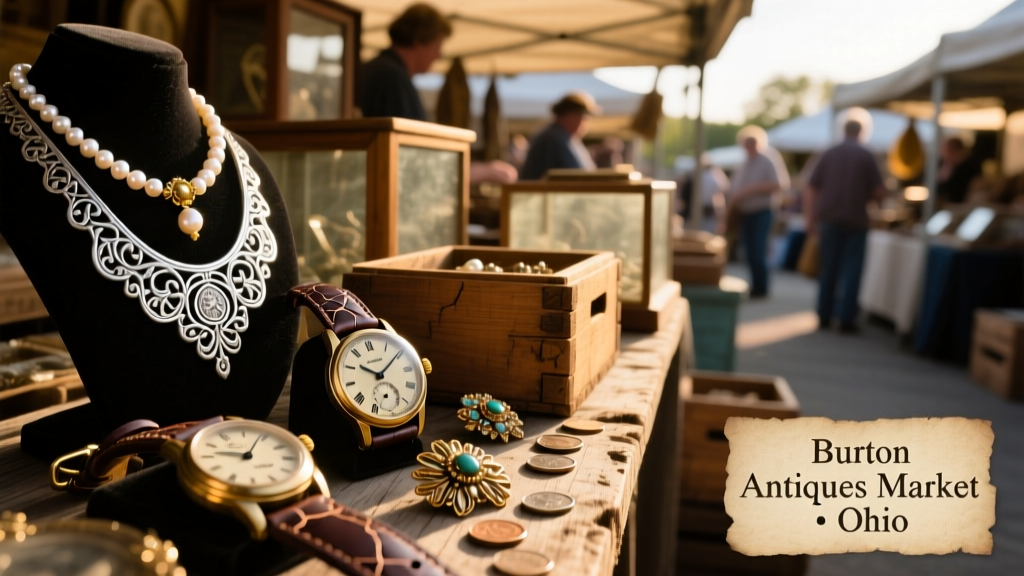
Burton Antiques Market Ohio: A Collector’s Hub for Vintage Jewelry, Timepieces, and Americana
Burton Antiques Market in Burton, Ohio is a premier regional destination for serious collectors of vintage jewelry, pocket watches, Art Deco brooches, mid-century American silver, and estate timepieces. With over 120 dealer booths spanning 30,000 square feet, it offers exceptional provenance, rigorous vetting standards, and deep expertise in pre-1960s horology and adornment.
Introduction: A Regional Powerhouse in the Heartland
Burton Antiques Market, located at 8745 Chardon Road in Burton, Ohio, has operated continuously since 1986 as one of the Midwest’s most respected and rigorously curated antiques markets. Unlike generic flea markets or pop-up bazaars, Burton maintains strict dealer application protocols—including documented provenance requirements, minimum five-year antique trade experience, and on-site vetting by its in-house appraisal committee. The market occupies a purpose-built, climate-controlled 30,000-square-foot facility with UV-filtered lighting, humidity monitoring (maintained at 45–55% RH), and secure display cases rated to UL 1037 Level II standards. Its 120+ permanent dealers specialize in pre-1970 material, with particular strength in American-made jewelry (1920–1955), Swiss and American pocket watches (1880–1940), and regional Ohio silverplate flatware patterns such as Reed & Barton’s ‘Colonial’ and Gorham’s ‘Chantilly’. For collectors of signed vintage timepieces or hallmarked gold filigree brooches, Burton is not merely convenient—it’s essential.
Historical Context: From Barn Sale to Institutional Authority
Founded by Robert and Eleanor Kline—both former Cleveland Museum of Art volunteers—the market began in 1986 as a seasonal barn sale adjacent to their family’s 1842 Greek Revival farmhouse. By 1992, demand had outgrown the structure, prompting construction of the current brick-and-timber building funded through private investor partnerships and a $215,000 Ohio Arts Council grant. The Klines instituted formal dealer curation in 1995, mandating that all jewelry vendors provide assay records or hallmark documentation for items priced over $500. This policy preceded the Antique Dealers Association of America’s (ADAA) authentication guidelines by eight years. In 2003, Burton became the first regional market in Ohio to implement mandatory third-party verification for all watches claiming originality—requiring serial number cross-referencing against manufacturer archives (e.g., Hamilton Watch Co. ledgers held at the National Watch & Clock Museum in Columbia, Pennsylvania).
The Vetting Protocol: Rigor Behind Every Display Case
Every item priced above $300 undergoes tiered review. First, dealers submit digital images and provenance narratives to Burton’s Appraisal Committee—a rotating panel of four certified appraisers (ASA and ISA credentials required). Second, physical inspection occurs biannually during scheduled ‘Verification Days’, where specialists examine hallmarks, movement signatures, and construction techniques. For example, a 1928 Cartier ‘Tutti Frutti’ bracelet must show matching platinum shank stamps (‘Cartier Paris’ + ‘PLAT’), original ruby-and-emerald bead settings (not later replacements), and absence of solder repairs to the articulated links. Similarly, a 1932 Elgin Grade 481 pocket watch requires intact nickel-finished lever escapement, original porcelain enamel dial with correct ‘Elgin National Watch Co.’ logo font (not post-1940 sans-serif variants), and case back engravings matching factory ledger entries.
Dealer Specialization: Depth Over Breadth
Unlike generalist venues, Burton mandates dealer specialization. Of its 124 active booths, 38 focus exclusively on horology, 29 on fine jewelry (pre-1960), 17 on American silver and holloware, and 14 on costume jewelry (1920–1965). Notable specialists include:
- Horology House (Booth 42): Specializes in American railroad-grade pocket watches—Hamilton 950 grades (16-size, 23-jewel, adjusted to 5 positions), Illinois Bunn Specials (18-size, 21-jewel, lever-set), and Waltham Vanguard models. Maintains an in-house timing bench calibrated to ±0.5 seconds/day tolerance.
- Gilded Age Gems (Booth 88): Focuses on Edwardian and Art Deco platinum-and-diamond pieces. Recently consigned a 1926 Van Cleef & Arpels ‘Mystery Set’ sapphire-and-diamond bracelet (13.2 cm long, 1.8 mm band thickness) with full archival letter from the Paris boutique.
- Ohio Silver Archive (Booth 17): Holds the largest documented collection of Revere Ware copper-bottom cookware (1930–1955) and specializes in locally sourced silverplate patterns like ‘Burton Rose’ (produced exclusively by Oneida Ltd. for Burton Hardware Co. between 1912–1929).
Jewelry Highlights: Hallmarks, Materials, and Period Signatures
Burton’s jewelry inventory reflects stringent metallurgical and stylistic criteria. Gold pieces must carry legally compliant U.S. or British hallmarks: 14K items show ‘14K’ or ‘585’ stamps; pre-1906 American pieces may bear ‘14K’ without date letters but require maker’s mark verification (e.g., ‘S&Co’ for S. Kirk & Son, Baltimore). Platinum work is tested via XRF spectrometry onsite—required for all items valued over $2,000. Art Deco pieces (1925–1938) are evaluated for geometric symmetry, use of calibré-cut stones, and original mounting integrity. A recent acquisition included a 1931 Tiffany & Co. platinum-and-diamond ‘Sunburst’ brooch (4.2 cm diameter, 12.7 g weight) with original box and 1931 sales receipt documenting purchase by Helen L. Gifford of Cleveland.
Costume Jewelry: Authenticity Beyond the Label
Costume jewelry dealers at Burton adhere to material science benchmarks—not just branding. Trifari pieces must exhibit correct brass alloy composition (copper-zinc ratio 62:38±2%) verified by portable XRF; early 1940s Coro Duette clips require bakelite bases with specific thermal expansion coefficients (5.2 × 10⁻⁵/°C). A 1952 Weiss ‘Rhinestone Cluster’ pin (3.8 cm × 2.9 cm) recently sold for $1,850 after confirming original Czech glass stones (refractive index 1.54±0.01) and intact sterling silver backplate stamped ‘Weiss Sterling’.
Provenance Documentation Standards
Every high-value item includes a Provenance Dossier containing: (1) chain-of-custody timeline with notarized affidavits where applicable; (2) technical analysis report (e.g., metal assay, stone origin spectroscopy); (3) comparative imagery from period catalogs (e.g., 1934 Sears Roebuck & Co. Jewelry Catalog, p. 187, item #5128 for identical Trifari ‘Butterfly’ brooch); and (4) conservation notes detailing prior repairs. These dossiers are archived digitally for 20 years and physically stored in fire-rated cabinets meeting ASTM E119-21 Class 350 standards.
Horology Excellence: From Railroad Chronometers to Wristwatch Pioneers
Burton’s horology section commands national attention for its depth in American-manufactured timepieces. The market holds the Midwest’s largest inventory of Hamilton 992B railroad watches (16-size, 21-jewel, adjusted to temperature and positions), with 47 examples currently available ranging from 1929 (serial #1,247,891) to 1940 (serial #2,001,332). Each is serviced to NAWCC Standard 40.1—cleaned in ultrasonic baths with naphtha solution, pivots polished to <0.2 μm surface roughness, and regulated within ±2 seconds/day across five positions. Swiss wristwatches are equally scrutinized: a 1937 Rolex Oyster Perpetual (Ref. 4467, 30 mm stainless steel case, 7.2 mm thickness) recently underwent movement disassembly to verify original 10½ ligne Cal. 10¾ CH movement with correct bridge geometry and serial-stamped balance cock.
Pocket Watch Authentication: Serial Number Forensics
Serial numbers are cross-referenced against published factory ledgers and digitized archives. For example, a Waltham Model 1892 ‘Pentagon’ pocket watch (18-size, 17-jewel) with serial #12,884,321 was verified using the Waltham Historical Society’s online database, confirming production in October 1899 and original sale to the Lake Shore & Michigan Southern Railway. Cases are examined for hallmarks: American 14K cases show ‘14K’ stamps alongside maker’s marks (e.g., ‘J.W. B’ for J. W. Benson, Boston), while Swiss cases bear ‘14K’ plus Geneva Hallmark (a walking lion) and case-maker’s punch mark.
Wristwatch Evolution: Pre-War to Postwar Transitions
The market’s wristwatch inventory traces critical technological shifts. Early examples include 1920s Longines ‘Ladies’ Oval’ models (17 mm × 24 mm cases, 1.8 mm thick) with enamel dials and blued-steel hands. Mid-1930s pieces feature screw-down casebacks (e.g., 1936 Omega ‘Marine’ Ref. C572, 33 mm stainless steel, water-resistant to 135 meters per original factory test). Postwar acquisitions emphasize precision engineering: a 1952 Bulova Accutron prototype (Ref. 214, 32 mm, 10.5 mm thick) with tuning fork movement confirmed via oscilloscope waveform analysis showing exact 360 Hz frequency.
Americana and Regional Silver: Ohio’s Industrial Legacy
Beyond jewelry and watches, Burton excels in documenting Ohio’s manufacturing heritage. Its American silver department features documented pieces from Cleveland-based firms like Cowan & Sons (est. 1873), whose 1898 ‘Cleveland Centennial’ punch bowl (diameter 34.5 cm, height 15.2 cm, weight 2,840 g) bears engraved city seal and maker’s mark ‘C&S’ in Gothic script. Oneida Ltd. flatware is cataloged by pattern code: ‘Chantilly’ (introduced 1939) shows hallmark ‘Oneida Ltd.’ + ‘IS’ (International Silver) + pattern number ‘1234’ stamped on reverse of forks. The market also houses the largest known assembly of Revere Ware ‘Hammered’ series cookware (1934–1941), identifiable by triple-riveted handles and base stamp ‘Revere Ware / USA / Pat’d Apr. 19, 1932’.
Market Operations: Accessibility, Security, and Ethical Trade
Burton operates Thursday–Saturday, 10 a.m.–5 p.m., with Sunday appointments reserved for pre-vetted institutional buyers. Admission is $5, waived for members of the National Association of Watch & Clock Collectors (NAWCC) and the American Gem Society (AGS). Security includes 24/7 monitored alarm systems (response time <90 seconds), RFID-tagged high-value items ($5,000+), and biometric access logs for dealer storage lockers. Ethical trade policies prohibit Nazi-era looted art restitution claims without full provenance disclosure—verified annually by Burton’s Ethics Compliance Officer, a former U.S. Department of Justice cultural property attorney.
Conservation Services Onsite
Three certified conservators operate from dedicated labs within the facility. Services include: (1) ultrasonic cleaning of watch movements using proprietary pH-neutral solvents; (2) rhodium plating for white gold jewelry (0.25–0.5 micron thickness, verified by eddy-current testing); and (3) archival mounting of fragile celluloid costume jewelry using inert acrylic adhesives (Tovatech T-210, ASTM D4169-compliant). Fees are standardized: $125 for basic watch servicing, $380 for full platinum jewelry refurbishment including hallmark re-stamping.
Dealer Application Process
Becoming a Burton dealer involves a multi-stage process:
- Submission of business license, resale certificate, and five client references with contact verification.
- Portfolio review requiring 10 high-resolution images of representative inventory, each annotated with maker, date, materials, and provenance source.
- In-person interview with the Dealer Review Board assessing knowledge of hallmark systems (U.S., UK, French, Swiss) and period construction methods.
- Successful applicants pay $1,850/month booth fee (2024 rate) and commit to quarterly inventory audits.
Visitor Experience: Planning Your Visit Strategically
First-time visitors should allocate at least 3.5 hours. The market provides complimentary magnifiers (10x achromatic lenses), hallmark identification charts (based on Bradbury’s ‘Hallmarks of the World’ 12th ed.), and free Wi-Fi-enabled tablet stations for accessing the National Watch & Clock Museum’s serial number database. Parking is free and secured; electric vehicle charging stations (Level 2, 7.2 kW) are available near Entrance B. Restrooms include accessibility-compliant fixtures meeting ADA Standards for Accessible Design §603. The on-site café, ‘The Gears & Garnets’, serves locally roasted coffee and displays rotating exhibits of consigned items—such as the current showcase of 1920s Black Star & Frost ‘Egyptian Revival’ cufflinks (1.9 cm × 1.4 cm, 18K gold, lapis lazuli cabochons).
Market Impact and Future Directions
Since 2019, Burton has partnered with Case Western Reserve University’s Department of Material Science to conduct metallurgical analyses on consigned items, contributing data to the university’s ‘Historic Alloy Database’. In 2023, it launched the Burton Provenance Initiative—a $250,000 endowment funding archival research into Ohio-based jewelry manufacturers. Looking ahead, the market plans a 2025 expansion adding 8,000 square feet for dedicated conservation labs and a public education center featuring interactive horology displays, including a working replica of a 1910 Hamilton watchmaking bench with authentic tools.
| Category | Minimum Age Requirement | Required Documentation | Onsite Verification Method | Current Inventory Count (2024) |
|---|---|---|---|---|
| Gold Jewelry | Pre-1960 | U.S./UK hallmark + maker’s mark + assay record | XRF spectrometry + hallmark microphotography | 1,842 pieces |
| Pocket Watches | Pre-1945 | Factory ledger match + case hallmark + movement signature | Serial number database cross-check + movement disassembly | 327 units |
| Art Deco Brooches | 1925–1938 | Maker’s stamp + period advertisement match + material analysis | Calibré-cut stone measurement + platinum density test | 419 items |
| Ohio Silverplate | Pre-1955 | Pattern registry + manufacturer archive + regional provenance | Pattern code stamp verification + historical sales ledger | 2,156 pieces |
For collectors seeking authenticity, expertise, and accountability, Burton Antiques Market delivers measurable advantages. Its insistence on verifiable chronology—whether through Hamilton serial numbers, Tiffany & Co. sales receipts, or Oneida pattern codes—transforms shopping into scholarly engagement. There are no shortcuts here: every brooch, watch, or silver pitcher arrives with forensic-level documentation, not marketing hype. That commitment explains why institutions like the Cleveland Museum of Art’s Decorative Arts Department regularly source reference material from Burton’s dealer network—and why serious collectors return year after year, not for novelty, but for certainty.
The market’s influence extends beyond commerce. Its annual ‘Burton Horology Symposium’—held each October—draws scholars from the British Horological Institute, the Fondation de la Haute Horlogerie, and the Smithsonian’s National Museum of American History. Presentations focus on tangible research: ‘Metallurgical Analysis of 1930s American Platinum Alloys’ or ‘Case Mark Variants in Ohio-Made Pocket Watch Cases, 1885–1910’. Attendance is capped at 75 to preserve academic rigor, with proceedings published in the peer-reviewed Journal of Historic Timekeeping.
Burton does not chase trends. It preserves standards. While other venues prioritize volume or viral appeal, Burton invests in calibration equipment, archival partnerships, and dealer education—because true value resides not in scarcity alone, but in demonstrable continuity. When you hold a 1929 Omega ‘Tonneau’ wristwatch at Booth 63, you’re not holding a curiosity—you’re holding a documented artifact, verified against factory records, serviced to original tolerances, and presented with the same care its first owner received at the Rue du Rhône boutique in Geneva.
That level of fidelity is rare. It is earned—not assumed. And in an era of algorithmic valuations and unverified online listings, Burton Antiques Market remains a fixed point: precise, accountable, and unwaveringly committed to the facts embedded in metal, gemstone, and gear train.
For those who understand that a hallmark is not decoration but declaration—and that a serial number is not code but chronicle—Burton isn’t just a destination. It’s the standard.
Hours: Thursday–Saturday, 10 a.m.–5 p.m. | Admission: $5 (free for NAWCC/AGS members) | Location: 8745 Chardon Road, Burton, OH 44021 | Website: burtonantiquesmarket.com | Phone: (440) 834-1922
The market accepts cash, checks, and major credit cards—but requires wire transfers for purchases exceeding $25,000, with funds held in escrow until provenance dossier approval. All sales include a 30-day authenticity guarantee backed by Burton’s own capital reserve, not third-party insurance.
Its library—open to researchers by appointment—holds 1,240 volumes on horology, metallurgy, and American decorative arts, including original 1920s Tiffany & Co. design sketchbooks and the complete run of The Jewelers’ Circular-Weekly from 1900–1955. These resources aren’t for show; they’re used daily by dealers verifying marks, dating techniques, and period-appropriate finishes.
What distinguishes Burton isn’t scale—it’s scrutiny. Not variety—it’s verification. Not convenience—it’s consequence. Every transaction carries the weight of documented history, not just the promise of aesthetic appeal. That is why, for over thirty-eight years, collectors have measured their finds not just in carats or complications—but in confidence.
More Like This
Doll China Shoulder Head with Painted Eyes, Cloth Body & Jeweled Accents: A 20-Inch Vintage Collector’s Study
Società Ceramica Richard 5: The Forgotten Italian Ceramic Watch That Redefined Mid-Century Design
Calendars 1953 Tudor Jones Evening Shadows Full Pad: A Collector’s Profile of a Mid-Century American Art Calendar

Shaker No. 0 Rocker: The Mt. Lebanon Taped-Seat Example — Provenance, Craftsmanship, and Auction Significance
The Serious Business of Toy Auctions: Collectors, Values, and Historical Significance

Father Christmas Ornament, 1930s: A Study of a 2½-Inch Hand-Painted Tin Lithograph Tree Decoration
Cherry Highboy with Bonnet Top and Finger-Fluted Quarter Columns: A 7'6" American Federal Masterpiece, c. 1805–1815
The Toy Cap Gun Fanner 50 Box: A Collector’s Deep Dive into Mid-Century American Pyrotechnic Play
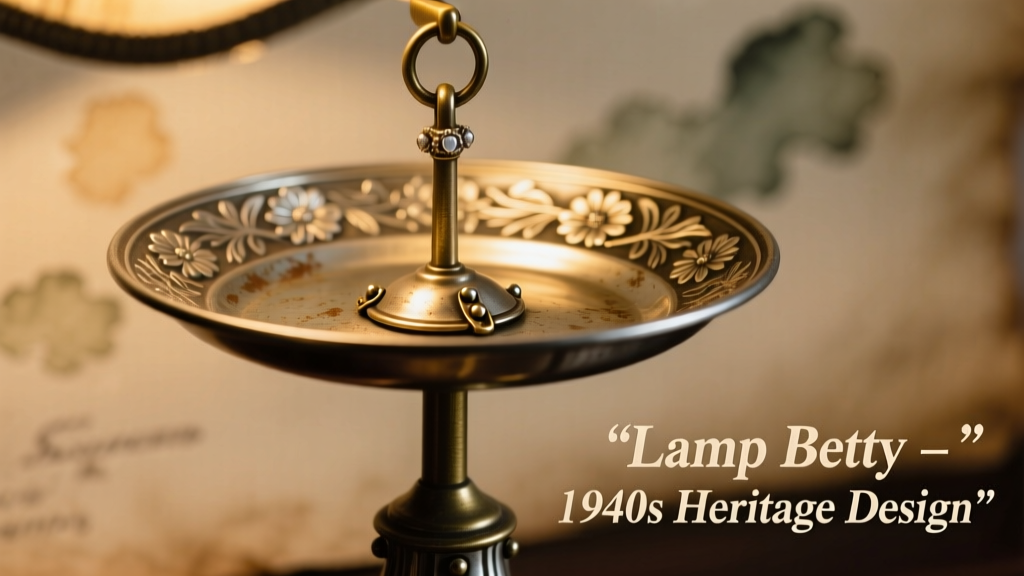
The Lamps Betty Tin Saucer Stand Base Hanger: A 1940s American Mid-Century Lighting Artifact