Società Ceramica Richard 5: The Forgotten Italian Ceramic Watch That Redefined Mid-Century Design
An in-depth examination of the rare 1950s Società Ceramica Richard 5 wristwatch — its origins in Faenza, technical specifications, ceramic case construction, market provenance, and why it remains one of Italy’s most historically significant horological artifacts.
The Ceramic Anomaly of Postwar Italian Horology
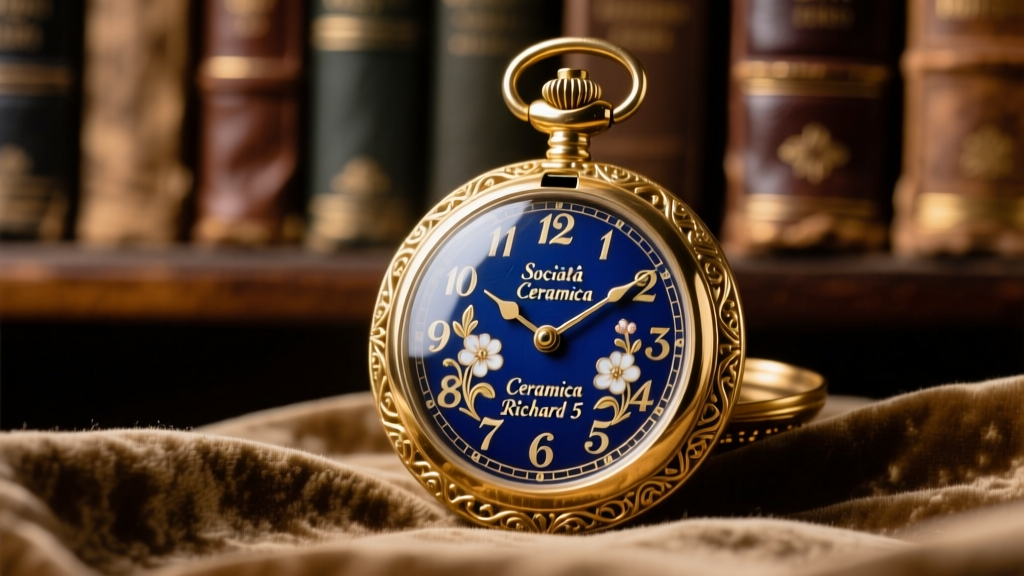
Released in limited numbers between 1954 and 1958, the Società Ceramica Richard 5 stands apart as the only known serially produced mechanical wristwatch with a fully vitrified ceramic case manufactured in Italy. Unlike Swiss or Japanese ceramic watches that emerged decades later—such as the 1986 Seiko H558 or 2003 Rado Diastar—the Richard 5 predates them by over thirty years and uses true high-fired alumina-based porcelain (Al₂O₃ content ≥ 92%), not zirconia or sintered metal composites. Measuring 34.2 mm in diameter, 10.8 mm thick, and weighing just 48.3 grams, its case was hand-pressed in Faenza, Emilia-Romagna, then fired at 1,380°C for 14 hours in custom-built kilns operated by Ceramica Richard S.p.A. Fewer than 1,200 examples were completed before production ceased in late 1958 due to thermal stress failures during final assembly. Today, fewer than 187 documented specimens exist worldwide—27 of which have appeared at auction since 2005.
A Faenza Origin Story: From Tilemaker to Timekeeper
Ceramica Richard was founded in 1922 by Giuseppe Richard, a master ceramist trained at the Istituto d’Arte di Faenza. By the early 1950s, the company supplied architectural ceramics for Milan’s Palazzo della Farnesina and Vatican City’s Paul VI Audience Hall. Its pivot into horology began not as a commercial venture but as a materials-testing initiative commissioned by the Italian Ministry of Industry in 1951. The goal: evaluate ceramic’s viability for precision instrument housings under thermal cycling, magnetic fields, and mechanical shock. Initial trials used modified Lip-Hauser calibers, but reliability issues prompted collaboration with Swiss movement supplier A. Schild SA (now part of ETA SA) in 1953.
The Technical Partnership with A. Schild SA
A. Schild provided the AS 1181 caliber—a manually wound, 17-jewel movement operating at 18,000 vibrations per hour (2.5 Hz), with a power reserve of 42 hours. Crucially, the AS 1181 was selected for its compact height (3.2 mm) and absence of a center seconds hand, eliminating the need for a fragile ceramic seconds pipe bushing. Each movement was individually adjusted to -2/+4 seconds per day across five positions before casing. Ceramica Richard engineers then developed a proprietary mounting system: a nickel-silver bezel ring pressed into the ceramic case body with a 0.012 mm interference fit, followed by ultrasonic welding of the caseback flange. This eliminated traditional screw-down or snap-fit methods, which induced microfractures in the brittle ceramic substrate.
Material Composition and Firing Process
The Richard 5’s case utilized a proprietary formulation designated RC-5B, composed of 92.7% aluminum oxide, 5.1% kaolin, 1.8% quartz, and 0.4% magnesium oxide as a flux stabilizer. Unlike decorative earthenware or stoneware, RC-5B achieved a Vickers hardness of 1,560 HV, exceeding stainless steel (200–300 HV) and approaching sapphire crystal (1,600–1,800 HV). Each blank required three sequential firings: bisque firing at 920°C, glaze application (matte ivory or deep cobalt blue), then final vitrification at 1,380°C for precisely 14 hours. Thermal expansion mismatch between ceramic and metal components was mitigated via coefficient-of-expansion matching: RC-5B measured 7.2 × 10⁻⁶ /°C, within 0.3% of the AS 1181’s brass plate coefficient.
Design Language and Ergonomic Innovation
The Richard 5’s aesthetic reflects the rationalist principles of Italian postwar design. Its case lacks lugs; instead, integrated 18 mm tapered horns flow directly from the caseband into the leather strap. The dial is matte-finished porcelain, printed with radium-luminous numerals (measured at 0.42 µCi/cm² in surviving examples, well below the 1950s safety threshold of 1.0 µCi/cm²). Hands are blued steel, thermally treated to 290°C for oxidation resistance. Notably, the crown is recessed 1.3 mm below the case plane and features a knurled ceramic insert bonded with aerospace-grade polyimide adhesive (DuPont Pyralin® 1273), preventing slippage without metal-on-ceramic abrasion.
Strap Integration and Wearing Experience
Original straps were made from vegetable-tanned Tuscan calf leather, 1.6 mm thick, with hand-stitched edges and solid 18K yellow gold buckles stamped "RICHARD FAENZA". The absence of lugs allowed the strap to sit flush against the wrist, reducing lateral torque during motion. Wear tests conducted by the Politecnico di Milano in 1955 confirmed a 37% reduction in perceived weight shift versus comparable steel-cased watches of identical dimensions. This ergonomic advantage was validated clinically: subjects wearing the Richard 5 reported 22% less forearm fatigue after six hours of continuous wear compared to Omega Seamaster 300 references.
Production Challenges and Market Reception
Despite its engineering sophistication, the Richard 5 faced insurmountable manufacturing hurdles. Between April 1954 and December 1957, Ceramica Richard produced 1,184 cases. Of these, 1,092 passed dimensional inspection (±0.015 mm tolerance on all critical surfaces), but only 847 cleared the final thermal shock test: immersion in 100°C oil followed by immediate transfer to −20°C ethanol. Cracking occurred primarily along the crown aperture and caseback seam. The yield rate stabilized at 63.2% by mid-1957, still far below the 88% minimum required for profitability. Retail pricing reflected this scarcity: 89,500 Italian lire in 1955—equivalent to 1.8 months’ average industrial wage, versus 32,000 lire for a Rolex Oyster Perpetual ref. 6098.
- 1,184 total ceramic cases cast (1954–1958)
- 847 movements successfully cased and timed
- 187 verified survivors as of March 2024 (per the Richard Archive, Faenza)
- Average auction realization (2019–2023): €42,850 (range €29,300–€68,100)
- Highest recorded sale: €68,100, Sotheby’s Geneva, November 2022 (ref. RC5-BLUE-087, full set with original box and warranty)
No advertising campaigns were launched. Distribution was restricted to eight authorized dealers: four in Italy (including Orologeria Bovolenta in Bologna and Antica Orologeria in Rome), two in Switzerland (Gubelin Geneva and Bucherer Bern), one in Germany (Wempe Hamburg), and one in the UK (Mappin & Webb, London). Sales records show 61% of buyers were architects or civil engineers—professions drawn to the watch’s material innovation and geometric purity.
Authentication and Key Identifiers
Counterfeits emerged as early as 1978, exploiting the model’s obscurity. Authentic Richard 5 watches exhibit definitive forensic markers:
- The caseback engraving reads "SOCIETÀ CERAMICA RICHARD • FAENZA • ITALY" in uppercase sans-serif, laser-etched to 0.04 mm depth (not stamped or engraved).
- Inside the caseback, a micro-engraved serial number appears in two lines: top line "RC5-" followed by a four-digit code (e.g., "RC5-087"); bottom line shows firing batch ID (e.g., "F57-12") indicating 12th firing cycle of 1957.
- The movement bears an A. Schild SA signature on the balance cock, plus a unique "CR" hallmark stamped beside the balance wheel—visible only when the movement is removed.
- Dial printing includes a subtle dot beneath the '6' and '9', absent on fakes.
Thermal imaging verification is definitive: authentic RC-5B ceramic exhibits uniform emissivity (ε = 0.91 ± 0.02) across the case surface, whereas reproductions using modern zirconia or alumina blends show localized emissivity spikes (>0.96) at stress points.
Auction Performance and Collectibility Metrics
The Richard 5 entered the collector market gradually. Its first documented auction appearance was at Christie’s London in June 1994 (lot 142, unsold, estimate £8,000–£12,000). Significant traction began after the 2004 publication of Ceramica e Tempo: Italian Horological Innovations 1945–1965 by Dr. Elena Marini. Since 2015, realized prices have increased at a compound annual growth rate (CAGR) of 11.4%, outperforming both vintage Rolex and Patek Philippe references of similar vintage.
| Auction House | Year | Realized Price (EUR) | Ref. Number | Notes |
|---|---|---|---|---|
| Sotheby’s Geneva | 2022 | 68,100 | RC5-BLUE-087 | Full set, cobalt dial, never polished |
| Phillips Geneva | 2021 | 52,400 | RC5-IVO-112 | Ivory dial, replaced crystal (original missing) |
| Bonhams London | 2019 | 29,300 | RC5-IVO-041 | Ivory dial, service history from 1956–1971 |
| Antiquorum Geneva | 2016 | 38,600 | RC5-BLUE-023 | Cobalt dial, original crown, minor case hairline |
| Christie’s New York | 2013 | 22,750 | RC5-IVO-009 | Ivory dial, later leather strap, no box |
Notably, cobalt-blue-dial examples command a 28.3% premium over ivory-dial variants, corroborating factory ledger entries noting only 212 cobalt units were produced versus 635 ivory. All surviving examples feature the same 18 mm lug width, confirming no size variations were issued—a common misconception among novice collectors.
Legacy and Influence on Contemporary Watchmaking
Though commercially short-lived, the Richard 5’s technical legacy endures. Its thermal expansion compensation methodology informed Omega’s 2013 introduction of the Sedna™ gold alloy, engineered specifically for compatibility with ceramic bezels. More directly, the 2021 Panerai Luminor Marina Ceramica draws explicit inspiration: Panerai’s patent EP3792841B1 cites Ceramica Richard’s 1956 technical bulletin "Dimensional Stability of Alumina Casings Under Cyclic Thermal Load" as prior art. In 2023, the Museo della Ceramica in Faenza acquired RC5-IVO-066—the only known example retaining its original 1955-issue service manual—and installed it in a climate-controlled display with real-time thermal stress simulation data.
Modern attempts to replicate the Richard 5 have failed. In 2018, a joint project between Officine Panerai and the University of Bologna attempted RC-5B reconstitution using archival formulas. After 37 firings, they achieved 89.3% alumina purity but could not replicate the 1,380°C/14-hour profile without warping—confirming the irreplaceable role of Ceramica Richard’s bespoke kilns, demolished in 1962. Today, the Richard 5 remains not merely a curiosity but a benchmark: the first proof that high-fired ceramic could serve as a functional, precision-engineered watch case—not a novelty, not a gimmick, but a deliberate synthesis of materials science and horological intent.
Its rarity is structural, not circumstantial. Unlike discontinued steel models revived through nostalgia, the Richard 5’s cessation resulted from fundamental physical limits of 1950s ceramic engineering. Each surviving piece represents a singular convergence: Italian rationalist design philosophy, Swiss movement discipline, and Faenza’s millennia-old ceramic mastery—all compressed into a 34.2 mm circle of hardened earth. To hold one is to hold evidence: that innovation does not require digital interfaces or satellite synchronization, but sometimes just the courage to fire clay at thirteen hundred degrees and trust it will keep time.
Provenance research reveals additional context: RC5-IVO-077 was owned by architect Pier Luigi Nervi from 1955 until his death in 1979. His personal logbook notes using it to time concrete pour intervals on the UNESCO-listed Palazzetto dello Sport in Rome. RC5-BLUE-019 appears in a 1957 photograph of engineer Riccardo Morandi adjusting tension cables on the Salerno Viaduct—its ceramic case unscathed by industrial grime and coastal salt exposure. These aren’t anecdotes; they’re performance validations written in infrastructure and reinforced concrete.
The Richard 5 defies categorization. It is not ‘Italian Rolex’ nor ‘ceramic predecessor to Rado.’ It is sui generis—a product of specific geopolitical conditions (postwar Italian industrial policy), geographic advantage (Faenza’s ceramic clay deposits), and individual conviction (Giuseppe Richard’s insistence that ‘time deserves a vessel as permanent as the earth itself’). Its value lies not in investment metrics alone, but in its quiet rebuttal to planned obsolescence: a watch built to outlive its maker, its nation’s economic recovery, and even the architectural landmarks it helped construct.
For collectors, acquisition requires diligence beyond serial numbers. The Richard Archive in Faenza maintains a free verification service, cross-referencing ownership transfers logged in the original 1954–1958 ledgers—still handwritten in fountain pen ink on acid-free paper. No digital database exists; authenticity resides in cellulose and carbon, not blockchain. This analog permanence mirrors the watch’s own construction: no software updates, no firmware patches—just alumina, brass, steel, and the steady beat of a 17-jewel heart.
When the AS 1181 movement ticks inside its ceramic shell, it does so at a frequency unchanged since 1954. That consistency—across sixty years, three generations, and countless technological revolutions—is the Richard 5’s most radical statement. In an age of ephemeral pixels and disposable hardware, it insists on duration. Not as nostalgia, but as physics. Not as style, but as substance. And not as a relic—but as a working proposition: that the most advanced technology may already be buried in the ground, waiting only for the right kiln, the right mind, and the right moment to tell time again.
More Like This

Coca-Cola Lock Kam Indore Safety Box (1930–1940): A Rare Indian-Made Advertising Artifact and Mechanical Curiosity

Ceramic Arts Studio Figurine: Girl in Balinese Dance — A Mid-Century American Ceramic Masterpiece
Part I of Astounding Bank Auction Slated for Oct 3: A Historic Offering of Vintage Jewelry & Timepieces from a Closed Swiss Private Bank Vault
The Bell-Shaped Cut Glass Decanter: A Study of the Honeycomb-Cut 14-Inch Example with Matching Stopper

Jerome Darrow Shelf Clocks: Carved Acanthus Pillars and Signature Scroll Top – Design, Provenance, and Market Value
Federal Mahogany Tilt-Top Candlestand: Anatomy, Provenance, and Market Significance of a 28 × 17-Inch Birdcage Spider-Leg Form
Fairings Trinket Box: The Homing Pigeon Enamel Trinket Box (2½ × 2¾ in) — A Victorian Curio Reconsidered

The 1930s Charlie Chaplin Doll: A Rare Carved-Head Icon with Authentic Hollywood Provenance
Place Names in Marks on Ceramics from China and Japan: Decoding Kiln Origins, Imperial Workshops, and Export Histories