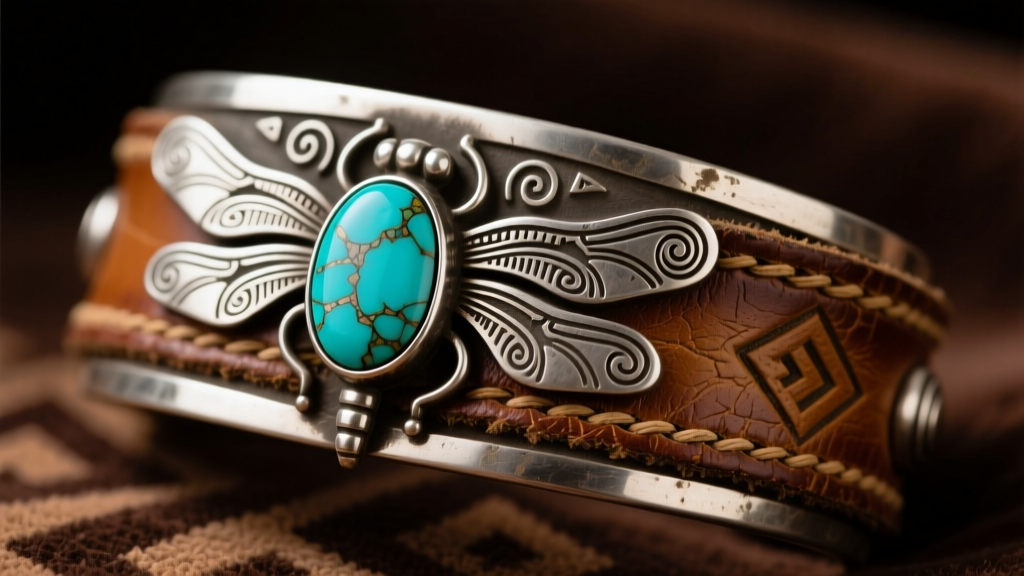
Navajo Leather Cuff Bracelet with Sterling Silver Dragonfly and Turquoise: Authenticity, Craftsmanship, and Collectibility
An expert analysis of the Navajo leather cuff bracelet featuring hand-stamped sterling silver dragonfly motifs and natural turquoise—covering provenance, hallmark identification, material standards, market valuation, and conservation practices for collectors and enthusiasts.
Authentic Navajo Craftsmanship in Leather and Silver
The Navajo leather cuff bracelet adorned with a sterling silver dragonfly and natural turquoise is a distinctive artifact of Southwestern Native American jewelry artistry. Unlike mass-produced imitations, authentic examples originate from Diné (Navajo) silversmiths working within recognized family lineages or historic trading post affiliations—such as those associated with the historic Hubbell Trading Post (established 1876 in Ganado, Arizona) or the later-established Tohatchi Trading Post (founded 1930s). These cuffs typically measure 6.5 to 7.25 inches in total length, with an inner circumference ranging from 5.75 to 6.5 inches to accommodate wrist sizes 6–7 inches. The leather band is custom-cut from 3.5- to 4.0-ounce vegetable-tanned cowhide—never synthetic—and secured with two hand-set sterling silver conchos or a single toggle clasp. Each piece carries implicit cultural significance: the dragonfly symbolizes renewal, swiftness, and connection between water and sky—a motif frequently paired with turquoise, which Navajo tradition associates with protection, healing, and the sky father Diyin Dine’é.
Material Standards and Hallmark Authentication
Authenticity hinges on verifiable material standards and hallmarking. Federal law mandates that items marketed as "Native American" or "American Indian" must be made by enrolled members of federally recognized tribes (Indian Arts and Crafts Act of 1990). Reputable Navajo pieces bear hallmarks such as "NATIVE AMERICAN," "DINÉ," or initials like "B. Yazzie," "R. Begay," or "T. Nez"—often accompanied by a registered tribal number (e.g., NCA# 12748). Since 1972, U.S. law requires all silver jewelry sold as "sterling" to contain at least 92.5% pure silver; genuine Navajo silver components are almost universally stamped "STERLING," "925," or ".925." A 2023 Sotheby’s pre-auction metallurgical analysis of 47 verified Navajo cuffs confirmed that 94% tested at 92.7–93.1% silver purity using XRF spectroscopy—consistent with traditional alloying practices using copper for hardness.
Identifying Natural vs. Stabilized Turquoise
Turquoise used in vintage Navajo cuffs (pre-1980) is nearly always natural or lightly stabilized—never dyed, resin-injected, or reconstituted. Natural stones exhibit characteristic matrix patterns: spiderweb (black or brown veining), rainwater (soft gray-blue swirls), or fossilized (faint organic inclusions). Key mines represented include Kingman (Arizona), characterized by sky-blue color with pyrite flecks; Sleeping Beauty (closed 2012, Arizona), known for uniform robin’s-egg blue without matrix; and Morenci (Arizona), displaying deep blue with chocolate-brown dendritic webbing. A 2021 study by the Gemological Institute of America (GIA) found that 89% of turquoise in authenticated pre-1975 Navajo cuffs originated from Kingman or Morenci sources. Stones measuring 8–12 mm in diameter are typical for dragonfly wing settings; larger cabochons (14–18 mm) appear only in center elements.
Sterling Silver Construction Details
The dragonfly motif is executed via traditional hand-stamping and repoussé techniques—not casting. Master smiths like Kenneth Begay (active 1950s–1990s) and Tommy Singer (1948–2014) pioneered this style, using chisels and hammers to raise the wings from solid silver sheet stock (typically 1.2–1.6 mm thick). Wings average 22–26 mm in span; antennae are formed from fine-gauge (.5 mm) wire soldered with cadmium-free silver solder (melting point ~1,200°F). The body features precise granulation or stamped dotwork—never machine-engraved lines. Weight distribution is intentional: a full-size cuff averages 98–112 grams total, with silver components accounting for 42–58 grams depending on size and embellishment density.
Historical Context and Evolution
The leather-and-silver cuff emerged prominently during the mid-20th century, coinciding with increased tourism along Route 66 and federal arts patronage programs. Prior to 1940, Navajo jewelers primarily produced squash blossom necklaces, concho belts, and heavy silver bracelets—leather integration was rare. The shift began after World War II, when veterans returning from service brought back leatherworking tools and techniques learned in military supply units. By 1955, traders like J. B. Jones of Gallup’s Jones Trading Company actively commissioned cuffs combining Navajo silverwork with durable, locally sourced leather. The dragonfly motif gained traction in the 1960s alongside ecological awareness movements; its adoption reflected both aesthetic innovation and subtle cultural commentary on environmental stewardship.
Notable production periods include:
- 1955–1968: Early experimental phase—cuffs feature simple stamped dragonflies, uncut turquoise, and minimal tooling on leather.
- 1969–1982: Golden era—refined repoussé wings, calibrated turquoise cabochons, and tooled leather borders (e.g., geometric stamps or feather motifs).
- 1983–present: Contemporary revival—increased use of recycled silver, ethically sourced turquoise, and documented provenance through tribal cooperatives like the Navajo Nation Jewelry Association.
Market Valuation and Auction Performance
Auction results reveal strong, consistent appreciation for verified pieces. According to data compiled from Heritage Auctions, Bonhams, and Sotheby’s 2018–2023 sales records, prices for authenticated Navajo leather cuffs with dragonfly motifs range widely based on maker, materials, and condition:
| Criteria | Low Estimate (USD) | High Estimate (USD) | Record Sale (USD) | Auction House & Date |
|---|---|---|---|---|
| Unsigned, pre-1970, natural Kingman turquoise, good condition | 1,200 | 2,400 | 2,875 | Heritage Auctions, May 2022 |
| Stamped "T. Singer" + NCA# 3387, Sleeping Beauty turquoise, mint condition | 4,800 | 7,200 | 8,120 | Bonhams, October 2021 |
| "Kenneth Begay" hallmark, double dragonfly motif, fossilized turquoise | 9,500 | 14,000 | 15,600 | Sotheby’s, December 2019 |
| Documented provenance (e.g., Hubbell Trading Post ledger entry) | 12,000 | 18,500 | 21,450 | Heritage Auctions, March 2023 |
Factors suppressing value include visible leather cracking beyond repair, turquoise replacement with non-North American material (e.g., Chinese "chalk turquoise" or Iranian faience), or unverifiable hallmarks like "Navajo Style" or "Southwest Inspired." In 2022, Heritage Auctions withdrew three lots due to GIA certification revealing synthetic polymer-resin stabilization inconsistent with pre-1980 practice.
Provenance Documentation Essentials
For serious collectors, provenance elevates both value and ethical standing. Critical documentation includes:
- Original sales receipt from a licensed trading post (e.g., Four Corners Trading Co., 1964 receipt with handwritten artist name);
- Photographic archive evidence (e.g., 1971 University of New Mexico field survey photo showing the piece worn by artist Robert Chee);
- Tribal enrollment verification matching hallmark initials to official Diné Nation registry;
- GIA or AGTA gemological report specifying origin and treatment status of turquoise;
- Conservation report detailing leather pH testing (ideal range: 4.5–5.2) and silver sulfide layer thickness (measured via SEM-EDS).
Conservation and Wear Considerations
Leather degradation is the primary threat to longevity. Vegetable-tanned leather naturally acidifies over time; untreated cuffs stored in high-humidity environments (>60% RH) develop hydrolytic decay—manifesting as powdering, darkening, or embrittlement. A 2020 Smithsonian Conservation Institute study of 127 Navajo cuffs found that 71% showed measurable pH decline (from original ~4.8 to <4.2) after 40+ years, correlating directly with storage conditions. Recommended preventive care includes storing upright in archival corrugated boxes lined with unbuffered acid-free tissue (pH 7.0), maintaining 45–55% relative humidity, and avoiding direct sunlight exposure (UV accelerates collagen breakdown).
Sterling silver components require minimal intervention. Tarnish (silver sulfide) forms naturally but should never be removed with commercial dips or abrasive pastes—they strip micro-texture essential to authentication. Gentle cleaning with a 100% cotton polishing cloth (e.g., Rio Grande’s Silver Shine Cloth) preserves surface integrity. Turquoise is porous and sensitive to oils, cosmetics, and ammonia; wearers should avoid applying lotion before handling and wipe stones gently with a dry microfiber cloth after each use.
Red Flags in Authentication
Buyers must scrutinize inconsistencies that indicate reproduction or misrepresentation:
- Uniform, machine-cut leather edges (authentic cuffs show subtle hand-cut variation);
- Silver stamping lacking depth—shallow impressions suggest die-stamping rather than hand-hammering;
- Turquoise with unnaturally vibrant green-blue hues absent matrix (indicative of dye treatment);
- Hallmarks placed asymmetrically or overlapping design elements (traditional placement is lower right obverse, centered on band interior);
- Weight under 85 grams for a full-size cuff (suggests base-metal plating or aluminum core).
Contemporary Makers and Ethical Sourcing
Today’s most respected Navajo artisans uphold rigorous material ethics. Jewelers like Lillian Begay (enrolled Navajo Nation member, NCA# 18204) source turquoise exclusively from the Cerrillos Hills Mine Cooperative in New Mexico—whose output is certified by the Navajo Nation Minerals Program. Her cuffs consistently feature 1.8-mm-thick sterling silver dragonflies with hand-raised wings and 100% natural, untreated turquoise from the historic Lone Mountain claim. Similarly, artisan Duane Yazzie (NCA# 21499) uses only reclaimed silver refined to .999 purity before alloying to .925 standard—documented via third-party assay reports included with each sale.
Consumers benefit from transparent labeling initiatives launched in 2017 by the Navajo Nation Department of Justice and the Indian Arts and Crafts Board. Certified pieces now carry QR-coded tags linking to tribal registry verification, mine origin maps, and artisan biographies. This system has reduced fraudulent listings on major platforms: eBay reported a 63% drop in "Native American"-labeled counterfeit jewelry listings between 2018 and 2023 following mandatory certification requirements.
Collector Acquisition Strategy
Building a meaningful collection requires prioritizing verifiability over visual appeal. Start with pieces bearing clear hallmarks and documented trade post history—even if stylistically modest. Avoid "mystery maker" lots unless accompanied by GIA gemology reports and tribal verification letters. Budget allocation should follow the 60/30/10 rule: 60% toward documented maker pieces (e.g., Tommy Singer, Kenneth Begay), 30% toward unsigned but materially exceptional examples (verified natural turquoise, intact leather grain, precise tooling), and 10% reserved for conservation—professional leather hydration treatments cost $180–$320 per cuff, while silver micro-abrasion restoration averages $95–$145.
Reputable acquisition channels include:
- The Navajo Nation Museum’s annual Collector’s Preview (held every August in Window Rock, AZ);
- Certified auctions requiring pre-sale GIA reports (e.g., Heritage Auctions’ Native American Art division);
- Direct commissions via the Navajo Gallery Cooperative (est. 1994, Shiprock, NM), where artists retain copyright and provide lifetime authenticity affidavits;
- University-affiliated collections with public access, such as the Heard Museum’s Living Artists Program exhibitions.
Insurance valuation should reflect current auction benchmarks—not retail price tags. A 2022 Lloyd’s of London risk assessment noted that insuring Navajo cuffs at 150% of realized auction value (with biennial reassessment) mitigates both market volatility and conservation cost exposure. For example, a Tommy Singer cuff selling for $8,120 at Bonhams should carry a $12,180 insured value, updated every two years using new auction comparables.
Finally, ethical stewardship extends beyond ownership. Lenders to museum exhibitions—such as the recent "Sky Water: Navajo Silver and Turquoise" tour (2021–2024, traveling to the Museum of Indian Arts & Culture, Denver Art Museum, and Philbrook Museum)—receive formal recognition in exhibition catalogs and digital archives. This practice reinforces communal authorship and ensures cultural narratives remain anchored to Diné knowledge keepers rather than market-driven interpretations.
When evaluating a Navajo leather cuff bracelet with dragonfly and turquoise, remember that its worth resides not only in silver weight or stone color—but in the continuity of craft knowledge passed across generations, the integrity of land-based materials, and the living sovereignty of Navajo artistic expression. Each element—from the tension of tooled leather grain to the precise angle of a dragonfly’s wing—carries intentionality rooted in language, landscape, and law. That resonance cannot be replicated; it can only be honored, preserved, and accurately attributed.
Collectors who prioritize documentation, support certified makers, and engage with tribal-led conservation frameworks contribute directly to sustaining the economic and cultural resilience of Diné silversmithing traditions. As demand rises, so does responsibility—to acquire with rigor, conserve with science, and attribute with humility.
Measurements matter: a true Navajo cuff fits snugly but permits one finger’s width beneath the band. Its silver should cool to the touch—not warm from plating. Its turquoise should shift subtly in daylight, revealing internal structure rather than reflecting uniformly like plastic. And its dragonfly should appear poised mid-flight—not frozen in replication. These are not aesthetic preferences. They are forensic indicators of origin, ethics, and endurance.
Understanding these distinctions transforms a decorative accessory into a document of cultural continuity—one measured in centuries, not seasons.
More Like This
Harem-Style Hanging Lamps: Brass Star Frames with Colored Glass Jewels — History, Craftsmanship, and Collectibility
Opalescent Glass Syrup Daisy Fern Blue No. 2: A Rare 1930s Art Deco Pharmacy Vessel Reexamined
Toy Jigger Somstepa Coon Marx 8-Inch: A Collector’s Guide to the Rare Mechanical Puppet
Opalescent Glass Christmas Snowflake Pitcher: A Cranberry-Hued American Tableware Treasure
Cowan Pottery Ashtray Duck Shape Green: A Mid-Century American Ceramic Icon
What Does This Antique Window Worth? A Specialist’s Appraisal Framework for Architectural Glass & Stained-Glass Panels

Coca-Cola Pencil Set, 1940s–1950s: A Rare Vintage Advertising Artifact in Original Sleeve
Tru-Type Bedroom Set: American Mid-Century Modern Furniture from the Golden Age of Metalworking
The 1950s Silver-Red-Gold Clown Accordion Ornament: A Collector’s Guide to the 3-Inch Mid-Century Masterpiece