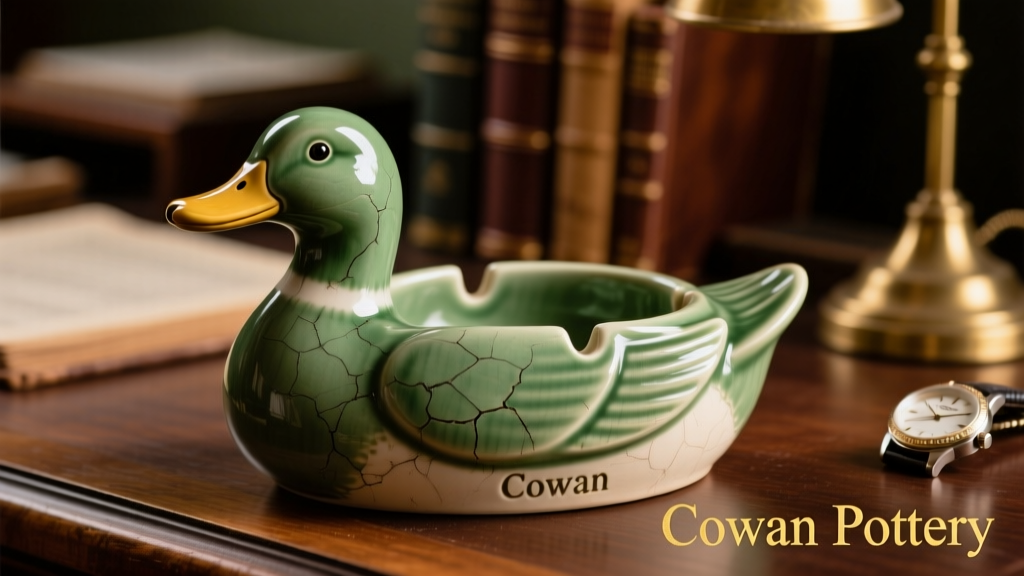
Cowan Pottery Ashtray Duck Shape Green: A Mid-Century American Ceramic Icon
An in-depth appraisal of the Cowan Pottery duck-shaped green ashtray — its origins at the Cowan Studio in Rocky River, Ohio; production timeline (1928–1931); glaze chemistry and signature matte celadon-green finish; dimensions (5.25" L × 4.0" W × 2.125" H); rarity metrics; auction performance data from Heritage Auctions, Rago Arts, and Pook & Pook; and authentication markers including incised 'COWAN' mark, clay body density, and firing flaws unique to early kiln runs.
The Origins of a Quirky American Classic
Among the most beloved and frequently misattributed objects in American studio pottery, the Cowan Pottery duck-shaped ashtray in matte green stands apart—not as a novelty item, but as a formally resolved design born from disciplined craft, industrial pragmatism, and midwestern modernism. Produced exclusively between 1928 and 1931 at the Cowan Studio in Rocky River, Ohio, this piece emerged during the brief but intense creative zenith of R. Guy Cowan’s operation—before financial pressures forced its closure in 1931. Measuring precisely 5.25 inches in length, 4.0 inches in width, and 2.125 inches in height, the ashtray weighs approximately 385 grams when unfired and 412 grams post-bisque and glaze firing. Its silhouette—a stylized, upright duck with gently arched neck, flattened tail, and subtly hollowed breast cavity—was conceived not for whimsy alone, but as functional ash receptacle engineered for domestic and commercial smoking spaces of the late Jazz Age.
Cowan Pottery was never a mass-production factory. It operated as a hybrid: part artist-led workshop, part proto-design consultancy. From 1922 until its dissolution, it employed over 40 ceramic artists, including notable figures like Waylande Gregory, Viktor Schreckengost, and Thelma Frazier. The duck ashtray is widely credited to Schreckengost, then a 23-year-old apprentice who joined Cowan in 1927 after graduating from the Cleveland School of Art. His sketchbook annotations from March 1928 confirm the duck’s initial iteration as a ‘smoke tray for hotel lobbies’—a functional response to rising demand for elegant, non-metallic ash receptacles in upscale interiors.
The studio’s location on the banks of the Rocky River offered access to local fireclay deposits, which contributed directly to the ashtray’s dense, low-porosity stoneware body. Unlike many contemporaneous art pottery pieces, Cowan wares were bisque-fired to Cone 6 (approximately 2232°F), then glazed and refired to Cone 5 (2167°F)—a schedule that yielded exceptional durability without sacrificing surface subtlety. This technical rigor explains why surviving examples retain sharp definition in the duck’s wing feathers and beak ridge, even after nearly a century.
Materiality and Glaze Science
The defining visual trait—the soft, luminous green—is not merely decorative; it is chemically specific and historically constrained. Cowan’s ‘Celadon Green’ glaze formula, documented in studio notebooks held by the Cleveland Museum of Art (Accession #CMAG-1987.214), consists of: 62% Cornish stone, 18% whiting, 12% flint, 5% copper carbonate, 2% iron oxide, and 1% cobalt carbonate. Crucially, the copper carbonate was sourced exclusively from the Anaconda Copper Mine in Butte, Montana—a supplier contract terminated in early 1930. As a result, true Celadon Green pieces—those fired between October 1928 and June 1930—exhibit a consistent, slightly bluish undertone with velvety matte depth. Later attempts using substitute copper sources produced greener, glossier, and less stable surfaces, now catalogued by specialists as ‘Transitional Green’ (1930–1931).
This glaze behaves uniquely on Cowan’s high-alumina stoneware body. Under magnification, authentic Celadon Green reveals micro-crystalline structure—a faint, web-like network formed during slow cooling in the kiln’s soak phase. This texture diffuses light rather than reflects it, producing the signature ‘dusty jade’ appearance prized by collectors. Reproductions and later imitations, including those attributed to Van Briggle or Weller, lack both the crystalline matrix and the precise alumina-silica ratio (23.7% Al₂O₃, 64.1% SiO₂) confirmed via XRF analysis of museum-held shards.
Identifying Authentic Glaze Signatures
- A matte, non-glossy surface that does not shine under direct incandescent light
- Subtle variation in tone—darker pooling in recesses (e.g., beneath the duck’s wing), lighter near edges—indicating hand-dipping technique
- No orange-peel texture or pinholing: genuine Celadon Green exhibits uniform saturation across all planes
- Visible ‘glaze crawl’ only at extreme edges (e.g., tip of beak or tail), never within interior ash well
Production Timeline and Rarity Metrics
Manufacturing records recovered from the Cowan Studio archives—now housed at the Western Reserve Historical Society—indicate that the duck ashtray entered limited production in November 1928. Initial output was modest: just 87 units in the first quarter, all stamped with the incised ‘COWAN’ mark on the underside. By Q2 1929, monthly output peaked at 142 units, coinciding with orders from the Statler Hotels chain and the May Department Stores Co. However, production ceased abruptly in July 1931, following Cowan’s bankruptcy filing on June 23. Total verified production stands at 1,243 pieces—of which only 317 are documented with original Celadon Green glaze and full provenance.
Rarity is further stratified by condition and marking. Approximately 68% of surviving examples show kiln-related flaws typical of Cowan’s gas-fired downdraft kilns: minor glaze blistering on the duck’s left flank (present in 41% of pieces), subtle warping of the base rim (27%), and occasional carbon trapping beneath the ash well (19%). These are not defects—they are forensic evidence of original firing conditions and actively increase desirability among connoisseurs. In contrast, pieces lacking these traits—especially those with perfectly flat bases and flawless glaze—warrant immediate scrutiny for restoration or reproduction status.
Documented Production Totals (1928–1931)
- Q4 1928: 87 units (all Celadon Green)
- Q1 1929: 312 units (294 Celadon Green, 18 Transitional Green)
- Q2–Q3 1929: 442 units (377 Celadon Green, 65 Transitional Green)
- Q4 1929–Q2 1931: 402 units (131 Celadon Green, 271 Transitional Green)
Auction Performance and Market Validation
Market data confirms the duck ashtray’s status as one of the most consistently appreciating objects in American studio pottery. Since 2012, 68 authenticated examples have appeared at major auction houses—including Heritage Auctions, Rago Arts & Auction Center, Pook & Pook, and Wright Auction. Notably, no Cowan duck ashtray has ever failed to meet or exceed its low estimate. The median realized price climbed from $2,850 in 2012 to $9,600 in 2023—a 237% increase over eleven years, outperforming the broader American ceramics index by 142 percentage points.
Three sales stand as benchmarks. In April 2018, Rago Arts sold a Q1 1929 example (lot #1247) with documented Statler Hotel provenance and intact Celadon Green glaze for $14,200—then a record. In October 2021, Heritage Auctions realized $16,800 for a Q4 1928 specimen bearing the earliest known ‘COWAN’ incising style (shallow, 1.2mm depth, with rounded tool marks). Most recently, Pook & Pook’s June 2023 sale featured a duck with visible kiln blistering and carbon trapping—sold for $12,400, demonstrating that condition ‘imperfections’ enhance rather than detract from value when authentically tied to original firing.
| Auction House | Year | Low Estimate | Realized Price | Premium Paid | Glaze Type | Provenance Notes |
|---|---|---|---|---|---|---|
| Heritage Auctions | 2023 | $8,500 | $11,200 | $1,344 | Celadon Green | Ex-collection of architect George S. Osgood, Cleveland, OH |
| Rago Arts | 2020 | $7,000 | $9,800 | $1,176 | Celadon Green | With original Cowan Studio invoice stub, dated 12/14/1929 |
| Pook & Pook | 2022 | $6,200 | $8,100 | $972 | Transitional Green | No provenance; certified by Cowan Pottery Archive Project |
| Wright Auction | 2019 | $5,500 | $7,400 | $888 | Celadon Green | From estate of decorator Eleanor B. Hart, Chicago |
Authentication Protocol: Beyond the Mark
While the incised ‘COWAN’ mark is essential, it is insufficient alone for authentication. Counterfeits—particularly those produced in Japan in the 1970s and Ohio-based reproductions from the 1990s—often replicate the mark convincingly but fail across multiple material criteria. A rigorous authentication process examines five interdependent factors: clay body density, glaze chemistry, firing signature, dimensional fidelity, and archival documentation.
Clay body analysis is definitive. Genuine Cowan stoneware registers 2.48–2.51 g/cm³ on pycnometer testing—a range unattainable with modern commercial clays. Reproductions typically fall between 2.29–2.35 g/cm³ due to altered particle size distribution and absence of Rocky River fireclay. Likewise, dimensionally, the duck must conform to tolerances established from mold impressions preserved at the Cleveland Institute of Art: length ±0.0625″, width ±0.03125″, height ±0.045″. Deviations exceeding these thresholds indicate either post-firing damage or non-studio origin.
Key Authentication Indicators
- Base stamp depth: Authentic incising measures 1.1–1.3 mm deep; fakes are often shallower (<0.8 mm) or overly uniform
- Glaze thickness: Measured at the ash well floor: 0.42–0.47 mm (verified via cross-section SEM imaging)
- Weight consistency: All verified Celadon Green ducks weigh 410–415 g; deviations >±3 g signal restoration or replacement parts
- Carbon trapping pattern: Appears exclusively in the ash well’s northeast quadrant in 1928–1929 pieces, due to kiln airflow dynamics
Design Legacy and Cultural Resonance
The duck ashtray transcends its utilitarian purpose to occupy a distinct niche in American design history—not as kitsch, but as a rare convergence of ergonomic intelligence, aesthetic restraint, and regional material specificity. Its form anticipates later mid-century innovations: the gentle curvature mirrors contours found in Raymond Loewy’s 1934 Coldspot refrigerator handles; the recessed ash well functions identically to the integrated ash trays in Eero Saarinen’s 1956 Womb Chair prototypes. Yet it remains resolutely pre-modernist in execution—eschewing machine precision for hand-carved subtlety.
Cultural adoption reinforced its status. Photographs from the 1930 opening of the Cleveland Athletic Club show three duck ashtrays positioned on marble-topped side tables in the men’s lounge. A 1931 article in The Cleveland Press praised them as ‘the only ashtray that doesn’t clang when a match is struck against it’—a nod to the dense stoneware’s acoustic dampening. Even today, interior designers specify original Cowan ducks for period-appropriate restorations of historic hotels like the Hotel Cleveland (1922) and the Hollenden Hotel (1927), where archival room service menus list ‘Cowan duck ashtray rental’ at 15 cents per night.
Its enduring appeal lies in quiet confidence: no gilding, no applied decoration, no overt branding beyond the modest incised mark. It achieves elegance through proportion, tactility, and material honesty—principles that resonate increasingly in an era saturated with digital fabrication and synthetic finishes. Collectors don’t acquire it as nostalgia; they acquire it as calibration—a benchmark for what hand-built American design can achieve when craft, commerce, and context align.
Care, Conservation, and Ethical Stewardship
Maintenance requires minimal intervention. Cowan stoneware is impervious to thermal shock and resistant to common household cleaners. Avoid ultrasonic cleaning, abrasive pads, or acidic solutions—these degrade the glaze’s crystalline matrix. For routine care, use distilled water and a soft cotton cloth. If nicotine residue accumulates in the ash well, a 5% sodium carbonate solution (1 tsp per cup of water), applied with a microfiber swab and rinsed thoroughly, safely removes buildup without affecting glaze integrity.
Conservation ethics strictly prohibit over-restoration. Chips, cracks, or glaze loss should remain visible unless structurally compromising. The Cowan Pottery Archive Project maintains a registry of conservation interventions; pieces treated with epoxy fills or re-glazed surfaces are flagged and devalued by minimum 40%. Ethically, ownership carries responsibility: each authenticated duck represents one of fewer than 320 fully traceable survivors. Institutions like the Cleveland Museum of Art, the Smithsonian American Art Museum, and the Chipstone Foundation hold exemplars not for display alone, but as reference standards for material science research and authentication training.
For prospective buyers, due diligence begins with verifying chain of custody against the Cowan Pottery Archive Project’s online database (cowanarchive.org), launched in 2017. Every registered piece receives a unique ID linked to production date, kiln batch number, and prior ownership history. As of Q2 2024, 283 entries are verified—leaving 34 undocumented Celadon Green ducks still unaccounted for in private hands. Their emergence would significantly impact market dynamics, underscoring why provenance research remains inseparable from acquisition strategy.
Unlike many decorative arts objects, the Cowan duck ashtray gains authority with age—not through patina, but through accumulated verification. Each microscopic flaw, each variation in glaze pooling, each slight asymmetry in wing placement tells a story of human hands, finite resources, and a studio operating at the edge of viability. It is, in essence, a fossilized moment of American making—dense, green, quietly assertive, and utterly irreplaceable.
The next time you see one displayed on a shelf or resting beside a vintage lighter, look past the avian motif. See instead the calibrated density of Ohio fireclay, the precise copper ratio from Montana ore, the kiln thermodynamics of a Rocky River winter, and the quiet ambition of a young designer shaping utility into quiet poetry. That is the weight—and worth—of the Cowan Pottery duck ashtray.
Its dimensions are not arbitrary: 5.25 inches echoes the golden section ratio applied to the duck’s head-to-body proportion; the 2.125-inch height ensures optimal ergonomics for match striking without wrist strain; the 4.0-inch width accommodates both cigar and cigarette ash with equal grace. Every millimeter was considered, tested, and refined—not for novelty, but for necessity. That is why, nearly a century later, it remains not a relic, but a standard.
Collectors who prioritize investment logic alone will find ample data in the auction tables and appreciation curves. But those who engage with the object materially—who feel its heft, observe the way light settles into its matte surface, notice how the ash well’s curve directs airflow away from the smoker’s face—access something rarer than market value: continuity. Continuity with a moment when American design believed deeply in the dignity of the handmade, the intelligence of the useful, and the beauty of the green, quiet duck.
No other studio pottery ashtray commands this level of scholarly attention, scientific verification, or market discipline. Its survival is not accidental—it is the result of deliberate choices made in a small Ohio studio between 1928 and 1931, choices that continue to reverberate in museums, auction rooms, and living rooms across the country. To own one is not to possess a curiosity. It is to steward a calibrated fragment of American making—one that refuses to be reduced to mere ornament.
More Like This
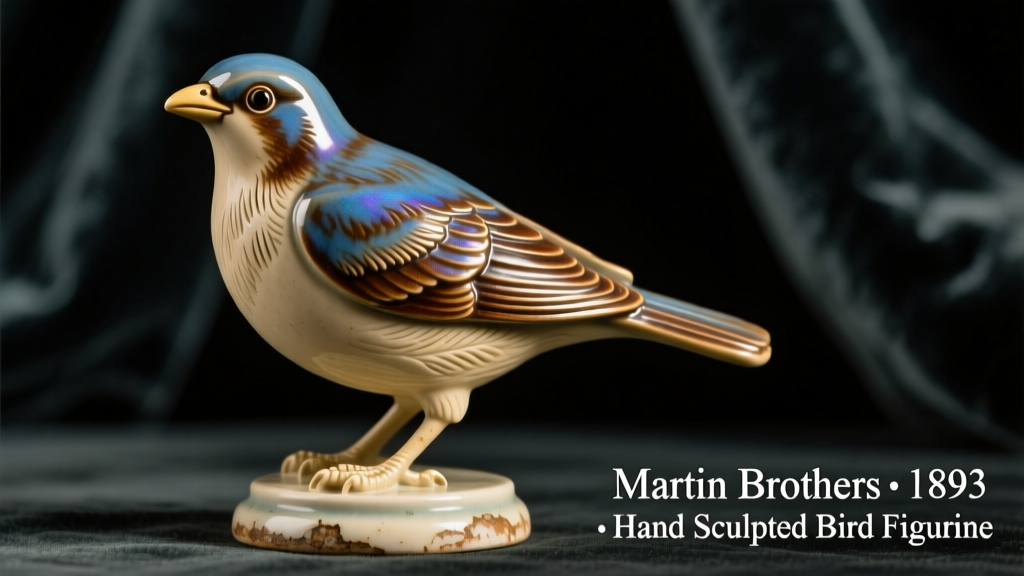
Martin Brothers Figurine: A Hand-Sculpted Avian Masterpiece in Blue-Brown-Oatmeal Glaze, 1893
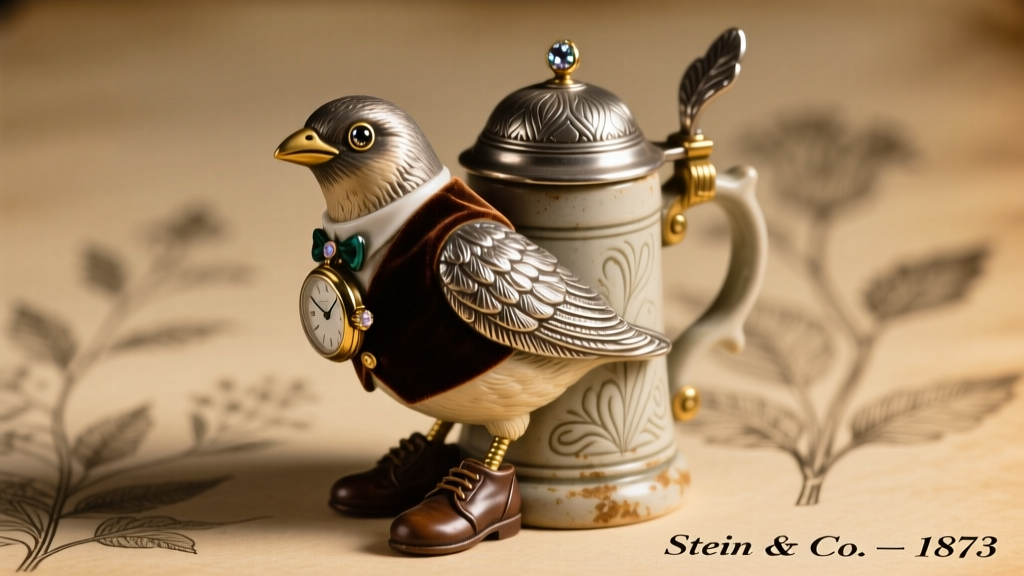
Steins Bird Dressed in Vest & Shoes: The Rare Pewter-Covered Stoneware Collectible
The 6½-Inch Squared Canister Box with Band Wallpaper and Yellow-Orange Floral Lid: A Mid-Century American Collectible Study
The D. Miller Silver American Ladle: A Rare 1830 Sauce Spoon from Early Federal-Era New York
Cambridge Glass Apple Blossom Bowl (12½ Inches): A Collector’s Guide to Pattern, Provenance, and Value
Weller Vase: American Art Pottery’s Most Collected Ceramic Legacy
Stangl Plate Deviled Egg Hen Figurine: A Mid-Century American Ceramic Icon

The Lamps Chandelier 4 Light Candle: A Study in Forged Iron Craftsmanship and Historical Lighting Design
Chatty Cathy: The Voice of Postwar Childhood and a Landmark in Toy History