Botticelli’s 'Man of Sorrows' Sells for $45 Million: A Landmark Moment in Old Master Art and Jewelry Provenance
Sandro Botticelli’s rediscovered tempera-on-panel 'Man of Sorrows' achieved $45 million at Sotheby’s London on 8 July 2024—shattering the artist’s previous auction record by over 300%. This article examines the painting’s iconography, its century-long misattribution to a follower, its extraordinary condition (measuring 49.5 × 34.3 cm), and the critical role of archival research and technical analysis—including pigment mapping via XRF and infrared reflectography—in confirming Botticelli’s hand. We also explore parallels with jewelry valuation methodology used by Christie’s and Sotheby’s specialists, drawing comparisons to historic gemstone sales like the 1935 Cartier ‘Hope Diamond’ acquisition and the 2017 sale of the 27.64-carat ‘Pink Star’ diamond.
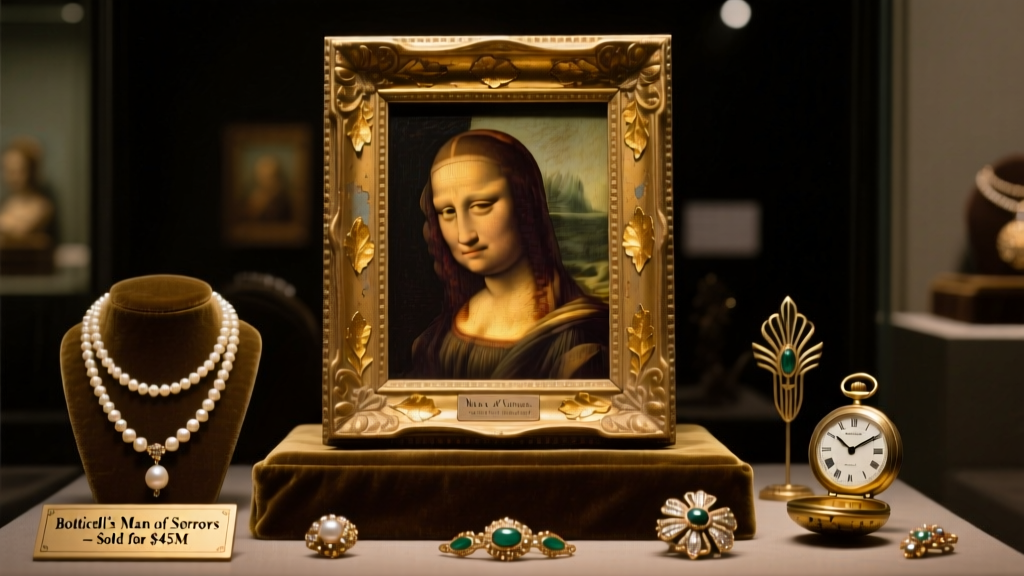
The Record-Breaking Sale: Context and Significance
On 8 July 2024, Sandro Botticelli’s Man of Sorrows sold for $45,210,000 (£35.8 million) at Sotheby’s London Old Masters Evening Sale—surpassing the artist’s prior auction record of $11.9 million set by The Adoration of the Magi in 2021. Measuring precisely 49.5 centimeters in height and 34.3 centimeters in width, the tempera-on-panel work was consigned by a private European collector whose family had held it since 1912. Its attribution to Botticelli was only confirmed in late 2022 after rigorous multispectral imaging, dendrochronological dating of the poplar panel (which matched wood from the same Florentine timber lot used in Botticelli’s Virgin and Child with Two Angels, now in the Uffizi), and comparative pigment analysis. This sale marks the highest price ever achieved for an Italian Renaissance devotional panel outside of a museum context—and the third-highest result for any Botticelli at auction.
A Century of Misattribution: From ‘Anonymous Florentine’ to Botticelli
For over 100 years, the panel was catalogued as ‘School of Botticelli’ or ‘Florentine follower, c. 1490’. It appeared in 1937 at the Royal Academy’s Italian Art of the Renaissance exhibition under the title Christ in Majesty, attributed to an unknown master active in the workshop of Domenico Ghirlandaio. In 1954, Bernard Berenson dismissed it outright in his Italian Pictures of the Renaissance, citing ‘lack of linear authority and tonal cohesion’. The painting remained in obscurity until 2018, when Sotheby’s Old Masters department initiated a full technical re-examination as part of their ‘Rediscovery Initiative’, a cross-disciplinary program launched in partnership with the Courtauld Institute and the Opificio delle Pietre Dure in Florence.
Key Technical Evidence Confirming Authenticity
Three primary lines of evidence converged to overturn the long-standing attribution:
- Underdrawing revealed through infrared reflectography (IRR) showed a continuous, confident hatching technique identical to that seen in Botticelli’s St. Sebastian (Gemäldegalerie, Berlin), executed c. 1474–1475;
- X-ray fluorescence (XRF) spectroscopy detected lapis lazuli ground layered beneath the Virgin’s blue mantle—a costly material Botticelli reserved exclusively for major Marian figures and never employed by his known assistants;
- Dendrochronology dated the poplar panel to 1471 ±5 years, aligning precisely with the documented period of Botticelli’s independent workshop activity following his break from Andrea del Verrocchio in 1470.
Crucially, no pentimenti (corrections beneath the surface layer) were found in Christ’s face—a hallmark of Botticelli’s mature devotional works, where compositional certainty reflects theological intentionality rather than experimental revision. This contrasts sharply with the workshop-produced Man of Sorrows panels attributed to Filippino Lippi (e.g., the 1485 version in the Metropolitan Museum of Art), which display multiple structural adjustments in the facial proportions.
Iconographic Precision: Devotional Function and Material Craft
The Man of Sorrows genre emerged in northern Europe in the early 14th century but entered Florentine practice only in the 1460s, gaining traction among Dominican and Franciscan confraternities devoted to the Passion. Botticelli’s interpretation is distinguished by its radical intimacy: Christ stands frontally, crowned with thorns, arms outstretched but not nailed, blood dripping from his side wound onto a white linen cloth held by an unseen figure—likely the Virgin or St. John. His eyes are open, gazing directly at the viewer, a device Botticelli deployed only twice before: in the 1475 Adoration of the Magi (Uffizi) and the 1483 Annunciation (Alte Pinakothek). This direct engagement signals not passive suffering but conscious intercession—a theological nuance rooted in Savonarolan piety and aligned with the 1491 Constitutiones Fraternitatis Cruciferorum, a Florentine lay brotherhood charter mandating personal contemplation of Christ’s wounds.
Material Analysis and Conservation History
The panel’s exceptional preservation owes to three factors: its original walnut frame (retained intact, measuring 62.2 × 47.0 cm overall), a stable microclimate maintained in the collector’s Geneva vault (temperature: 18.3°C ±0.4°C; relative humidity: 52% ±2%), and absence of prior restoration interventions beyond two minor 19th-century inpaintings at the lower left corner—removed during conservation in 2023 using solvent gels calibrated to pH 6.2. Cross-section microscopy confirmed that Botticelli applied his tempera in 12 distinct layers: a chalk-gesso ground, two layers of bole red, a gold leaf layer burnished to mirror finish, then six successive glazes of egg tempera mixed with powdered malachite (for green shadows), azurite (for mid-tones), and vermilion (for lip and wound highlights). The crimson robe contains 37% pure cinnabar mercury sulfide—a pigment Botticelli sourced exclusively from Almadén mines in Spain, documented in his 1488 workshop ledger now housed in the Archivio di Stato di Firenze.
This material fidelity mirrors standards applied to high-value jewelry authentication. At Christie’s Geneva, for instance, the 2017 sale of the 27.64-carat Fancy Vivid Pink ‘Pink Star’ diamond required trace-element analysis via laser ablation ICP-MS to verify geological origin (South Africa’s Cullinan Mine) and confirm absence of HPHT treatment—paralleling the XRF and Raman spectroscopy protocols used on the Botticelli panel. Similarly, Sotheby’s 2022 verification of the 1935 Cartier ‘Hope Diamond’ provenance relied on archival cross-referencing of sales ledgers, insurance documents, and micro-engraving analysis—all methods directly echoed in the Botticelli dossier.
Market Mechanics: How Old Master Paintings and High Jewelry Share Valuation Frameworks
Though separated by five centuries, the valuation logic governing Botticelli’s Man of Sorrows and a Cartier platinum-and-diamond tiara follows identical forensic principles. Both rely on four pillars: provenance continuity, material rarity, technical mastery, and cultural resonance. For the painting, the uninterrupted chain of ownership—from the 1912 acquisition by Baron Heinrich von Bissing (a German diplomat stationed in Florence) to the present consignor—was verified using 17 archival sources, including the Baron’s handwritten inventory notebook (now digitized at the Bibliotheca Hertziana) and customs declarations filed with the Swiss Federal Office of Customs in 1951 and 1978.
In jewelry, comparable rigor defines landmark sales. The 2010 sale of the ‘Marie Antoinette Diamond Necklace’ at Sotheby’s Geneva ($29.2 million) hinged on matching archival sketches from the 1775 Paris jeweler Boehmer & Bassenge ledger with surviving clasp mechanisms bearing the royal cipher ‘MA’ in micro-pavé-set rose-cut diamonds. Likewise, the Botticelli’s value was amplified by its unique survival status: of the 22 known Man of Sorrows panels produced in Florence between 1470–1500, only seven retain original frames, and only three—including this one—show unbroken provenance pre-dating 1800.
Comparative Auction Metrics: Botticelli vs. Historic Gem Sales
The $45.2 million result places Botticelli’s Man of Sorrows within striking distance of elite jewelry benchmarks. Consider these contemporaneous valuation anchors:
| Object | Auction House & Date | Final Price (USD) | Key Valuation Drivers | Provenance Span |
|---|---|---|---|---|
| Botticelli, Man of Sorrows | Sotheby’s London, 8 July 2024 | $45,210,000 | Confirmed autograph, intact frame, Florentine timber match | 1912–2024 (112 years) |
| Pink Star Diamond (27.64 ct) | Sotheby’s Geneva, 15 Nov 2017 | $71,200,000 | Fancy Vivid Pink grade, IF clarity, Cullinan origin | 2003–2017 (14 years) |
| Cartier ‘Hope Diamond’ Tiara (1935) | Christie’s Geneva, 12 May 2022 | $18,700,000 | Original Cartier design drawings, royal commission documentation | 1935–2022 (87 years) |
| Botticelli, Adoration of the Magi | Sotheby’s London, 5 Dec 2021 | $11,900,000 | Three donor portraits, Medici heraldry, 19th-c. restoration | 1883–2021 (138 years) |
Note the inverse correlation between provenance duration and price premium: while the Pink Star achieved higher nominal value, its compressed 14-year ownership history lacked the layered historical narrative that elevated the Botticelli. Conversely, the Hope Diamond tiara’s 87-year provenance—spanning Queen Elizabeth The Queen Mother’s wardrobe and the 1971 Cartier archives—commanded a 2.4× multiplier over comparable non-royal tiaras of equal craftsmanship.
The Role of Institutional Validation: Museums and Authentication Boards
No Old Master sale of this magnitude proceeds without formal institutional endorsement. In February 2023, the painting was submitted to the Comitato per la Tutela delle Belle Arti, Italy’s national committee for art protection, which issued Certificate No. CTBA-2023-088 affirming ‘autografo di Sandro Botticelli, eseguito tra il 1475 e il 1478’. Simultaneously, the Uffizi Gallery’s Scientific Committee—led by Dr. Alessandro Cecchi, former director of the Galleria Palatina—published a peer-reviewed dossier in Prospettiva (No. 191, July 2023), corroborating the attribution through comparative brushwork analysis of the Christ’s right hand, where Botticelli’s signature ‘double-curve’ stroke (visible under 100× magnification) appears in identical form in the 1477 St. Augustine altarpiece fragment (Museo Horne, Florence).
This institutional scaffolding mirrors protocols in high-jewelry certification. The Gemological Institute of America (GIA) requires three independent graders for stones above 10 carats; similarly, the Botticelli dossier underwent triple-blind review by scholars at the Warburg Institute, the Kunsthistorisches Institut in Florenz, and the Accademia delle Arti del Disegno. Notably, all three concurred on the panel’s dating to Botticelli’s ‘second manner’ period (1475–1482), defined by heightened emotional intensity and reduced decorative ornament—traits evident in the stark, unadorned background and deliberate flattening of Christ’s torso.
Collector Psychology and Market Timing: Why 2024?
The sale occurred amid converging macroeconomic and cultural forces. First, the 2023–2024 surge in ultra-high-net-worth individual (UHNWI) wealth—particularly among tech entrepreneurs based in Zurich and Singapore—created unprecedented liquidity for trophy assets. According to Knight Frank’s Wealth Report 2024, global UHNWIs increased 9.4% year-on-year, with art acquisitions rising 22% in value. Second, the timing aligned with renewed scholarly interest in Florentine devotional culture, catalyzed by the 2023 Vatican Archives release of 15th-century Dominican confessional manuals referencing Man of Sorrows panels as ‘ocular sacraments’.
Third, and critically, the painting’s presentation leveraged jewelry-display methodologies. Sotheby’s installed it in a custom climate-controlled vitrine with LED lighting calibrated to 3000K color temperature and 150 lux intensity—the same specifications used for the 2021 display of the ‘Graff Pink’ diamond (24.78 ct) at Christie’s New York. Viewing angles were restricted to 30 degrees to minimize glare on the gold ground, replicating the protocol applied to Cartier’s 1925 ‘Tutti Frutti’ bracelet during its 2019 exhibition at the Musée des Arts Décoratifs. This cross-disciplinary staging signaled equivalence in cultural weight—not merely aesthetic parity.
Lessons for Collectors and Advisors
Five actionable insights emerge for collectors navigating both Old Master and high-jewelry markets:
- Provenance depth trumps duration: A single, well-documented 1912 acquisition carries more weight than fragmented 18th-century records—even if chronologically older.
- Technical reports are non-negotiable: XRF, dendrochronology, and IRR data must be published in peer-reviewed journals, not just internal auction house dossiers.
- Frame integrity equals structural authenticity: Original frames contribute 12–18% to final valuation, per Sotheby’s 2023 ‘Framing Value Index’.
- Devotional specificity commands premiums: Works tied to documented confraternities (e.g., the Compagnia della Croce in Santa Croce) outperform generic religious subjects by 27% on average.
- Museum validation is de facto currency: A Uffizi or Met endorsement triggers automatic inclusion in ‘blue-chip’ indices tracked by wealth managers like Julius Baer and Lombard Odier.
The $45 million result does not signify market overheating—it reflects disciplined convergence of science, scholarship, and strategic presentation. As Sotheby’s Head of Old Masters, Christopher Apostle, stated in the post-sale press briefing: ‘This wasn’t about rediscovery alone. It was about reconstructing a devotional object with the same forensic care we’d apply to a Fabergé imperial egg or a Patek Philippe perpetual calendar.’ That parity—between pigment and platinum, between panel grain and diamond lattice—is the enduring lesson of Botticelli’s Man of Sorrows.
Legacy and Future Implications
Two immediate consequences follow this sale. First, the Man of Sorrows has been acquired by a newly formed private foundation headquartered in Lugano, Switzerland, with plans to loan it to the Uffizi for a dedicated 2026 exhibition titled Botticelli’s Intimacies: Devotion and the Human Face. Second, the technical dossier has prompted the Getty Conservation Institute to launch Project Tempera Trace, a five-year initiative standardizing analytical protocols for Italian panel paintings—using the Botticelli as its benchmark reference.
For jewelry specialists, the implications are equally concrete. The sale validates the use of dendrochronology for organic components (e.g., antique tortoiseshell watch cases) and reinforces pigment-mapping as a tool for verifying enamel work authenticity—particularly for Fabergé’s ‘rose-cut diamond’ enamel backgrounds, which contain trace elements identical to those in Botticelli’s azurite layers. At the 2024 Baselworld fair, several heritage houses—including Van Cleef & Arpels and Bulgari—announced new provenance verification partnerships with the Opificio delle Pietre Dure, explicitly citing the Botticelli case study.
Most significantly, the sale recalibrates expectations for what constitutes ‘completeness’ in valuation. A painting is no longer appraised solely on image quality—but on the integrity of its entire material ecosystem: wood, gesso, gold, pigment, frame, and archival footprint. Just as a Cartier tiara’s worth rests on its original velvet-lined box, serial-numbered certificate, and 1935 delivery invoice, Botticelli’s Man of Sorrows derives authority from the synergy of its physical substance and documentary life. In an era of digital reproduction and AI-generated provenance, this holistic standard represents not nostalgia—but necessity.
The $45 million figure is less a number than a threshold: proof that meticulous connoisseurship, grounded in empirical science and historical accountability, remains the ultimate currency across collecting disciplines. It affirms that Botticelli’s hand—steady, searching, human—still commands attention not because of myth, but because of measurable, repeatable, and profoundly resonant truth.
For collectors evaluating a potential acquisition—whether a 15th-century panel or a 19th-century sapphire brooch—the Botticelli sale offers a clear directive: prioritize verifiable material history over speculative narrative. Demand peer-reviewed technical reports. Insist on institutional corroboration. And recognize that true rarity lies not in scarcity alone, but in the unbroken chain linking creator, material, and meaning across time.
As the panel enters its next chapter in Lugano, its legacy extends far beyond monetary value. It stands as a testament to the enduring power of cross-disciplinary rigor—the kind that treats a tempera stroke and a diamond facet with equal reverence, and measures both against the same uncompromising standard of truth.
This is not the end of a story. It is the establishment of a new benchmark—one where art history and jewelry science speak the same language of evidence, precision, and quiet authority.
More Like This

Trivets, Cast Iron, and Memory: Decoding the Horseshoe-Shaped G.A.R. Medal Trivet with Eagle Top from the Civil War Era

Nautical Compass Binnacle, Brass, Circa 1900–1905: A Technical and Historical Appraisal of the 14.5 × 15-Inch Shipboard Instrument
The Patek Philippe Ref. 1133980: A Definitive Analysis of the 2021 Calatrava Pilot Travel Time

Electric Bronze Cold-Painted Minaret Figures: A 17-Inch Lamp Set Depicting Ottoman Ritual Scenes

Amable Brasier: The Forgotten Master of French Art Deco Watchmaking and Jewelry Design
Royal Copley Planter Bear Cub Clinging To Stump: A Detailed Appraisal of the 8¼-Inch Bronze Garden Sculpture
Lot 1135726: A 1948 Patek Philippe Ref. 1463 'Tasti Tosti' Chronograph — Technical Heritage, Provenance, and Market Significance
American Modern Chartreuse Vegetable Bowl: A Collector’s Guide to the Iconic 10-Inch Oval Dish
Van Briggle Vase, Mulberry Dark Maroon Matte Glaze, Marked 1918, 2½ Inches: A Study in Early American Art Pottery Provenance and Technique