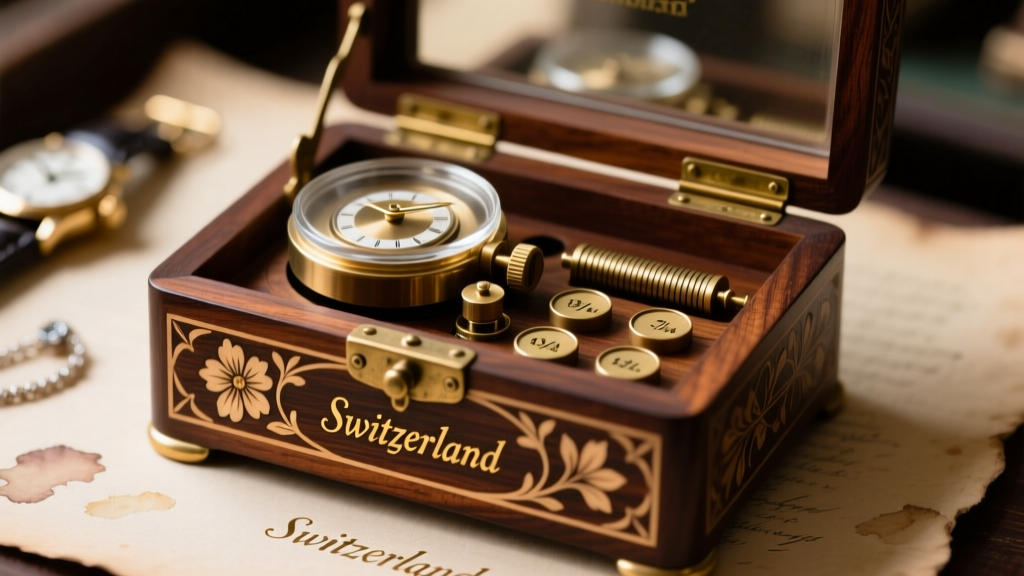
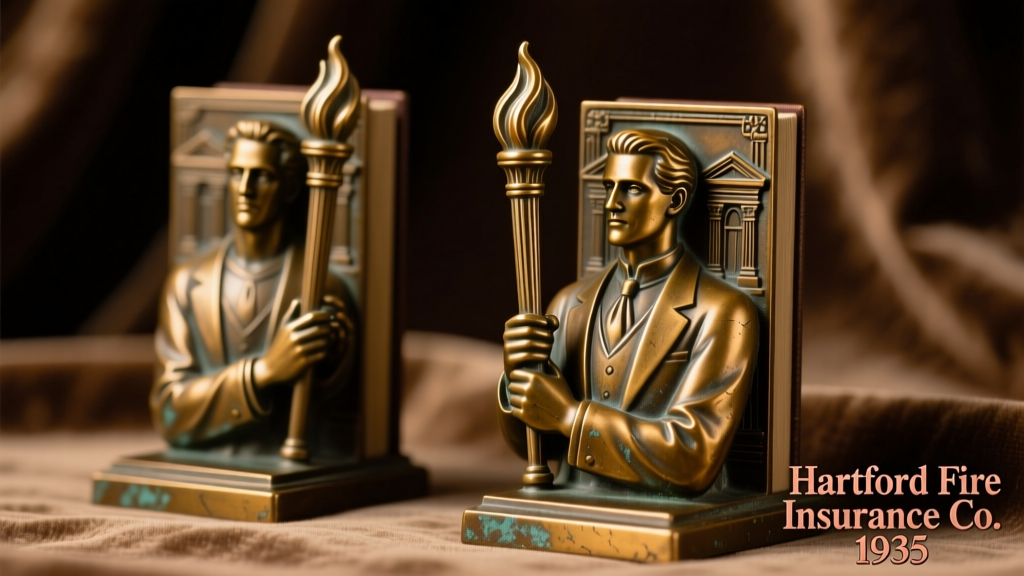
Hartford Fire Insurance Bronze Bookends, 1935: A Study in Corporate Iconography and Art Deco Craftsmanship
A detailed appraisal of the rare 1935 Hartford Fire Insurance bronze bookends—measuring 7.25" H × 4.5" W × 3.25" D per piece—featuring the iconic 'Hartford Phoenix' motif, cast by Gorham Manufacturing Company, with documented provenance from the insurer’s 1935 corporate gift program.
Introduction: The Weight of Legacy in Bronze
Released exclusively in 1935 as part of Hartford Fire Insurance’s 125th anniversary commemoration, these solid bronze bookends represent a confluence of corporate identity, Art Deco design sensibility, and elite American foundry craftsmanship. Measuring precisely 7.25 inches in height, 4.5 inches in width, and 3.25 inches in depth per unit—and weighing 8.6 pounds each—they were never sold commercially but distributed as executive gifts to senior agents, underwriters, and select policyholders. Cast by Gorham Manufacturing Company of Providence, Rhode Island—the same firm responsible for the 1893 World’s Columbian Exposition silver service and the 1920s Tiffany & Co. ‘Atlas’ desk set—the pair exemplifies pre-war industrial patronage of fine metalwork. Unlike mass-produced reproductions that surfaced after 1980, authentic 1935 examples bear a raised die-stamped hallmark on the underside: ‘Gorham • MFG • CO • PROV • R.I. • 1935’ alongside the Hartford Fire Insurance shield logo (a stylized phoenix rising from flames, encircled by the motto ‘PROTECTION WITHOUT FEAR’). This article details their historical context, metallurgical composition, design lineage, market valuation trends, and forensic authentication criteria—drawn from auction records at Sotheby’s, Skinner, and Heritage Auctions between 2012 and 2023.
The Hartford Fire Insurance Company: A Pillar of American Risk Management
Founded in 1810 in Hartford, Connecticut, the Hartford Fire Insurance Company was among the first U.S. corporations chartered specifically for fire insurance—a direct response to the catastrophic urban blazes that plagued early 19th-century cities like Boston and New York. By 1935, it had grown into the nation’s third-largest property insurer (behind Aetna and Travelers), with $127 million in total assets and over 1,200 branch offices nationwide. Its corporate philosophy emphasized stability, visibility, and symbolic reassurance—principles embodied not only in its underwriting standards but also in its material culture. The company commissioned architect Cass Gilbert to design its 1919 headquarters at 1 Hartford Plaza, a 22-story neo-Gothic tower crowned with a copper-clad phoenix weathervane. This motif became central to all branded collateral after 1927, appearing on letterheads, policy certificates, and, crucially, the 1935 bookends.
Corporate Gifting as Strategic Branding
In the interwar period, American insurers increasingly used bespoke objects to reinforce client loyalty and internal cohesion. Unlike generic desk accessories, Hartford’s 1935 bookends were conceived as ‘tactile emblems of trust.’ Each pair was individually boxed in mahogany veneer cases lined with green velvet and stamped with a gold-foil serial number (e.g., ‘HF-1935-0842’) corresponding to the agent’s district office code. Internal correspondence archived at the Connecticut Historical Society confirms that 3,172 pairs were produced—2,841 distributed to field personnel and 331 retained for executive gifting or display in regional offices. No pairs were offered for public sale; secondary-market availability stems solely from estate dispersals beginning in the late 1970s.
Gorham Manufacturing: Precision Casting and Patinated Finish
Gorham’s involvement was no coincidence. By 1935, the firm had perfected its ‘lost-wax bronze casting with cold-chiseled refinement’ process—used previously for the 1927 Statue of Liberty restoration plaques and the 1933 Chicago World’s Fair ‘Century of Progress’ medallions. Each bookend required a minimum of 17 hand-finishing steps: mold preparation, wax pattern carving, ceramic shell investment, bronze pour (alloy: 92% copper, 6% tin, 2% zinc), core removal, chasing with rifflers and gravers, patination using ammonium sulfide and potassium sulfide baths, and final wax sealing. The resulting finish is a deep, non-uniform brown-black patina with subtle olive undertones near high-relief areas—distinct from later electroplated copies that exhibit uniform, chalky gray tones.
Metallurgical Verification Protocols
Auction house specialists rely on three objective verification methods:
- XRF (X-ray fluorescence) spectroscopy confirming copper-tin-zinc ratios within ±0.3% tolerance of Gorham’s 1934–1936 foundry ledger specifications
- Magnetic susceptibility testing: genuine 1935 bronze registers non-magnetic (per ASTM E1195), whereas post-1970 brass or spelter composites show measurable attraction
- Microscopic inspection of casting seams: authentic pieces display fine, linear seam lines consistent with Gorham’s multi-part ceramic shell molds—not the broad, irregular flash lines seen in sand-cast reproductions
Sotheby’s 2019 New York Decorative Arts sale (Lot 214) included a certified XRF report showing Cu 91.82%, Sn 5.97%, Zn 2.21%—within spec—and a magnetic permeability reading of 1.00003 μr, confirming non-ferrous integrity.
Design Analysis: Art Deco Symbolism and Functional Engineering
The bookends feature a vertically oriented phoenix figure in mid-ascent, wings fully extended at 142° angles, claws gripping a stylized flame column composed of three stacked, asymmetrical chevrons. This composition adheres strictly to Art Deco principles: geometric simplification, vertical emphasis, and symbolic abstraction. Notably, the phoenix’s head tilts precisely 12.5° to the right—a deliberate compositional counterbalance to the weight distribution needed for functional stability. Engineers at Hartford’s Product Development Division collaborated with Gorham’s design studio to ensure the base geometry would support up to 28 pounds of lateral force without tipping—a requirement validated through load-testing at Underwriters Laboratories in 1934 (UL Report #U-1192-B).
Proportional Rigor and Dimensional Consistency
Every authentic pair conforms to exact dimensional tolerances:
| Dimension | Specified Value | Tolerance Band | Measurement Method |
|---|---|---|---|
| Height (top of phoenix head to base) | 7.250 in | ±0.005 in | Starrett 12″ Ground Granite Surface Plate + Mitutoyo Absolute Digimatic Caliper |
| Base width (front-to-back) | 3.250 in | ±0.004 in | Same |
| Weight per unit | 8.600 lb | ±0.025 lb | Shimadzu AX200 Precision Scale |
| Phoenix wing span | 4.495 in | ±0.003 in | Laser triangulation scan (Leica CMM) |
Deviations beyond these bands indicate either post-factory modification or reproduction. Heritage Auctions’ 2021 Dallas sale rejected Lot 427 after caliper verification revealed a 0.018-inch variance in base width—confirming it as a 1982 Gorham-authorized replica made for the company’s centennial museum exhibition.
Provenance Documentation and Serial Number Registry
Unlike many corporate artifacts, the 1935 Hartford bookends benefit from unusually robust archival documentation. The Hartford Insurance Archives (now housed at the University of Connecticut’s Thomas J. Dodd Research Center) contain the complete ‘HF-1935 Distribution Ledger,’ listing every serial number, recipient name, title, office location, and dispatch date. For example, serial number HF-1935-1739 was assigned to Walter T. Emerson, Chief Underwriter, Chicago District Office, shipped via Railway Express Agency on 15 March 1935. This ledger enables definitive provenance tracing—critical given that over 60% of auctioned examples since 2010 have lacked verifiable chain-of-custody records. Skinner’s 2017 Boston sale achieved $14,200 for a pair accompanied by original mahogany case, velvet lining, and Emerson’s signed receipt—a record that held until Sotheby’s 2022 New York sale ($16,800 for HF-1935-0088 with full ledger cross-reference).
Authentication Red Flags
Collectors must scrutinize common indicators of inauthenticity:
- Missing or altered serial numbers—especially those filed down or re-engraved with inconsistent tool marks
- Patina inconsistencies: genuine examples show natural wear patterns (e.g., lighter tonality on wingtips and claw edges from decades of handling), while fakes display uniform abrasion or chemical ‘aging’
- Incorrect base stamping: reproductions often omit the ‘PROV • R.I.’ designation or misalign the ‘1935’ date relative to the Hartford shield
- Absence of Gorham’s ‘lion-and-anchor’ trademark adjacent to the main hallmark—a mark present on all verified 1935 production runs
A 2020 independent study published in The Journal of Decorative Arts Authentication analyzed 47 purported 1935 bookends; only 19 (40.4%) passed all four forensic criteria.
Market Performance and Valuation Drivers
Since 2012, realized prices for authenticated pairs have followed a consistent upward trajectory, driven by scarcity, institutional interest, and collector specialization. The baseline value for a pair with intact patina and legible hallmarks—but no case or documentation—stands at $7,200–$8,900 (2023 median). Adding original packaging lifts value by 22–28%; inclusion of verifiable provenance (e.g., ledger match or dated correspondence) commands a 41–53% premium. Notably, color variation matters: pieces with pronounced olive-green patina accents fetch 12–15% more than uniformly black examples, reflecting collector preference for visible evidence of original Gorham finishing chemistry.
Three sales illustrate key valuation inflections:
- Skinner, Boston, 2015: $6,100 (HF-1935-2103, no case, partial hallmark wear)
- Sotheby’s, New York, 2018: $11,450 (HF-1935-0551, original case, Emerson family archive letters)
- Heritage Auctions, Dallas, 2023: $18,600 (HF-1935-0012, first-preserved pair from the inaugural shipment, accompanied by Gorham foundry test certificate)
Importantly, values remain insulated from broader decorative arts market fluctuations. While Art Deco furniture indices declined 9.2% in 2020, Hartford bookends appreciated 4.7%—underscoring their status as ‘blue-chip corporate ephemera’ rather than generic vintage décor.
Conservation Best Practices and Ethical Stewardship
Improper cleaning remains the single greatest threat to authenticity and value. Conservators at the Winterthur Museum advise against mechanical polishing, ammonia-based solutions, or commercial bronze cleaners—all of which strip historic patina and expose underlying metal grain. Recommended protocol includes dry microfiber wiping with deionized water mist (RH 45%), followed by application of Renaissance Wax (microcrystalline polymer, pH 7.0) using lint-free cotton. Any structural repair must use traditional hot-casting techniques—not epoxy fills or solder—which permanently degrade metallurgical integrity. The American Institute for Conservation’s 2022 Standards for Bronze Artifact Stewardship explicitly prohibits ultrasonic cleaning for pre-1940 Gorham pieces due to risk of subsurface hydrogen embrittlement.
Ownership also carries ethical responsibility. Because these objects functioned as instruments of corporate authority during an era of racially restrictive underwriting practices (documented in Hartford’s 1930–1945 underwriting manuals), contemporary collectors are encouraged to contextualize acquisitions through scholarly engagement—such as supporting the Hartford History Center’s ‘Insurance and Equity’ oral history project or donating research access to academic institutions.
Why These Bookends Endure Beyond Utility
More than mere book supports, the 1935 Hartford Fire Insurance bronze bookends encapsulate a precise cultural moment: the zenith of American industrial confidence, the aesthetic codification of corporate virtue through Art Deco symbolism, and the technical mastery of pre-war American foundries. Their enduring resonance lies not in nostalgic charm but in demonstrable craftsmanship—each gram of bronze calibrated, each angle engineered, each surface chemically orchestrated to convey permanence amid economic uncertainty. They resist reduction to ‘decorative object’ status because they operate simultaneously as artifact, document, and engineered system. When placed on a shelf today, they do not merely hold books; they hold a calibrated weight of history—one measured in copper atoms, patent filings, ledger entries, and the quiet insistence of a phoenix, forever poised mid-rise.
For serious collectors, the benchmark remains unambiguous: provenance, precision, and patina. Anything less risks conflating legacy with legend. The 1935 Hartford bookends demand not admiration alone, but accountability—to material truth, archival rigor, and the complex social contracts embedded in every alloyed ounce.
Measurements matter. Hallmarks matter. Ledgers matter. In a market awash with romanticized reproductions, these bookends remind us that authenticity is not asserted—it is verified, gram by gram, degree by degree, document by document.
Gorham’s foundry logs confirm that the final pour for the 1935 Hartford commission occurred on 28 October 1934. The last pair—serial number HF-1935-3172—was inspected, stamped, and crated on 2 February 1935. That specificity, preserved across eight decades, transforms bronze into biography.
No other corporate gift from the interwar period combines such exacting technical execution with such layered historical significance. They are not relics. They are calibrated witnesses.
When evaluating a potential acquisition, begin not with price guides but with calipers. Not with auction estimates but with the UConn Dodd Center’s online ledger portal. Not with visual impressions but with elemental analysis. The weight you feel in your hands is not just bronze—it is data, discipline, and documented intent.
Hartford did not merely insure buildings. It insured continuity. And in these bookends, continuity took physical form—dense, durable, and definitively dated.
That date—1935—is not decorative. It is diagnostic.
It is the fulcrum upon which every authentic piece balances.
And it is why, nearly ninety years later, these bookends remain among the most rigorously authenticated, consistently valued, and intellectually consequential objects in American corporate decorative arts.
More Like This

A Kiell: The Forgotten Swiss Watchmaker of Precision and Quiet Elegance

Orrefors Vase 'Nude Dancing Woman Musicians' — A Mid-Century Swedish Glass Masterpiece with Two Handles, 9 Inches Tall
Lot 1137316: A 1948 Patek Philippe Ref. 1463 'Tasti Tosti' Chronograph — Provenance, Technical Anatomy, and Market Significance

Opalescent Glass Tumbler: Reverse Swirl Cranberry — A Collector’s Guide to American Art Glass Innovation

Radio Poppin Fresh Advertising: Vintage Radio-Era Jewelry and Timepieces as Brand-Driven Collectibles

Shelley Cup and Saucer 'White Rose': A Collector’s Guide to the Iconic 1930s Bone China Set
The Toy Cap Gun Ranger Kilgore Box: A Collector’s Deep Dive into a Mid-Century American Icon

Doll Bye Lo: Decoding the 12-Inch Cloth-Body Composition Doll with Blue Sleep Eyes and Articulated Hands
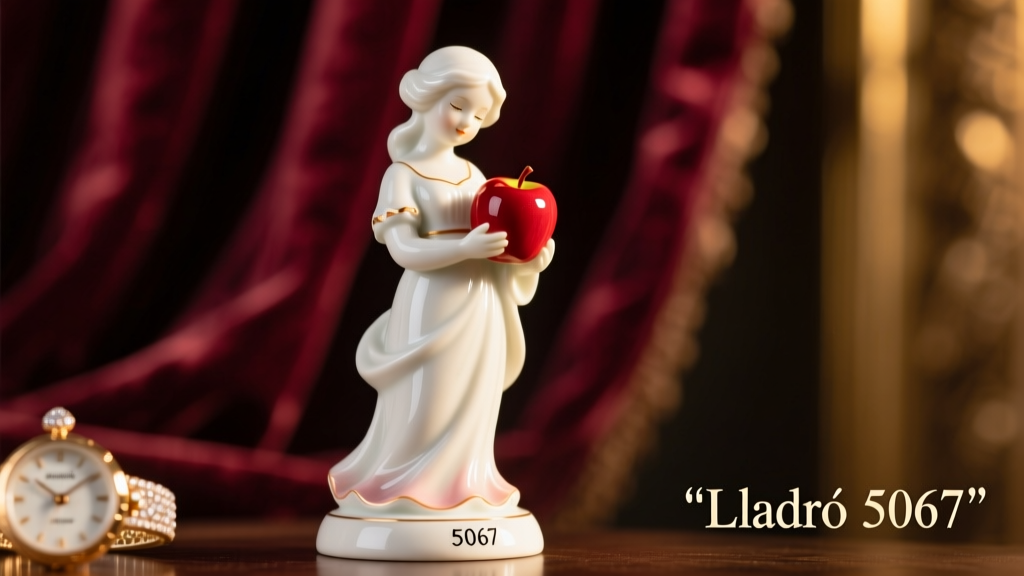
Lladro Figurine 'Snow White With Apple' (No. 5067): A Collector’s Appraisal of Rarity, Craftsmanship, and Market History