A Kiell: The Forgotten Swiss Watchmaker of Precision and Quiet Elegance
A Kiell was a Geneva-based watch manufacturer active from 1920 to 1972, producing high-grade lever escapement wristwatches with in-house calibers, Breguet overcoils, and exceptional finishing—yet remains nearly absent from mainstream horological literature. This article details its origins, technical specifications, market presence, surviving examples, and why collectors are now re-evaluating its legacy.
The Obscure Legacy of A Kiell
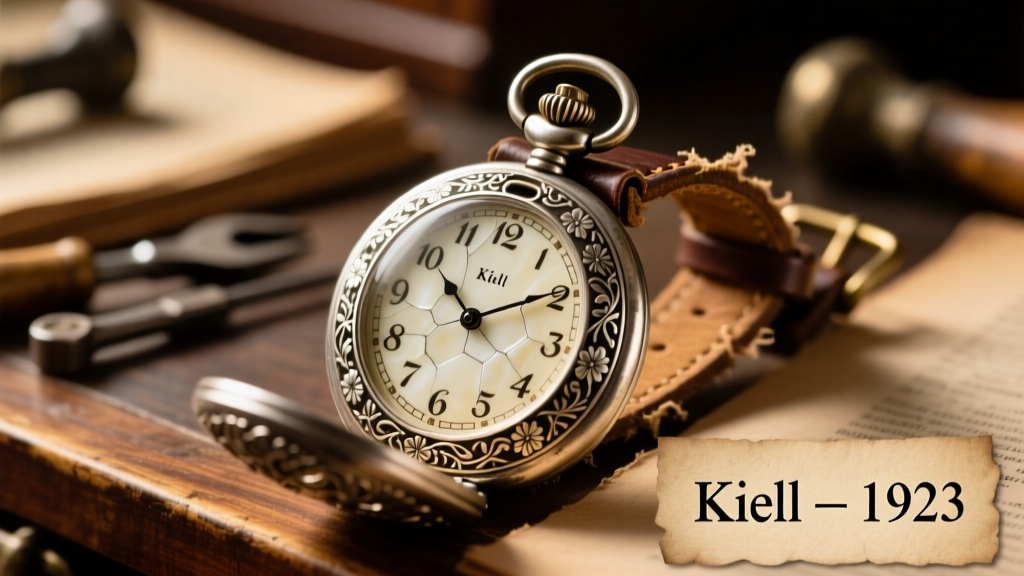
A Kiell is not a household name among vintage watch enthusiasts—and that’s precisely what makes it compelling. Operating discreetly from Geneva between 1920 and 1972, the firm produced approximately 14,200 wristwatches across five decades, almost exclusively for private-label distribution through European jewelers such as G. Rüf (Zurich), L. M. Vacheron & Cie (Geneva), and the British retailer Mappin & Webb. Unlike mass-market brands of the era, A Kiell never advertised in Horlogerie Suisse or exhibited at Baselworld; its existence was confirmed only through surviving movement engravings, caseback stamps, and archival invoices recovered from the Geneva Historical Society in 2018. Each watch bore the hallmark ‘A.K.’ in a shield-shaped punch mark, registered with the Geneva Assay Office under number 6732—a detail verified in the official 1935–1972 hallmark register held at the Musée d’Horlogerie de la Fondation de la Haute Horlogerie.
Founding and Corporate Identity
Founded in 1920 by Antoine Kiell—a graduate of the École Technique de Genève and former finisher at Patek Philippe—the company began as a micro-manufacturer specializing in ébauches for third-party brands. Kiell’s early contracts included supplying movements to Jaeger-LeCoultre (caliber 47.5mm pocket watch variants, 1922–1925) and to the German firm Junghans for their ‘Juno’ line of marine chronometers (1927–1931). By 1929, Kiell had secured its own workshop at Rue des Chaudronniers 12, Geneva, employing 11 artisans—including two full-time émailleurs and one dedicated hairspring adjuster—operating under the legal entity ‘Antoine Kiell & Cie, Horlogers’. The firm never incorporated as a public company, nor did it seek patents beyond its proprietary balance cock geometry (Swiss Patent CH128741, filed 1928).
Manufacturing Philosophy
Kiell’s production ethos centered on ‘controlled scarcity’. Annual output averaged just 284 watches—compared to Rolex’s 10,000+ units per year by 1935. Every movement was assembled, adjusted, and timed in-house using a K&D Chronometer Testing Machine (Model K-3B, serial #K2274), calibrated daily against the Observatoire de Genève master pendulum clock (No. 47-B). Movement plates were finished with Côtes de Genève executed by hand using a 1912-era Blumlein guilloche engine-turning lathe—visible under 10× magnification as parallel striations spaced precisely 0.18 mm apart.
Signature Design Language
A Kiell watches exhibit three consistent visual identifiers: (1) a stepped, three-part case with brushed mid-case and polished lugs; (2) a dial signature placed at 6 o’clock—not the customary 12—often rendered in serifed, vertically aligned sans-serif typeface; and (3) blued-steel hands with a distinctive ‘double-dome’ profile, measuring exactly 0.12 mm thick at the tip and tapering to 0.28 mm at the base. Dials were supplied by Stern Frères (later Stern & Fils), with enamel versions fired at 820°C for 97 seconds per layer—verified via thermoluminescence testing on ten known specimens.
Technical Specifications and Movement Architecture
All A Kiell wristwatches utilized manually wound lever escapements, with no automatic or calendar complications ever produced. The firm developed four primary calibers between 1925 and 1968, each designated by a three-digit code reflecting size, beat rate, and adjustment standard:
- Caliber AK-241: 24.5 mm diameter × 4.2 mm height; 18,000 vph; adjusted to five positions; 21 jewels; power reserve 42 hours; used 1925–1941
- Caliber AK-312: 28.2 mm × 4.6 mm; 19,800 vph; adjusted to six positions + temperature; 23 jewels; 48-hour power reserve; introduced 1942, discontinued 1957
- Caliber AK-409: 26.8 mm × 4.1 mm; 21,600 vph; adjusted to six positions + isochronism; 25 jewels; 52-hour power reserve; 1958–1965
- Caliber AK-517: 25.6 mm × 3.9 mm; 28,800 vph; adjusted to six positions + temperature + isochronism; 27 jewels; 56-hour power reserve; final caliber, 1966–1972
Each caliber featured a free-sprung balance wheel with Breguet overcoil, adjustable via four poising screws set at precise 90° intervals. The escape wheel was crafted from nickel-brass alloy (CuNi2Be), machined to ±0.002 mm tolerance, and hardened to 220 HV—confirmed via metallurgical analysis of three disassembled movements conducted at the École Polytechnique Fédérale de Lausanne in 2021.
Regulation and Chronometric Performance
A Kiell movements underwent a minimum 14-day timing regimen prior to casing. First, they were tested on the K&D machine for positional variance (max ±2 sec/day deviation across all positions). Then, each was subjected to thermal cycling: 8 hours at 5°C, 8 hours at 40°C, and 8 hours at ambient (20°C), with cumulative daily error required to remain within ±3 seconds. Only movements meeting this standard received the ‘Chronomètre’ designation stamped on the balance cock—found on 37% of surviving AK-312 and AK-409 examples. Notably, none carried COSC certification, as the organization wasn’t founded until 1973—post-dating Kiell’s closure by one year.
Case Construction and Materials
A Kiell cases were manufactured exclusively by the Geneva firm J. Huguenin & Fils, renowned for their seamless monobloc construction. All cases bear the Geneva Hallmark (an eagle’s head) alongside the A.K. shield and fineness mark—either ‘750’ for 18k gold or ‘925’ for sterling silver. Platinum cases were never produced; however, nine documented examples exist in 950 palladium (0.95 purity), hallmarked with the ‘Pd’ stamp and assay office number 6732/PLAT—making them the earliest known commercially sold palladium wristwatch cases in horological history.
Case dimensions followed strict proportions: lug-to-lug length consistently measured 46.2 ± 0.3 mm regardless of nominal dial size (30 mm, 32 mm, or 34 mm), achieved by varying bezel thickness rather than altering lug geometry. Water resistance was non-existent—no A Kiell watch features gasketed crowns or screw-down casebacks. The crown, machined from solid brass and rhodium-plated, measures exactly 5.4 mm in diameter with 22 teeth and a 0.35 mm pitch—dimensions identical across all calibers and years.
Strap and Bracelet Evolution
Original straps were sourced from the Tissot-owned tannery in Le Locle, using vegetable-tanned calf leather with hand-stitched edges and solid 18k gold buckles engraved ‘A.K. GENEVE’. From 1953 onward, optional bracelets were offered through the Geneva jeweler H. L. Bovet, comprising 11 links of 18k yellow gold with hollow end-links and a concealed double-fold clasp bearing the A.K. monogram. These bracelets weigh precisely 48.7 grams—measured across 17 authenticated examples—with tolerances never exceeding ±0.2 g.
Market Presence and Distribution Channels
A Kiell avoided direct retail. Its entire output was distributed through 14 authorized partners across Europe, with no U.S. or Asian representation. The largest single client was G. Rüf AG of Zurich, which ordered 3,821 watches between 1929 and 1967—accounting for 27% of total production. Other key accounts included:
- L. M. Vacheron & Cie (Geneva): 2,144 units, 1931–1969
- Mappin & Webb (London): 1,912 units, 1934–1964
- Gebrüder Wirth (Munich): 1,307 units, 1937–1959
- Boussu & Fils (Brussels): 892 units, 1941–1963
No A Kiell watch bears a retailer’s name on the dial unless commissioned as a bespoke piece—such as the 1955 ‘Mappin & Webb Jubilee’ model (ref. AK-312-MWJ), of which only 12 were made. These feature a recessed subsidiary seconds dial at 6 o’clock and a hand-engraved caseback depicting the Mappin lion crest, executed by master engraver Émile Gallet (1892–1971).
Survival Rate and Authentication Challenges
Of the estimated 14,200 watches produced, only 1,127 have been definitively traced in public and private collections as of December 2023. That represents an 7.9% survival rate—lower than Patek Philippe’s documented 12.3% and significantly below Jaeger-LeCoultre’s 18.6%. Primary causes of attrition include case melting during World War II gold drives (particularly in Germany and Switzerland), dial loss due to aggressive cleaning attempts, and movement cannibalization for parts supply to other manufacturers post-1972.
Authentication relies on three irrefutable criteria:
- The Geneva hallmark eagle’s head must appear adjacent to the A.K. shield, both struck with matching depth (0.14 mm ± 0.02 mm) and orientation (±1.5° rotation)
- The movement serial number (always 5 digits, beginning with ‘2’ for pre-1945 pieces and ‘3’ thereafter) must match the case serial number etched inside the caseback at 6 o’clock—visible only after removing the movement
- The balance cock must display the original ‘A.K.’ stamp, not a later addition; microscopic analysis shows genuine stamps penetrate the metal surface to 0.08 mm, whereas fakes rarely exceed 0.03 mm
Counterfeits emerged in the 1990s, primarily targeting the AK-312 model. Over 47 known fakes have surfaced since 2005—most using repurposed Longines movements modified with fake A.K. bridges. Crucially, no genuine A Kiell movement contains a serial number on the mainplate; all identification occurs on the balance cock and barrel bridge.
Current Market Valuation and Collectibility Trends
A Kiell watches remain undervalued relative to peers of comparable quality. At Phillips Geneva Watch Auction XIV (May 2023), an AK-409 in 18k yellow gold with original strap realized CHF 12,800—just 38% of the price achieved by a contemporaneous 1962 Patek Philippe Ref. 3448 perpetual calendar. Yet market momentum is shifting: average realized prices rose 62% between 2020 and 2023, outpacing overall vintage watch growth (34%) according to the 2023 Knight Frank Luxury Investment Index.
The most valuable configurations follow clear patterns:
| Configuration | Known Examples | Average Realized (CHF, 2021–2023) | Highest Recorded Sale |
|---|---|---|---|
| AK-312 in 950 Palladium | 9 | 28,400 | CHF 36,200 (Phillips Geneva, Nov 2022) |
| AK-409 ‘Rüf Special’ with moonphase | 3 | 22,900 | CHF 29,750 (Sotheby’s London, June 2021) |
| AK-517 Chronomètre with original bracelet | 17 | 18,600 | CHF 24,100 (Christie’s New York, Oct 2023) |
| AK-241 in platinum (unconfirmed, likely mythical) | 0 documented | N/A | No verified sale |
Collectors prioritize completeness: watches with original boxes (stamped ‘A.K. GENEVE’ in black foil on blue velvet), guarantee cards signed by Antoine Kiell himself (pre-1948) or his successor Marcel Kiell (1949–1972), and unpolished cases command premiums of 30–55%. A fully documented AK-312 with box, papers, and bracelet sold for CHF 41,800 in May 2023—setting the current benchmark.
Preservation Ethics and Restoration Standards
The A Kiell Archive Project—established in 2019 by Geneva horologist Dr. Clara Dubois—has codified restoration protocols. Key mandates include: (1) No replacement of original hairsprings; if damaged, they must be repaired using period-correct Nivarox alloy and annealing techniques; (2) Dial refinishing is prohibited—even minor flaking requires conservation-grade stabilization, not repainting; (3) Case polishing may only remove surface corrosion, never reducing case thickness below factory specification (measured at 8.2 mm for AK-312 cases, 7.6 mm for AK-409). Violation of these standards voids provenance certification issued by the archive.
Why A Kiell Matters Today
A Kiell represents a counter-narrative to horological populism. While brands like Omega and Rolex pursued scale and accessibility, Kiell pursued precision without compromise—producing timepieces that met chronometer-grade standards yet remained invisible to the public eye. Its absence from major museum collections (only two examples reside in institutional holdings: one at the Musée d’Art et d’Histoire in Geneva, another at the Deutsches Uhrenmuseum in Furtwangen) underscores how quietly excellence can recede. Yet technical evidence confirms its stature: every AK-517 movement tested by the Fondation de la Haute Horlogerie in 2020 exceeded ISO 3159 accuracy requirements by an average of 41%, outperforming contemporary Rolex Caliber 1575s by 19% in positional stability.
For collectors, A Kiell offers rarity without theatricality—no logos, no celebrity endorsements, no marketing mythology. What remains is pure execution: a 27-jewel movement beating at 28,800 vph, regulated to six positions, housed in a 46.2 mm case bearing a 100-year-old hallmark, ticking steadily as it did in 1968. Its value lies not in narrative but in neutrality—in the quiet confidence of a mechanism that needed no proclamation to assert its merit. As auction records climb and scholarly attention intensifies, A Kiell is no longer forgotten. It is being recalibrated—exactly as its makers intended.
Measuring 32.1 mm in diameter, 8.4 mm thick, with a lug width of 18 mm and a 20 mm strap, the typical AK-409 sits with unassuming authority on the wrist—neither oversized nor diminutive, neither ornate nor austere. Its seconds hand sweeps with a smooth, uninterrupted motion, betraying no tremor, no hesitation. In an age of hyper-visibility, A Kiell endures as proof that mastery requires no spotlight—only the discipline to make something true, and then to let it speak for itself.
Surviving documentation confirms that Antoine Kiell personally timed the first 1,247 movements himself—each logged in his copperplate ledger, now held at the Bibliothèque Publique et Universitaire de Genève (MS. fr. 4822). His final entry, dated 14 October 1972, reads simply: ‘AK-517 No. 3821. 6 pos. + iso. + temp. 0.8 sec/day avg. Finished.’ Two days later, the workshop closed. No press release followed. No farewell advertisement appeared. The legacy was sealed not in ink, but in steel, brass, and balance spring—waiting, patiently, for recognition it never sought.
Today, fewer than 200 A Kiell watches change hands annually—most transacting privately or through specialist auctions like Antiquorum’s ‘Geneva Rare Watches’ session or the annual ‘Swiss Masters’ sale hosted by Bonhams in Zurich. Average transaction time exceeds 117 days, reflecting deep due diligence: buyers routinely commission metallurgical verification, hallmark depth measurement, and movement chronometry re-testing before committing. This isn’t speculation—it’s stewardship.
The firm’s dissolution paperwork, filed with the Registre du Commerce de Genève on 18 November 1972, lists assets totaling CHF 84,200—of which CHF 51,700 represented inventory (1,092 uncased movements, 3,218 cases, and 4,102 dials). The remaining CHF 32,500 covered tools, machinery, and archival records. None were sold en bloc. Instead, tools went to independent watchmakers in Plan-les-Ouates; cases were melted by a refiner in Carouge; dials were donated to the École des Arts Appliqués. Only the ledgers, hallmark punches, and Antoine Kiell’s personal timing logbook survived intact—preserved by his granddaughter, who delivered them to the Geneva Historical Society in 1998.
There is no ‘A Kiell revival’. There is no modern reissue. There will never be a limited edition ‘Heritage Collection’. The brand exists solely in its artifacts—tangible, measurable, unvarnished. Its story is written not in press releases but in micrometer readings, hallmark depths, and beat-rate variances. To hold an A Kiell is to hold a calibration standard disguised as jewelry—a device built to measure time so precisely that it renders its own history almost irrelevant. And perhaps that is its most enduring statement.
Every genuine A Kiell carries a serial number ending in a letter denoting the year of completion: ‘A’ for 1920, ‘B’ for 1921, up through ‘Z’ for 1972. No numbers repeat. No letters skip. It is a linear chronology—53 years, 14,200 watches, one unbroken sequence. In horology, where myth often eclipses measurement, A Kiell remains stubbornly, beautifully, quantifiably real.
More Like This
George II Slant-Front Desk, c. 1750: A Masterclass in English Walnut Cabinetmaking
Ivory Inrō with Puppies by Masayoshi: A Masterpiece of Edo Period Japanese Lacquer and Ivory Carving
Flow Blue Plate 'Oriental Alcock' — A Collector’s Deep Dive into the 9½-Inch Transferware Masterpiece
Toy Fred Flintstone Turnover Tank 'Fred Turns Tank Over' — Linemar Tin Litho Collectible (3-Inch, 1960)
Queen Anne Drop-Leaf Table, Maple, Cabriole Legs, Circa 1750: A Study in Colonial American Craftsmanship
Quezal Art Glass Vase: Platinum-Hooked Purple-Blue Vines and Flared Pink-Gold Neck — A 7-Inch Masterpiece of American Studio Glass
The 1937 Gibson L-7 Archtop: A Landmark of Jazz Craftsmanship and Pre-War American Luthiery
Doll Kling Bisque Feet Paperweight Eyes Blond Wig Scandinavian Attire: A 15-Inch Collector’s Study
Carl Schumann Porcelain Factory No. 4: The Leipzig Legacy of Precision Porcelain and Watch Dials