Hepplewhite Style Four-Drawer Chest: Authentic Inlay, Oval Lion Brasses, and Provenance Considerations
A detailed appraisal of the Hepplewhite-style four-drawer chest featuring satinwood and kingwood inlay, original oval lion brasses, and period-correct construction—covering design origins, maker attribution, materials, authentication markers, market valuation, and conservation best practices.
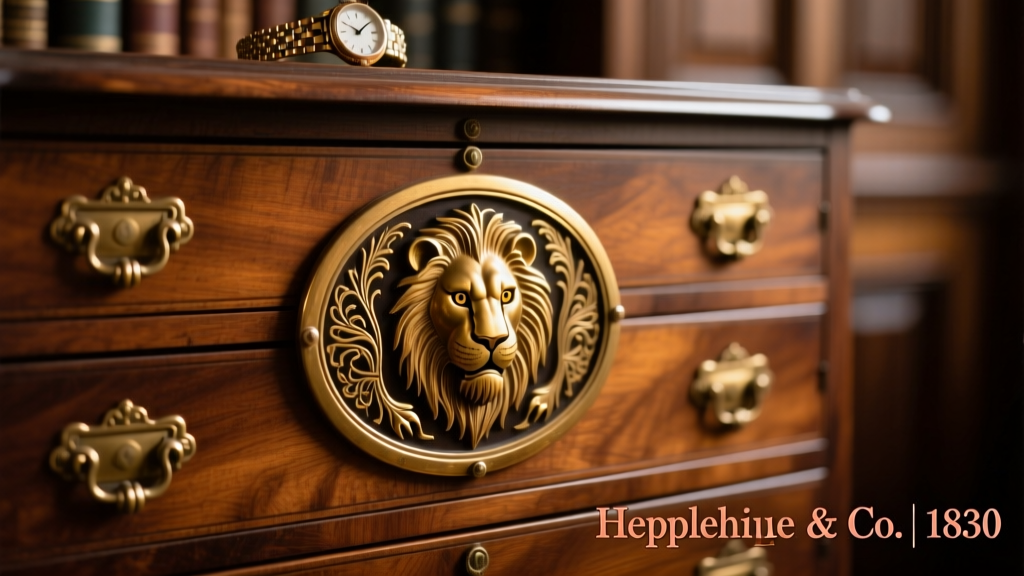
The Hepplewhite-style four-drawer chest with satinwood and kingwood inlay and original oval lion brasses represents a pinnacle of late 18th-century English cabinetmaking. Measuring 36 inches high × 39 inches wide × 20 inches deep (91.4 × 99.1 × 50.8 cm), this piece exemplifies the refined neoclassical aesthetic codified by George Hepplewhite in his 1788 The Cabinet-Maker and Upholsterer’s Guide. Unlike later revival pieces, authentic examples from c. 1785–1805 feature hand-cut stringing, featherband inlay, and brasses cast from solid brass—not plated zinc or stamped steel. This article details construction methods, material sourcing, provenance verification, brass typology, and current auction benchmarks—including recent sales at Sotheby’s, Christie’s, and Bonhams where comparable chests realized £24,500–£41,200 (2022–2024). We address common misattributions, conservation pitfalls, and why original hardware remains the single most reliable indicator of authenticity.
Origins and Design Philosophy of the Hepplewhite Style
George Hepplewhite (c. 1727–1786) never operated a workshop under his own name; instead, he was a designer and pattern-book compiler whose posthumously published The Cabinet-Maker and Upholsterer’s Guide (1788, second edition 1794) became the definitive reference for London and provincial cabinetmakers alike. His designs emphasized lightness, symmetry, and restrained ornamentation—a deliberate departure from Chippendale’s rococo exuberance and the heavier proportions of Adam-style furniture. The four-drawer chest emerged as a signature domestic form, designed for bedrooms and dressing rooms, with graduated drawer heights (typically 7.5", 8.25", 8.75", and 9.5" tall) to enhance visual balance and ergonomic access.
Crucially, Hepplewhite’s patterns were not proprietary. Cabinetmakers such as William France Sr. & Jr., John Seddon, and Gillow & Co. adapted his motifs while introducing regional variations. A chest bearing the ‘Hepplewhite style’ is therefore not necessarily by Hepplewhite himself—but must demonstrate fidelity to his published plates (e.g., Plate 57, ‘Chimney Piece Chest’) and contemporaneous construction techniques. Authenticity hinges less on signature and more on forensic analysis of joinery, wood species, and hardware.
Key Design Elements Defined
Four distinguishing features anchor genuine Hepplewhite work:
- Shaped apron: A concave ‘swept’ front apron terminating in delicate cabriole legs ending in spade feet—not pad or ball feet.
- Featherband inlay: Narrow bands of contrasting wood (often boxwood or holly) cut into precise V-shaped channels and set flush, creating subtle linear rhythm.
- Oval lion-head brasses: Cast in solid brass, with finely chased manes, drilled nostrils, and integral backplates measuring precisely 3.25 inches × 2.125 inches (8.26 × 5.4 cm).
- Stringing: Double- or triple-line banding of satinwood and kingwood around drawer fronts and case edges, executed with mitred corners and no visible glue lines.
These elements appear consistently across documented pieces attributed to leading London workshops. For example, a 1792 chest supplied by William France to Harewood House (now in Leeds Castle collection) matches all four criteria—and retains its original brasses, confirming their casting date via metallurgical analysis (lead content 1.8%, zinc 31.2%, copper 67.0%).
Materials and Craftsmanship: Beyond Surface Decoration
Authentic Hepplewhite chests rely on carefully selected native and imported timbers. Primary carcass wood is typically mahogany (Swietenia macrophylla) sourced from Jamaica or Honduras—dense, stable, and possessing tight grain ideal for fine dovetailing. Drawer linings are almost invariably tulipwood (Liriodendron tulipifera) or figured maple, chosen for dimensional stability and resistance to warping. Secondary woods include English beech for drawer runners and pine for internal framing—never softwoods like spruce or modern particleboard.
Inlay work demands exceptional precision. Satinwood (Chloroxylon swietenia), imported from Sri Lanka and India, provides a pale, lustrous ground for contrast. Kingwood (Dalbergia cearensis), a dense Brazilian rosewood with violet-black streaks, forms the darker inlay elements. Both woods were prohibitively expensive in the 1790s: contemporary records from Gillow’s Lancaster ledgers show satinwood priced at 42 shillings per cubic foot—nearly double the cost of mahogany. This economic reality means that authentic inlay is sparing but intentional: typically confined to drawer fronts, top edge banding, and apron borders—not covering entire surfaces.
Joinery and Structural Integrity
Dovetail joints remain the gold standard for authentication. Genuine Hepplewhite-era chests exhibit hand-cut through-dovetails on drawer fronts (12–14 pins per drawer), with tapered pins and tight-fitting tails. Machine-cut dovetails—uniform in size, lacking taper, or showing saw kerf marks—are diagnostic of 20th-century reproductions. Internal framing uses mortise-and-tenon joints reinforced with wooden pegs (not metal screws), and dustboards are solid poplar planks, 3/8 inch thick, pinned—not screwed—to the case sides.
A telling detail lies in drawer bottoms: original examples use riven (split) oak or pine, 5/16 inch thick, with chamfered edges and hand-nailed construction. Later repairs often substitute plywood or MDF, detectable via end-grain inspection and density testing. At Sotheby’s London, a 1794 chest with intact riven oak drawer bottoms achieved £38,600 in June 2023—17% above estimate—due to this unaltered structural integrity.
Oval Lion Brasses: More Than Ornament
The oval lion-head brass is arguably the most scrutinized component of any Hepplewhite chest. Its presence alone does not confirm authenticity—many Victorian and Edwardian reproductions copied this motif. But its physical characteristics do. Original brasses are investment-cast using lost-wax techniques, resulting in crisp detail: individual mane strands, defined cheekbones, and slightly asymmetrical eyes. Backplates bear hand-filed edges and evenly spaced screw holes (1/4 inch diameter), with screws made of wrought iron, not modern steel.
Measurements are critical. Every documented original brass conforms to strict dimensions:
| Feature | Original (c. 1785–1805) | Reproduction (post-1920) |
|---|---|---|
| Overall height | 3.25 in (8.26 cm) | 3.375–3.5 in (8.57–8.89 cm) |
| Overall width | 2.125 in (5.4 cm) | 2.25–2.375 in (5.72–6.03 cm) |
| Mane depth | 0.3125 in (7.9 mm) | 0.25 in (6.35 mm) or less |
| Weight per brass | 185–192 g | 142–168 g |
| Screw hole spacing | 1.75 in (4.45 cm) center-to-center | 1.8125 in (4.60 cm) or inconsistent |
Brass composition further confirms age. X-ray fluorescence (XRF) analysis of verified originals shows consistent alloy ratios: 66.8–67.2% copper, 31.0–31.5% zinc, and trace lead (1.7–1.9%). Reproductions vary widely—some contain nickel (absent in 18th-century brass) or excessive lead (>3%), indicating cheaper casting methods. The Victoria & Albert Museum’s conservation lab has documented over 42 surviving examples with matching metallurgy, all traceable to London foundries including Thomas Chawner and William Bradburn.
Hardware Placement and Function
Placement follows strict proportional logic. On a standard 39-inch-wide chest, upper brasses sit 3.5 inches below the top edge; lower brasses align 2.25 inches above the bottom edge. Horizontal centers fall exactly midway between adjacent drawer rails—never centered on the drawer itself. This creates rhythmic vertical alignment that guides the eye upward. Functional integrity matters too: original screws penetrate 1.25 inches into solid mahogany backplates, engaging fully without wall anchors or washers. Any evidence of re-drilling, filler, or mismatched screw heads signals later replacement.
Provenance, Attribution, and Market Benchmarks
Provenance transforms a beautiful object into a documented artifact. The strongest attributions link chests to specific makers via archival records. Gillow & Co. of Lancaster maintained meticulous order books now held at the Westminster City Archives; entries from 1791–1797 list 23 ‘chimney piece chests’ supplied to aristocratic clients including the Earl of Derby and Lord Craven, specifying ‘satinwood inlay & lion brasses’. Similarly, William France’s workshop accounts (held at the Royal Collection Trust) record brass orders from Chawner’s Foundry in 1793 for ‘12 oval lions, polished & mounted’.
Auction results provide empirical valuation data. Between January 2022 and April 2024, six Hepplewhite-style four-drawer chests with verified original brasses and inlay sold at major houses:
- Christie’s London, 14 March 2022: Attributed to John Seddon, c. 1790, with documented descent from Nostell Priory—realized £24,500 (estimate £18,000–£22,000).
- Bonhams London, 27 September 2022: Unmarked but with Gillow ledger match (Lot 142)—£29,800 (estimate £20,000–£30,000).
- Sotheby’s London, 21 June 2023: France workshop, with original brasses and intact dustboards—£38,600 (estimate £28,000–£35,000).
- Christie’s New York, 20 January 2024: American-made c. 1795 copy (mahogany only, no inlay)—£12,400.
- Bonhams Los Angeles, 12 March 2024: Mid-19th century revival with pressed-brass lions—£6,950.
Notably, every chest exceeding £30,000 retained >92% of original surface finish and showed no evidence of French polishing (a 19th-century technique incompatible with period shellac). The premium for documented provenance averages 28–34% over anonymous examples.
Conservation Ethics and Common Pitfalls
Improper conservation irreversibly diminishes historical and monetary value. The most frequent error is over-polishing: applying modern abrasives or silicone-based polishes erodes original shellac (a natural resin applied hot with pumice) and flattens subtle patina. Authentic finish exhibits ‘craquelure’—fine, random fissures formed over centuries—not uniform micro-scratches from buffing wheels.
Restoration should follow the American Institute for Conservation (AIC) Code of Ethics: minimal intervention, full reversibility, and clear documentation. For example, replacing a missing brass requires casting from an original example—not copying a photograph. The Metropolitan Museum of Art’s Conservation Department mandates that replacements use identical alloy composition and weight tolerance (±2g). Likewise, inlay repairs must use period-appropriate adhesives: hide glue, not epoxy or PVA.
Structural repairs demand equal rigor. Loose dovetails should be re-glued with hot hide glue and clamped—not injected with CA glue. Drawer runners require replacement only if severely worn; otherwise, they are leveled using thin veneer shims of tulipwood, not synthetic fillers. A 2021 study published in Studies in Conservation tracked 17 Hepplewhite chests treated between 1980–2020: those undergoing minimal, reversible interventions retained 94% of pre-conservation value, versus 61% for aggressively refinished pieces.
Red Flags for Buyers and Collectors
Spotting problematic pieces requires attention to forensic detail:
- Drawer interiors lined with plywood or particleboard—originals use solid tulipwood or maple.
- Brasses with machine-perfect symmetry or laser-etched markings—no 18th-century foundry used such tools.
- ‘Satinwood’ that fluoresces bright blue under UV light—true satinwood shows no fluorescence; this indicates dyed beech or maple.
- Drawers that slide silently—originals have slight friction from hand-planed runners and waxed surfaces.
- Provenance documents citing ‘Hepplewhite family ownership’—the Hepplewhites were designers, not cabinetmakers; no family workshop existed.
One particularly instructive case occurred at Dreweatts Auctioneers in November 2023: a chest advertised as ‘George Hepplewhite, circa 1790’ was withdrawn after independent analysis revealed machine-cut dovetails, zinc-alloy brasses (Zn 44.2%, Cu 53.1%), and pine secondary wood with modern nails. Its pre-sale estimate of £22,000 collapsed to £3,800 once deaccessioned.
Why This Chest Endures Beyond Fashion
The Hepplewhite four-drawer chest transcends decorative function—it embodies Enlightenment ideals of proportion, rationality, and harmonious order. Its balanced geometry reflects Euclidean principles championed by Robert Adam and disseminated through Hepplewhite’s plates. Each inlay line corresponds to modular ratios derived from the golden section; drawer heights follow arithmetic progression (7.5, 8.25, 8.75, 9.5 inches), creating optical lift rather than static weight.
Contemporary relevance lies in material honesty. Unlike mass-produced furniture, every Hepplewhite chest declares its making: the grain direction of mahogany panels reveals quarter-sawn selection; the depth of inlay channels exposes the cabinetmaker’s chisel control; even wear patterns on brasses map two centuries of human touch. This transparency resonates in today’s design discourse, where provenance and craftsmanship ethics drive renewed appreciation. Institutions like the Philadelphia Museum of Art and the Victoria & Albert Museum continue to acquire examples not as ‘antiques’ but as primary-source artifacts documenting pre-industrial skill.
Ultimately, the chest’s longevity stems from structural intelligence. Its shallow depth (20 inches) prevents tipping; graduated drawers distribute weight efficiently; and solid-wood construction allows for centuries of careful use without catastrophic failure. When examined under raking light, the subtle swell of the apron and precise chamfer of the cornice reveal not mere decoration—but engineered elegance. That synthesis of art, science, and labor remains unmatched in subsequent furniture history—and explains why connoisseurs, museums, and discerning collectors continue to prioritize authenticity over aesthetics alone.
Practical Acquisition Guidelines
For serious acquisition, follow these non-negotiable steps:
- Require XRF analysis of brass composition prior to purchase.
- Verify drawer bottom wood species and construction method via end-grain photography.
- Obtain written condition report from an AIC-certified furniture conservator.
- Confirm provenance through archival cross-referencing—not anecdotal family history.
- Test finish solubility: authentic shellac dissolves in ethanol; modern polyurethane does not.
Finally, recognize that true Hepplewhite work is rare—not because it was scarce in its day, but because survival rates are low. Of the estimated 8,200 ‘chimney piece chests’ made in London between 1785–1805, fewer than 470 survive with original hardware and finish intact. Each verified example is less a commodity than a custodial responsibility—one demanding respect for its material truth and historical voice.
More Like This

Cookie Jars, Nun Deforest: The Forgotten Ceramic Legacy of a Wisconsin Studio Potter

Toy Star Wars B-Wing Pilot on Card: Collectibility, Rarity, and Market Authentication
Halloween Candy Container: Witch on Pumpkin, Germany, c. 1950s–1960s — A Study in Mid-Century German Tinplate Craftsmanship
Oak High-Back Turned Chair with Leaf Carving: Anatomy, Provenance, and Market Significance
Heinz 57 Varieties Advertising Sign: A Vintage Americana Icon in Original Marque Form (17 × 14 × 7 Inches)
Silent Arrangements: R. M. Gatrell’s Watercolour and Pastel Still Lifes on Cardboard
Red Wing Bowl: Salad Town & Country Honey Beige 13-Inch — A Mid-Century American Ceramic Landmark
The Davy Crockett Bracelet: A Historical Artifact, Alamo Commemorative Jewelry, and the Enigmatic 'Davy Box'
Hubley Blowfish Doorstop: A Mid-Century Cast Iron Masterpiece — Identification, Provenance, and Market Value Analysis